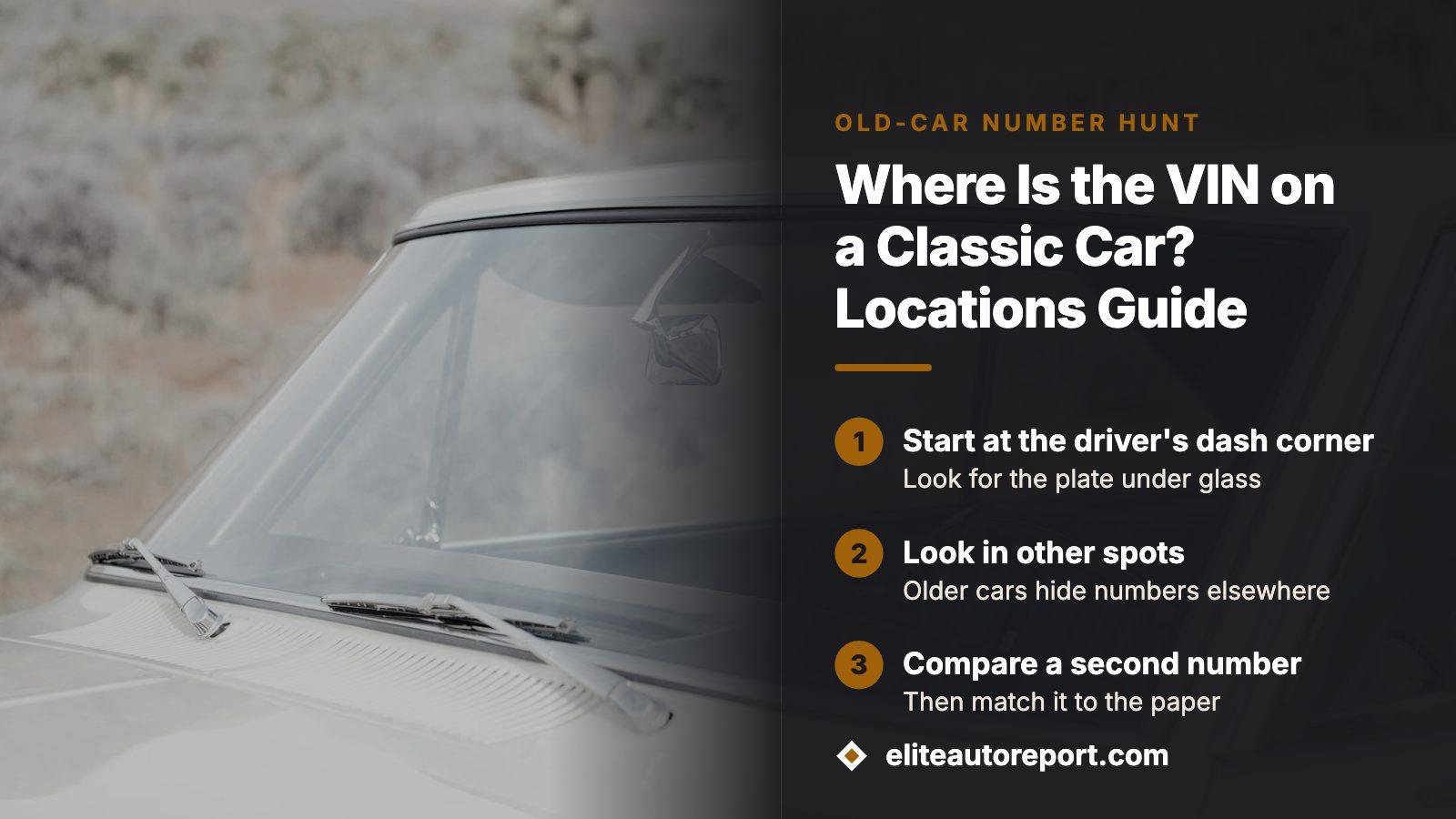
THE SHORT ANSWER
Check the dash top nearest the steering wheel first, where glass meets dash, then the driver's door jamb and the firewall. Pre-1981 cars may carry the number on a body plate, the frame rail or the steering column instead. Match whatever you find against the title, character by character, and inspect the plate for scratches, loose rivets or a disturbed windshield seal.
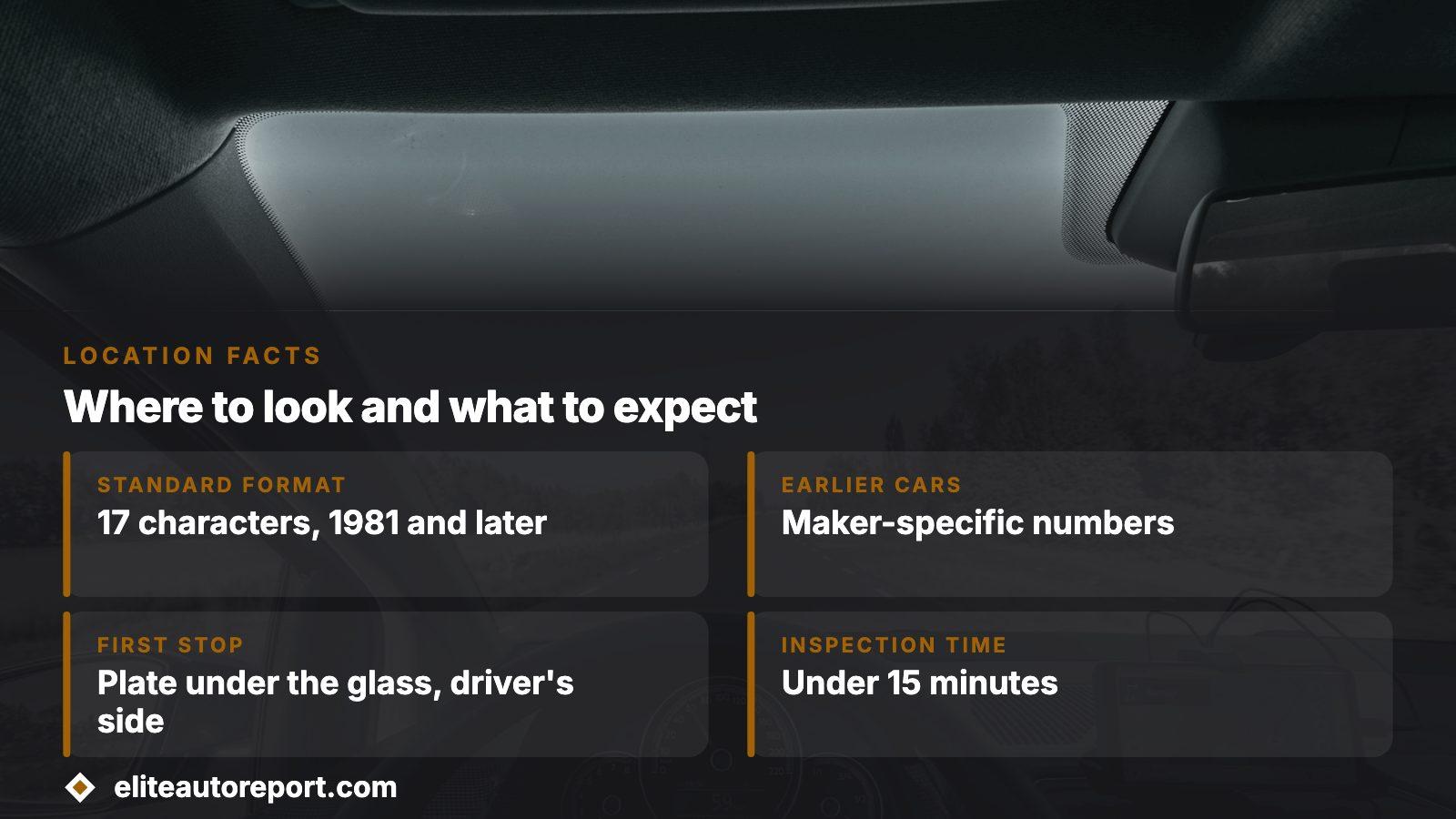
- Standard format
- 17 characters, required on cars of the 1981 model year and later
- Earlier cars
- Maker-specific numbers, rejected by the federal decoder
- First stop
- Plate under the glass, driver's side of the dash
- Inspection time
- Under 15 minutes by the insurance-fraud guide
Start at the driver's corner of the dash
Stand outside the car, crouch beside the left windshield pillar and look down into the dash. On a car built to the modern federal rule, a plate with the number is mounted there so a person standing beside the left pillar can read it without opening anything, with characters that must stand 4 mm high at minimum. Insurance fraud investigators call it the public VIN.
Many classics predate that rule, so do not conclude anything from an empty corner. An older car from the sixties may have the number on a plate on the door post, on the left side of the firewall, or in a spot the maker picked for its own reasons. Work outward from the dash and write down every number you see, with a photo of each.
Other places an older car can hold its number
California's verification form for inspectors lists the locations a DMV representative or licensed verifier must choose from when recording where the number was found. It is a handy checklist for a buyer too, because it covers the spots a collector car actually uses.
- Readable through the glass, down near the dash
- The door frame or door post, often on a riveted tag
- The firewall or elsewhere in the engine compartment
- The steering column
- A stamping on the body or on the frame, on either side
The same form asks how the number is attached: adhesive, rivets, screws, or stamped into metal. Rivets that look fresh on an otherwise tired tag, or screws where a maker would have used rivets, are a reason to ask questions.
Why the 1981 line changes what you are reading
Federal rules set one structure for every vehicle: 17 characters, the ninth being a check digit, with no I, O or Q. Federal text for the 1980 model year and later keeps two vehicles from sharing a number for 60 years, and the version covering model year 2009 and earlier used a 30-year window. A number from before that era follows the maker's private scheme.
NHTSA's decoder shows the gap plainly. I sent it an 11-character 1967-style serial with the year 1967 and it returned zero results and an error about a pre-1981 decode attempt. California's dealer manual adds that a 17-digit number is required on 1983 and newer cars, and on trailers from 1985, which is why registration paperwork for a car from the early 1980s can still show a shorter number.
| Model year | What to expect on the car | Decoder result |
|---|---|---|
| Before 1981 | Maker-specific serial, location varies | Rejected as a pre-1981 year |
| 1981 and later | Standard 17 characters, tenth character is the year | Normally decodes |
| 1983 and later | Seventeen digits required by California for registration | Normally decodes |
Read the plate and the area around it
Thieves and fraudsters swap plates because a plate is the easiest identity to fake. The National Insurance Crime Bureau's inspection guide says a quick look, under 15 minutes, can often spot trouble, though it does not guarantee detection. Its advice for the dash plate is concrete.
- Scratches or damage on the plate itself or on its rivets
- Marks on the dashboard or the windshield pillar close to it
- A torn or loose rubber seal or molding around the glass
- Extra glue on the windshield, which can mean the glass came out
- A missing plate on a car that should have one
A fresh windshield is an innocent explanation
Plenty of classics have had glass replaced. Fresh sealant is not proof of anything, but it is a reason to check a second location before you accept the plate.
Find a second number to compare
One plate proves little. In California's verification manual, the door label serves as a backup reading of the dash number, and inspectors must hunt for another visible number whenever that label is gone. On a car with 1970 or later model years, that same state form requires the label to be checked.
The NICB guide describes the label inside the driver's door: it carries the number plus the month and year of production, and it is meant to break apart if removed. Warning signs include a screw or plug over the digits, loose corners, tears and scratched characters. It also points to labels on the fenders, hood, doors, bumpers and quarter panels, a body plate, and the firewall, where paint of a different shade, a cleaner patch or a weld near the number deserves a closer look.
Be realistic about older cars: the label may never have existed, panels may be repainted, and a restored firewall will look different from the rest of the bay. Use these checks to find questions, not verdicts.
Match the car to the paper
Before you inspect, gather what the seller has: the title, registration, bill of sale and any old insurance card. The NICB guide suggests photographing them first. Then compare every number against the car, character by character, and look at the paper itself for white-out, strike-overs, erasures or paper that looks bleached.
- Photograph the title, registration and any bill of sale
- Copy the number from the dash plate and from one second spot
- Compare each character with the documents
- On a 17-character car, compare the tenth character with the model year
- Ask the seller to explain any difference before money moves
If the car and the paper disagree, California has the owner swear in a signed statement, under penalty of perjury, to not having known. That should tell you how seriously registrars take a mismatch.

After you have the number, check what the car did before
If the car carries a standard 17-character number, EliteAutoReport runs it for auction history and photos, which matter most on a luxury, exotic or collector car that has been repainted. The preview costs nothing, and the full report is a single payment, with details on the pricing page. We do not promise results for older serials.
For a pre-1981 car, the number will not be a standard VIN and a lookup will usually return little. Lean on the state title record, a hands-on inspection and a specialist who knows the make. Our classic car title search guide explains what an automated check can and cannot find on an older chassis.
Where this information comes from
- eCFR: 49 CFR 565.13, VIN general requirements — Backs the 17-character format, plate placement and character height.
- eCFR: 49 CFR 565.23, requirements for model year 2009 and earlier — Backs the 30-year no-repeat window in the earlier rule.
- NHTSA vPIC VIN decoder — Backs the decoder's refusal of pre-1981 years and the maker-reported data note.
- NICB: Vehicle Identification Inspection Guide — Backs the plate, label, firewall and paperwork checks.
- California DMV: vehicle verifications — Backs the door label as a backup reading and the search for another number.
- U.S. Code: 18 U.S.C. 511 — Backs the federal ban on altering numbers and the state-law replacement exception.
Sources and photos: Facts checked against the sources above in November 2026. Photos by Wesley Tingey, Owen Michael Grech and Sander Jeurissen on Unsplash; diagrams by EliteAutoReport.
Keep reading
- Classic Car Title Search by VIN: What Turns Up and What Doesn'tWhat a title search can and cannot find on an older car.
- Matching Numbers Classic Car: How to Verify the Claim Before You PayConfirming that the parts on the car belong to it.
- Car Auction Results Database: Where Classic Car Results LiveHow past sale results for collector cars are kept and read.
- Classic Car Appraisal by VIN: What a Number Can and Cannot ValueWhat a VIN can and cannot say about a collector car's value.
Frequently asked questions
Where is the VIN on a car from the sixties?
There is no single spot. Check the door post, the firewall, the steering column and the frame, then the dash corner by the windshield. Makers chose their own formats before 1981, so the number is shorter than 17 characters and sits where that maker put it. Match it against the paper title.
Can I decode a pre-1981 serial number with NHTSA?
No. The federal decoder returns zero results and a pre-1981 error for earlier years, and says its data is reported by the maker. Ask the maker, a marque club or a specialist for a decoding chart, and treat an empty result as normal.
What if the plate looks scratched?
Photograph it and compare a second number from the door or firewall. Scratches can mean tampering, but a replaced windshield or ordinary wear can cause them too. If the numbers disagree, or the seller cannot explain it, involve NICB or local law enforcement.
Is a replaced VIN tag illegal?
Not necessarily. Federal law bans knowingly altering a number but excepts replacement done under state law by someone who does not know the car is stolen. Ask for the state paperwork showing who issued the new tag and why.
Will EliteAutoReport work on my classic?
It works on a standard 17-character VIN, which generally means a 1981 or later model year. A free preview shows what it finds before you pay. Older serial numbers usually return nothing, so rely on state records and an in-person look.
Now check the car itself
The guide explains what to look for. The report shows what this VIN has on record.