THE SHORT ANSWER
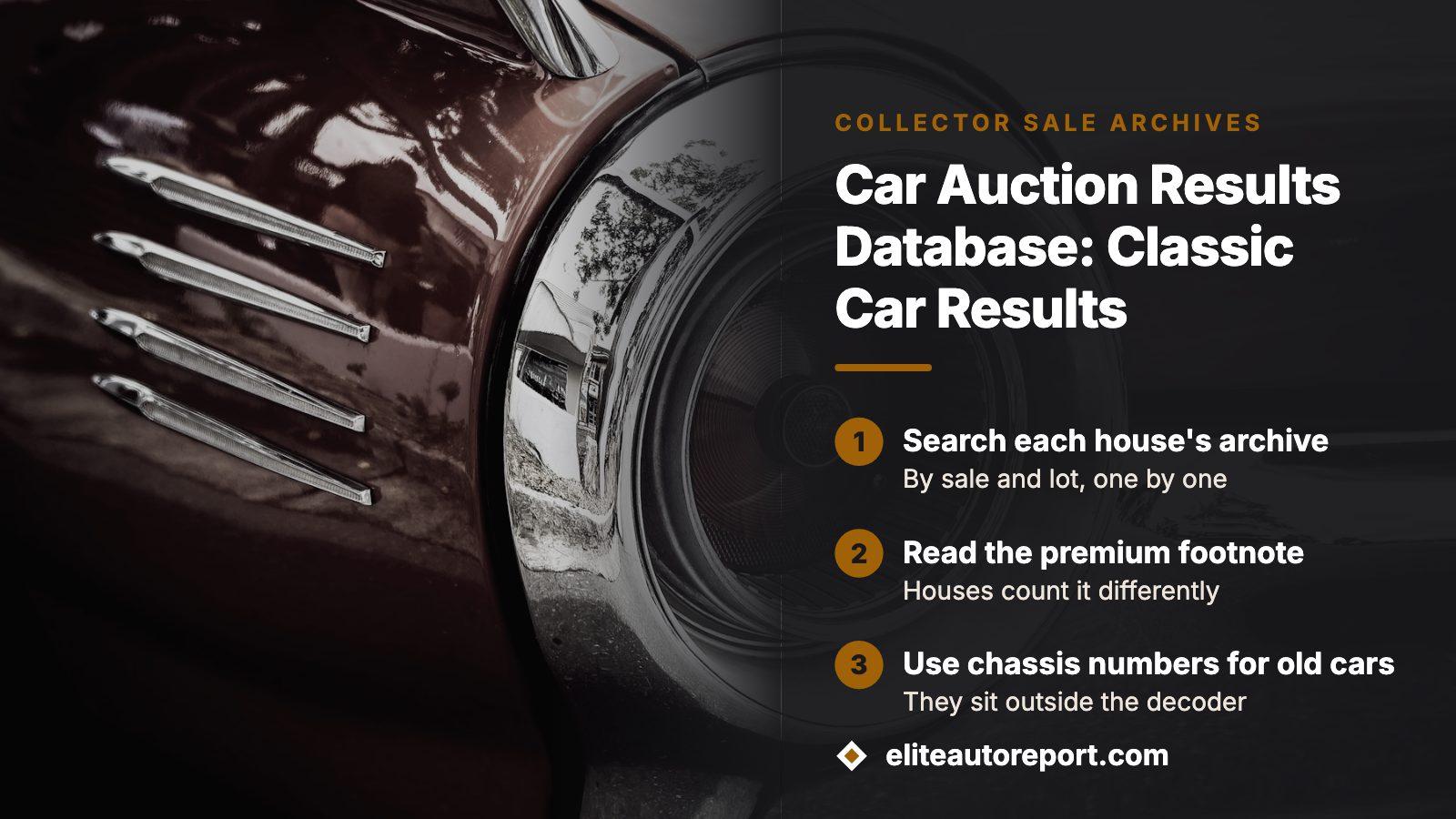
Historical results for classic cars sit in each auction house's own archive, so you search RM Sotheby's, Bonhams and Gooding Christie's one by one, by sale and lot. Read the footnote before comparing prices, because houses differ on whether the premium is counted. Cars from before the 1980 VIN standard fall outside NHTSA's decoder, and houses catalogue them by chassis number. For a car with a full 17-character VIN, start with the free preview.
- Where results live
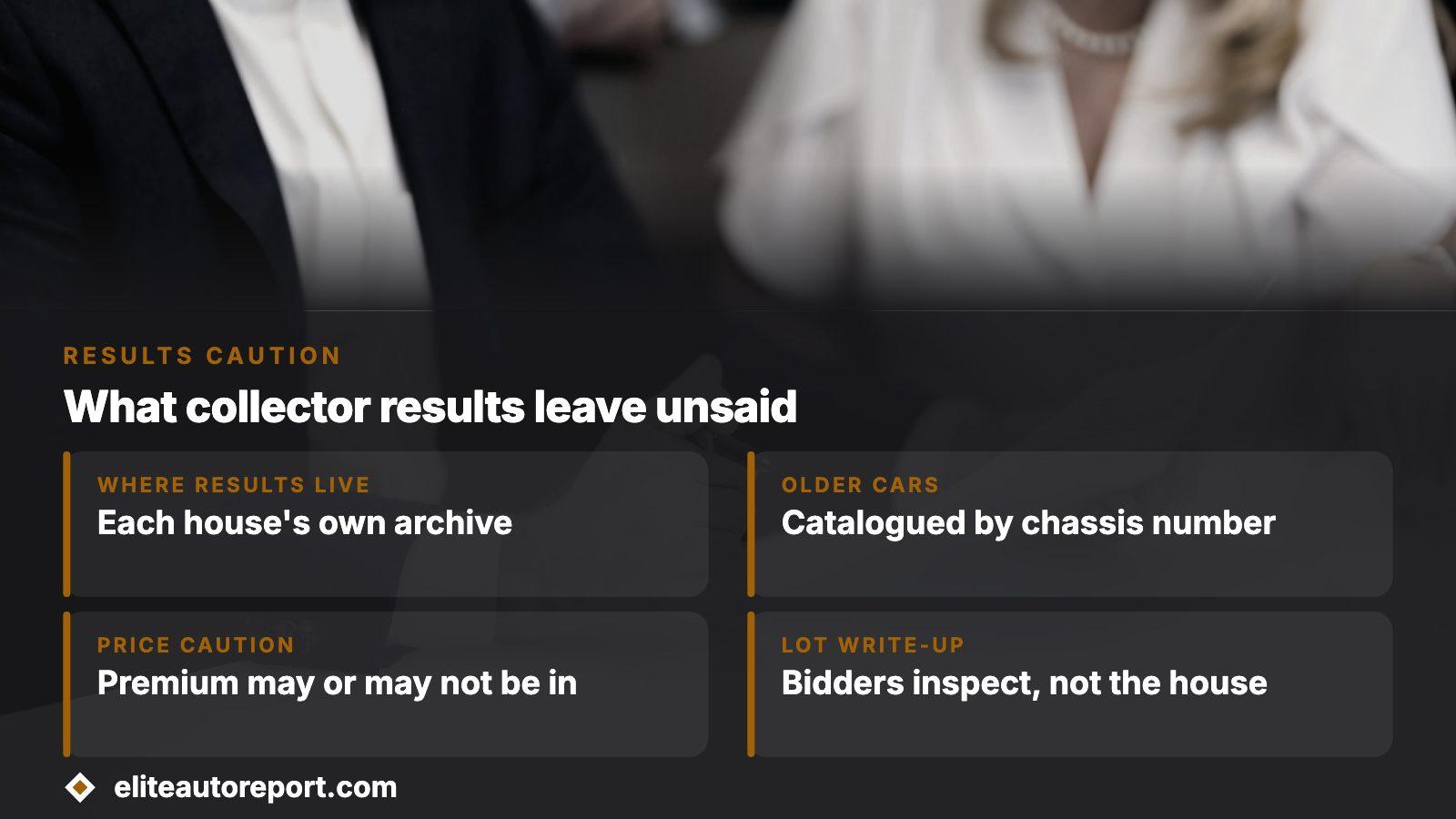
- In each house's own archive, by sale and lot
- Older cars
- Catalogued by chassis number, outside NHTSA's decoder, before 1980
- Price caution
- Some figures include the premium and some do not
Where collector-car results are kept
The primary record of a sale lives with the house that ran it. Every major house publishes its own archive, arranged its own way, and you reach a result by sale first and lot second.
| House | How you reach past results | What a page can carry |
|---|---|---|
| RM Sotheby's | A year picker running from 2002 to 2026, then the sale | Live sales and its Sealed sales in one list |
| Bonhams | Filters for country, category, year from 2003, month and sale type; Motoring is one category | Sold lots, with chassis and engine numbers on early cars |
| Gooding Christie's | Year and sale-type filters; the vehicles page can show past auctions only | A lot page can show estimate, chassis, engine and an owner-by-owner provenance list |
Mind the small print on the site itself. RM Sotheby's terms limit use of its pages to informational, non-commercial or personal purposes, so treat an archive as something to read and cite, not something to paste into your own listing. If a site gathers results from several houses into one list, treat it as a copy and open the house's own lot page to confirm the figure.
What the price on the page actually includes
Two houses can print a sold figure and mean different things. Gooding Christie's conditions of sale say every bid amount, the winning one included, leaves out the buyer's premium and taxes. For a vehicle at a live US sale that premium is 12% of a final bid up to $250,000, then 10% on the part above it; at an online-only sale it is 10%. A finished Bonhams motoring sale labels each sold price inc. premium.
| Figure on the page | Usually means | Why it matters |
|---|---|---|
| Gooding final bid | The hammer price alone | The buyer paid more once premium and taxes were added |
| Bonhams sold for, inc. premium | Hammer plus premium | Not comparable with a hammer-only figure |
| Estimate | An opinion written before the sale | Gooding calls it no forecast, and it excludes the premium |
Bonhams charges its premium in bands set by each sale's conditions. Motor Cars sat outside its rate change that began on 1 October 2026. Notes on its London motoring sale of 30 October 2026 apply 15% up to £500,000 of the hammer and 12% above that, plus VAT on the premium. Other sales may print other bands, so compare one house in one period.
A worked example
Say a live US sale ends on a $1,000,000 final bid. The house adds $30,000 on the first $250,000 and $75,000 on the rest, so the buyer owes $1,105,000, ahead of taxes and license fees.
Reserves, no-sales and the deal after the block
Collector sales usually carry a reserve, the lowest figure the seller will take. Gooding's conditions say reserves stay confidential and never exceed the low estimate. The auctioneer may place bids for the seller to protect that figure, though never at or above it. A lot that falls short is not necessarily finished: the house's FAQ welcomes an inquiry about a car that went unsold, so a no-sale line may be followed by a deal the archive page does not show.
Pace shapes the numbers too. The FAQ puts the speed at 12-15 lots an hour, and a bid cannot be withdrawn once made. A result records one fast moment, not a valuation.
Why a VIN search rarely finds an older collector lot
Archives file a car by sale, lot, chassis number and engine number. Bonhams lists a 1901 Panhard et Levassor under chassis no. 624, which is no VIN at all. Federal rules give modern cars a 17-character number. NHTSA's decoder is aimed at model years from 1981 onward and skips cars built before the 1980 standard.
Even the catalogue's number can differ from the paper one. A Gooding lot page for a 1965 Ferrari 275 GTB shows chassis 06617 and a footnote saying the car is titled as 275GT06617. With two strings for one car, a search on one can miss the record filed under the other.
- Search an archive by sale, make, model, chassis number and lot.
- Search a VIN history for a car that carries a standard 17-character number.
- For anything in between, try both and write down every number the paperwork shows.
What a lot write-up does and does not promise
A glossy lot page reads like a verdict. The conditions behind it say otherwise, at least at Gooding Christie's.
- Statements about make, rarity and provenance are given as opinion, not warranty.
- A condition report that skips repairs, damage or replaced parts does not mean there are none.
- The house does not inspect; bidders do, at viewing hours or by appointment.
- It makes no promise about the title papers, which come from the seller.
- A car can arrive on a bill of sale instead of a title, and the catalogue is meant to say so.
A high result tells you buyers believed the write-up. Whether the papers and the mileage hold up is a separate question.
Setting a result beside the car's own trail
A result is the market's view of a car on one day. The VIN record is the car's paper trail, and it answers other questions. Federal rules make an auction company keep, for five years after a sale, the name of the last owner and of the buyer, plus the VIN and the mileage shown the day it took the car in. A price is not on that list. The national title system adds title data, brands, the latest odometer reading and salvage or total-loss history, in a report it calls intentionally concise.
- Note the sale, the date and the lot from the archive.
- Run the VIN, if the car has a full 17-character one, and look for an entry near that date.
- Compare the odometer reading from the sale with the catalogue's mileage claim and the dash.
- Read the photos before you read any label.
- Ask the seller about every gap.
Expect thin records on older cars. A car of model year 2010 or older can change hands without a written mileage statement once a decade has passed, and some states exempt old vehicles from titling. A quiet result is weaker evidence on a classic than on a five-year-old car.

Where the VIN check fits, and what it costs
The check earns its place when the car has a standard VIN and you are close to committing: a luxury or exotic car built since the 1980 standard, with an auction in its past. Start with the free EliteAutoReport preview. Paying for the full report is a one-off step with no subscription, and the pricing page lists the sizes on offer, from a lone report up to larger bundles. Where entries exist, the auction section sets dates and photos beside title brands and odometer readings.
- Ask the seller for the sale paperwork and the original photos.
- Pay a specialist in that marque to inspect the car, because no record can judge condition.
- Request the state's own title record; the national system tells buyers to consider it, since its report holds less.
Where this information comes from
- Gooding Christie's: conditions of sale — premium, estimates, reserves and what a description promises
- Gooding Christie's: frequently asked questions — unsold lots, bill-of-sale cars, past-auction filters and pace of sale
- Bonhams: buyer's premium and other charges — how the premium is banded and why motor cars follow their own table
- Bonhams: The Golden Age of Motoring Sale — a finished motoring sale, with sold-for wording and its premium notes
- NHTSA vPIC: VIN decoder — the model-year range its decoding covers
- 49 CFR part 580: odometer disclosure requirements — what an auction company keeps and when mileage statements stop
- NMVTIS: information for consumers — what the national title system holds and where it falls short
Sources and photos: Facts checked against the sources above in November 2026. Photos by Warren Griffiths, Michal Biernat and Carrie Allen www.carrieallen.com on Unsplash; diagrams by EliteAutoReport.
Keep reading
- Auction History by VIN: Photos for Luxury, Exotic and Classic CarsHow an auction history check by VIN works and what its photos can show.
- Car Auction History Prices by VIN: Luxury, Exotic and Classic CarsWhy a VIN search shows dates and photos far more often than a sale price.
- Sample reportA finished report to look over before you buy one.
- PricingWhat a single report or a larger pack costs, paid once.
Frequently asked questions
Is there one database of classic car auction results?
Not a primary one. RM Sotheby's, Bonhams and Gooding Christie's each publish their own archive, arranged by sale and lot. To follow one car you may need to check several, and a deal struck after the auction may never show up in any of them.
Do published auction results include the buyer's premium?
It depends on the house and the page. Bonhams marks its sold prices as including the premium, while Gooding Christie's says its bid amounts leave it out. Read the footnote or the conditions of sale before you set one result beside another.
Can I find a classic car's auction history by VIN?
Only if the car has a standard 17-character VIN and the sale was recorded in a source the report draws on. Earlier cars are catalogued by chassis number, and NHTSA's decoder does not cover vehicles from before the 1980 standard. Search the archives instead.
What does a no-sale mean at a collector auction?
Usually that bidding stopped below the reserve, the lowest figure the seller would accept. Gooding Christie's tells people to get in touch about unsold lots, so the car may change hands later at a price the archive page does not show.
Does a high auction price mean the car has a clean history?
No. A price reflects buyers' opinion of the write-up, and the conditions of sale call that write-up opinion rather than fact. The national title system also warns that a search can return a false negative. Pair any result with the VIN record, the state title record and an inspection.
Now check the car itself
The guide explains what to look for. The report shows what this VIN has on record.