THE SHORT ANSWER
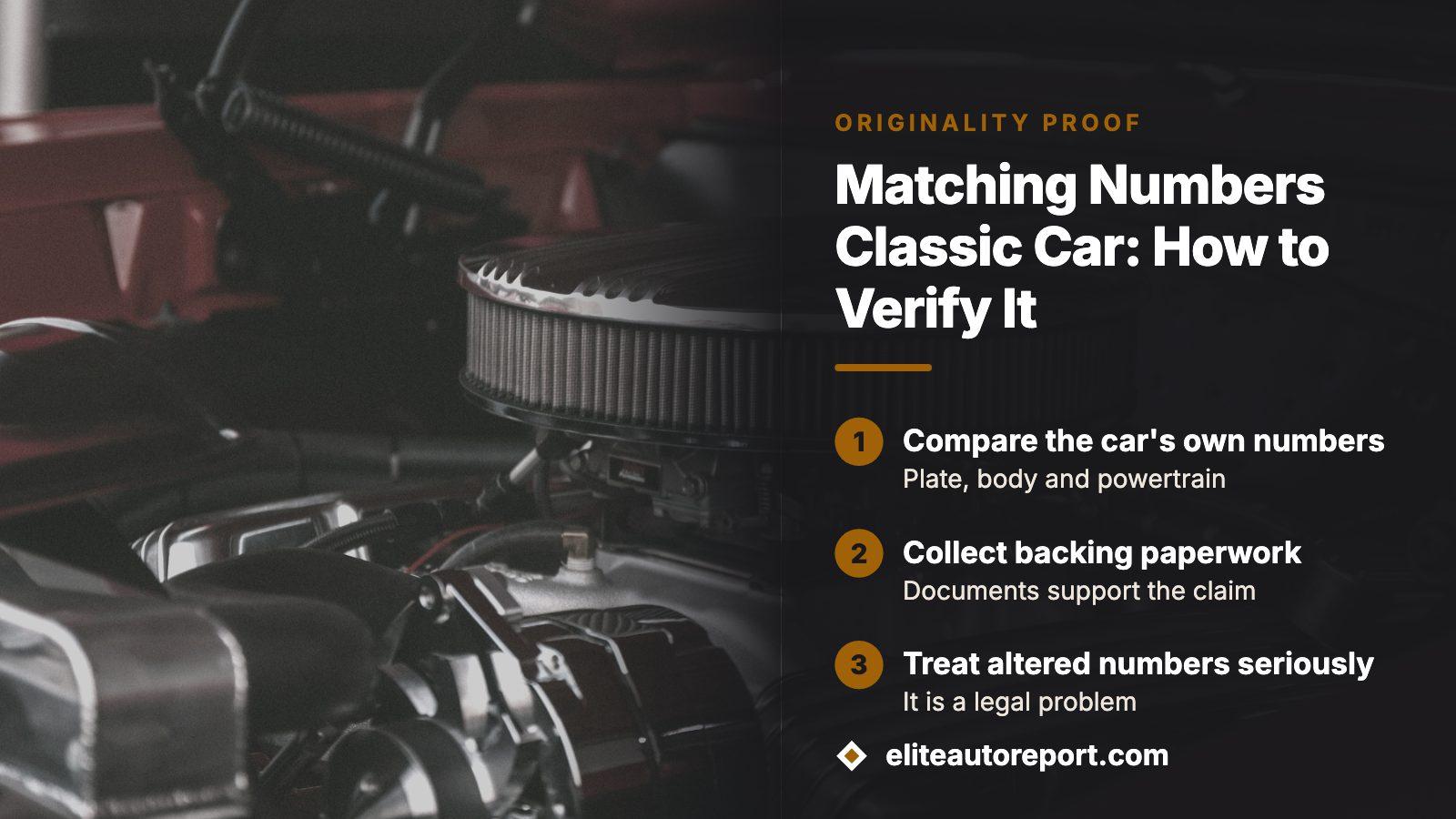
Treat a matching numbers claim as a statement to test, not a fact. Compare the stamped codes on the engine, gearbox and body with the VIN, ask for the maker's archive paperwork or build documents, and look for signs of altered numbers. Then run the VIN to see whether title, auction and sale records agree with the seller's story.
- Federal VIN rule
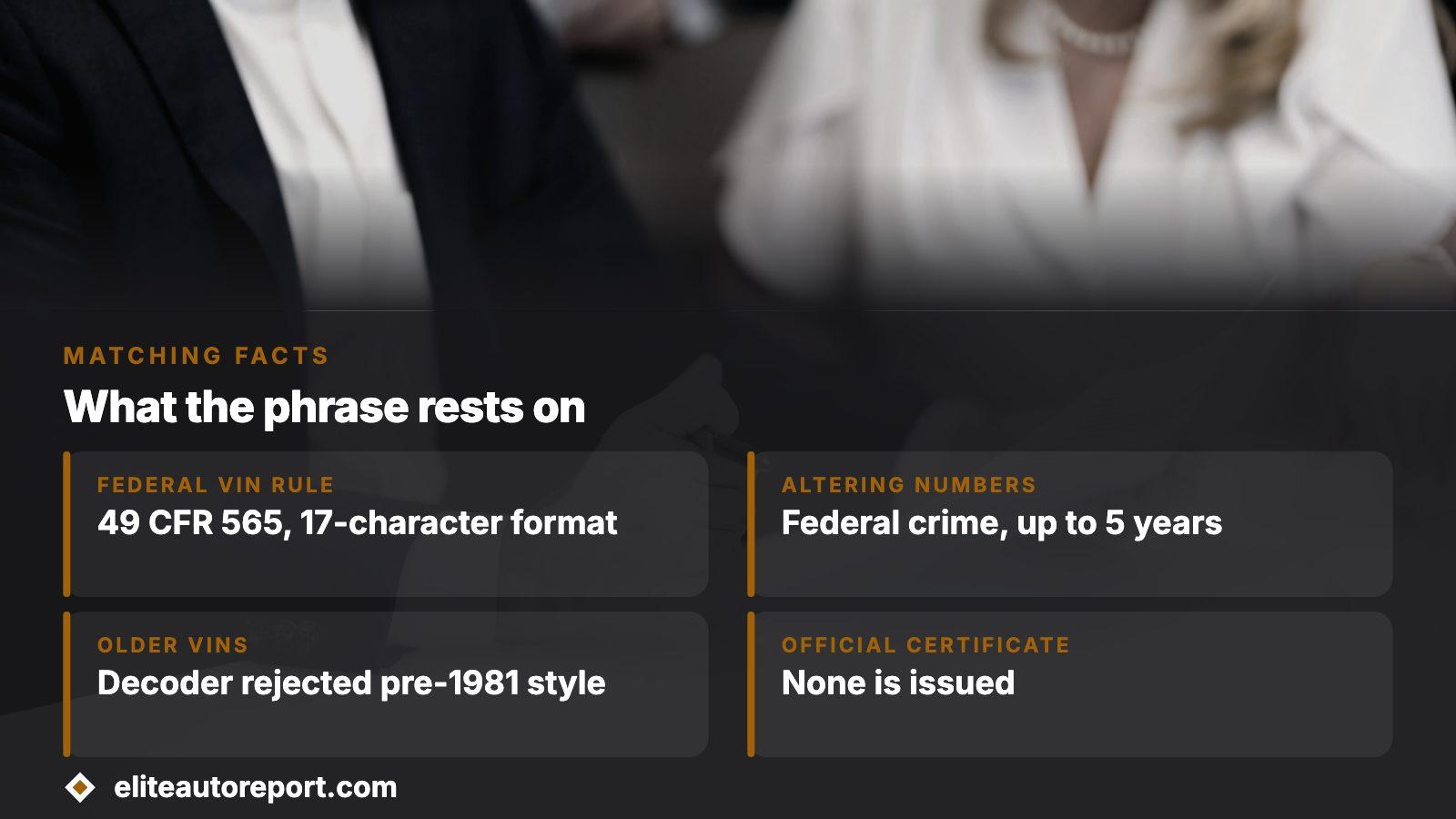
- 49 CFR 565 sets the 17-character format
- Altering numbers
- A federal crime under 18 U.S.C. 511, up to 5 years
- Older VINs
- Federal decoder returned nothing for a pre-1981 style VIN
What the phrase promises, and what it does not
Sellers use the phrase loosely. In the collector world it usually points to the engine, the transmission and sometimes the rear axle or body being the original set, each carrying a code or serial that traces back to this exact chassis. A seller who says the car is numbers-matching is making a claim about factory originality, not about condition, mileage or whether the car has ever been wrecked.
That gap matters at the price points where exotic and luxury classics trade. A car can have its original engine and still carry a rebuilt title. It can also have a replacement block and a spotless record. The phrase answers one narrow question, and you need other records to answer the rest.
Why nobody issues an official certificate
The federal rule on vehicle identification numbers, 49 CFR Part 565, governs the VIN: its length, its check digit and its uniqueness. It says nothing that certifies an engine stamping against a chassis. The stated aim of the rule is to simplify retrieval of identification information and improve recall accuracy, not to authenticate collector claims.
So the verdict is yours to assemble. Evidence comes from three places: the metal on the car, the paper that came with it or can be requested from the maker, and the recorded history attached to the VIN. A claim that holds up in all three is far stronger than one that rests on a seller's word.
Why an old VIN will not decode cleanly
The 17-character format with a check digit in position 9 is the modern standard, and the model-year table in the rule begins at 1980 and 1981. Cars built before that era carry shorter, maker-specific numbers that follow no common pattern.
We tested this on NHTSA's own decoder with a Corvette-style number from the pre-1981 period. It returned no make and no model year, and flagged the number as incomplete, with an unregistered manufacturer and an invalid year character. The tool did what it was built to do. It simply was never designed for those numbers.
What this means for you
If a free online decoder rejects a vintage VIN or returns blanks, that says nothing about the car. Decode it with a marque club, a maker archive or a specialist who knows the format for that brand and year.
What to compare on the car itself
Start with the physical evidence, and do it in good light with the seller's permission to clean grime away. The goal is a consistent story across every number you can find.
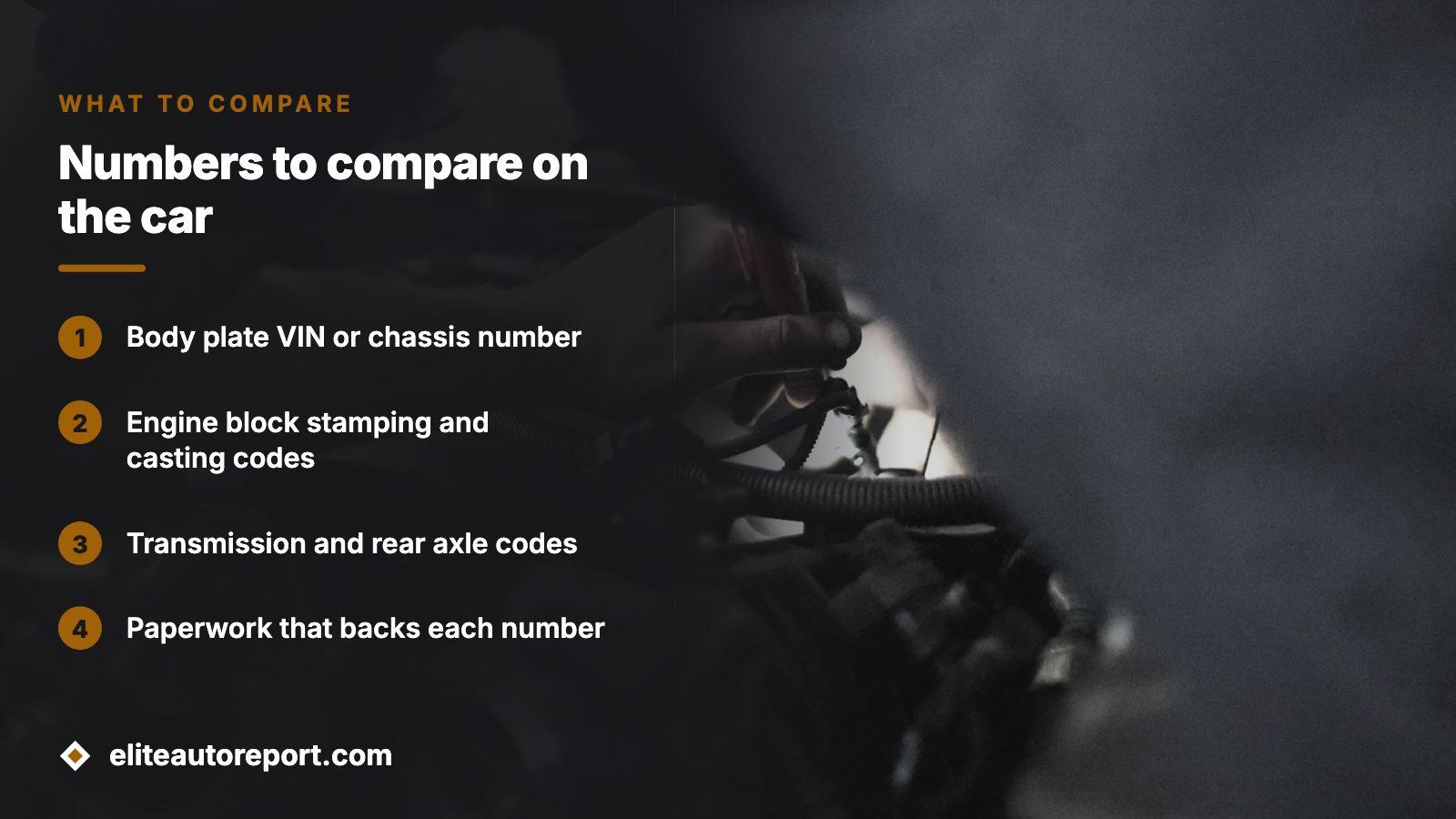
- The VIN or chassis number on the body plate and any stamped location the marque is known for, checked for matching font and spacing.
- The engine block stamping and casting codes, compared with what the maker's documents or a marque expert say that car should carry.
- The transmission and rear axle codes, since these are the parts most often swapped without comment.
- Date codes on cast parts, which should fall before the car's build date and not after it.
- Fresh grinding, uneven paint over a stamped pad, or mismatched stamp depth, any of which suggests a number was reworked.
Photograph every stamping beside a ruler for scale and send the pictures to an owners' club registrar before you commit.
The paperwork that backs a claim
Original build documents, the dealer's invoice, a protection plate, a window sticker if one survives, and long-running service files all help. Some makers also keep archives open to the public. General Motors runs one such archive at its Heritage Center. By its own description, the public can ask for material from a store of photographs and microfilm running into the millions, and a kit service covers over 900 models.
Other brands run their own heritage or classic departments, and each has its own process and fees, so ask the maker directly. Paperwork that names this specific chassis is strong evidence. Generic brochures for the model are not.
Be careful with unsigned letters
A certificate of authenticity from a seller's friend, or a spec sheet with no maker letterhead and no chassis number, proves very little. Ask who issued it and whether you can verify it with them.
Altered numbers are a legal problem, not a cosmetic one
A single federal statute, 18 U.S.C. 511, targets anyone who knowingly defaces or changes a vehicle's ID number. Parts are included, so numbered engines and gearboxes fall inside it. Punishment can reach 5 years behind bars, a fine, or both.
Lawful work is carved out. Restoring or replacing a number under state rules is allowed, and so is an alteration a repairer cannot avoid while fixing the vehicle. A restamp done under a state process should leave paper behind. If a seller says a number was restamped, ask for that paperwork and keep a copy.
Where the VIN record tests the story
A numbers-matching car with a clean-looking block can still have a dark past. This is where the VIN check earns its place. Federal title data, gathered by the Justice Department through NMVTIS, backs many VIN reports. That data can surface title brands a seller never brought up.
For the luxury and exotic cars this site covers, auction history and photos by VIN add a second check. Sale records and listing photos can show whether the engine bay looked original at an earlier sale, whether the car was ever a salvage lot, and whether the mileage story holds. If a past photo shows a different engine than the one now installed, the claim needs a hard explanation.
Run the free preview first to see what exists for the VIN. The full report is a one-time purchase, with current options on the pricing page.
Reading the results next to your inspection notes
Lay your photographs and the report side by side. You are looking for agreement, and the table below shows the common ways the two disagree.
| What you find | What it may mean | Next step |
|---|---|---|
| Auction photos show a different engine or color | Drivetrain or paint changed since that sale | Ask for receipts and dates of the work |
| Salvage or rebuilt title brand | Structural repair, possibly with replacement parts | Pay for an independent inspection before negotiating |
| Mileage jumps or odd gaps | Odometer change or long storage | Request service records for the missing years |
| Records appear only after a recent date | Imported, barn find or retitled car | Ask for foreign documents and prior titles |
Treat the premium as unproven until you verify it
If a seller wants extra for numbers matching, make the offer conditional on the evidence you checked: stamped codes, maker paperwork where it exists, and a VIN record that has no unexplained gaps.
Write that condition into the purchase agreement. If the claim fails after the sale, you will be arguing about a verbal statement. If it is in the contract, you have something firm to stand on. For a high-value car, an inspection by a marque specialist is cheap protection.
Where this information comes from
- eCFR: 49 CFR Part 565, Vehicle Identification Number requirements — VIN length, check digit, uniqueness window and model-year table
- GovInfo: 18 U.S.C. 511, altering or removing motor vehicle identification numbers — the federal crime, its penalty and its exceptions
- NHTSA vPIC VIN decoder API — the decoder we tested with an older style number
- VehicleHistory.gov: NMVTIS consumer information — what the national title system is for
- GM Heritage Center — example of a maker archive open to the public
Sources and photos: Facts checked against the sources above in November 2026. Photos by Victor Hughes, Mustafa Sheikhmouss and Carrie Allen www.carrieallen.com on Unsplash; diagrams by EliteAutoReport.
Keep reading
- Where Is the VIN on a Classic Car? Dash, Door, Firewall and FrameFind the number locations before you compare any stampings.
- Classic Car Title Search by VIN: What Turns Up and What Doesn'tCheck how the title history lines up with the seller's story.
- Classic Car Appraisal by VIN: What a Number Can and Cannot ValueSee how a VIN feeds a value estimate for an older car.
- Car Auction Results Database: Where Classic Car Results LiveLearn how past auction sales can support or challenge a claim.
Frequently asked questions
Does matching numbers mean a classic car is original?
No. It speaks only to major mechanical parts being the factory set. Paint, interior, body panels and wheels can all be changed, and the car can still carry a salvage brand. Treat it as one point of evidence among several, and check title and sale history alongside the stampings.
Can a VIN check prove the engine is original?
Not by itself. A VIN record covers title, auction and sale events, not engine serial numbers. What it can do is show photos and dates from earlier sales, which sometimes reveal that the engine bay looked different back then. Combine it with stamp checks and maker paperwork.
Why does the free VIN decoder reject my vintage car's number?
Federal decoding rules are built around the 17-character format. Older numbers are shorter and follow each maker's own pattern, so the NHTSA tool returned no make or year for one we tried. Use a marque club or maker archive for those cars.
Is restamping a number illegal?
Changing a vehicle's ID number is a federal crime, with an exemption for restoring or replacing one under state law. A legal restamp should come with state paperwork. Without it, treat the car as a risk and consider walking away.
How do I get proof from the manufacturer?
Contact the maker's heritage or classic department with the VIN or chassis number. Some makers, GM among them, run archives with documents on request. Fees and turnaround vary by brand, so ask before you rely on a delivery date.
Now check the car itself
The guide explains what to look for. The report shows what this VIN has on record.