THE SHORT ANSWER
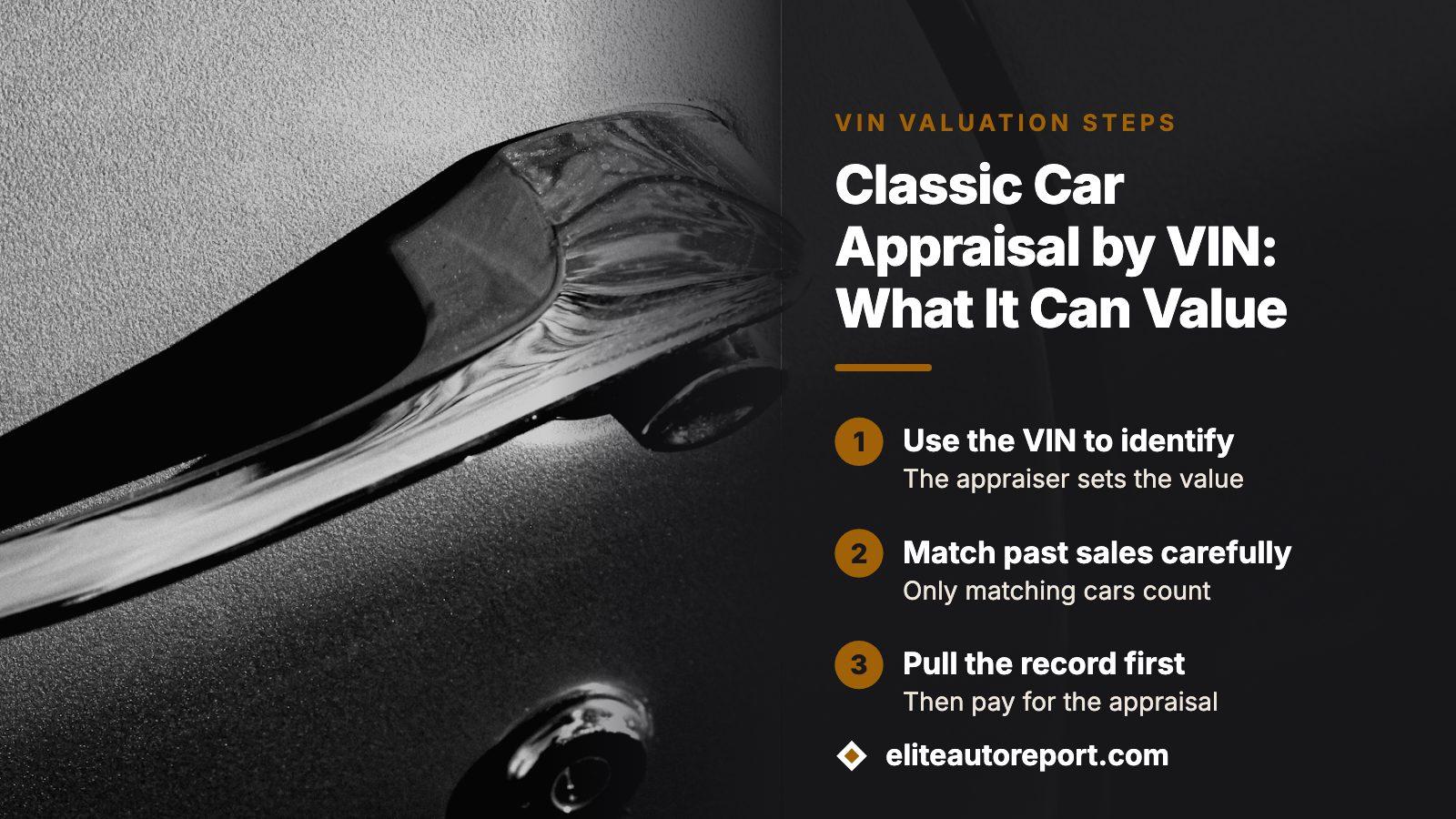
A classic car appraisal by VIN is really a two-part job. An appraiser inspects the car and sets a value from comparable sales and condition. The VIN, or chassis number on older cars, tells the appraiser exactly what the car is, and a history check can surface auction sales, title brands and odometer entries that move the figure. The number alone never sets a price.
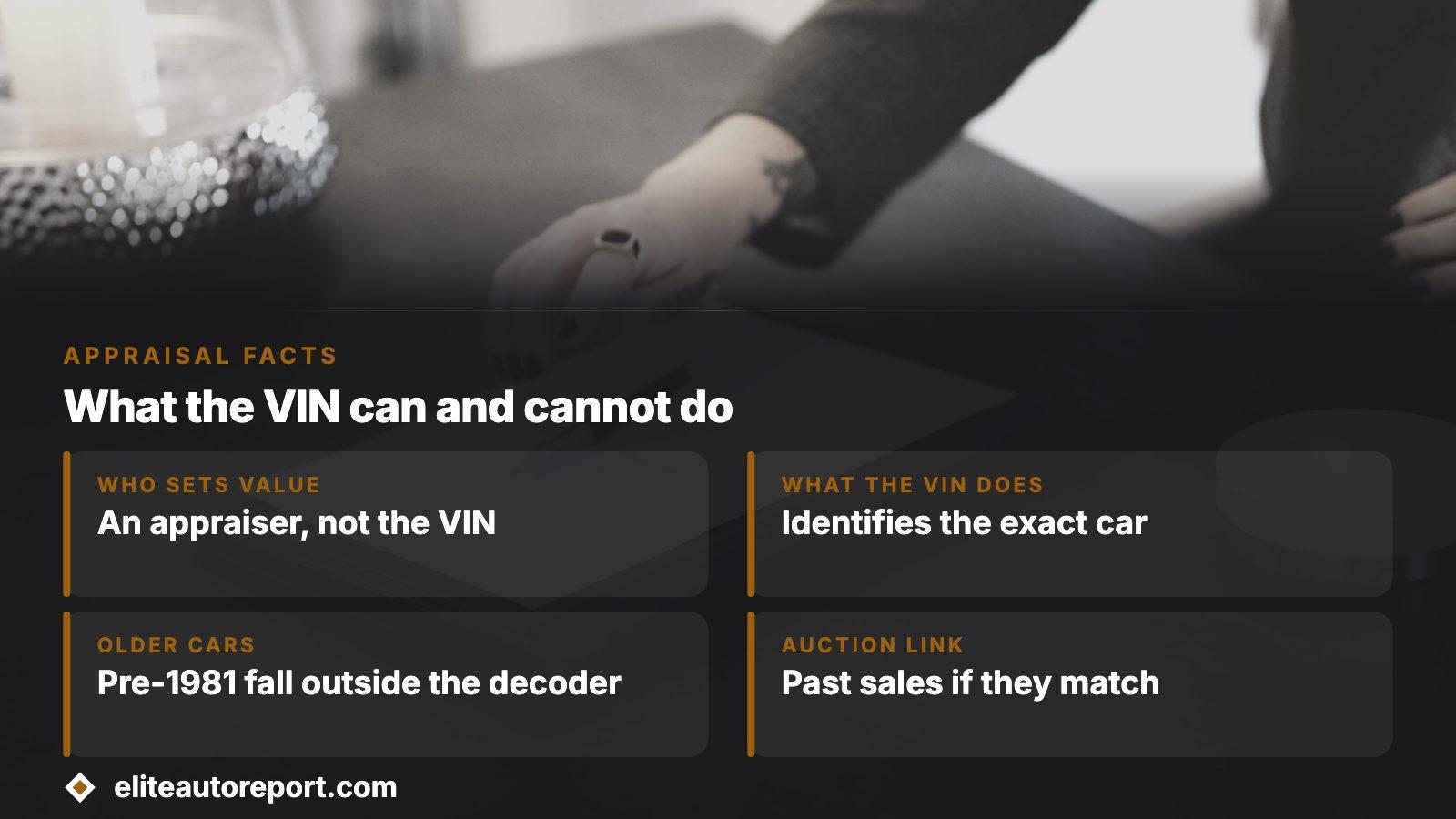
- Who sets the value
- An appraiser, not the VIN
- What the VIN does
- Identifies the exact car and opens its record
- Older cars
- Pre-1981 numbers fall outside NHTSA's decoder
- Auction link
- Past sales are evidence, if they match the car
What an appraisal is, and what a VIN is for
Two different things get blurred in this search. An appraisal is an opinion of worth, written by someone qualified to give one. The VIN only labels the car. It says which one is in front of you and stays silent on price.
The IRS frames fair market value as an open-market sale price that two informed parties would agree on, with nobody under pressure to deal. Notice what is missing from that definition: nothing about a lookup. The agency lists four inputs: what was paid, sales of comparable cars, replacement cost and the opinion of a professional appraiser. A number can feed the second input, because a sale of this very chassis is the best comparable you will ever get.
What the number tells an appraiser
For a luxury or exotic car, small differences swing the figure. The right engine, the original body style and the production slot all matter, and the serial number is how those are confirmed. A modern 17-character VIN opens with a maker and vehicle-type code in positions one to three, then positions four to eight describing the build, then the model year at position ten.
Federal rules add a wrinkle that catches people with cars built near the old and new VIN changeovers. On a passenger car or light truck, position seven decides the cycle: a digit places the year character in the span ending 2009, a letter in 2010 through 2039. An appraiser who reads the year code without checking that position can be a full generation off.
Why older numbers need a different route
NHTSA describes its decoder as built for 1981 and newer cars, and says anything older than the 1980s standard sits outside it. A test with a short invented number returned error codes for an incomplete VIN and a maker tied to an unrelated vehicle of another year. That is the failure to avoid: a decoder that guesses will happily describe the wrong car.
- Pre-standard cars carry shorter, maker-specific serials, so the appraiser reads the plate and stampings by hand.
- Match the serial on the title, the body plate and the frame or block stamping before anyone values the car.
- A replica that carries the original's make, model and year in its VIN is a legal oddity, so confirm what you are looking at is not a replicated car.
Our matching-numbers guide goes through that comparison in detail. For the appraisal, the point is simple: an unverified identity makes every later figure worthless.
Where auction history fits the valuation
Our focus is auction history and photos by VIN, and this is where it earns its place in an appraisal. A past sale of the same car is a data point no catalog average can match, but only when the record is read correctly.
| Auction record shows | How an appraiser uses it |
|---|---|
| Earlier sale of the same car | Anchor for the trend, if the condition then was similar |
| Photos taken at the lot | Evidence of condition, paint and interior on that date |
| Salvage or damage listing | Reason to discount, or to inspect the repair closely |
| Repeated resales in a short span | Prompt for questions about why owners let it go |
Ask what the printed price included. Houses differ on whether a figure counts the buyer's fee, and our classic auction results guide covers how to read that line. Never compare a price with a premium to one without.
Title and odometer entries that move the number
A brand on the title is the single biggest valuation event short of a crash. The federal title database gives shoppers a short summary: who holds the title, the newest mileage entry, any junk, salvage or flood label, and occasionally a theft note. Its makers kept it terse on purpose, focused on a few fraud and theft signals.
Silence is not clearance
By the program's own figures, 87 percent of the national fleet is covered, and a search can miss a brand it never received. Rules for branding differ from state to state, so the same wreck can be branded in one state and carry no label in another. Count a clear result as one input and keep the inspection.
Mileage deserves a caveat of its own. Under federal odometer rules, a car of model year 2010 or older can change hands without a mileage statement after a decade has elapsed from the first day of its model year. Many classics therefore have gaps that no record can fill, and an appraiser should not lean on the odometer.
Choosing an appraiser and what to hand over
For insurance or private sale, you can hire anyone you trust. For a charitable gift above the threshold the IRS sets, the rules are firm. The agency asks for a qualified appraisal signed by a qualified appraiser, which means verifiable education and experience valuing that kind of property, and a completed Form 8283 with the return.
- Choose someone who regularly values the make or era in question.
- Steer clear of any appraiser who wants a cut of the appraised amount, since the IRS bars that fee structure for a qualified appraisal.
- Give the appraiser every fact, including damage and repairs. Misrepresenting facts can sink the appraisal.
- Expect the paper to be dated close to the gift, within the window the agency sets.
Published price guides are not official and are not appraisals of your car, though they are useful for rough comparison, and a private-party figure is the more realistic reference than dealer retail.
Run the record first, then pay for the appraisal
An appraiser's hourly clock should not be spent discovering a salvage brand. If your car has a 17-character VIN, run the record before you book the inspection. The preview is free, and the full EliteAutoReport is paid once, no subscription involved, and the pricing page shows today's options.
- Copy the VIN from the title and again from the car, and confirm they match.
- Run the preview, then open the report if the car checks out.
- Note any auction sale, brand or odometer entry, with dates.
- Give those notes to the appraiser and ask how each one affects the figure.
If the car predates the 17-character era, the report may have little to say, and the appraiser's inspection plus the maker's or club's records will carry the weight.

Red flags that should stop the valuation
Some findings change the job from valuing the car to deciding whether it is the car it claims to be. The federal title program cites a car-cloning ring in Florida that cloned over 250 cars worth $8 million, a scheme uncovered when states compared records.
- A VIN that fails the position-nine check calculation, which exists to catch mistranscription.
- An auction listing whose photos show a different color, body style or interior from the car in front of you.
- A title brand the seller never mentioned.
- Sale history with long unexplained gaps or a string of quick resales.
Each of these is grounds to stop and ask questions. None is proof of fraud, and none should be settled by a seller's say-so.
Where this information comes from
- IRS Publication 561: Determining the Value of Donated Property — fair market value, qualified appraisals and appraisers, price guides for vehicles
- NHTSA vPIC VIN decoder — decoder scope for model years 1981 and later
- 49 CFR 565.15 VIN content requirements — what each VIN position means, check digit, year code range
- NMVTIS consumer information — what the title system shows, its coverage and its gaps
- 49 CFR 580.17 odometer disclosure exemptions — when older vehicles need no mileage statement
Sources and photos: Facts checked against the sources above in November 2026. Photos by Linus Belanger, Alejandro Escamilla and Annika Wischnewsky on Unsplash; diagrams by EliteAutoReport.
Keep reading
- Matching Numbers Classic Car: How to Verify the Claim Before You PayHow to confirm the serials on a classic agree before it is valued.
- Car Auction Results Database: Where Classic Car Results LiveWhere past sale prices live and how to read what they include.
- Classic Car Title Search by VIN: What Turns Up and What Doesn'tFinding and reading a title record for an older car.
- Where Is the VIN on a Classic Car? Dash, Door, Firewall and FrameLocating the serial on a car built before modern standards.
Frequently asked questions
Can I get a classic car appraisal just from the VIN?
No. A value is an opinion that rests on inspection, condition and comparable sales. The VIN identifies the car and opens its record, which the appraiser then weighs. Any site claiming an instant figure from the number alone is estimating, not appraising.
Does a VIN check work on a car from the muscle-car era?
Mostly not. NHTSA built its decoder for 1981 and newer, and older cars carry shorter maker-specific serials. A record may still exist if the car was ever titled and reported. Expect the inspection and the maker's own records to do most of the work.
Do past auction prices set the appraised value?
They inform it. An earlier sale of the same car is strong evidence, but only if condition, date and the fee treatment line up. An appraiser still adjusts for what has changed since, including repairs, wear and the market.
Who counts as a qualified appraiser for tax purposes?
The IRS looks for verifiable education and experience valuing that kind of property, plus a recognized designation or coursework with two or more years of experience. It does not endorse any particular appraiser or organization, so check credentials yourself.
Is the vehicle history preview free?
The preview is free. Opening the whole report takes one payment with nothing recurring, and the pricing page has the current choices. Start with the preview to learn whether the car merits an appraiser's time.
Now check the car itself
The guide explains what to look for. The report shows what this VIN has on record.