THE SHORT ANSWER
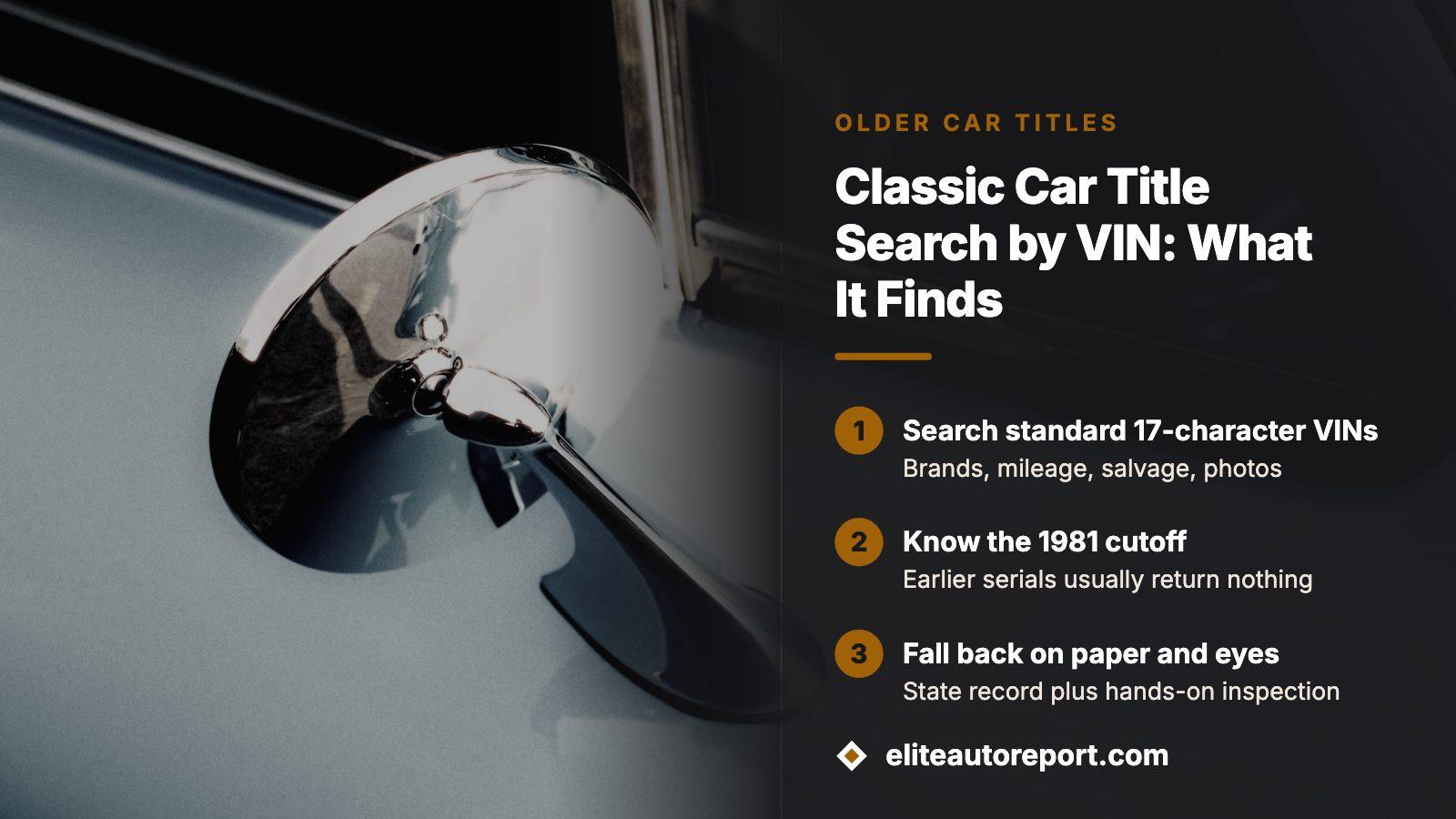
Enter the car's 17-character VIN and EliteAutoReport searches title brands, mileage readings, salvage records and auction photos, with a free preview before you pay anything. That covers cars from the 1981 model year on. A pre-1981 serial number is not a standard VIN and usually returns nothing, so an antique needs its paper title, a copy of the state's own record and a hands-on inspection instead.
- Search key
- A standard 17-character VIN
- Older cars
- NHTSA's decoder rejects model years before 1981
- Cost
- Free preview, then one payment
- Antique status
- A state label, so definitions differ
What a title search can pull up on an older car
Title data in the national database arrives from DMVs, insurers, recyclers and salvage yards, and a salvage auction counts among those yards. A lookup returns which state holds the title and when it was last issued, any brands, the odometer, total-loss history and salvage history. Repairs, recalls and servicing are outside its scope. EliteAutoReport adds the auction file with photos wherever one exists, the part a seller of a high-end car is least likely to mention.
| Record | Where it comes from | What it means on a classic |
|---|---|---|
| Title brand | The state that titled the car | A salvage, flood or similar label that follows the car across state lines |
| Odometer entry | Title paperwork and later mileage reports | A reading, not proof, since old cars may be exempt from disclosure |
| Total loss or salvage | Insurers, salvage yards and auctions | Flagged as a write-off or salvage at least once; the repair itself goes unrecorded |
| Auction sale and photos | Auction records on file for the VIN | The car as it looked before anyone fixed it |
The 1981 line: why old serial numbers fail a VIN search
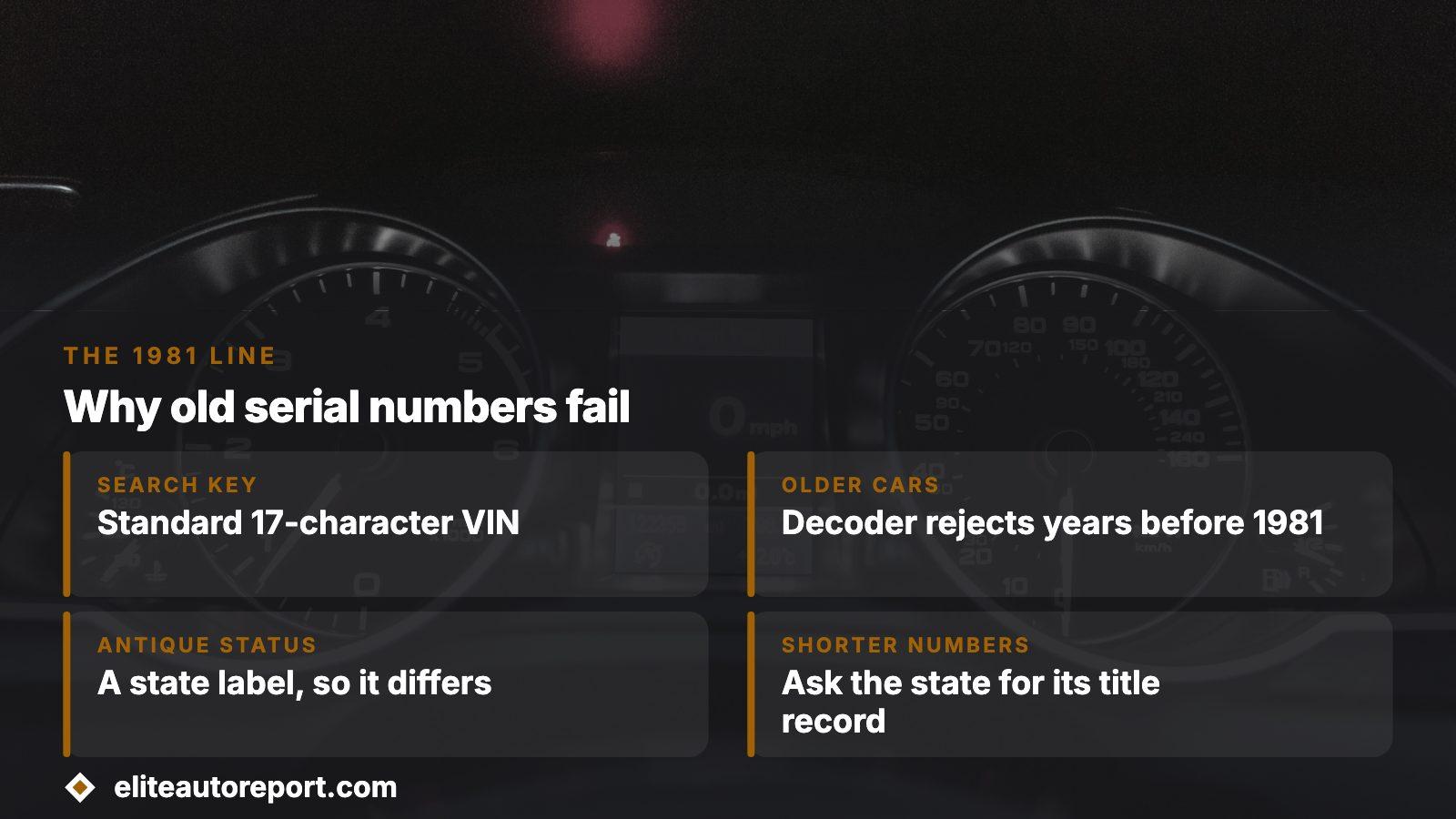
Federal rules fix every VIN at 17 characters, and the format is built around model years that begin at 1980. Older cars carry whatever serial or chassis number their maker chose. Feed NHTSA's own decoder a 1967-style number with the year 1967 and it hands back zero results plus a message that pre-1981 years are not accepted.
A search keyed to 17 characters has nothing to match on a car stamped with an older number. That is a limit of the numbering, not a verdict on the car.
- Built from 1981: run the full 17-character VIN.
- Built earlier: copy the serial or chassis number exactly as stamped, then request the title record from the state that issued the title.
- Unsure which applies: note every number on the car and on the paperwork, and try each one.
Where the record goes thin on an antique
The federal reporting duty is young. Insurers and salvage yards had to begin by March 2009, so a write-off from before then reaches the system only through a brand the state recorded. Insurers file only on cars within five model years, counting the current one, so a total loss on a much older car need not be filed by its insurer. Yards face no cutoff and report any model year.
States add gaps of their own. In some, a vehicle past a given age needs no title at all, so a lookup may find a thin record or none.
Blank is not the same as clean
On a recent car, nothing found is mild reassurance. On an older one it mostly shows how little was ever reported. Fill the space with the paper title, the state's record and a physical check.
Antique and classic labels: a state decision, not a federal one
Each state writes its own terms, so one state's antique can be another's ordinary used car. Pennsylvania calls a vehicle antique once it is more than 25 years old and classic at 15 or more. Both must be non-reproductions kept close to the maker's specification, and an owner can have the title changed from classic to antique when the car ages into it.
The same fact sheet adds that a salvage certificate offered as proof of ownership triggers an extra form, one that also covers reconstructed, modified, flood and recovered-theft vehicles.
- A salvage, reconstructed or flood term anywhere in the chain of titles
- A title issued by a state where the car has never lived
- A reproduction or kit body presented as an original
- No mileage stated at the last transfer
Auction records and photos on collector cars
A written-off luxury or exotic car is where the auction record earns its place. The Justice Department cautions that a total-loss label does not always mean a wreck. A stolen car that nobody recovers within 30 days can be declared a loss by its insurer; if it reappears undamaged, the label stays and an auction house may list it as a runner in perfect order. The opposite case is just as real, where a glossy repair hides structural damage.
The photos show which case you have. Compare the title type at the sale, the sale date and the mileage with the seller's paperwork. A car sold as never damaged that went through a salvage auction is the mismatch to take seriously.
How to run the search before you commit
- Find the number on the car itself, then on the title and registration. California's process uses the federal safety label as a backup source for the public number, so look for that label too.
- Photograph the plate or stamping yourself. Pennsylvania's antique application asks for exactly that.
- Enter the 17-character VIN for the free preview. With a shorter number, skip to step five.
- Compare brands, mileage and any auction photos in the report against the paper title.
- For a shorter number, ask the issuing state for its title record. The federal system says that fuller record sits with the state, and approved providers have to point buyers toward it.
- Book a hands-on inspection whatever the search shows.

Reading the odometer line on an old title
For cars from model year 2010 or earlier, the federal odometer rule lets the seller skip the mileage statement once a sale lands a decade or more after that year began. Later models get the same exemption after two decades. A blank or stale reading on an old car is therefore often lawful rather than suspicious by itself.
It does mean the paper trail may hold no recent reading to compare against. Weigh the odometer entry against wear on the pedals and seat.
When the numbers on the car and the paper disagree
A mismatch between plate and title is where a search ends and a physical inspection begins. California's DMV manual lists the cases where it always wants the car looked over in person: last registered out of state, a former junk or salvage car returning to the road, no DMV record, or a VIN on the certificates that differs from the one on file. Other states run their own procedures, so ask your DMV before any money changes hands.
Verify before you pay
If the seller cannot explain a gap between the stamped number and the title, treat the car as unproven until the state has inspected it.
Paying for the report, then the sensible next moves
The preview costs nothing. A full report on one VIN is a one-off payment that never renews. Bundles come as 3, 5 or 10 reports, and the pricing page has the rates. The sample report shows a finished one first.
- Save the auction photos now, since listings change.
- Match the title type, brands and mileage against the seller's paper.
- Request the state's own title record for any older number.
- Have a specialist who knows the marque inspect the car.
Where this information comes from
- Bureau of Justice Assistance: NMVTIS for consumers — Backs the brand, state-difference, age-exemption and total-loss points.
- Bureau of Justice Assistance: NMVTIS frequently asked questions — Backs the insurer model-year window, the 2009 start, salvage auctions as reporters and the state title record.
- NHTSA: vPIC decoder API — The decoder's documentation, plus a live test with a 1967-style number.
- eCFR: 49 CFR part 565, vehicle identification numbers — Backs the 17-character rule and the 1980 model-year starting point.
- eCFR: 49 CFR 580.17, odometer disclosure exemptions — Backs the decade and two-decade mileage-statement exemptions.
- PennDOT: antique, classic and vintage plates fact sheet — One state's definitions of antique and classic, and its application needs.
- California DMV: vehicle verifications, manual section 1.165 — Backs the cases that call for a physical inspection and the safety label as a second source.
Sources and photos: Facts checked against the sources above in November 2026. Photos by Linus Belanger, Dylan Michaud and Ambitious Studio* | Rick Barrett on Unsplash; diagrams by EliteAutoReport.
Keep reading
- Car Auction Results Database: Where Classic Car Results LiveWhere past sale results for collector cars are kept, and how to read the price.
- Auction History by VIN: Photos for Luxury, Exotic and Classic CarsWhat an auction history check returns for a luxury or exotic car.
- VIN Market Value for Luxury, Exotic and Classic Cars: A Five-Step CheckHow a VIN-based value is built once the title looks sound.
- Sample reportA finished report, photos included, before you pay for one.
Frequently asked questions
Can I search a classic car's title by VIN?
Yes, if the car carries a standard 17-character VIN, which in practice means model year 1981 or later. The search returns brands, mileage entries, salvage records and auction photos where they exist. An earlier serial number is not a standard VIN and usually finds nothing, so request the title record from the state.
How do I do an antique car title search?
Start with the paper title and the number stamped on the car. Antique is a state-defined label, so check your state's use of it. Then ask the issuing state for its record, search any 17-character number, and arrange an inspection. No single database covers a car built before 1981.
Does a clean result mean the title is clean?
Not by itself. Federal reporting by insurers and salvage yards began in 2009, insurers file only on newer model years, and some states exempt older vehicles from titling. On an antique, a clean result can reflect missing data, so weigh it against the paper title, the state record and an inspection.
Why does my pre-1981 number return nothing?
Before the 1981 standard, makers chose their own serial or chassis numbering. NHTSA's decoder rejects model years before 1981, and a search keyed to 17 characters has nothing to match. Write the number down exactly as stamped and use it for the state's title request and a hands-on check.
Do I need a search if the seller shows a clean title?
Yes. A paper title can omit a brand applied in another state, and states define salvage and flood differently. A brand stays on file nationally, and a search ties the VIN to records outside the seller's folder, including auction photos. It still does not replace an inspection.
Now check the car itself
The guide explains what to look for. The report shows what this VIN has on record.