
THE SHORT ANSWER
NHTSA holds 92 owner complaints for 1991 through 1997 Land Cruisers, and 29 of them involve the brakes. No Toyota recall campaign exists for those years. The patterns worth asking about are cracked fuel tanks on 1995 to 1997 trucks, rusted brake lines, warped rotors and an overheating fuel injection relay on early trucks. Check those, then run the VIN for title brands and auction photos.
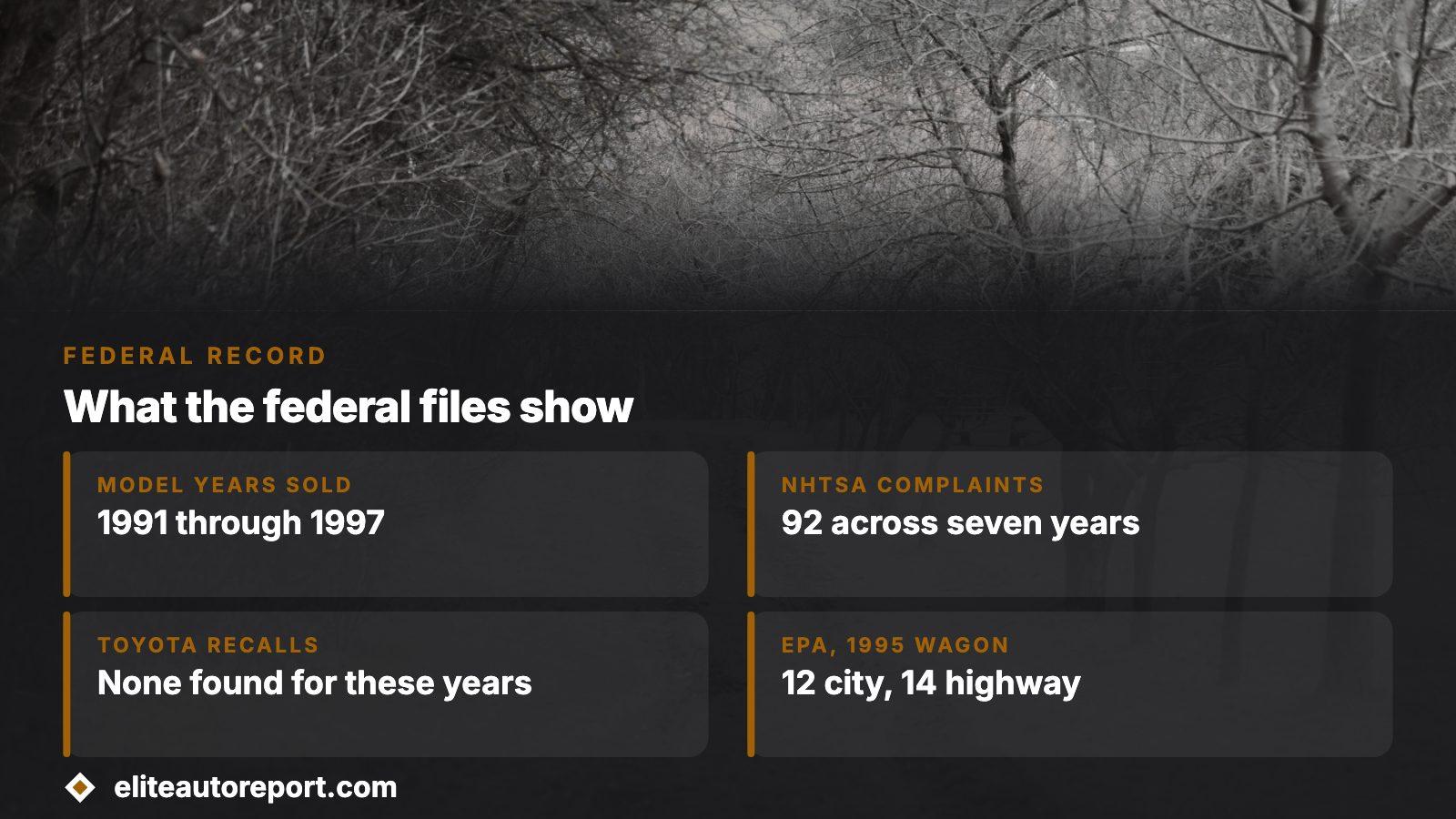
- Model years sold in the US
- 1991 through 1997
- NHTSA owner complaints
- 92 across the seven years
- Toyota recall campaigns
- None found for these years
- EPA rating, 1995 wagon
- 12 city, 14 highway, 13 combined
What you are actually shopping for
Federal databases file these trucks as Toyota Land Cruiser with a model year, nothing more. The enthusiast name 80 series stands for seven model years, 1991 to 1997, and I read the government record for each of them. The EPA lists the 1995 wagon as a 4.5 L six with a four-speed automatic, four-wheel drive and regular gasoline.
That EPA entry also shows the cost of ownership at the pump: 12 city, 14 highway and 13 combined. Toyota's own newsroom pages cover only current Land Cruisers, so I make no claims here about production totals or trim breakdowns. Anyone quoting those numbers should be able to show you where they read them.
The recall record is nearly empty, and that needs context
NHTSA's recall lookup returns no Toyota campaign for any 1991 to 1997 Land Cruiser. The 1991, 1992 and 1993 trucks show one entry, number 93E023000, and it is not Toyota's. It was filed by an aftermarket hitch maker, Reese Products, in July 1993 because a weld in one hitch design could break. The fix is a replacement hitch.
A quiet recall file is not the same as a trouble-free truck. Owners of these Land Cruisers filed complaints about problems that never produced a campaign, which is why the next section matters more than the recall list. If a seller says no recalls, ask whether a towing hitch was ever fitted to that truck.
Owner complaints, year by year
| Model year | Complaints | Brake entries | Crash-flagged |
|---|---|---|---|
| 1991 | 11 | 1 | 1 |
| 1992 | 10 | 2 | 0 |
| 1993 | 9 | 5 | 2 |
| 1994 | 22 | 5 | 5 |
| 1995 | 8 | 4 | 3 |
| 1996 | 15 | 8 | 1 |
| 1997 | 17 | 4 | 2 |
Across all seven years, 14 entries are flagged as crashes and 12 injuries are listed. None is flagged as a fire. The counts are small, and some entries repeat the same filing number, so treat the table as a map of where owners complained rather than a failure rate. NHTSA does not know how many trucks were on the road.
The fuel tank that cracks on top
Four complaints from 1995, 1996 and 1997 trucks describe the same thing: a crack in the steel tank that lets fuel seep out when the tank is filled. Two were filed in 2019, one in 2016 and one in 2022, so this is a problem that shows up decades after the truck was built.
From an NHTSA owner complaint
The owner of a 1995 truck wrote in 2019 that the original tank cracked, then two replacement tanks from a dealer cracked too, all within about six months. Fuel puddled under the truck and ran onto the driveshaft near the muffler.
The takeaway: fill the tank before you buy, then look underneath after it sits. A damp spot on the top seam is a negotiating point, and a replacement tank is no guarantee.
Brakes, rotors and rusted lines
Brakes lead the complaint list at 29 of 92 entries. Many are about rotors that warp and pads that wear fast, and a 1996 owner wrote that the dealer called replacing brakes three times in two years normal for the truck. The more serious entries come from 1994, where owners described ABS trouble and violent pulling to the right that ended in rollovers.
From an NHTSA owner complaint
A 1995 owner reported in 2012 that a metal brake line beside the frame had rusted through, leaving no braking at all. He swerved around a stopped car and crossed an intersection on a red light. It was the second steel line to fail on that truck, after a power steering cooler line.
Lines rust where road salt sits, so a truck from a snowy state deserves a flashlight and a pick under the frame. Ask for receipts showing which lines were replaced.
Early trucks and the fuel injection relay
Three complaints from 1991 and 1992 trucks say the relay that feeds the fuel injection system ran hot or failed, and one stalled the engine. One 1991 owner said a thin wire had been fitted where a thicker one belonged and that the cure was heavier wire.
- 1992: an owner reported rivets popping out of an engine, oil gushing from the hole and an engine swap in 1997.
- 1997: an owner reported coolant mixing with engine oil after repairs failed.
- 1996: an owner was told by a dealer that engine sludge had locked the motor.
Single complaints prove nothing about every truck. They do tell you what to ask a seller: has the relay been looked at, and is there a record of any engine replacement.
Decode the VIN before you drive anywhere
NHTSA's decoder handled partial numbers that began with the Toyota Land Cruiser prefix. The tenth character set for 1991 returned a 1991 Land Cruiser, an SUV with six cylinders, four-wheel drive and a Toyota City plant. The 1992 and 1995 characters returned matching years. A pattern set for 1997 came back as an eight-cylinder 4.7 L engine, which is a different truck.
Take the complete number off the truck itself, then compare what the decoder says with what you see in the engine bay. A mismatch in year, engine or drive type means the number, the truck or the listing is wrong.
Where a VIN check earns its keep on a collectible
Desirable trucks tend to leave a paper trail: a wholesale auction, a salvage sale after a rollover, a title moved between states. NMVTIS, the federal title system run by the Justice Department, aims to keep buyers away from fraud and unsafe cars and to stop stolen ones being resold. Its news page includes flood damage notices.
- Title brands, which a seller may not mention
- Auction sales and the photos taken at them
- Odometer readings that fail to climb in a sensible line
- Theft and lien records
A rolled 1994 truck with a rebuilt title can look excellent after paint. EliteAutoReport gives a free preview first, and the full report is one payment, with amounts on the pricing page.
A short list before money changes hands
- Decode the VIN and match year, engine and drive type to the truck.
- Run the history check and read any auction photos against the paint and panels you see.
- Fill the tank, park over clean cardboard and look for a fuel stain.
- Inspect each metal brake and steering line beside the frame, not only the rotors.
- Ask for service records covering the fuel injection relay, tank, brake lines and any engine work.
If the history report and the seller's story disagree, believe the report until the seller produces paper that explains it.

Where this information comes from
- NHTSA owner complaint 11194943 — owner experience, paraphrased
- NHTSA owner complaint 10471436 — owner experience, paraphrased
- NHTSA complaints API: Toyota Land Cruiser — source for the per-year complaint counts
- NHTSA recalls API: Toyota Land Cruiser — shows the single trailer hitch campaign
- NHTSA vPIC VIN decoder — partial-VIN decode results
- EPA fueleconomy.gov: 1995 Land Cruiser Wagon 4WD — engine, transmission and mpg
- VehicleHistory.gov (NMVTIS) — what the federal title system is for
Sources and photos: Facts checked against the sources above in November 2026. Photos by engin akyurt, Mustafa Sheikhmouss and Ahmet Yüksek ✪ on Unsplash; diagrams by EliteAutoReport.
Keep reading
- Matching Numbers Classic Car: How to Verify the Claim Before You PayHow to confirm the numbers on a collectible truck belong together.
- Where Is the VIN on a Classic Car? Dash, Door, Firewall and FrameFinding the number on an older vehicle.
- Classic Car Title Search by VIN: What Turns Up and What Doesn'tTracing the title history of an older vehicle.
- Car Auction Results Database: Where Classic Car Results LiveHow past auction sales show up in a vehicle's record.
Frequently asked questions
Which years are the 80 series Land Cruiser?
US-market trucks of this generation run from model year 1991 to model year 1997. NHTSA and the EPA list them simply as Toyota Land Cruiser by year, so match the year from the tenth VIN character to the seller's claim before you read anything else.
Has Toyota recalled the 80 series?
NHTSA's recall lookup shows no Toyota campaign for 1991 through 1997. The only record is a 1993 equipment recall by a hitch maker for 1991 to 1993 trucks. Owners still reported fuel tank and brake problems, so the missing recall does not clear the truck.
Do 80 series Land Cruisers leak fuel?
Four owner complaints from 1995 to 1997 trucks describe a cracked tank that drips when filled. That is a small sample, but the reports came years apart. Fill the tank during a test drive and check underneath afterward.
Can a VIN check show if a Land Cruiser went through an auction?
A history report can list auction sales and photos taken at them, along with title brands and odometer readings. It cannot cover a private sale that left no record, so combine it with service receipts and an inspection.
What is the quickest way to spot a wrong VIN?
Decode it and compare the result with the truck. The year, engine and four-wheel drive should agree. In my test, a pattern set for 1997 returned an eight-cylinder engine, which signals a different vehicle than this generation.
Now check the car itself
The guide explains what to look for. The report shows what this VIN has on record.