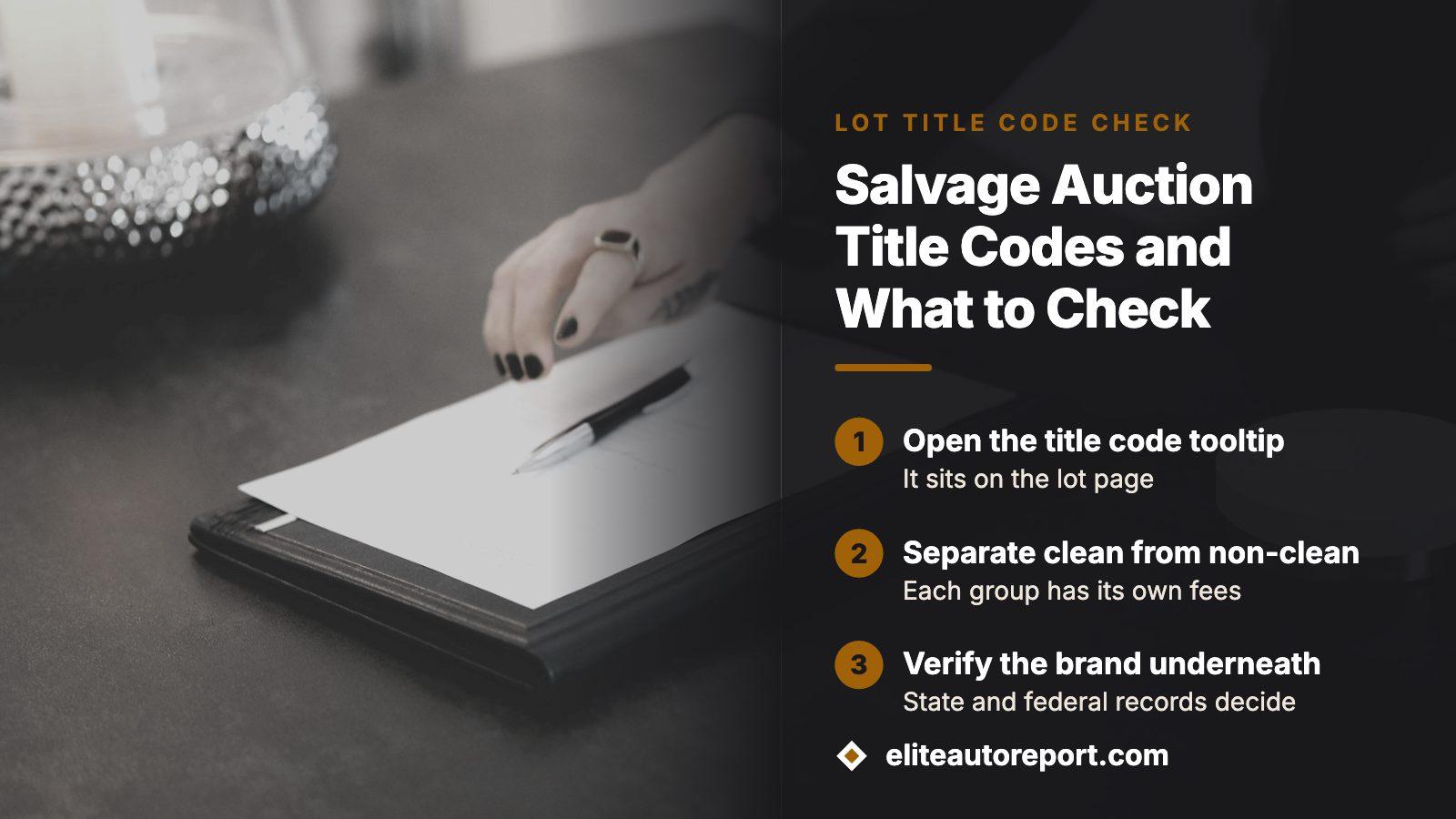
THE SHORT ANSWER
A title code at a salvage auction names the kind of ownership document the car sells with. Copart says each lot's title group, clean or non-clean, appears in a tooltip on the lot page. Treat the code as a starting label only. Auctions do not vouch for it, states define salvage differently, and a VIN lookup shows the brands and total-loss history behind it.
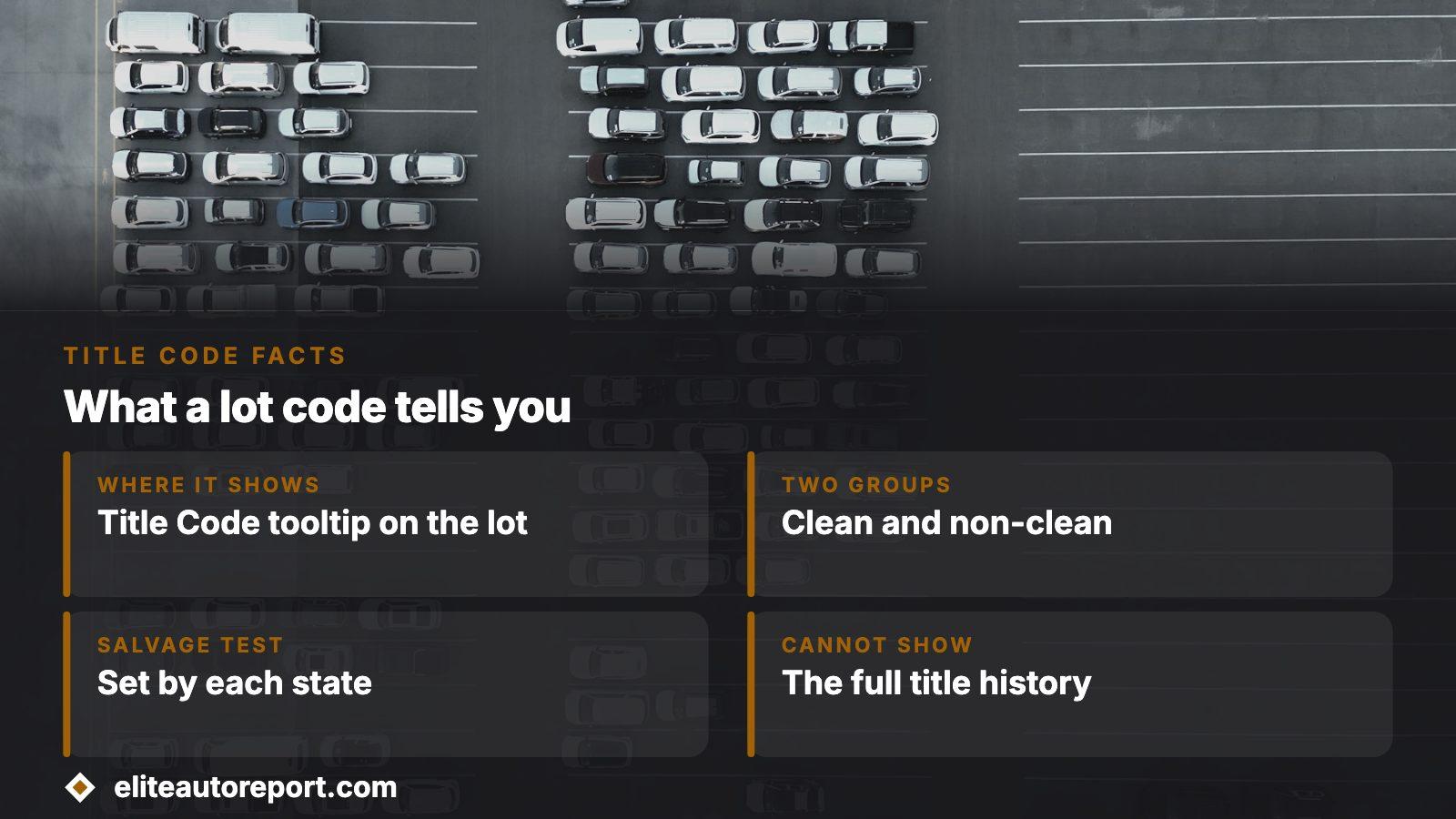
- Where it shows
- Title Code tooltip on a Copart lot page
- Two groups
- Clean and non-clean, with separate fee tables
- Salvage test
- Repair cost above pre-damage worth, set by each state
- Free first step
- VIN preview before you pay for a full report
What a title code on an auction lot actually is
Every vehicle at a salvage auction arrives with some kind of ownership paperwork, or with a promise that paperwork is on its way. The title code is the auction's short label for that paperwork. It tells you whether the car sells as a normal titled vehicle or as one a state or insurer has already marked down.
Copart does not hide where to look. Its member fee page points to a tooltip on the Lot Details page, where the title code reveals the group a lot belongs to, either clean or non-clean. Its buyer checklist adds the same field to a short list of things to read before bidding, next to the repair estimate and the odometer.
At EliteAutoReport we read these lots with luxury, exotic and classic cars in mind. For those buyers the code matters twice: once for the paperwork, and again because a rare car with a branded title behaves very differently on resale than a commuter sedan does.
Clean and non-clean: the split that drives your costs
The auction's own wording draws one main line. IAA calls a title clear when no insurer ever wrote the car off, and salvage when an insurer ruled the repair bill higher than the value of the car. Copart bakes the same split into its bidding fees, with one set of tables for clean titles and another for non-clean ones.
So the code does real work before you ever collect the car. A non-clean group can put your final bid into a different fee table, which changes what the car costs you at the invoice. Run your maximum bid through the table for that group, not the one you assumed.
Read the group, not just the word
A lot page can say clean while the car still has a salvage past. The label describes the document in hand on sale day, not every record that exists about the VIN.
The state and federal brands underneath
Auction codes sit on top of title brands that states apply and report to the federal title system. Texas publishes a useful list of the brands that make a car salvage there, and the descriptions show how many different stories end in one word.
| Brand | What it means in plain terms |
|---|---|
| Fire damage | The car was damaged by fire. |
| Owner retained | An insurer called it a total loss, but the owner kept the car. |
| Salvage, damage or not specified | Repairs crossed a state-chosen percentage of retail value, or an insurer took the car over in a settlement. |
| Salvage, other than damage or theft | A reason like an abandoned car towed and never claimed. |
| Salvage retention | Branded salvage and kept by the owner. |
| Salvage, stolen | A theft claim was paid and the state reported the car as salvage. |
Texas treats a car with any of these brands as salvage. It has to be rebuilt and pass inspection before anyone drives it on public roads, and until then the state will issue only a salvage or nonrepairable title, or let the owner dispose of it.
Why the same car can carry different labels
Salvage is an economic test, not a damage test. The federal title system's consumer pages say states do not agree: identical damage may earn a brand in one jurisdiction yet stay below the line in the next. Flood brands exist in some states and are absent in others.
Texas shows the same thing in its definition: the line is a jurisdiction-defined percentage of retail value. A supercar with a high retail price and a modest repair bill can sit on the safe side of one state's line and over another's. That is why a title code read in isolation can mislead a buyer who knows only their home state's rules.
- A car can be treated as salvage at some point yet carry no brand, because holding time in a salvage yard does not force a brand.
- If a stolen car goes unrecovered long enough for the insurer to write it off, that write-off remains even when the car later turns up unharmed.
- An auction can then sell that car in working order, with a total-loss history attached.
What a code cannot tell you
IAA's glossary says the actual cash value on a listing comes from the seller and is shown for information only, and the auction does not stand behind it. Its auction rules go further and tell buyers to confirm the title type and brand before any repair, because a state can reclassify a title after the sale.
A code also says nothing about how the car got there. Was it hit, burned, flooded, stolen, or simply abandoned? Did an insurer take it, or did the owner keep it and later sell? The code is silent on all of it, yet on a rare car those answers decide whether the repair is worth doing.
Missing paperwork is its own category
IAA keeps cars it has no saleable title for in an unassigned pool with no auction date yet. Ask what the paperwork status is, and how long the title took to arrive, before you commit.
Run the VIN check before you place a bid
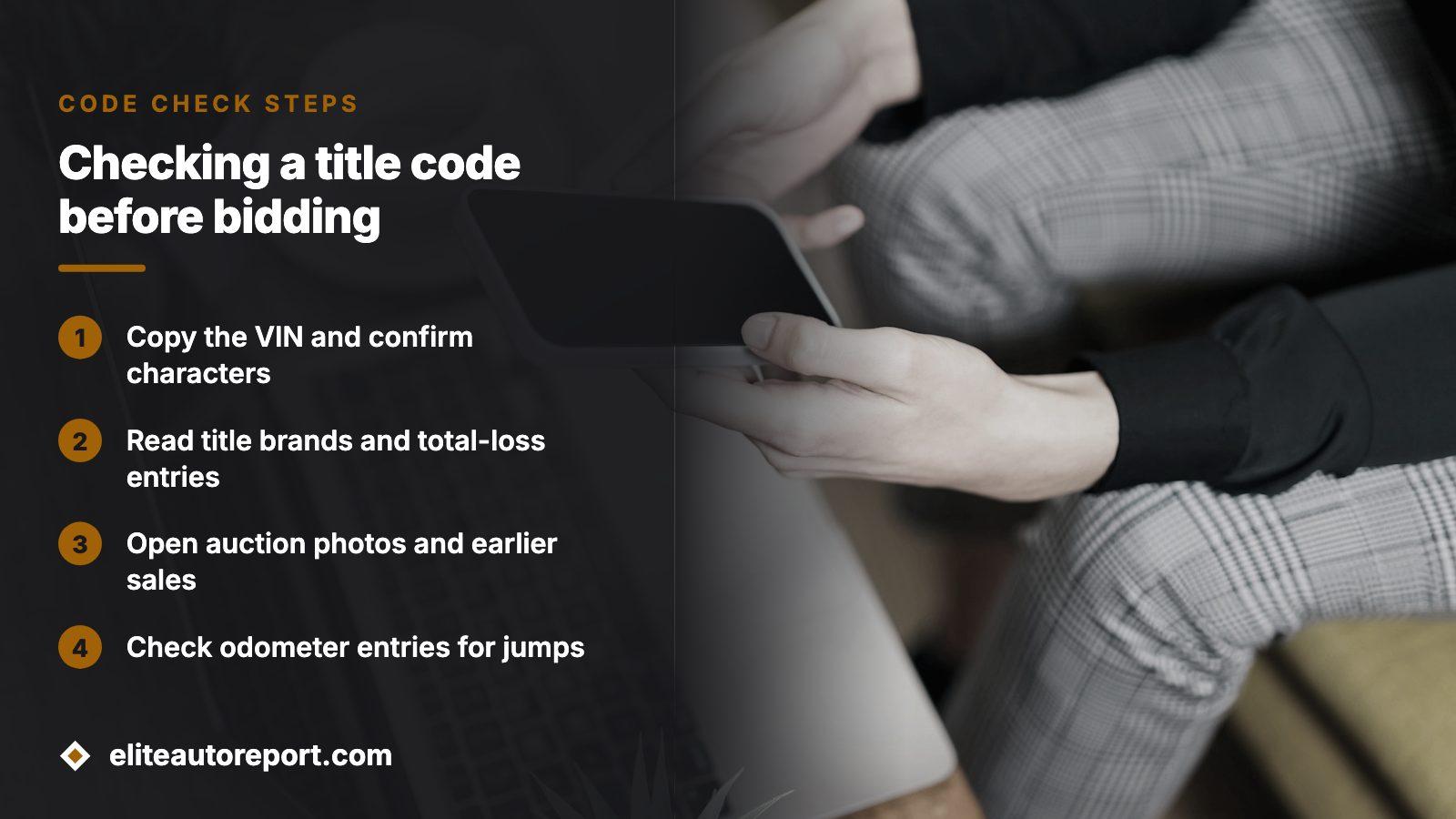
Copy the 17-character VIN from the lot page, then look for the same digits on the car itself in the photos, on the dash or door jamb if shown. Mismatches on a classic are common enough to deserve a second look. Enter the VIN into the preview, which is free, and see which records exist.
- Copy the VIN from the lot and confirm every character against a photo of the car.
- Read the title brands and any total-loss entry, then compare them with the lot's code.
- Open the auction photos and earlier sales for the same VIN, and look for a car that has been listed before.
- Check the odometer entries for jumps or rollbacks.
- Pay for the full report only if this car stays on your shortlist.
If the brands in the record are worse than the code suggested, you have saved yourself a bad bid.
Red flags when the code and the record disagree
- A clean code, yet the record holds an insurer write-off or a move into a salvage yard.
- A theft-related salvage brand with no sign that the car was recovered undamaged.
- A brand that appeared only after a move to another state.
- A car that has been through the same auction before and failed to sell, or sold and came back.
- Photos that show far more damage than the lot's damage label implies.
NHTSA has also warned about substandard replacement air bag inflators tied to crashes in cars that were mostly salvage or rebuilt. A non-clean car with a deployed air bag deserves an inspection that looks at what went back in.
Cost, and your next move
You can run the VIN preview at no charge. The full report is billed once, per report or as a pack when you are tracking several lots, and nothing renews. Check the pricing page for today's options.
Once you have the record, set it beside the lot page and keep both. If the brand will push your fee table up or your insurance quote out of reach, work that number into your maximum bid, then book a mechanic who knows the marque to inspect the car in person if you can.
Where this information comes from
- Copart: Member fees — where the title group shows and how fee tables split by it
- IAA: U.S. vehicle titles, clear and salvage — the auction's own description of clear and salvage titles
- IAA Help: Glossary of terms — value and unassigned-vehicle wording
- TxDMV: Salvage vehicles — the list of brands that count as salvage in Texas
- NMVTIS consumer information — how states differ and how records can be incomplete
Sources and photos: Facts checked against the sources above in November 2026. Photos by Annika Wischnewsky, Jakub Żerdzicki and Iain on Unsplash; diagrams by EliteAutoReport.
Keep reading
- Copart Damage Types: What a Lot's Damage Label Really Tells YouWhat the damage labels on a lot mean, the other half of reading a listing.
- Copart VIN Check: Auction Photos and History for Luxury and Classic CarsWhat a VIN search finds on a Copart lot.
- IAAI VIN Check: IAA Auction History for Luxury, Exotic and Classic CarsThe same look-up for IAA listings.
- Car Auction Photos by VIN: Find Salvage Sale Pictures Before You BuySee the lot photos tied to a VIN.
Frequently asked questions
Where do I find the title code on a Copart lot?
Open the Lot Details page and hover over the Title Code field. Copart says the title group, clean or non-clean, appears in that tooltip. The buyer checklist also lists title type among the items to read before bidding.
Does a clean code mean the car was never salvage?
No. IAA's rules say a clear-title car can still show junk or salvage in later federal system reports, and a state can reclassify the title after you buy. Check the VIN record, not just the label.
Can I drive a car right after buying it with a salvage title?
Not in general. IAA says each state sets its own steps for a rebuilt title, and Texas says a salvage car must be rebuilt and inspected before use on a road. Read your state's rules before you bid.
Why do fees change with the title code?
Copart prices its bidding fees from separate tables for clean and non-clean title groups. Find the group on the lot page and check the table for your vehicle type, because the same final bid can cost different amounts.
Is the VIN check really free?
Nothing is charged for the preview alone. Any full report is a single purchase, alone or bundled, and it will not bill you again. The pricing page shows what is available today.
Now check the car itself
The guide explains what to look for. The report shows what this VIN has on record.