THE SHORT ANSWER
Copart lots carry a damage description, and the broad kinds are the ones federal and state rules name: collision, flood, fire, hail and theft recovery. The label is a starting clue, not a verdict. Search the 17-character VIN on EliteAutoReport to see the title brand, total-loss status and any auction photos on file. The preview is free, and a report is a single payment.
- Main sellers
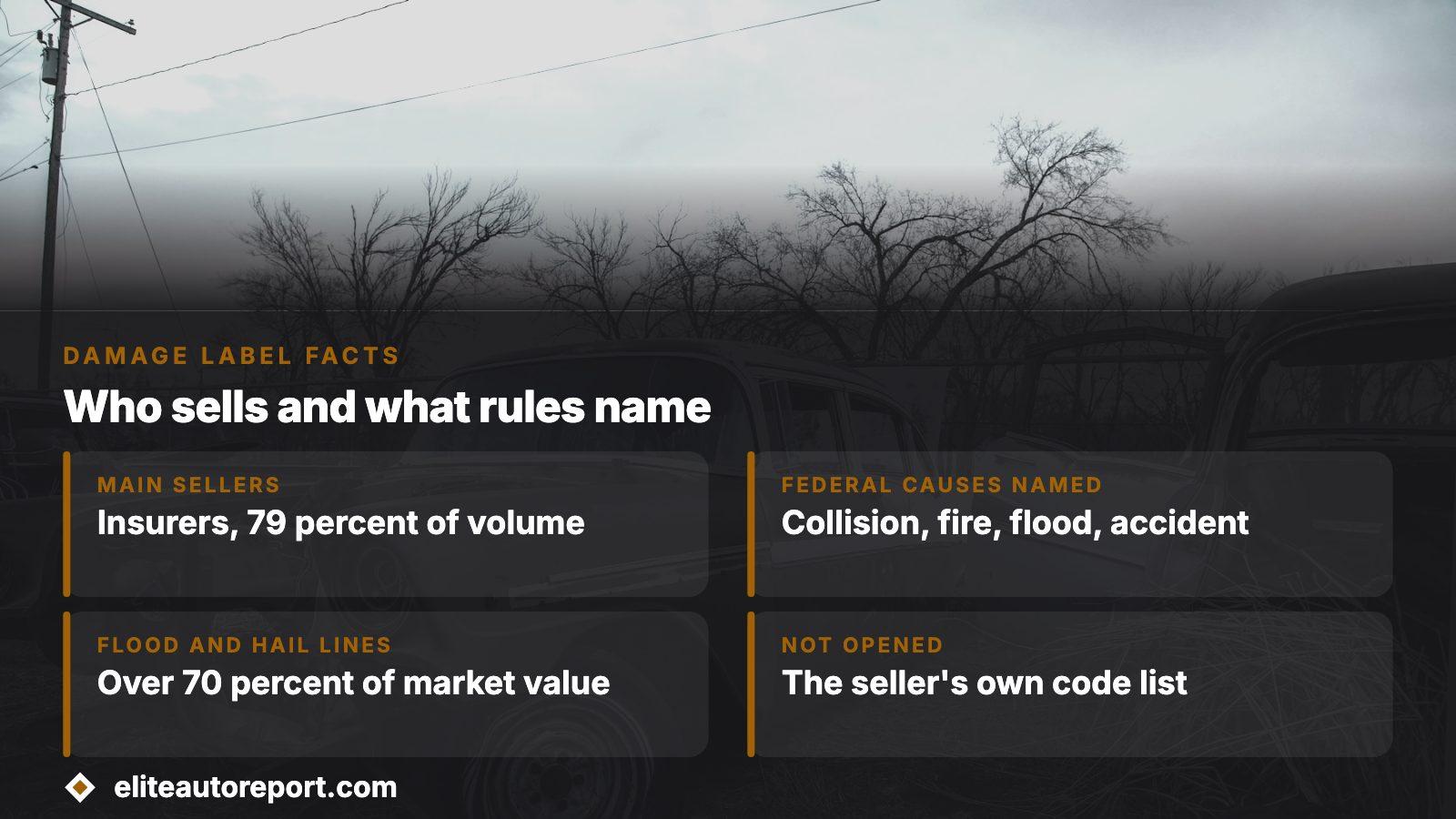
- Insurers: 79 percent of Copart's fiscal 2026 volume
- Federal causes named
- Collision, fire, flood, accident, trespass
- Wisconsin flood and hail lines
- Repair cost above 70 percent of market value
- What I could not open
- Copart's own list of damage codes
A damage label is a clue, a title brand is a record
Searching for Copart damage types usually means one thing: a car you like has a lot page, and the page names a kind of damage. That name is shorthand written for bidders. It was not written for the person who will register the car, insure it and sell it later.
Copart's own help pages refused to load for this write-up, so the exact wording of its damage list is not reproduced here. What can be sourced is the layer underneath: the federal and state definitions that decide whether a damaged car becomes a branded salvage vehicle. Those definitions are what your insurer, your DMV and your next buyer will care about.
On a Ferrari, a Bentley or a tidy air-cooled Porsche, a mild-sounding label can hide a four-figure bodywork bill or a six-figure structural repair. The label tells you where to look. The records tell you what happened.
Why most damaged cars on the block come from insurers
In its annual report to the SEC for fiscal 2026, Copart says insurers supplied 79 percent of the vehicles it processed. Most of those were total losses the insurer judged not worth repairing, or stolen cars recovered after the owner had already been paid.
That means a damage label usually sits on top of an insurance claim, and a claim leaves paper. The same filing says volume swells when severe weather hits: tornadoes, floods, hurricanes and hailstorms are named, and the company says it recovered and resold a huge number of water-damaged cars around Hurricanes Helene and Milton in 2024.
What follows from that
A car with a weather label probably belongs to a batch with other cars from the same storm. If the photos show a waterline or hail pitting, ask where else the VIN has appeared.
The kinds of damage rules actually name
Federal rules for the national title database define a salvage automobile as a car harmed by a crash, a blaze, rising water, trespass or some other event, where repairing it and its leftover scrap worth together would outrun what it was worth before the loss. That is the working vocabulary behind most labels. Here is how each kind tends to matter to a buyer.
| Kind of loss | What to look for | Why it matters |
|---|---|---|
| Collision | Impact side, airbag deployment, panel gaps | Structure may be bent even when paint is perfect |
| Flood | Waterline in photos, silt under carpet | Electronics and wiring fail months later |
| Hail | Pitting across roof, hood and trunk | Often cosmetic, but states handle the brand differently |
| Fire | Engine bay or cabin scorch | Wiring and harness damage can be hidden |
| Theft recovery | Ignition, steering column, missing parts | A total-loss label can persist on a car that is fine |
The same damage can earn different titles in different states
No single national threshold decides branding. Wisconsin's DOT, for example, gives flood damage its own brand once repair cost passes 70 percent of market value, and a submerged car under seven years old also gets a salvage brand. Hail has a separate brand there too, but only when the car can be fixed without replacing exterior sheet metal or plastic; otherwise it becomes salvage.
Texas frames salvage as repair cost exceeding the car's value before the damage, and leaves out a theft payout unless the theft itself did that much harm. Wisconsin also has a claim-paid brand for insured cars with repair costs past 30 percent.
The point is practical. Two cars with the identical lot label may carry different titles, shaped by the state that handled the loss and the state that registered the car next. Always read the brand on the record, not the label from the lot.
Checking a label against the VIN
Copy the VIN off the windshield-base plate or the driver's door pillar, and compare it with the lot listing before anything else. Then work through these steps in order.
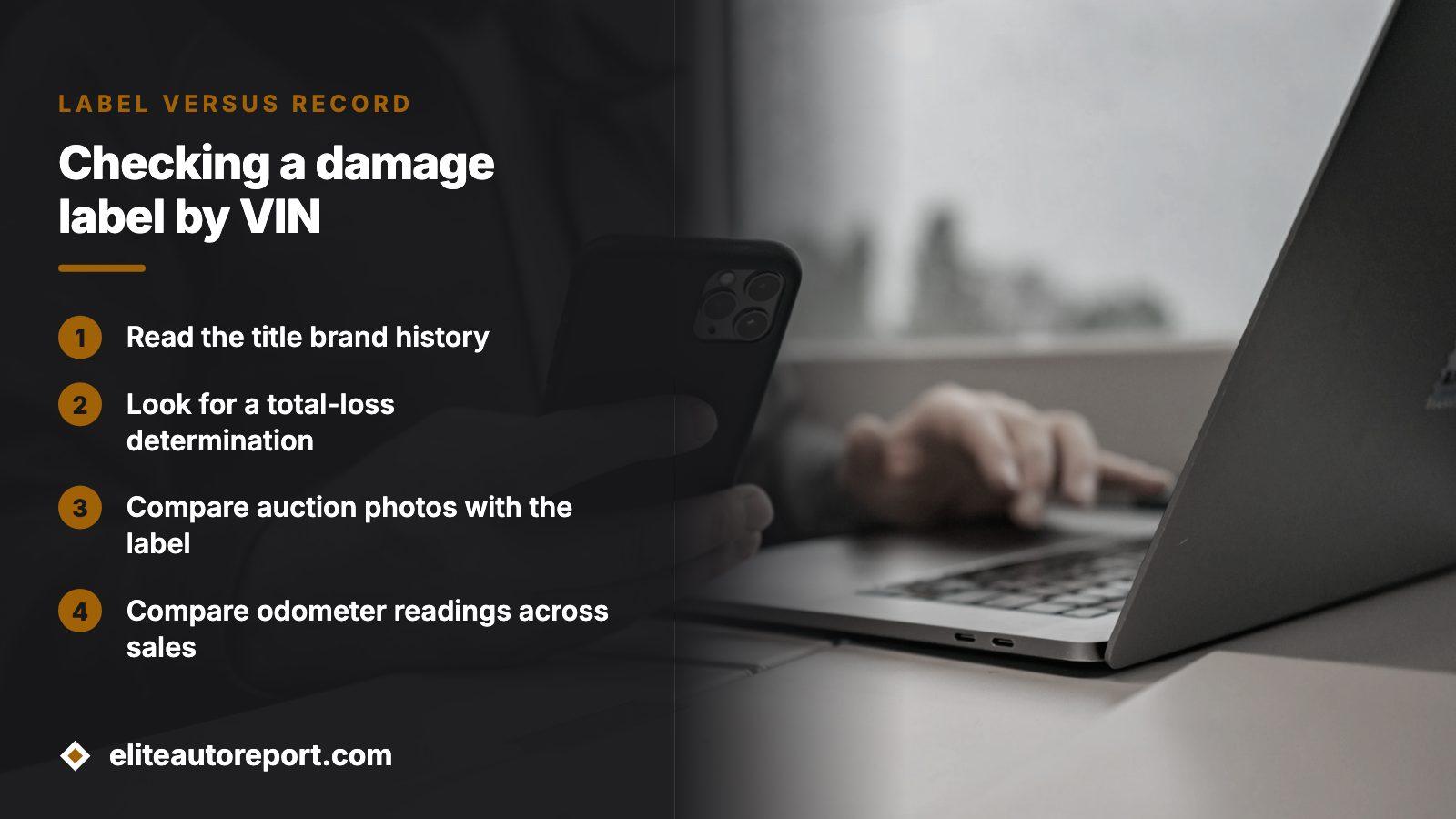
- Search the VIN and read the title brand history, including brands applied by other states.
- Look for a total-loss or salvage determination and its date.
- Open any auction photos on file and compare the damage in them with the label.
- Compare odometer readings across the sale date for jumps or rollbacks.
- Run NICB's free VINCheck as a second source, remembering it only covers insured cars.
Once a state applies a brand, the federal title system holds on to it, and the system logs hand-offs to salvage yards too. It does not hold repair history, so a clean-looking record still leaves the repair quality unproven.
Reading pre-repair photos on an exotic or classic
Copart says every vehicle is imaged at its storage site, and it has posted listing pictures online since 2001. For a high-value car those frames are the best evidence of the car before a body shop touched it, and they often outlive the listing.
Set the photographed damage beside the actual car. A rear impact in the photos should show up as fresh welds, sealer or mismatched paint thickness at the trunk floor and rear rails. If the seller says it only had a scuff, the photos can settle that in a minute.
Water leaves quieter marks
The FTC lists mildew, stains, grit or silt beneath the mats and dash, foggy light housings and a heavy cleaning-product odor as signs of flood damage. Photos from the lot plus those cues beat any seller's story.
Red flags worth walking away over
- A seller who says the damage was minor but whose VIN shows a salvage or total-loss record.
- A title issued in a different state shortly after an auction sale.
- A label that mentions water while the car has new carpet and no explanation.
- Auction photos showing structural damage on a car now advertised as accident-free.
- A history report that comes back empty on a car with obvious repair work.
A blank search does not prove the car is clean. Repairs paid privately generate no claim, and plenty of older cars never crossed an auction lane. A history search narrows the risk, and an independent shop's hands-on inspection closes the gap.
Running the check on EliteAutoReport
Type in the VIN and the free preview shows if records turn up for it. Buying the report unlocks the details that matter for a damage label: title brands, total-loss and accident records, odometer readings, and salvage auction history with photos where they are on file.
No subscription is involved. One payment buys a single report, or a bundle when you are weighing several cars; see the pricing page for what is on offer. That suits the usual exotic-car hunt, where you may look at three or four candidates before one is worth an inspection.
Do the VIN search before you pay a deposit, and again after any pre-purchase inspection turns up something the seller did not mention.
Where this information comes from
- Copart Inc.: annual report (Form 10-K), fiscal 2026 — Who supplies Copart's vehicles, weather-driven volume and vehicle imaging.
- 28 CFR 25.52: NMVTIS definitions — The federal wording for a salvage automobile and the events it names.
- NMVTIS: information for consumers — What the federal title record shows, and where states differ.
- Wisconsin DOT: title brands — Flood, hail and claim-paid brand thresholds, as one state's example.
- TxDMV: salvage and nonrepairable manual — How Texas defines a salvage vehicle and treats theft payouts.
- FTC: don't get swamped buying a flood-damaged car — Physical signs of water and the limits of the NICB database.
Sources and photos: Facts checked against the sources above in November 2026. Photos by Maxim Tolchinskiy, Anastasiia Nelen and Leo_Visions on Unsplash; diagrams by EliteAutoReport.
Keep reading
- Copart VIN Check: Auction Photos and History for Luxury and Classic CarsHow a VIN lookup finds a Copart sale and what it shows.
- Salvage Auction Title Codes: How to Read Them on a Luxury or Classic LotWhat the title codes on auction lots stand for.
- Flood Damage Car Check Before You Bid: A Step-by-Step Guide for Auction CarsA closer look at water-damaged cars sold through salvage lanes.
- Car Auction Photos by VIN: Find Salvage Sale Pictures Before You BuyFinding the pre-repair pictures tied to a VIN.
Frequently asked questions
What are the main damage types on Copart?
I could not open Copart's own list, so I will not give you its codes. The kinds that federal and state rules name are collision, flood, fire, hail and theft recovery. On any lot, treat the label as a hint and check the VIN for the actual title brand.
Does a damage label mean the car has a salvage title?
No, not on its own. Branding depends on the state and its repair-cost threshold, and a car can be sold with a label yet be titled differently later. Insurer total-loss determinations count as salvage under the federal definition, so look for that record on the VIN.
Is hail damage treated like a collision?
Not everywhere. Wisconsin gives hail its own brand when the car can be repaired without replacing exterior panels, and calls it salvage if panels must be replaced. Other states differ, so read the title brand your own state would apply.
Can a VIN check show auction photos?
Where photos are on file for a salvage auction sale, a report can show them next to the sale record. Not every car has them, and an empty result does not prove a car never sold at auction.
Should I buy a car with flood damage on its record?
Water damage tends to show up later in wiring and electronics, so most buyers should pass or pay for a thorough independent inspection first. Price the car for the risk, and confirm the brand on the title before any money moves.
Now check the car itself
The guide explains what to look for. The report shows what this VIN has on record.