THE SHORT ANSWER
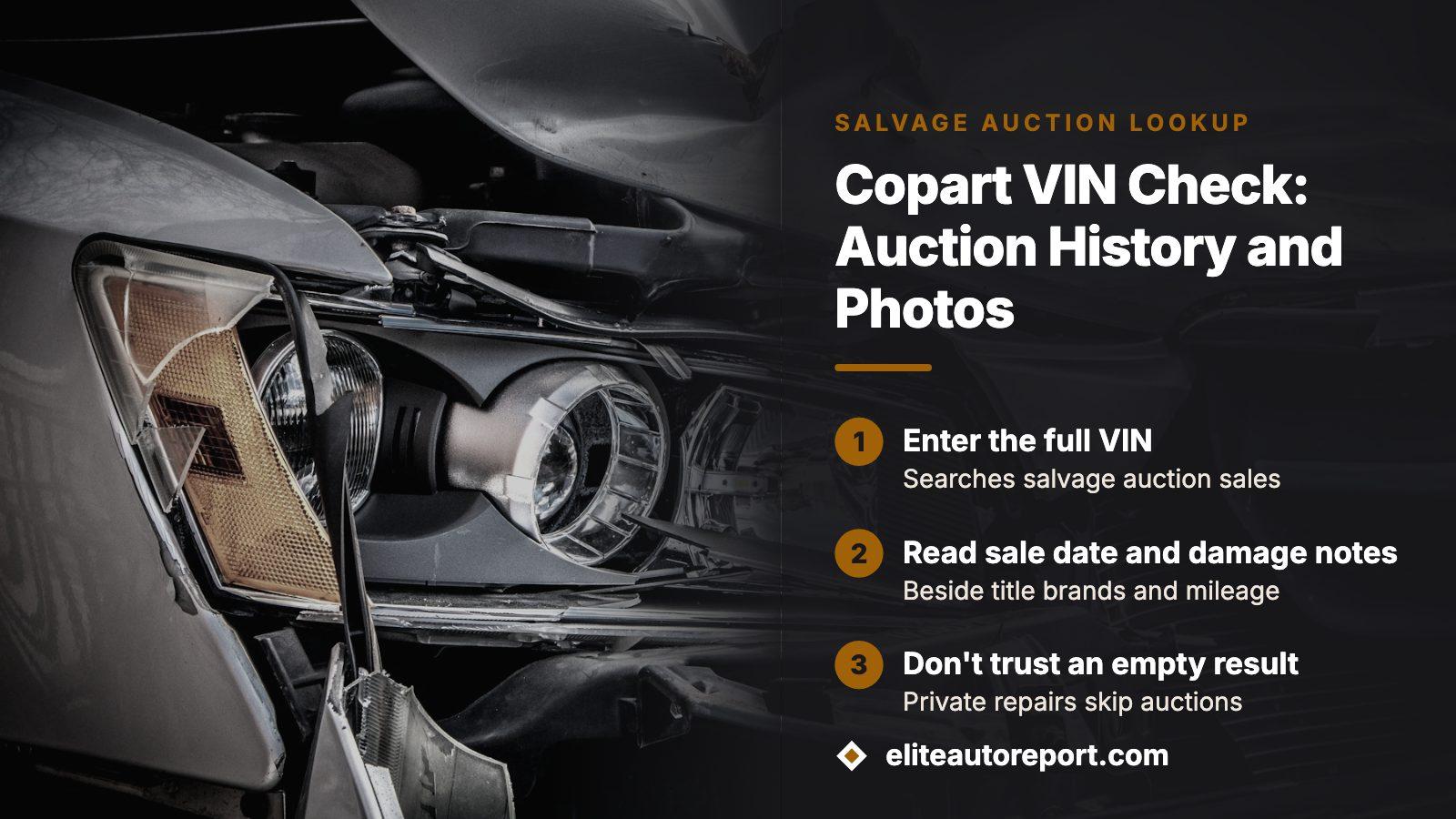
Type the car's 17-character VIN into EliteAutoReport and it searches for salvage auction sales on record. Where one is on file, you get the sale date, damage notes and pictures alongside the title brands and mileage history. You see the preview at no cost, and a full report is paid for once, with no plan to cancel. An empty result is not a clean verdict, since many repaired and older cars skip auctions.
- Search key
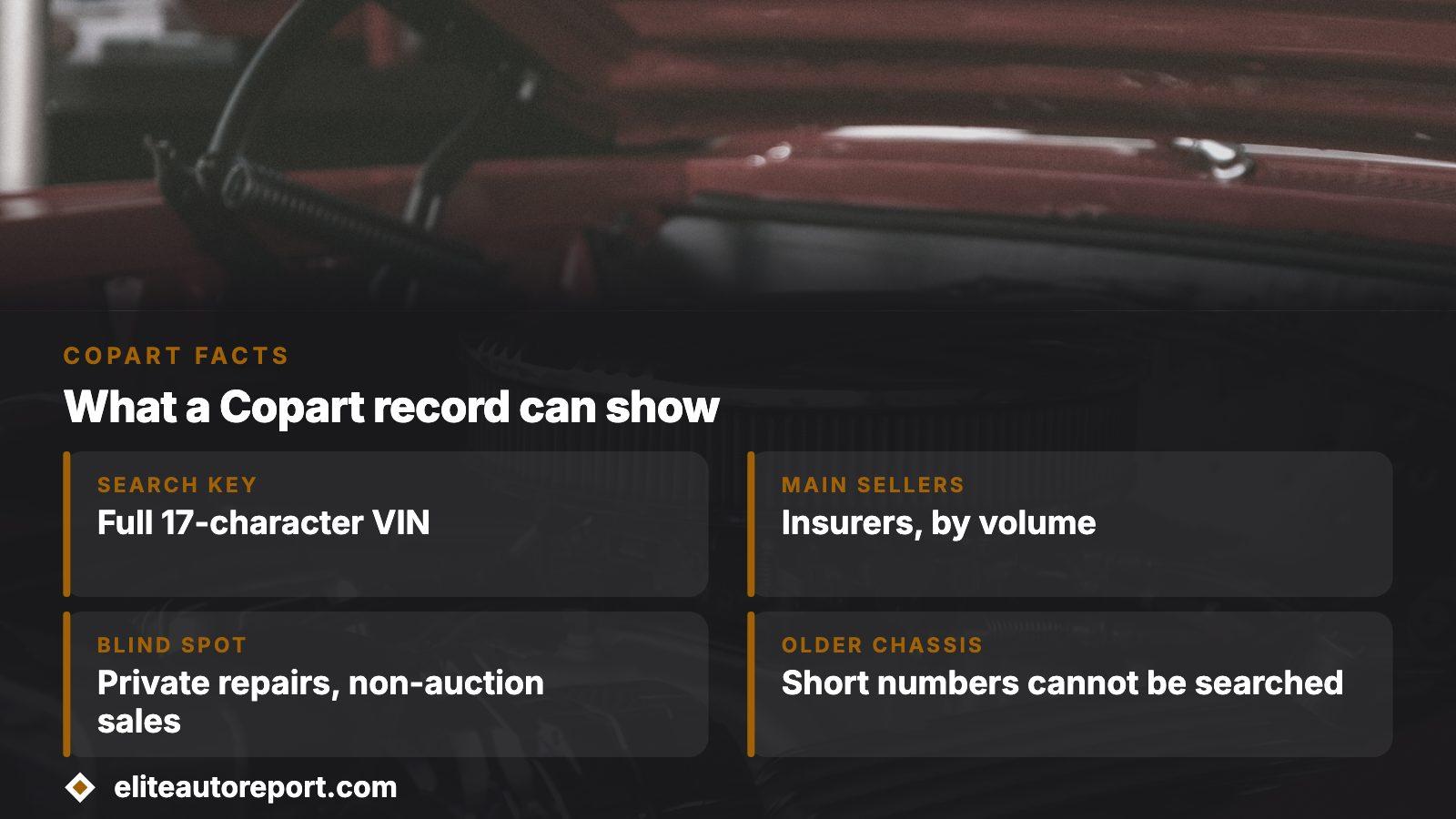
- The full 17-character VIN
- Cost
- Free preview, then a single purchase
- Main sellers
- Insurers: 79 percent of Copart's latest fiscal-year volume
- Blind spot
- Cars repaired privately or sold outside an auction
What a Copart sale on a VIN tells you about the car
Copart sells online. Bidders go through an open preliminary round, then an internet-only auction. Who sells matters more than how. In the company's latest annual report to the SEC, insurers supplied 79 percent of the vehicles it processed, mostly total losses plus stolen cars recovered after a payout.
A VIN with a Copart lot behind it therefore usually signals an insurance event, not a routine trade-in, and a seller's listing rarely mentions that. On a high-end car the event may be years old while the paint looks perfect today.
Why luxury, exotic and older cars land on salvage lots
Texas treats a car as salvage once the bill to fix it, parts and labor included, tops the car's pre-damage value. Premium parts and specialist labor push that bill up fast, so a hit a family sedan survives can total a late-model exotic. Many are rebuilt and resold.
- A late-model luxury car with a heavy front impact and a repair estimate above its value
- A theft recovery the insurer had already paid on before the car resurfaced
- An older car released by a lender or a fleet operator
Older cars add a twist. New York, for one, generally does not brand titles on cars more than eight model years old, so a classic can have a salvage past and a spotless title.
How to run a Copart VIN lookup before you view the car
- Take the VIN from the car and again from the title; the two must agree exactly. It is stamped on a dash plate and printed on a sticker along the driver's door edge.
- Enter it in the box on the home page. A typo returns someone else's car, so recheck before reading anything into the result.
- Look at the free preview. If you want the detail, buy one report; packs exist for anyone weighing several candidates.
- Save the photos and notes and hold them against the seller's ad before you set a viewing.
Do it before you travel. The record shows where to point a flashlight once you are at the car.

Reading the sale record and the pre-repair photos
A damage line is someone's summary; the photos are the evidence. Copart's annual report says each vehicle is digitally imaged during processing at its storage sites. Where a sale record carries those pictures, hold them up against the car you are actually looking at, panel by panel.
| In the photo | Ask the seller |
|---|---|
| Airbags fired and the dash pulled apart | Whether new restraint parts were fitted, and by whom |
| A waterline across leather or carpet | Whether the car sat in water; check beneath the carpets for silt |
| Wheels, seats or brakes gone but panels straight | Whether it is a theft recovery, a different repair and a different risk |
| A crushed corner with the subframe exposed | Who straightened it and on what equipment |
Line up each dated mileage reading against the dash today. A number that falls between two dates is the loudest warning in the file.
A clean title in hand and a salvage record on file
Both can be true. Each state writes its own branding rules, and a car can pass through a salvage yard without ever picking up a brand. The federal title database reaches about 87 percent of vehicles nationwide, and states contribute unevenly, with more than half reporting. A search that finds no junk or salvage history can still be wrong.
From an NHTSA owner complaint
An owner of a 2023 Tesla Model 3 told NHTSA in 2024 that the seller had shown a clean title and a new state title also came back clean. Then the owner's wife had an accident, and the maker's service center refused the car over its salvage status. Only afterward did history reports show junk-and-salvage and total-loss entries.
Take from it that a clean paper title cannot erase an insurer's total-loss record. Run the VIN before you pay.
Classics and older exotics: where the trail goes cold
Auction history exists only for cars that passed through an auction that kept records. Older cars have more ways around it.
- A repair paid for by the owner, with no insurance claim, leaves nothing behind
- A car kept after a settlement and repaired never reaches a lot
- A title from a state that skips branding older cars shows no warning
- A chassis number shorter than 17 characters cannot be searched at all
No record is not a clean record
On a recent car, a blank result is mild reassurance. On a thirty-year-old exotic it proves little, so lean on title history, seller-supplied photos and a marque specialist's inspection.
Copart VIN check free: what costs nothing and what does not
A few checks cost nothing and deserve a run first, though none returns a sale record.
| Check | What it shows | What it misses |
|---|---|---|
| NICB VINCheck (free) | Flood damage, theft with no recovery, or a salvage declaration | Cars never insured, so a clean result proves nothing |
| NHTSA recall lookup (free) | Safety recalls still open on the VIN | Accidents, auctions and title history |
| Federal title record via an approved provider (provider's fee) | Title brand, last odometer reading, insurer total loss, salvage-yard transfer | Anything outside that short list, and states that do not report |
| The free preview on this site | A first look at the car before you spend anything | The full detail, which sits in the paid report |
You pay once per report; there is no renewal to track. Rates for a single report or a pack sit on the pricing page.
Bidding yourself: registration, licenses and state limits
Copart reports roughly a million registered members and asks for government photo ID before any member buys. It sells mainly to licensed dismantlers, rebuilders and dealers. Its filing also describes a broker program under which members of the public purchase via a registered member.
Then the state steps in. In Texas an insurer may pass a salvage-titled car only to a licensed dealer, an out-of-state buyer, a casual auction buyer or a metal recycler. A casual buyer is limited to five such cars a calendar year. Rules shift, so confirm with your own DMV.
- The title the car will arrive on
- Whether your state lets an unlicensed buyer own it
- The inspection a rebuilt car needs before registration
After the result: what to ask before any money changes hands
- Match the title type and issue date on the record to the document the seller is showing you.
- Ask for every lot photo, then have a marque specialist inspect the car with the pictures in hand; a history report is no substitute.
- Price it as a rebuilt car if the record says so, and run the two free lookups from the table above.
- Download the photos today. Listings come down, and sellers go vague once the pictures are gone.
If the record and the seller's story agree, you can negotiate with some confidence. If they do not, you found out before the deposit, which is the cheapest time to find out.
Where this information comes from
- Copart Inc.: annual report (Form 10-K), fiscal 2026 — How the auction runs, who sells, what members must show and how vehicles are imaged.
- NMVTIS: information for consumers — What the federal title record shows, and where coverage and state branding rules leave gaps.
- FTC: used cars — The free NICB and NHTSA lookups, and why a history report does not replace an inspection.
- FTC: don't get swamped buying a flood-damaged car — What a salvage title means, and why the free NICB data misses cars that were never insured.
- TxDMV: salvage and nonrepairable motor vehicle manual — Texas's salvage definition, who may buy salvage-titled cars at auction and the casual-sale limit.
- NY DMV: buying a salvage vehicle — Which New York cars get a rebuilt-salvage brand and which older ones generally do not.
- NHTSA owner complaint 11616948 — owner experience, paraphrased
Sources and photos: Facts checked against the sources above in November 2026. Photos by Clark Van Der Beken, Alejandro Escamilla and Victor Hughes on Unsplash; diagrams by EliteAutoReport.
Keep reading
- IAAI VIN Check: IAA Auction History for Luxury, Exotic and Classic CarsThe same check for cars that sold through the other big salvage auction.
- Auction History by VIN: Photos for Luxury, Exotic and Classic CarsHow auction records, photos and damage notes are laid out for any car.
- Sample reportA finished report, photos included, to look over before you pay for one.
- PricingRates for one report or a pack, paid once.
Frequently asked questions
How do I check a VIN for Copart history?
Enter the full 17-character VIN on EliteAutoReport and start with the free preview. Where a salvage auction sale is on file, the report shows its date, damage notes and photos next to title brands and mileage readings.
Is there a free Copart VIN lookup?
Partly. The NICB VINCheck screen and NHTSA's recall search are both free to use, as is the preview here. None of them gives you an actual sale record with photos; that sits in the paid report, bought once.
Does a Copart sale mean the car was totaled?
Often, though not always. Most insurer-sold cars are total losses or recovered thefts. The federal title system notes that a car stolen and not found within 30 days can be declared totaled, and the status stays even if it later turns up in good condition.
Why does a clean title not guarantee a clean history?
States decide what to brand, and some skip older cars; New York generally leaves titles unbranded on cars more than eight model years old. A car can also sit in a salvage yard without picking up a brand. Check both the VIN record and the state title.
Can an ordinary buyer bid on a salvage car at Copart?
It depends on the state and the car. Members must supply photo ID, the company sells mainly to licensed trade buyers, and a broker route exists for the public. Texas caps casual buyers at five such cars a year.
Now check the car itself
The guide explains what to look for. The report shows what this VIN has on record.