THE SHORT ANSWER
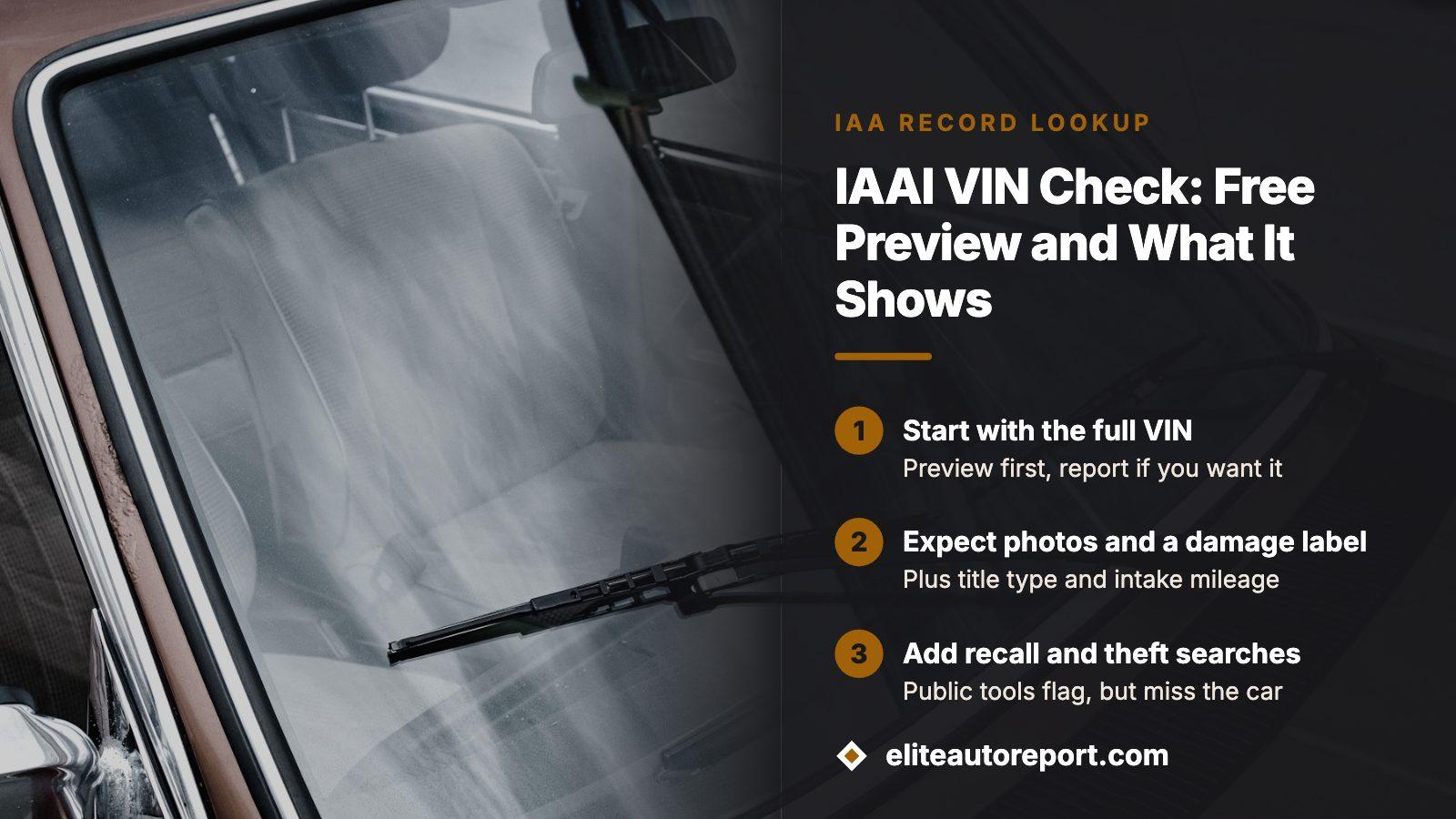
Type the full VIN into EliteAutoReport to start the free preview, then buy the report if you want the auction section next to title brands, odometer readings and open recalls. Where an IAA sale is on file, expect photos, a damage label, a title type and the mileage logged at intake. NHTSA's recall search and NICB's VINCheck add useful flags at no charge, yet neither shows the car itself.
- Search key
- The full 17-character VIN
- Best for
- Luxury, exotic and classic cars that may have crossed an IAA lane
- Cost
- Free preview, then one payment per report or pack
What a hit at IAA actually tells you
People search for "IAAI" because the company's website is iaai.com. That site says its used stock comes from donations, finance companies, government sources, dealers, rental companies and fleet dealers, and it also lists total-loss and salvage cars. A VIN that turns up there proves a consignment, not a wreck.
On a luxury, exotic or classic car, that distinction shapes the whole negotiation. IAA carries Luxury and Classics as search categories, so a high-end car is nothing unusual there. The useful question is which sort of sale yours was and what shape the car was in on arrival.
What the auction record can hold
Where an IAA sale is on file, these are the pieces a record tends to carry. How much appears depends on what was logged for that lot.
| Record item | What it usually holds | What it cannot promise |
|---|---|---|
| Photos | Yard pictures taken before any later repair | Angles nobody shot; IAA says images do not show full condition |
| Damage label | A primary damage type and a loss type, the fields IAA's filters use | The full extent; IAA says a label is not exhaustive |
| Title type | Clear or salvage when the car was listed | Today's brand, which can change after a sale |
| Start status | Run & Drive, Starts or Stationary, as assessed on arrival | How the car behaves at pickup |
| Odometer | The reading logged at intake | That the figure was true; IAA disclaims mileage discrepancies |
Treat the damage label as an index and the photos as the evidence, since a label is one clerk's summary.
The no-cost routes, and what each leaves out
Several lookups cost nothing or very little, and they are worth running first. None replaces the others.
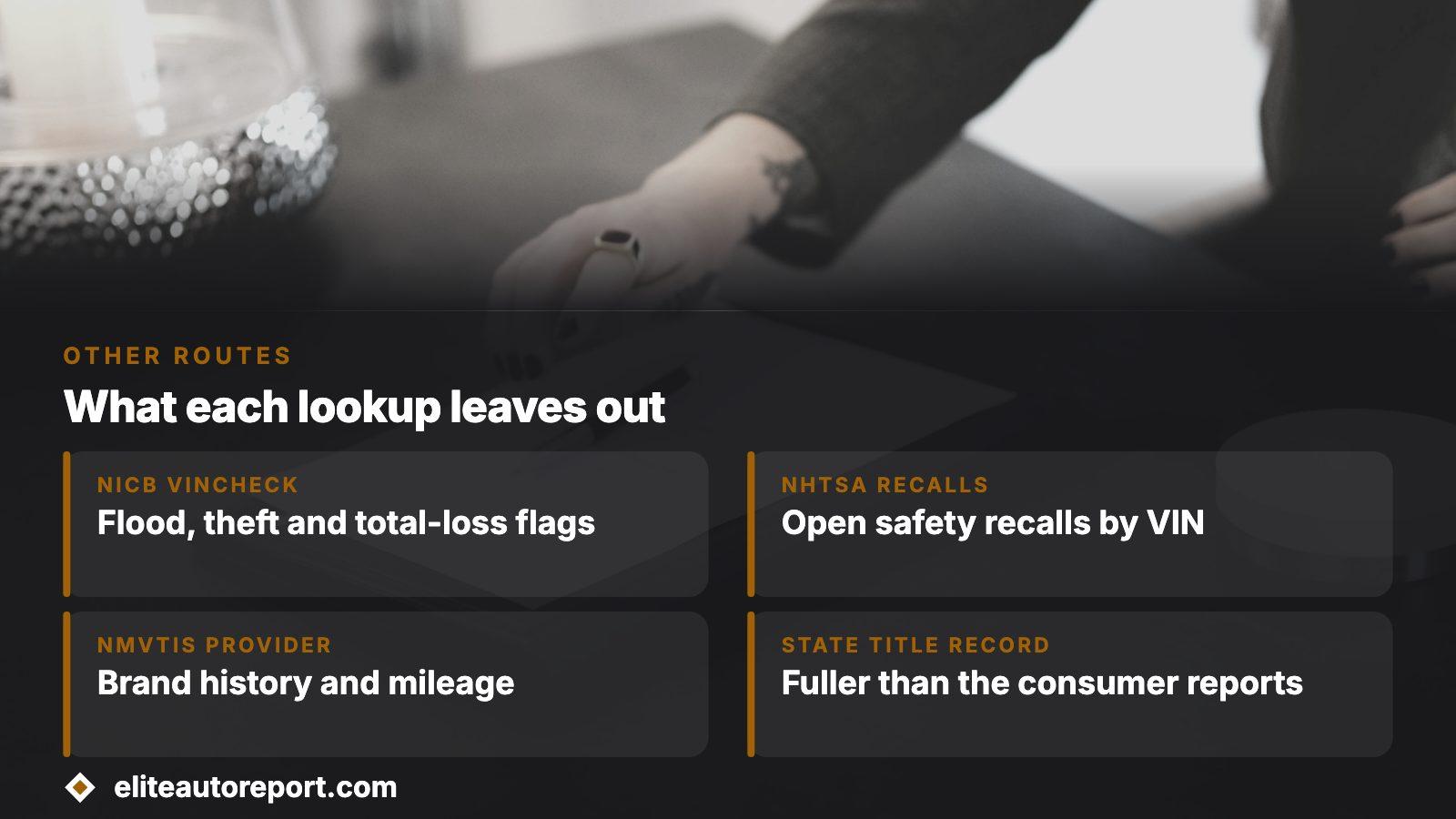
- NICB VINCheck: flags a car that was flood damaged, stolen and never recovered, or declared salvage. Expect a flag, not pictures.
- NHTSA recall search: lists open safety recalls by VIN. IAA's rules make this the buyer's job.
- IAA's own site: filters by title type, damage type, make and year. Bidding needs a registered buyer account.
- NMVTIS through an approved provider: brand history, the latest odometer reading and insurer total-loss decisions. Providers set their own fees, and the published list of contents has no photos.
- The state title record, which NMVTIS consumer reports link to.
Together these cover brands, theft and recalls cheaply. They miss the picture of the car at intake, the part a high-end buyer usually wants most.
Running the check on a specific car
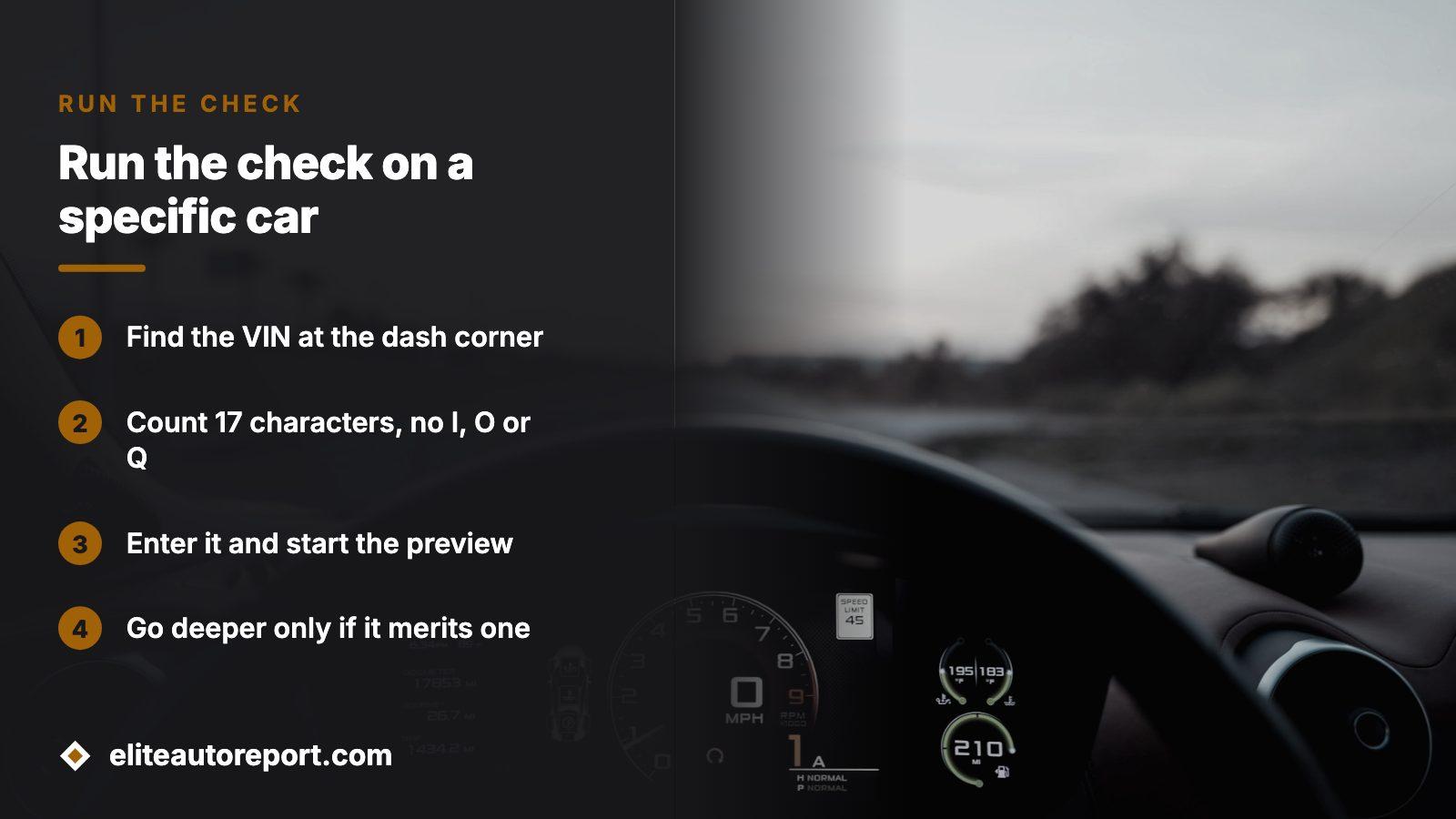
- Peer in through the windshield at the dash corner by the steering wheel and write the VIN down. Check it against the ad and the seller's paperwork, since listings carry typos.
- Count the characters. A VIN has 17, and I, O and Q never make it into one, so spotting any of them means you misread a character.
- Enter the VIN on EliteAutoReport and start the free preview.
- If the preview suggests the car merits a deeper look, buy the report and open the auction section first. Note the sale date, title type, damage label and intake mileage.
- Set those against the seller's story and today's odometer, and ask about any entry nobody mentioned.
Reading the record on a luxury or exotic car
Read the title type first and the photos second. A clear title with light damage tells one story, a salvage title with crushed front-end photos tells another, and each calls for a different offer.
IAA's own definitions keep the listing honest. Run & Drive only records that on arrival the engine started and idled, forward and reverse engaged, and the wheel turned. An airbag marked intact means only that the bags looked unfired then. IAA does not test them, and it warns that some cars carry spent bags that were never replaced.
Hidden damage matters most on complicated cars. IAA names electrical, suspension, frame and water damage among the places it can sit, so ask which shop did the repairs, then pay a specialist for that make to look. The FTC adds that no report takes the place of an outside inspection.
What IAA says about its own listing data
The Auction Rules are blunt. IAA takes no duty to confirm that vehicle information is accurate and tells bidders not to rely on it, whether the item is the VIN, mileage, title, damage type or images. It says it is not responsible for odometer discrepancies and suggests getting a history report from another source before bidding.
After a win, buyers must confirm the title type and brand before repairs. A clear-title car can still carry a salvage history, and the rules point to NMVTIS, where such a car can show a junk or salvage entry. The federal page adds that a brand, once a state applies it, stays in the record.
Red flags that justify walking away
- An IAA sale the seller never mentioned, especially one with a damage label.
- A logged mileage above what the odometer reads today.
- Photos of crushed structure or spent airbags on a car sold as having had paint work only.
- A clear title in the ad but a junk or salvage entry in a federal-database record.
- A price far under comparable cars, with nothing on the record to explain it.
From an NHTSA owner complaint
One owner's complaint concerns a 2025 Toyota Camry sold through IAA that showed 6,000 miles at purchase. A scan run to clear a warning light then read 54,000, and the owner says the dealer, told while the car was still at the lot, gave no help.
That is one owner's account, not a finding. It still shows why intake mileage deserves a second source: a scan, the state title record and the report should all agree.
Classics and older exotics: when the number is the problem
IAA lists Classics as a vehicle type, so a collector car can turn up in its search. A car sold privately leaves no auction trail, so a blank result proves little.
The number itself can also fail you. The federal year-code table starts at 1980, so an older car falls outside it and may not carry a modern 17-character number. One mistyped character sends a lookup to nothing or to the wrong car. Match every character to the stamping or plate on the car, photograph it, and only then run the search.
Cost and what to do next
Start with the free preview on EliteAutoReport. If the car earns a closer look, the report is a single payment. Anyone lining up several candidates can buy 3, 5 or 10 reports at once. No subscription sits behind either option, and the pricing page carries the amounts.
- Ask the seller for the IAA photos and the repair invoices.
- Have a specialist for the make inspect the car and put the VIN on the written findings.
- Read the state title record before you pay.
Where this information comes from
- IAA: used vehicles — where its stock comes from, the Luxury and Classics categories and registered-buyer bidding
- IAA: auction rules — what IAA says about the accuracy of listing data, start codes, airbags, odometers and title brands
- NMVTIS: information for consumers — what the federal title database holds and its limits, including total-loss labels
- FTC: buying a used car — what NICB's VINCheck and NHTSA's recall lookup show, and why a report is not an inspection
- 49 CFR part 580: odometer disclosure requirements — what an auction company must keep about each vehicle it sells
- 49 CFR part 565: vehicle identification number requirements — how a VIN is built, which letters it never uses and where the year-code table starts
- NHTSA owner complaint 11731152 — owner experience, paraphrased
Sources and photos: Facts checked against the sources above in November 2026. Photos by Max Tokarev, Dennis Eusebio and Annika Wischnewsky on Unsplash; diagrams by EliteAutoReport.
Keep reading
- Copart VIN Check: Auction Photos and History for Luxury and Classic CarsThe same lookup for the other large salvage auction.
- Auction History by VIN: Photos for Luxury, Exotic and Classic CarsHow an auction history search by VIN works and what its photos can show.
- Sample reportA finished report to look over before you buy one.
- PricingWhat one report or a larger pack costs, paid once.
Frequently asked questions
Is there a free IAAI VIN check?
Parts of one. Recall lookups from NHTSA and VINCheck from NICB carry no fee, and EliteAutoReport begins with a free preview. Each no-cost tool answers one question, such as theft, salvage status or open recalls, so the auction photos and the mileage log still call for a report.
Does an IAA record mean the car was wrecked?
No. IAA lists much of its used stock as clear-title cars with light damage, supplied by rental fleets, finance companies and dealers. Read the title type, damage label and photos instead of assuming. NMVTIS also notes that a total-loss label can stay on a stolen car recovered in good condition.
What does Run & Drive mean on an IAA listing?
It is a snapshot from the day the car reached the yard: the engine started and idled, forward and reverse engaged, and the steering turned a full rotation each way. IAA says this promises nothing about pickup day or roadworthiness. Starts is weaker, and Stationary means the car would not start, had engine damage or went untested.
Why can the IAA mileage differ from the dash?
The auction logs the reading on the day it takes possession, and federal rules make it keep that record for five years after the sale. A figure higher than the dash shows now is worth chasing through the state title record. A lower one may mean the car has been driven since.
Is a VIN check enough before buying a luxury car from auction?
No. IAA's rules leave the inspecting to the buyer, and the FTC says a report cannot stand in for an outside inspection. Use the check to decide whether the car is worth inspecting, then pay a specialist for that make, ask for written findings with the VIN, and use any gaps when you talk price.
Now check the car itself
The guide explains what to look for. The report shows what this VIN has on record.