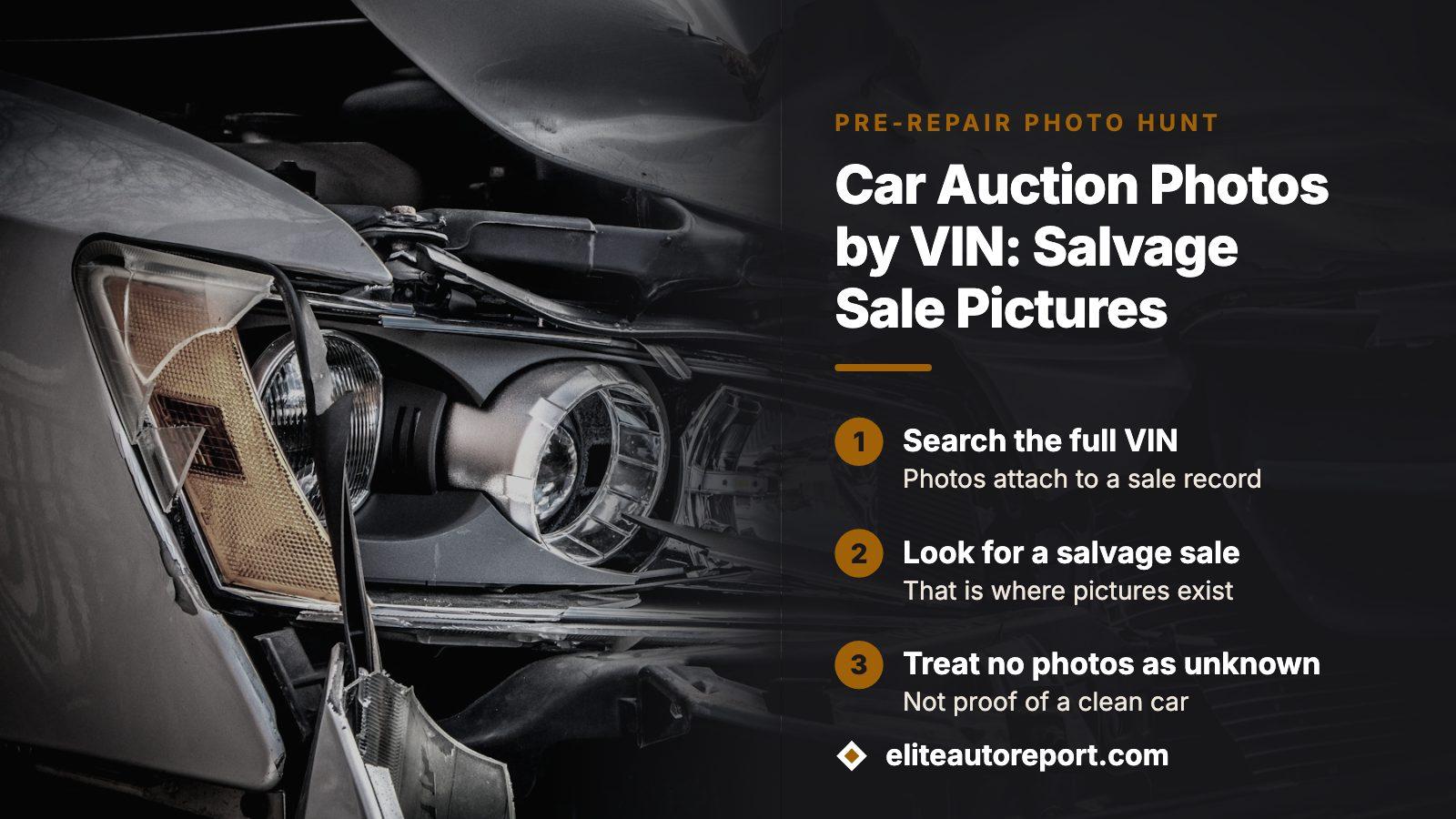
THE SHORT ANSWER
Auction photos are not stored in government title records, so a free title lookup will not return them. A history report that carries auction data can attach pictures to a sale when they exist. Start with the free preview on EliteAutoReport, which tells you whether a sale is on file, then decide on the one-time report. No sale found means no photos, not a clean bill of health.
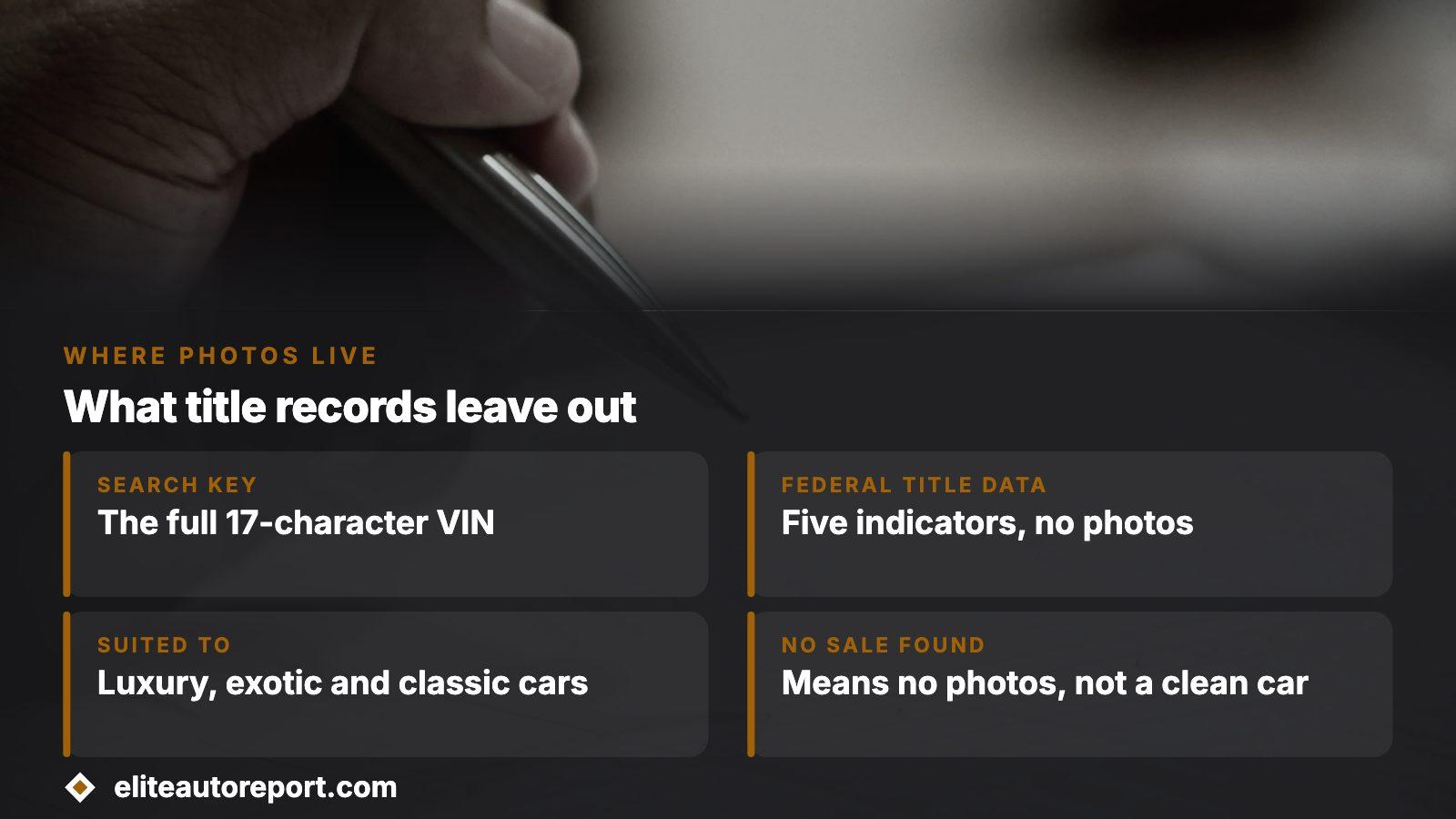
- Search key
- The full 17-character VIN
- Federal title data
- Five indicators, none of them photos
- Best for
- Luxury, exotic and classic cars with a repair story
- Cost
- Free preview, then a single report payment
Why pictures from before the repair matter
A listing photo shows a car on its best day: washed, lit and usually repaired. The sale photo shows the day it was worth less than its repair bill. For a Bentley or an old Ferrari, that gap can be the whole story, because one rebuilt quarter panel can sit under a flawless respray.
Words in a title record tell you that damage happened. Pictures tell you where. A crushed corner, a waterline on the door cards or a burned engine bay each point to a different inspection, and a buyer who knows which one can ask a mechanic to look at the right place first.
What the government title records do and do not contain
The Justice Department's national title system keeps its consumer report to five items. Two concern the title itself (where it was issued, and when), one is the odometer, and two are damage flags: a total loss and a salvage past. Brand labels sit alongside. DOJ calls the result deliberately short, and pictures are not in it.
That matters when you search. A title lookup can say a car carries a salvage or junk brand, and it can show a total loss, but it cannot show what the car looked like. Auction photos come from the sale side, which is why they appear in history reports that pull auction data in addition to title data.
What this means in practice
If a site promises sale photos from nothing but a state title lookup, treat the promise with suspicion. Titles record status. Pictures live with whoever ran the sale.
How a salvage sale leaves a trail you can follow
Federal rules oblige titling agencies, insurers and a long list of salvage handlers to send data to the title system. The handlers include recyclers, salvage pools and auctions that move total-loss cars. This duty is why a wrecked car's past is hard to scrub clean.
The net has holes. A yard that sees only a handful of wrecks, fewer than 5 in a year, does not have to file, and certain recyclers cannot link a car to its VIN in the first place. An empty record therefore shrinks the chance of a hidden wreck without removing it. Use any report, ours included, as one input beside a hands-on inspection.
How to run the lookup, step by step
Trust the metal over the advert. Copy the number from the car, where two spots on the driver's side carry it, and confirm it agrees with the title or registration before you type anything into a search box.
- Copy all 17 characters from the car or the title, checking letters against digits.
- Enter them in the preview box on this site and read what the free summary says about auction sales.
- If a sale is on file, buy the single report to open the sale details and any photos attached to them.
- Save the pictures and compare them with the car in person, panel by panel.
If the number on the metal differs from the number in the listing, stop there, whatever the seller says.

Reading salvage auction photos like a buyer, not a browser
Look at the damage zone first, then at what surrounds it. Impact damage usually travels: a front hit often shows in the hood latch area, the headlamp mounts and the wheel arch. Water damage hides in different places, so look for silt lines, wet carpets and fogged lamps.
- Compare panel gaps and paint sheen in the photo with the car today; a freshly aligned gap that was crooked in the sale picture is evidence of structural repair.
- Look for open airbag covers or dangling restraint parts, which mean replacement work you should ask to see receipts for.
- Note the odometer if a dash shot shows it, and match it to the mileage history.
- Check whether the wheels, badges and trim in the photo are the ones on the car now.
California's DMV gives a similar field checklist for a car hiding its past. It points to heavy repair work inside the fenders, dirt or corrosion beneath the trunk mat, a VIN plate fixed by anything but rivets, an airbag warning lamp that never goes out, and door or hood labels that have gone missing.
Why luxury, exotic and classic cars need extra care
On a high-value car the temptation to repair rather than scrap is strong, so more of these cars come back to the road. California's DMV says plenty of revived salvage cars are repaired well. It also warns that others were never properly fixed or road-tested, and that a few were put back together from stolen parts.
Classics add a wrinkle. A car kept in a private garage for decades may never have gone near an auction, and a repair made at a body shop leaves nothing in any database. For those cars the report narrows the question rather than settling it, and the pre-purchase inspection does the rest.
When no photos come back
Several things produce an empty result. Perhaps the car never crossed an auction block. Perhaps the sale is old and nobody kept the pictures. A private channel that reports nothing is another possibility, and so is a single wrong character in the VIN.
| Result | Likely meaning | Next step |
|---|---|---|
| Sale found, photos attached | Car sold through a recorded auction | Compare pictures with the car in person |
| Sale found, no photos | Sale on record, pictures not on file | Ask the seller for repair invoices and inspect the car |
| No sale found | No recorded auction, or an unreported sale | Check title brands and book an inspection |
| VIN not recognized | Typo, or very old or foreign-market car | Recheck the number on the car itself |
Whichever row you land on, DOJ still wants a separate mechanic's inspection paired with the title report prior to buying.
Paying for the report, then using the pictures
The summary screen costs nothing. Unlocking the whole report is a one-off purchase; bundles exist for shoppers with a shortlist, and no plan rolls over month to month. The pricing page holds the amounts.
With pictures in hand, give them to your mechanic, have the seller account for each repaired area, and leave if the story contradicts what the photos show. A rebuilt car can be fair value at the right price; an undisclosed one is a different matter.
Where this information comes from
- NMVTIS: Understanding an NMVTIS vehicle history report — the five title indicators and the inspection advice
- NMVTIS: Who reports to NMVTIS — which businesses report salvage data, and the small-yard exemption
- NMVTIS: Consumers — why a national brand record resists title washing
- California DMV: Branded titles — physical clues of undisclosed salvage history
Sources and photos: Facts checked against the sources above in November 2026. Photos by Clark Van Der Beken, Michal Biernat and Masjid MABA on Unsplash; diagrams by EliteAutoReport.
Keep reading
- Auction History by VIN: Photos for Luxury, Exotic and Classic CarsThe wider check on a car's auction sales and what each field means.
- Salvage Exotic Cars: How to Check One by VIN Before You Bid or BuyHow rebuilt exotics behave once they are back on the road.
- Salvage Auction Title Codes: How to Read Them on a Luxury or Classic LotDecode the title labels that sit beside the pictures.
- Sample reportSee the layout of a finished report before paying.
Frequently asked questions
Can I see car auction photos by VIN for free?
The preview on this site is free and tells you whether an auction sale is on file for the VIN. Opening the sale details and attached pictures needs the paid report. Government title lookups are free or cheap, but they do not carry pictures, so they cannot answer this question.
Why are there no salvage auction photos for my car?
Either the car never went through a recorded auction, the sale is too old to have pictures on file, or the VIN was entered wrongly. A blank result is not proof of a clean history, so pair it with title brand checks and an inspection.
Do auction photos show the car after repair?
No. They show the vehicle as it was when offered for sale, usually damaged and unrepaired. That is their value: you can compare them with today's car and see which areas were fixed, and how thoroughly.
Can a seller delete the auction photos?
Sellers cannot edit the sale record behind a VIN. A private seller can hide pictures from you, which is why you should look them up yourself rather than ask for them, and treat a refusal to discuss repairs as a warning.
Is a car with auction photos always a bad buy?
No. Many rebuilt cars are sound and priced to match. The pictures give you a repair checklist for your mechanic. Walk away if the seller cannot explain the damage or the receipts, or if the car's condition contradicts the photos.
Now check the car itself
The guide explains what to look for. The report shows what this VIN has on record.