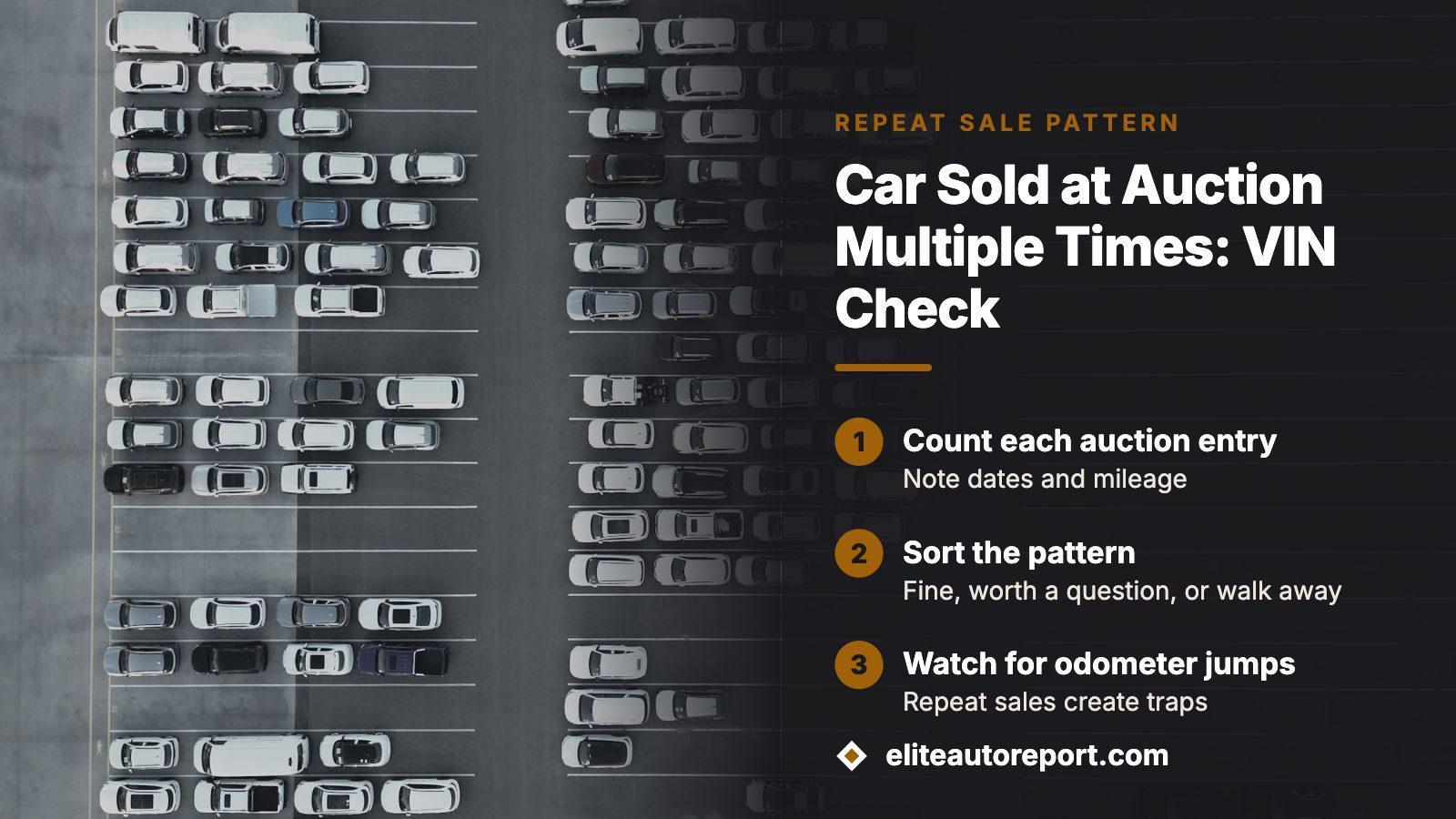
THE SHORT ANSWER
Start the free preview at EliteAutoReport with the car's 17-character VIN. If records exist, the paid report lays every auction entry beside the title brands and odometer readings. Count the entries and compare dates, mileage and photos between them. Two sales a year apart with the same mileage and clean photos is ordinary. Three or more in a short span, or mileage that moves backward, deserves a hard stop and a mechanic.
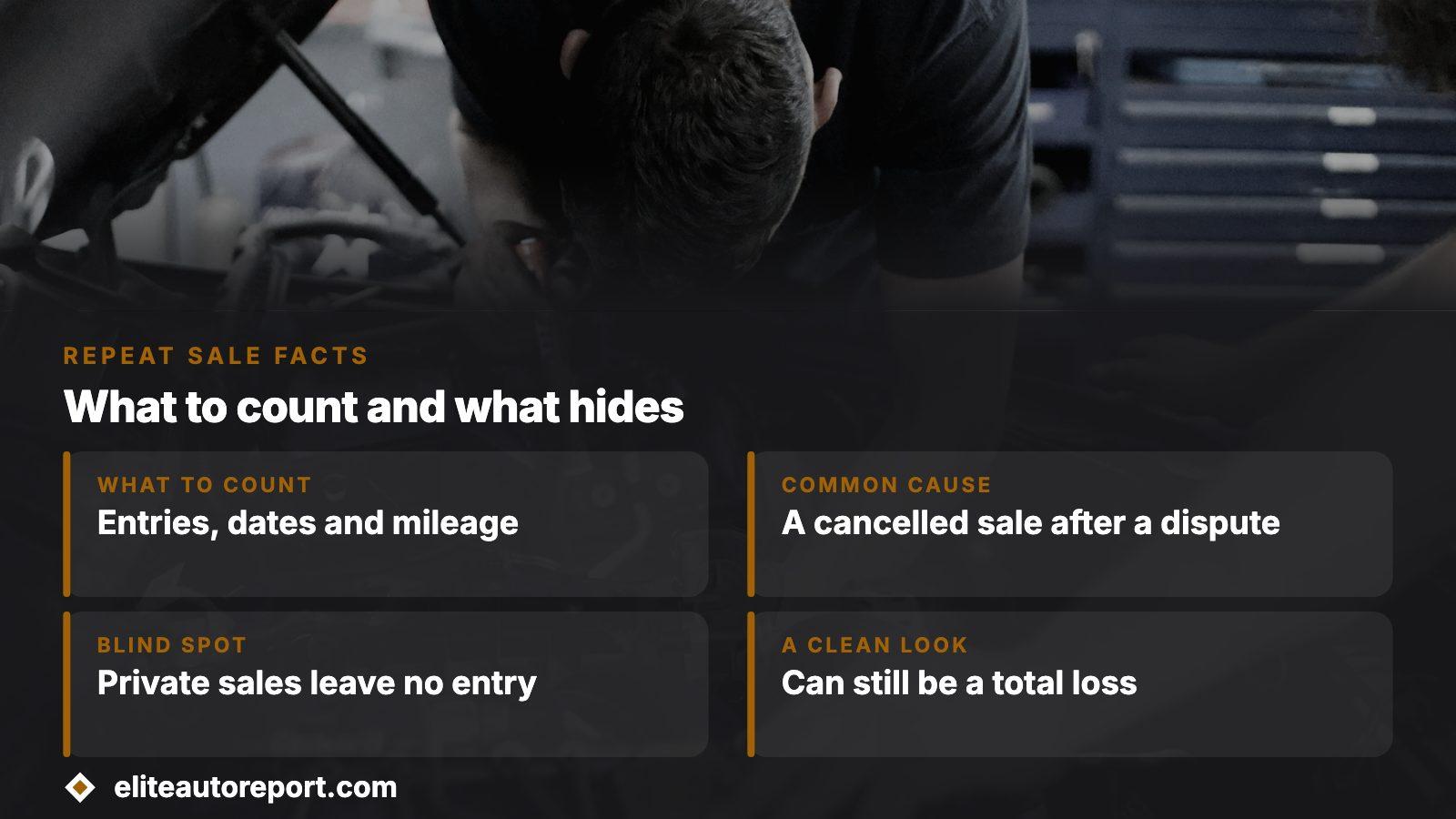
- What to count
- Auction entries, dates and the mileage at each
- Common cause
- A sale cancelled after a buyer's dispute
- Blind spot
- A private or handshake sale leaves no auction entry
Why the same car keeps coming back to the lane
Some repeat sales are harmless. A dealer buys a car, decides it does not fit the lot, and sends it back through. An exotic that fails to reach its reserve gets re-entered at a later sale. A lease return changes hands from one wholesaler to the next on its way to a retail buyer.
Others are warnings. Manheim's arbitration page names two outcomes for a buyer claim that holds up: money off the price, or the whole sale undone. When a sale is undone, the car goes back to the seller and can be offered again, which means the second listing may hide a dispute about the first. The page does not say what the dispute was, so the record alone never tells you.
What a VIN check shows about repeat sales
Each time a car crosses a block and the sale is recorded against its VIN, the history can pick up a new entry: a date, a photo set, sometimes a damage note. Lining the entries up is the whole exercise. You want to see how many there are, how far apart, and whether the story stays consistent from one to the next.
- The number of auction entries and the gap between each one
- Odometer readings attached to each entry and to title transfers
- Title brands, and the date each one was applied
- Photos from each sale, so you can compare panels, wheels and interior wear
- Theft and total-loss records that explain a sudden trip to a salvage sale
EliteAutoReport leans on this auction angle because the cars it serves, luxury, exotic and classic, often pass through only a handful of sales in their lives. Three entries on a car like that is a pattern, not noise.

Running the VIN before you bid
- Pull the VIN off the listing and compare it with the dashboard plate and the door-jamb sticker. If they disagree, stop there.
- Enter it at EliteAutoReport and read the free preview, which tells you whether records exist.
- Buy the report if you plan to bid. The cost sits on the pricing page, and it has no subscription behind it.
- Write the auction entries in date order with mileage beside each, then read the title and brand section against that list.
- Open the photo sets one after another and look for the same damage, repaired or not.
Do this before the auction opens, not after you win. Most dispute windows are short, and a fix after the hammer falls costs more than a decision made at the keyboard.
Reading the pattern: fine, worth a question, walk away
| What you see | Likely reading | What to do |
|---|---|---|
| Two entries, months apart, same mileage, clean photos | Dealer-to-dealer resale or a missed reserve | Normal; inspect as usual |
| Entries close together, same seller each time | Possible cancelled sale or repeated failure to move | Ask the seller directly why |
| A salvage or total-loss entry between two retail sales | Damage or theft recovery in the middle | Get the full state title record and an independent inspection |
| Mileage lower at a later entry than an earlier one | Odometer problem or data entry error | Do not buy until the discrepancy is explained in writing |
| Photos show different wheels, trim or paint between sales | Repairs, swaps or a mixed-up VIN | Re-check the VIN, then book a marque specialist |
The odometer and brand traps repeat sales create
Federal odometer rules require the seller to disclose mileage on the title or reassignment document at each transfer, and the seller signs it. Dealers keep copies of the statements they issue and receive for five years. A car that has moved through several hands should therefore have a clean chain of mileage statements, and gaps in that chain are worth asking about.
Brands behave differently. The Department of Justice's NMVTIS page says the system keeps each brand ever reported, so a trip across a state line does not launder it. Still, states differ: a flood car branded in one may carry no flood designation in another, so a car can look clean in the title state it ended up in. A repeat-sale car with a gap in its brand history is exactly where to ask for the original state's record.
A total-loss car can look perfect
The same NMVTIS page describes a case that confuses buyers. Picture a theft where the car stays missing for 30 days, long enough for the insurer to book it as a total loss. If it surfaces later without a scratch, that classification stays on record, and whoever holds it, an insurer or an auction pool, can still offer it for sale as the sound car it is.
What that means for a relisted exotic
A salvage-type entry does not always mean wreck damage. Look at the photos from that sale. If the car is clean in them, a theft recovery is a plausible explanation, but ask for the insurer's paperwork and a full inspection before you accept it.
What the record cannot tell you
A VIN report is a set of reported events. The NMVTIS consumer page describes its own report as intentionally concise, and warns that a clean-looking answer may be wrong because reporting is incomplete and some states never brand. It also carries only a slice of what the state's own title file contains.
- Private sales and dealer swaps leave no auction entry, so a car can have more owners than the record shows
- The reason for a cancelled sale is not shown in an arbitration outcome
- Repairs done at an independent shop usually appear nowhere
- A clean report does not replace a pre-purchase inspection by someone who knows the marque
If you already bought it and the history looks wrong
Manheim asks a claimant to send paperwork, the car or the title quickly, with an outer limit of 5 calendar days from the specialist's request, or the case can be closed. Its digital transaction window runs 10 calendar days. Those figures belong to Manheim and apply only to its marketplace, so read the terms of whatever auction you used.
Act on day one: pull the history, photograph every flaw, and file in writing. Photos or video can sometimes replace trucking the car back, but certain cases require a physical inspection. Red-light and as-is sales narrow what can be disputed, usually to odometer and title announcements.
Pricing, then the entries
Anyone can read the preview without paying. The report itself is paid once. Current figures for a lone report or a pack are listed on the pricing page; buy a pack if you are weighing a few cars from one sale. Nothing renews later.
When the preview turns up records, buy the report and go through the entries by date. A blank preview still tells you something: either the car never crossed a block, or the sale left no trace under that VIN.
Where this information comes from
- Manheim: Arbitration — Cancelled sales, sale lights and claim timelines at one auction operator
- NMVTIS: Information for consumers — Brand retention across states, recovered stolen cars and false negatives
- NMVTIS: Frequently asked questions — Which entities, including auctions, handle salvage vehicles
- 49 CFR part 580: Odometer disclosure requirements — Mileage disclosure at each transfer and statement retention
Sources and photos: Facts checked against the sources above in November 2026. Photos by Iain, Alejandro Escamilla and Mustafa Sheikhmouss on Unsplash; diagrams by EliteAutoReport.
Keep reading
- Auction History by VIN: Photos for Luxury, Exotic and Classic CarsWhat an auction history section holds, entry by entry
- Is It Bad if a Car Was Sold at Auction? Luxury, Exotic and Classic CarsThe wider worry about any car with an auction sale behind it
- Auction Car Mileage Check by VIN: Is the Odometer Telling the Truth?Comparing odometer readings across sales
- Salvage Auction Title Codes: How to Read Them on a Luxury or Classic LotDecoding the title labels attached to salvage sales
Frequently asked questions
Is a car that sold at auction several times a bad car?
Not automatically. Dealers resell cars through auctions routinely, and an exotic that misses its reserve may be listed again. The number matters less than the pattern: consistent mileage, steady photos and sensible gaps are reassuring, while quick repeats from one seller call for questions.
Can a VIN check show why a sale was cancelled?
Usually not. Auction operators list cancellation as one possible arbitration outcome, but the reason for a given dispute is not part of a VIN history. Ask the seller, and treat a vague answer as information.
Does moving a car to another state erase its brand?
The federal title system keeps every reported brand, so a move does not wash it from the record. The catch is that states define brands differently, so the state where the car now sits may show nothing. Ask for the original state's title record.
What if the preview shows no auction entries?
Then either the car never sold through a reporting auction or the sale left no record under that VIN. Private sales do not appear. Confirm the VIN on the car itself and inspect it as you would any other.
How do I check before I bid?
Copy the VIN from the listing, verify it on the car or in photos, run the preview, and buy the report if records exist. Do it before the sale opens, because dispute windows after a win are short.
Now check the car itself
The guide explains what to look for. The report shows what this VIN has on record.