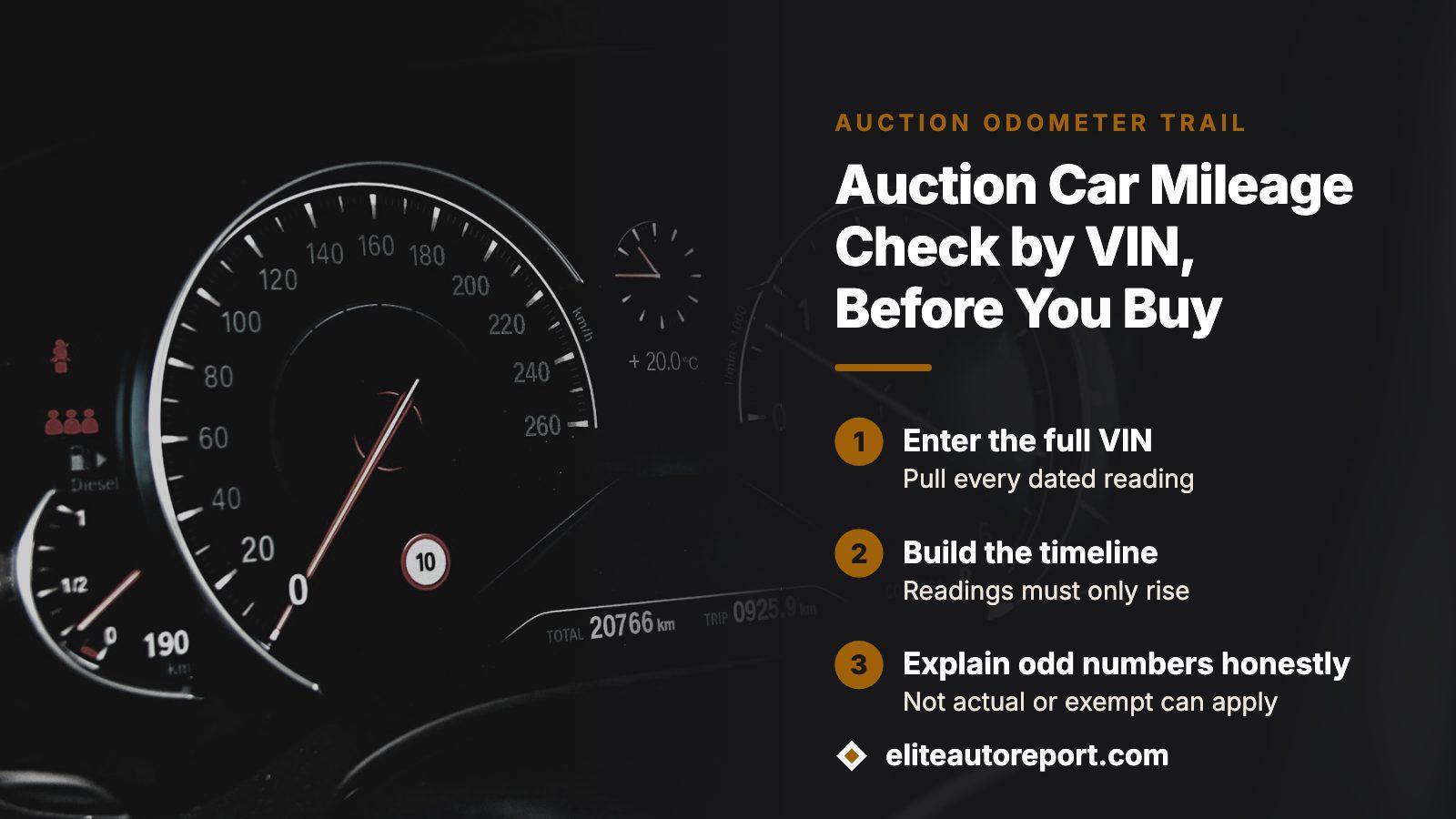
THE SHORT ANSWER
Type in the 17-character VIN and EliteAutoReport lists the odometer readings on file, including any logged at an auction sale, beside title records and damage notes. Put them in date order. Mileage should only climb; a lower figure on a later date is the warning sign. Start with the free preview; the complete report is one payment if you go on.
- What you need
- The full 17-character VIN
- The test
- Dated readings must rise, never fall
- Cost
- Free preview, then one payment per report or pack
- Limit
- A car with no auction sale has no auction reading
What an auction mileage check actually compares
Mileage gets written down in a sale lane by people with little reason to flatter it. The consignor wants the car gone, the auction wants a clean transaction, and the buyers are trade professionals who will check. That makes the reading logged at the sale a useful anchor.
The check sets that anchor beside the other dated readings attached to the VIN: those at title transfers, those from inspections or emissions visits where a state records them, and the figure on the odometer in front of you. If they agree with the car's age and use, the clock is probably honest. If a later number sits well below an earlier one, you have found the thing this page exists for.
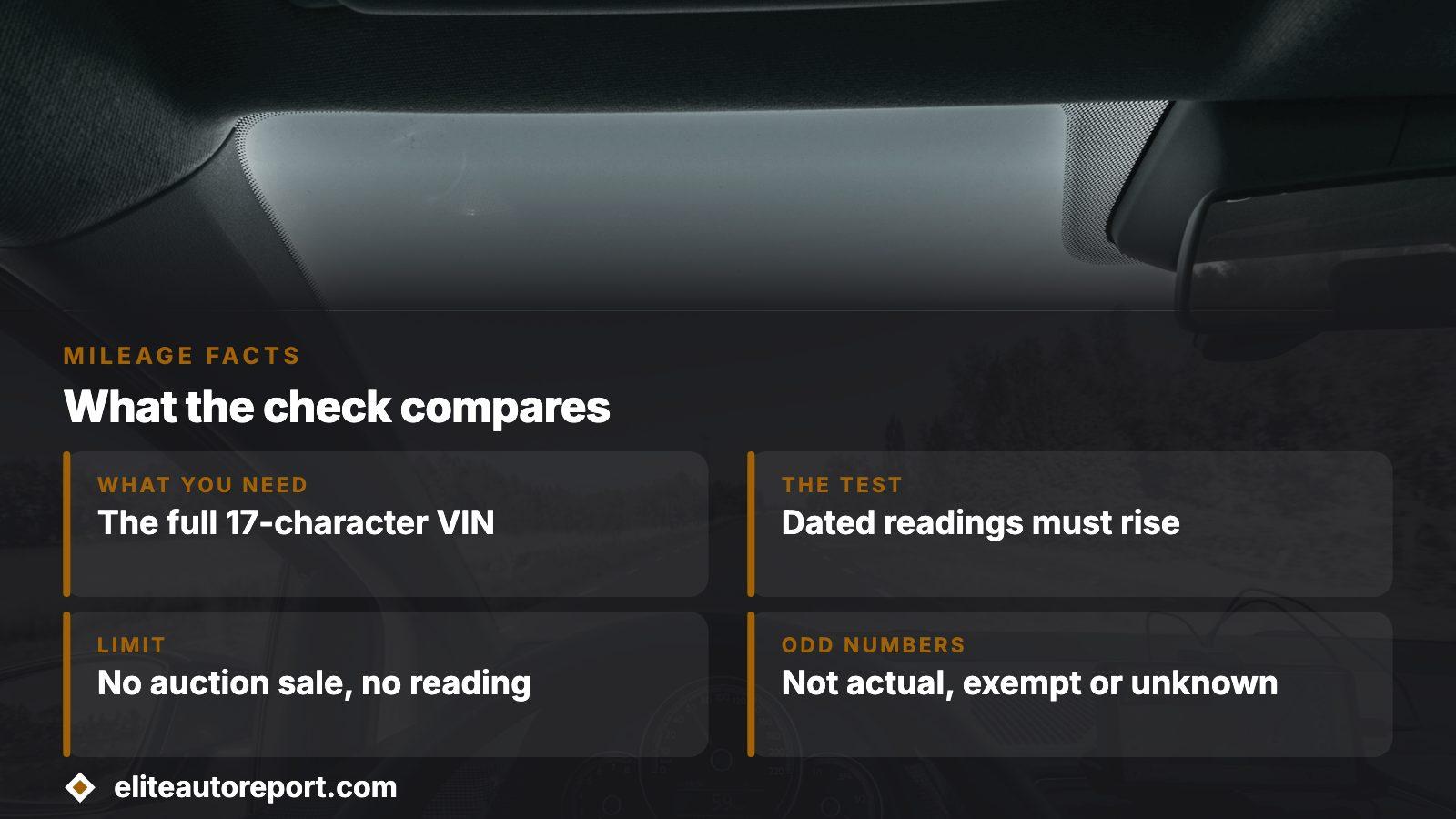
Why a reading taken at an auction is hard to dismiss
Federal odometer rules do more than require a seller to sign a mileage statement. They also tell auction companies to keep their own file on each sale for five years: who owned the car before, who bought it, the VIN, and the reading on the day the auction took possession. Whether that file reaches a given report depends on the record, but it explains why sale-day mileage tends to exist at all.
Sellers have a separate duty at every change of ownership. The seller signs a statement giving the reading, the date, both parties' names and the VIN, and certifies that the figure is accurate, exceeds the dial's mechanical limit, or cannot be trusted. The buyer signs too. A sale-day reading plus a signed statement gives you two independent people on record with a number.
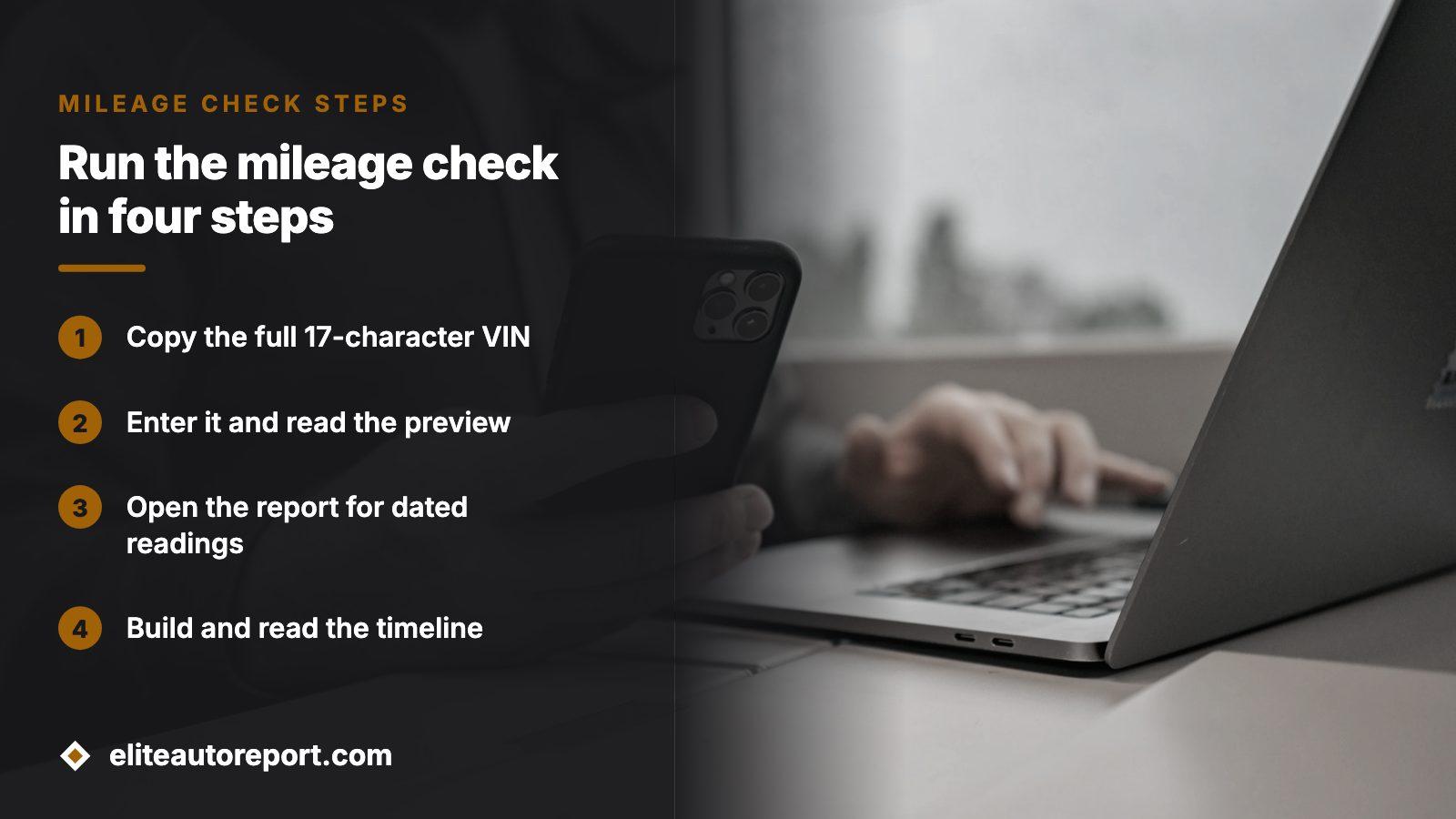
Run the check in four steps
- Copy the full 17-character VIN from the dash, the driver's door jamb or the title, and confirm all three agree before you type it in.
- Enter it on EliteAutoReport and read the free preview, which tells you whether a record exists for that car.
- If you want the detail, open the full report and find the odometer entries and any auction sales with their dates.
- Copy the readings onto one list, oldest first, and add today's dash figure at the bottom.
Do this before you pay a deposit or book a transporter, not after. If a seller dodges the VIN on an expensive car, that tells you plenty.
How to read the timeline you just built
| Pattern | Likely meaning | Your move |
|---|---|---|
| Readings rise steadily with each date | Normal use | Carry on with the rest of the report |
| A big gap with no readings | A long stretch off the road, or thin record keeping | Ask the seller what happened in those months |
| Auction reading higher than the dash | A possible rollback | Stop and ask for service paperwork |
| Reading flagged as not actual | The previous owner knew the display was unreliable | Treat the true mileage as unknown |
| No auction entry at all | The car never sold through a recorded auction | Rely on the title and test readings instead |
Rounding is normal. A difference of a few hundred miles between a sale and a title event is noise. A difference of tens of thousands is not, and nobody drives that many miles backwards.
What a mismatch looks like when it happens to a buyer
NHTSA keeps owner complaints on file, and some of them describe this exact gap. Treat them as the owner's account, not a ruling, but the pattern is instructive.
From an NHTSA owner complaint
One owner of a 2008 Cadillac Escalade wrote that the dealer who sold it had picked the SUV up at a sale in late May 2019. The history report they attached put it at 230,000 miles that day, yet an emissions test three days on logged just 98000. They also said a discrepancy form was tucked into the stack of papers without comment, and the dealer kept their deposit.
The lesson is the order of operations. The auction reading and the test reading were both dated, both on record and both checkable before signing. Pulling them up the day you find the car, rather than the day after you sign, is the whole advantage.
Not actual, exempt and unknown: three honest reasons for odd numbers
Not every strange number is fraud. A cluster that was swapped, a dial that rolled past its limit or a failed display can all leave a car with a legitimate mileage question. The rules give sellers a formal way to say so: a written statement that the display cannot be trusted, plus a discrepancy warning for the buyer. That is the honest route, and it should lower the price.
- Cars of model year 2010 or older drop out of the statement requirement ten years after January 1 of their model year, so an old exotic may carry no disclosure at all.
- Model year 2011 and newer stay covered for twenty years, so a missing statement on a recent car deserves a question.
- Anything rated over 16,000 pounds gross weight is exempt too, which covers heavy trucks and big motorhomes.
On an exempt car, no statement means nothing. On a covered one, it is a gap, and the seller should fill it in writing.
Where the check helps most: luxury, exotic and classic cars
Mileage is a bigger share of the asking price on a performance or collector car, so the incentive to trim it is bigger too. A low-mileage sports coupe with a polished story is exactly the car a careful buyer should test hardest.
Classics need a gentler reading. Many have been rebuilt, had engines swapped or sat for decades, and a five-digit odometer may have rolled over more than once. For these, the auction entry is less a verdict than a dated datapoint, and the best use is to see whether the seller's account matches it. A record that is simply missing is common here, because a good many of these cars were never sold through a recorded auction.
The federal title database carries the latest odometer reading it received and brand history, but it is deliberately short and can miss cars that a state never branded. It covers fewer facts than a full report, and you should say so when you ask a seller to rely on it.
Cost, and your legal options if the mileage was false
Looking at the preview costs nothing. After that you buy a report outright, alone or in a bundle, and no renewal follows. Amounts are listed on the pricing page.
If you do end up with a car whose mileage was falsified, federal law allows a civil suit against whoever tampered or misstated with intent to defraud. The award is triple your real loss or $10,000, whichever is larger, with costs and a reasonable attorney's fee added if you win. You must file within 2 years after the claim accrues, so keep the report, the listing and every signed paper. A lawyer can tell you whether your facts fit.
Where this information comes from
- GovInfo: 49 CFR Part 580, Odometer Disclosure Requirements — Backs the auction record-keeping rule, the signed mileage statement, the not-actual wording and the exemptions.
- GovInfo: 49 U.S.C. 32710, civil actions by private persons — Backs the damages formula, the filing window and the fee award.
- NMVTIS: Information for consumers — Backs what the federal title database shows and where its coverage can fall short.
- NHTSA owner complaint 11221863 — owner experience, paraphrased
Sources and photos: Facts checked against the sources above in November 2026. Photos by Viktor Theo, Anastasiia Nelen and Sander Jeurissen on Unsplash; diagrams by EliteAutoReport.
Keep reading
- Auction History by VIN: Photos for Luxury, Exotic and Classic CarsThe wider check: sale dates, damage notes and photos by VIN.
- Is It Bad if a Car Was Sold at Auction? Luxury, Exotic and Classic CarsHow to tell whether a particular car has been through a sale.
- What Happens When You Buy a Car at Auction: Fees, Title and Hidden HistoryYour move if you are the one bidding.
- PricingSingle reports and packs of 3, 5 or 10, paid once.
Frequently asked questions
Can I check the mileage of an auction car by VIN?
Yes, if the car has a recorded sale. Enter the VIN and the preview shows whether a record exists. The full report then lists odometer readings by date, including one logged at the sale where it is on file, so you can compare it with the dash and the title.
Why does an auction car show different mileage on different records?
Readings are taken on different days and rounded differently, so small gaps are normal. A later figure far below an earlier one is the problem. Each record carries a date, so line them up and see which one breaks the climb.
Does a clean report mean the mileage is real?
Not on its own. Any report reflects only what got recorded. A car may have missed the auction lane, skipped an inspection or been branded in a state that reports less. Pair the report with service paperwork and a hands-on look at pedal rubber, seats and tires.
What does not actual mileage mean on an auction listing?
The seller has put in writing that the dash figure is unreliable, often after a cluster swap or failed display. It is a legal disclosure, not an accusation. It does cap what the car is worth, so price it as a car with unknown mileage.
Mileage check first, or mechanic's inspection first?
Before. A mileage problem can save you the inspection fee and a trip. If the dated readings already contradict the dash, ask the seller to explain in writing, and only book a mechanic if the answer holds up.
Now check the car itself
The guide explains what to look for. The report shows what this VIN has on record.