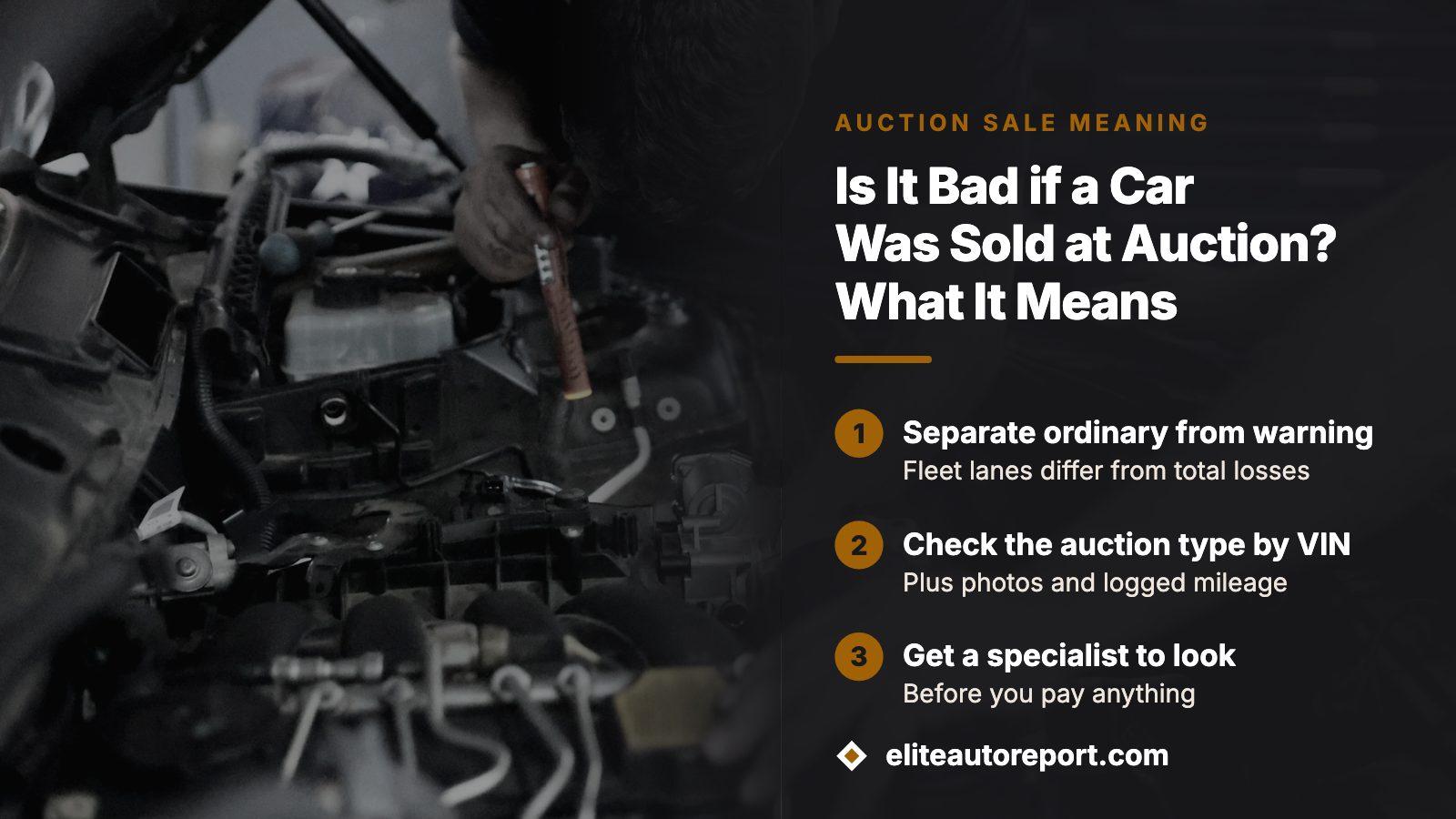
THE SHORT ANSWER
Not by itself. A sale through a dealer, rental or fleet lane is ordinary and says little about the car. A sale as a total loss, or a salvage title behind it, is a real warning and should change the price and the inspection. Check the VIN for the type of auction, the odometer reading logged that day and any photos on file, then have a specialist look at the car.
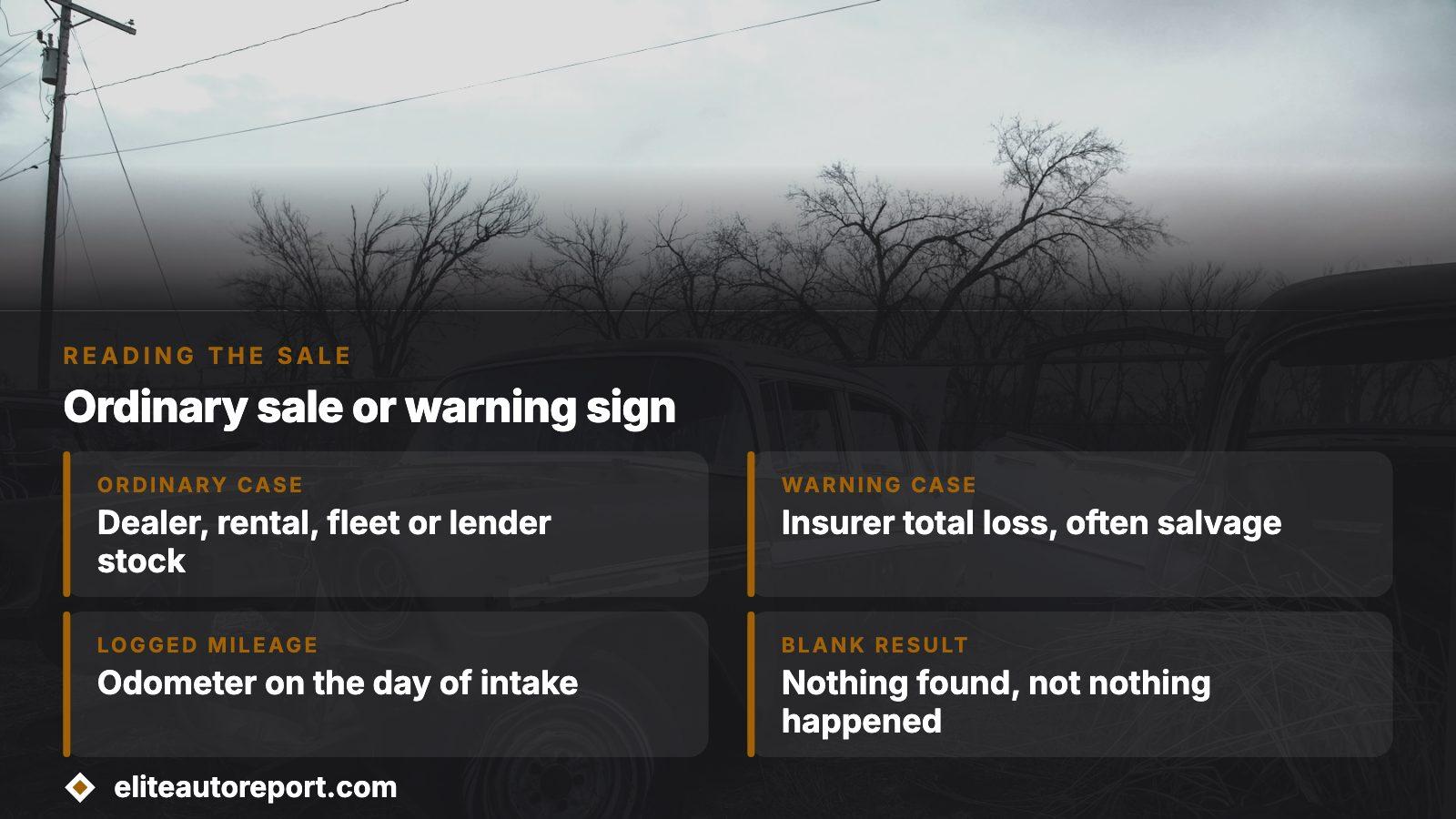
- Ordinary case
- Dealer, rental, fleet or lender stock sold through a wholesale lane
- Warning case
- An insurer's total loss, usually with a salvage brand
- Mileage on file
- Auction companies log the odometer on the day they take possession
- Blank result
- Means nothing found, not nothing happened
Two kinds of auction share one name
Sold at auction describes two very different events. In one, a dealer, rental or fleet operator, lender, donation program or government office moves a vehicle it has finished with through a wholesale sale; auction operators name these very sellers for their clear-title, light-damage cars. In the other, an insurer has treated a damaged car as a total loss, and the paperwork that follows usually reads salvage.
| Kind of sale | Who is usually selling | What it tells you |
|---|---|---|
| Dealer wholesale lane | Dealers, rental and fleet companies, lenders, donors | The car changed hands inside the trade. Judge it on mileage, condition and its other records. |
| Total-loss or salvage lot | Insurers | A serious loss event. The title brand and the pre-repair photos matter most. |
| Collector or specialist sale | Owners and consignors of collectible cars | A provenance question: condition that day, paperwork and earlier owners. |
When a sale at auction is ordinary
A dealer lane works like a handoff between businesses. Manheim, an auction operator, sells cars under a light system, and the light tells you what the seller was prepared to promise.
- Green: the seller guarantees the car is free of known defects
- Yellow: announced conditions limit what the buyer can dispute
- Red: sold as is, with disputes allowed only in limited cases
- Blue: the title was not present at the sale
Local policy decides which cars go red automatically, using price, model year or mileage, so a red light can reflect age or miles as much as a known fault. Ask which light, what was announced and whether the title was on hand; a vague reply is information too.
When the sale is a warning sign
A total-loss sale is the one that matters. Every month, insurers report to the federal title system the cars they took over and judged to be junk or salvage, a group that takes in total losses under state law and under the insurer's own policy terms. The cause is another matter: flood, fire or collision may be listed, but insurers are only encouraged to say, so an entry can sit on file with no explanation.
What a total-loss entry changes
Once the record shows a total-loss sale, stop asking whether the car is acceptable and start asking what the brand does to its value, what the repair involved and who certified the work. Ask for invoices and photos before you talk price.
A rebuilt car can be sound. On a luxury or exotic badge, though, parts and workmanship vary widely, so photos from before the repair outweigh a seller's summary.
What the record adds on a luxury or exotic car
EliteAutoReport searches auction history by VIN and shows any sale entries and photos on file, next to the car's brand history, mileage readings and open recalls. The photos are what a polished listing cannot copy. They show the car as it arrived, and on a car with costly panels, glass and electronics they tell a specialist where to look first.
| Entry | How to use it |
|---|---|
| Sale date | Line it up against the title issue date and any repair invoice the seller shows you |
| Odometer that day | Compare it with the cluster now and with every other dated reading |
| Title type at sale | Clear or salvage; a salvage sale followed by a tidy title needs an explanation |
| Damage note | Read it, then match it to what the photos show |
| Photos | Print them, take them to the inspection and have each damaged area checked |
The mileage an auction wrote down
Federal rules make an auction company keep, for five years after a sale, the previous owner, the buyer, the VIN and the odometer reading from the day the car arrived. A dated reading from a third party is hard to argue with, and two NHTSA complaints show one surfacing after the purchase.
From an NHTSA owner complaint
A 2009 Mercedes-Benz ML350 changed hands in a dealer sale in October 2024, showing 146,743 miles at purchase according to the owner. During service, an independent mechanic turned up a vehicle history record with a much higher figure, 196,577 miles, dated July 15, 2024, when the SUV was still with an auction company.
The lesson: a mechanic found the gap months in, from the kind of record a buyer can pull before paying.
From an NHTSA owner complaint
A 2010 Dodge Charger buyer paid a private seller whose advert and title both said 99,000 miles. The car then failed an emissions test, the check engine lamp turned out to be blocked from view, and a VIN search turned up an auction sale on September 25, 2017 with 199,955 miles on the odometer.
The lesson: run the VIN before paying, and treat an earlier reading far above the title as a reason to stop.
Why a blank result proves less than it seems
NMVTIS, the federal title database, cautions that a clean search may be a false negative: certain states apply no brands, and some entities that should report do not. High-end and older cars meet more gaps.
- Insurer filings reach back five model years, counting the current one, so an older exotic can fall outside them
- A repair the owner pays for privately creates no insurer filing, and may leave no auction record either
- A federal report is deliberately narrow, built around five indicators, so details of repairs are simply not in it
Classics add one more. The signed mileage statement a seller must hand over stops applying to older vehicles: a 2010 model or earlier once ten years have passed since its model year began, and a 2011 model or later after twenty. On a collectible there may be no statement at all, and fewer dated readings to compare.
Treat a blank as unanswered
No auction entry on a thirty-year-old exotic means little. Lean on the state title record that NMVTIS encourages buyers to request, any paperwork the seller can produce, and a hands-on inspection.
Checks to run before you pay
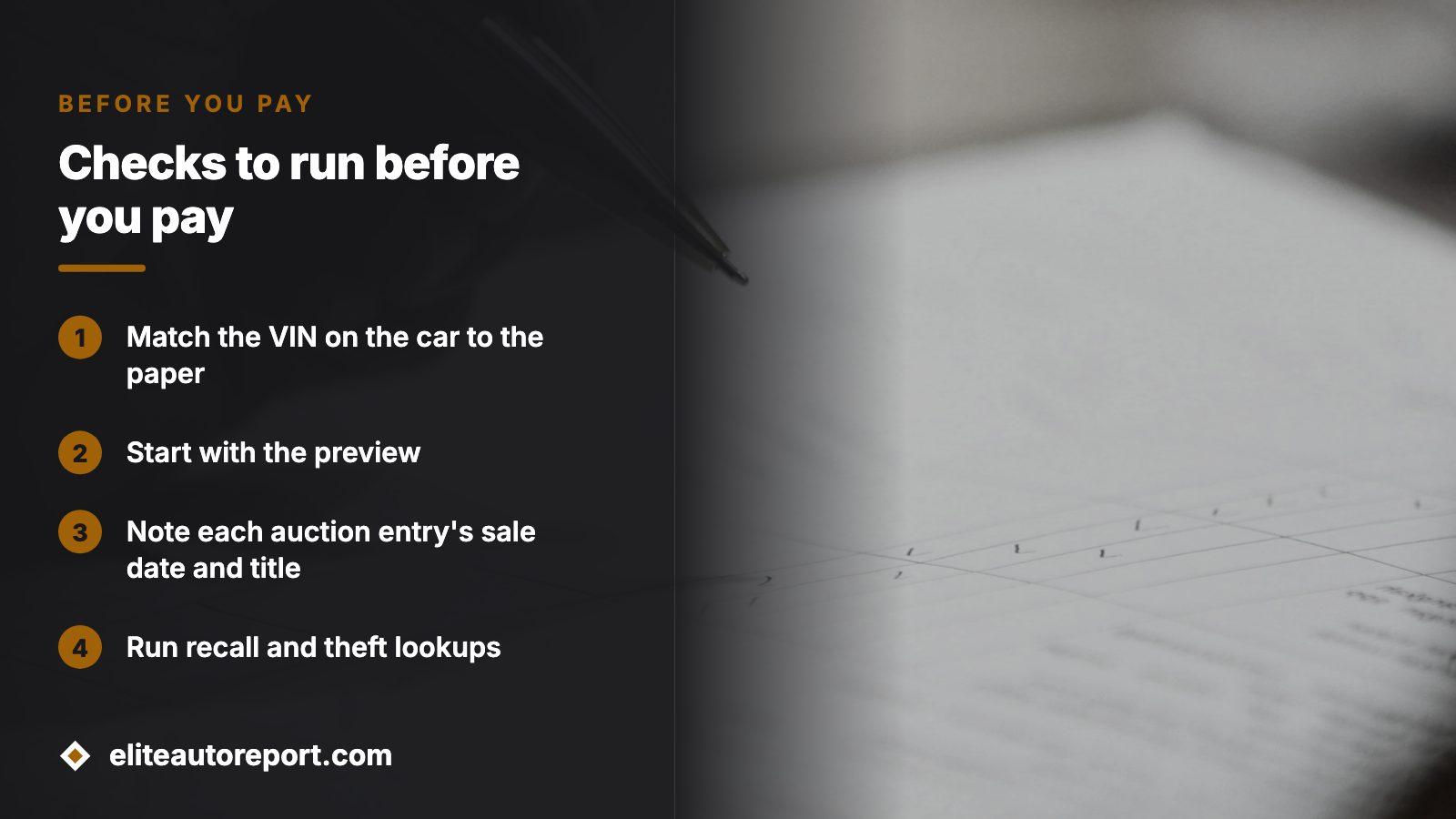
- Match the VIN on the car itself to the one printed on the title, character by character, then search.
- Begin with the free preview on EliteAutoReport. A full report is one payment, no subscription, with rates on the pricing page.
- Open any auction entry and note the sale date, the title type and the odometer reading. Set them beside the title issue date and the mileage in the advert.
- Run NHTSA's recall lookup on the VIN, and NICB's lookup for flood damage, both of which the FTC points buyers to.
- Book an independent inspection and take the photos along; the FTC is plain that no history report replaces one.
Do all of it before the viewing. A mismatch found before payment costs a phone call, and one found later costs far more.
Where this information comes from
- NMVTIS: information for consumers — Backs the false-negative warning, the narrow scope of a federal report and the advice to request the state title record.
- 28 CFR 25.55: Responsibilities of insurance carriers — Backs the monthly insurer inventory, the five-model-year window and the optional reason for loss.
- 49 CFR part 580: Odometer disclosure requirements — Backs the auction company's mileage record and the age exemptions from the written statement.
- Manheim: arbitration and sale lights — Backs the meaning of the green, yellow, red and blue lights and the local red-light policy.
- FTC: used cars — Backs the inspection advice and the NICB flood and NHTSA open-recall lookups by VIN.
- NHTSA owner complaint 11680606 — owner experience, paraphrased
- NHTSA owner complaint 11040275 — owner experience, paraphrased
Sources and photos: Facts checked against the sources above in November 2026. Photos by Mustafa Sheikhmouss, Masjid MABA and Leo_Visions on Unsplash; diagrams by EliteAutoReport.
Keep reading
- Auction History by VIN: Photos for Luxury, Exotic and Classic CarsHow an auction history check by VIN works, and what the photos can show.
- Car Auction Results Database: Where Classic Car Results LiveCollector and classic sales are a separate question; start here for them.
- Sample reportSee a finished report, auction photos included, before you buy one.
- Delete Car Auction History? What Can Be Fixed and What Stays on FileWhat to do if an auction record on a car looks wrong, and whether it can be removed.
Frequently asked questions
Does an auction sale mean the car was damaged?
No. Many sales are dealers, rental and fleet operators, lenders, donors or government offices clearing stock, and auction operators label title type as clear or salvage. Damage is signaled by a total-loss sale and a salvage title, not by the word auction. Find out which kind of sale it was first.
How can I tell a salvage auction from a dealer auction?
Look at the title type at the time of sale and for any total-loss entry. A salvage title usually points to an insurer having written the car off. A dealer lane sale usually shows a clear title and, at some operators, a green, yellow or red light. Photos and damage notes, where on file, settle most doubts.
How long are auction mileage records kept?
Federal rules make an auction company keep a record of each sale for five years: the seller before it, the buyer, the VIN and the mileage logged when it took possession. Older sales can be harder to document, so ask what paperwork came with the car.
Does a classic need a written mileage statement when it is sold?
Often not. Federal rules exempt a 2010 or earlier vehicle once ten years have passed since its model year began, and a 2011 or later vehicle after twenty. On an older collectible you may get no signed statement, so lean on dated readings from other records, such as an auction entry, and on service history.
If the history shows no auction sale, is the car clean?
No. It means nothing was found. NMVTIS cautions that a result may be a false negative, states differ on branding, and insurer reports reach back only five model years. Ask for the full state title record, then pay for an independent inspection before you commit.
Now check the car itself
The guide explains what to look for. The report shows what this VIN has on record.