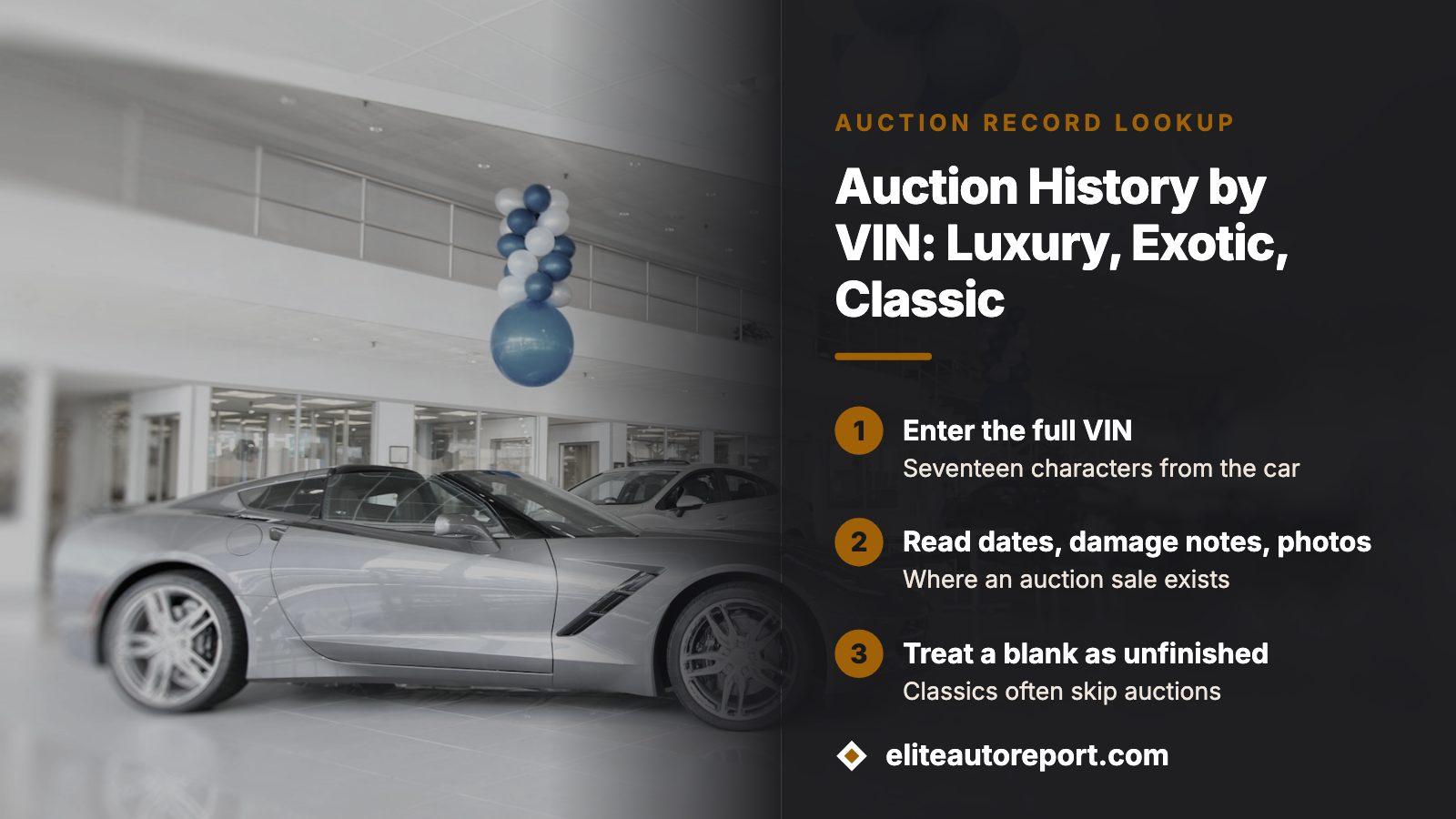
THE SHORT ANSWER
Enter the 17-character VIN and EliteAutoReport looks for auction sales on record for that car. A free preview comes first, and the report itself is a single purchase, not a subscription. It lays out sale dates, damage notes and photos where they exist beside title brands, odometer readings and recalls. No record does not mean no history: classics and privately repaired cars often never touch an auction.
- Search key
- The full 17-character VIN
- Cost
- Free preview, then one payment per report or pack
- Covers
- Only cars that went through a recorded auction
- Insurer reports
- Current model year plus four earlier ones
Why a high-end car can have an auction record at all
Nobody consigns a healthy car to a salvage auction. The usual route starts with a claim: an insurer decides the repair bill is out of proportion to the car's value, settles with the owner, takes the wreck and sells it at auction to get some cash back. In the USA, Copart and IAA are the two big names in that trade.
A premium badge makes that arithmetic arrive sooner. Parts, paint and specialist labor cost more on a luxury or exotic car, so damage that would be a routine repair on a commuter can total it instead. Plenty of these cars are rebuilt and resold, sometimes with a story tidied up along the way. The auction record is where the untidied version survives.
What an auction history check returns for your VIN
Enter the VIN and EliteAutoReport looks for auction sales on record for that car. Each sale it finds sits beside title brands, odometer readings, accident records, open recalls and market value. Salvage lots are written for professional bidders, so a listing tends to be specific, though how much is on file varies by car.
| Piece of the record | What it gives you |
|---|---|
| Sale date | A fixed point to sort every later repair, inspection and title event against |
| Damage notes | Where the car was hit, often with a second note that tells the real story |
| Odometer at sale | A dated mileage reading, sometimes carrying a qualifier such as not actual |
| Photos | The car as it arrived, before any repair |
| Title type at sale | Which document it sold on: salvage, rebuilt or a non-repairable certificate |
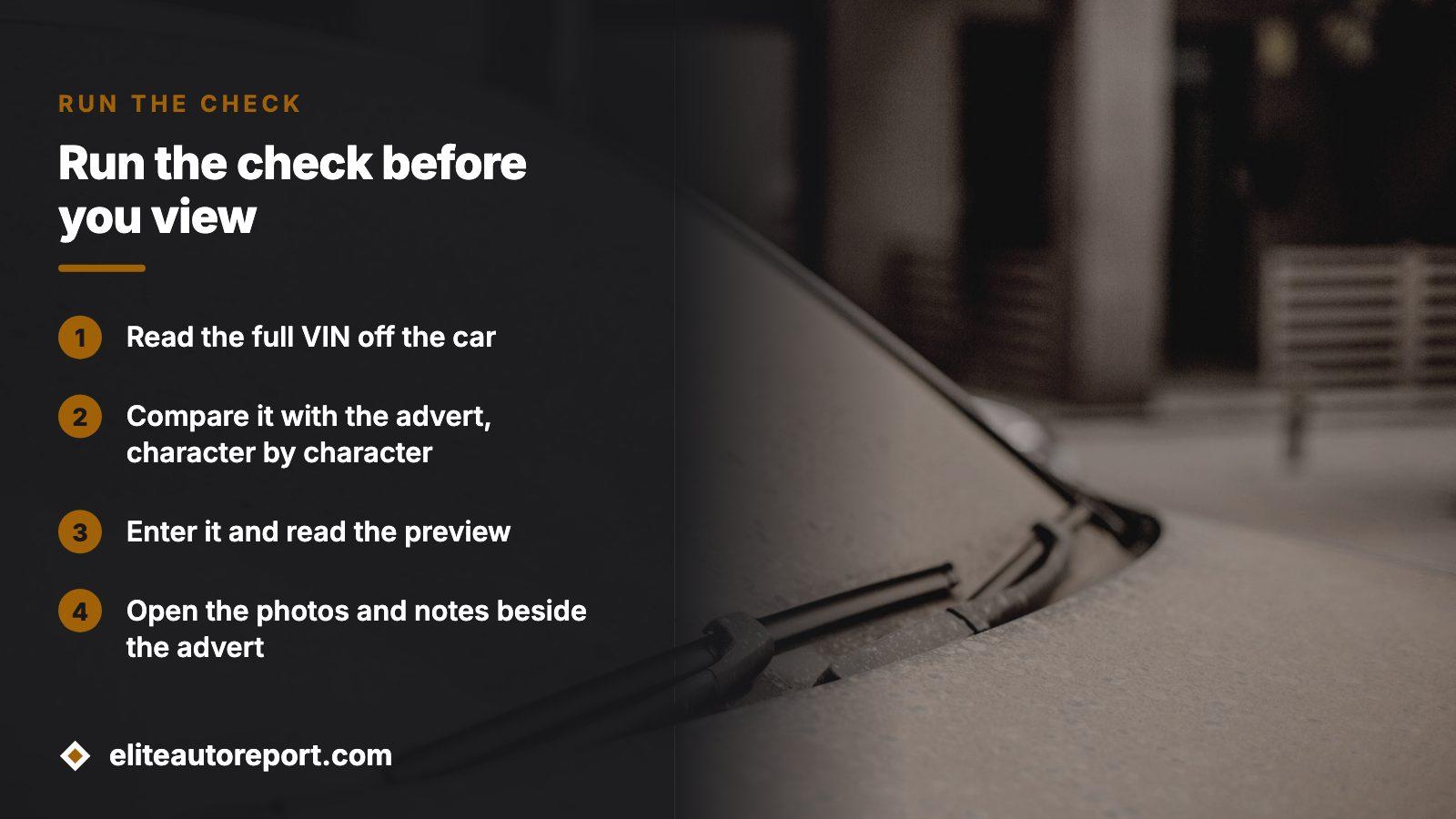
How to run the check before you view the car
- Get the full 17-character VIN. Look through the windshield from outside, low on the driver's side, or open the driver's door and read the jamb sticker. The title and registration carry it too.
- Read the number off the car itself and compare it character by character with the advert. A typo pulls up the wrong car, and a real mismatch is a question for the seller.
- Type the VIN into the box on the home page and look at the preview. If the car still interests you, buy one report; packs of 3, 5 and 10 suit anyone comparing several cars.
- Open the photos and notes beside the seller's advert and compare them panel by panel.
Do this before the viewing, not after. The photos tell you where to put your attention once you are standing next to the car.
Reading pre-repair photos on a luxury or exotic car
A damage note is a one-line summary typed by someone clearing a busy yard. The photos are the evidence. On a car with expensive panels and hand-finished trim, they show how much was torn up before a repair shop touched it.
| What the photo shows | What it points to |
|---|---|
| A splayed or tucked wheel, or the car on a dolly | Suspension or subframe damage rather than bodywork |
| Folded front structure with the engine exposed | An impact that went past the bumper into the structure that carries crash loads |
| Airbags out and torn pillar trim | A severe collision, and a repair bill that includes the restraint system |
| A tide line on the seats, silt in the footwells | Water exposure, whatever the damage note says |
| Soot in the vents, melted wiring | Fire, which leaves electrical faults long after the paint is fresh |
| Missing wheels and a stripped cabin, little impact damage | A theft recovery, which is a different repair and a different risk |
Take the images to the car and compare paint texture, panel gaps and overspray where the photos showed damage. Give a marque specialist the same pictures before a pre-purchase inspection.
Damage notes, run-and-drive and the odometer flag
Lots usually carry a primary and a secondary damage note, and the second deserves the closer read. Front end plus undercarriage describes an impact that reached the structure. Hail with nothing after it describes a different event and a different price.
Run and drive usually means the car moved under its own power in the yard, often a short distance, and says nothing about roadworthiness. Missing keys cost real money on a modern car with coded keys. An odometer reading marked not actual stays on the record, so treat it as a mileage discrepancy logged years before today's advert and set it against every other dated reading.
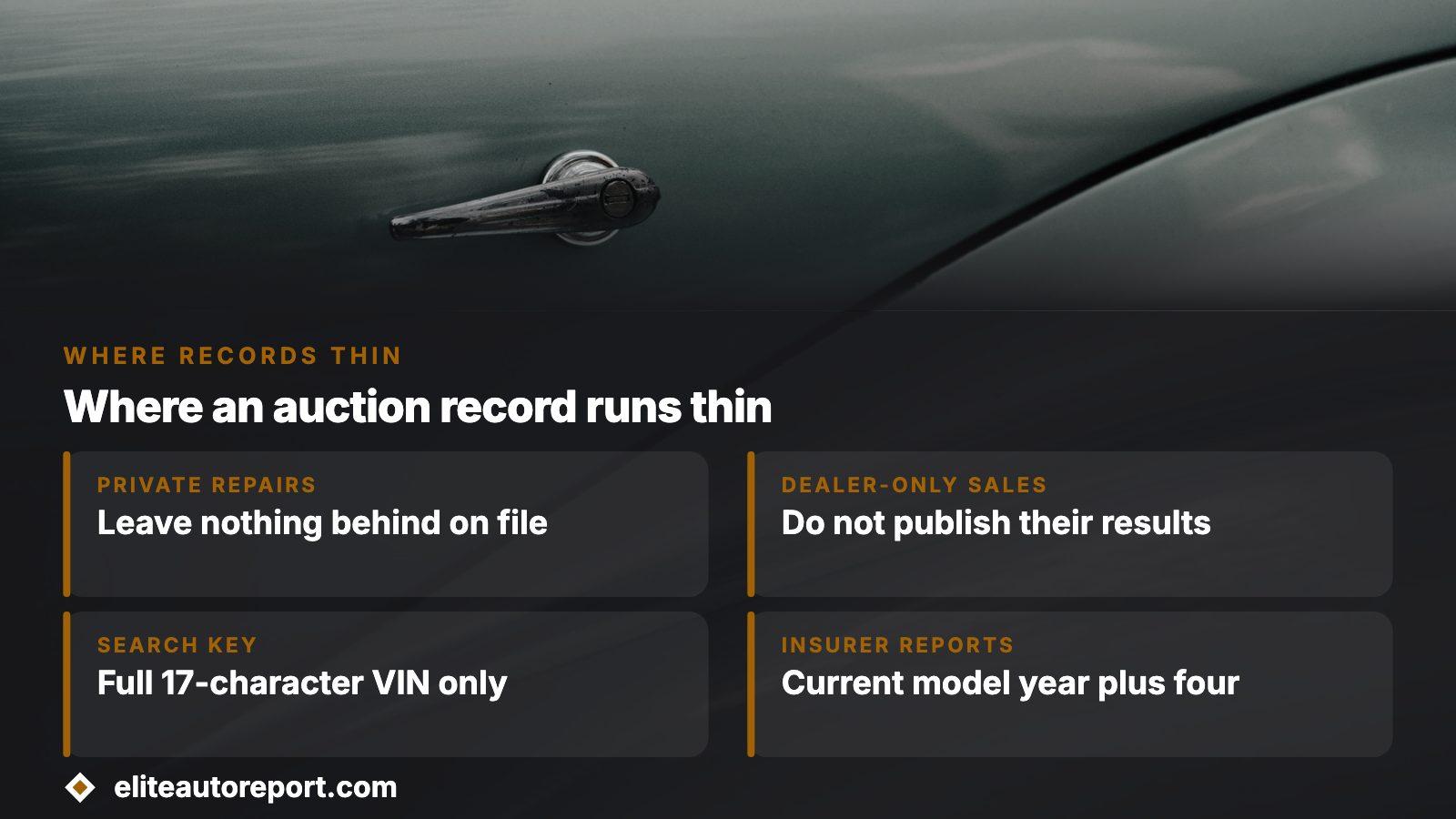
Classics and older exotics: where the record runs thin
Auction history exists only for cars that went through an auction, and older cars have more ways around the system. The federal rule requiring insurers to report junk and salvage cars reaches back only four model years beyond the current one (28 CFR 25.55), and stating the reason for the loss is merely encouraged. Under 28 CFR 25.56, a yard handling under five of these vehicles in a year does not have to file the salvage-yard report.
- A repair paid for privately, with no insurance claim, leaves nothing behind
- An owner who keeps the car after a settlement may fix it and never consign it
- Dealer-only wholesale auctions do not publish their results
- A classic with an older, shorter chassis number cannot be searched, because the check needs a full 17-character VIN
A blank result is not a clean bill
Nothing found means nothing found. On a recent car it is mild reassurance. On a thirty-year-old exotic it proves very little, so lean on the title history, any photos you can get and a hands-on inspection.
When the seller's story and the auction record disagree
A specialist dealer or private owner may honestly not know what a car went through before they bought it. The aim is a specific conversation instead of a vague one, and the auction record supplies the specifics.
| The advert says | Ask this |
|---|---|
| Rebuilt and fully inspected | Inspected by whom, and can I see the paperwork? A passed rebuilt inspection is not an appraisal of workmanship |
| Clean title | Clean in which state, issued when? Compare the issue date with the auction sale date |
| Minor damage, professionally repaired | Can I see the lot photos? Whoever bought it at auction has seen them |
| Only a theft recovery | The photos reveal whether it was stripped or hit |
| Never been damaged | If a record exists, the silence is the finding |
Cost, and your next move after the result
The preview is free. A full report on one VIN is paid for once and never renews; single-report and pack rates are set out on the pricing page. The sample report shows a finished one before you spend anything.
- Save the photos today. Listings get taken down, and sellers grow vaguer once the pictures are gone.
- NHTSA's recall lookup costs nothing, and the NICB VINCheck search, which looks for theft and total-loss records, is free as well. Run both.
- Compare the auction title type and sale date with the title the seller is showing you, then book a specialist inspection with the pre-repair photos in hand.
Where this information comes from
- 28 CFR 25.55: Responsibilities of insurance carriers — Backs the monthly insurer report, the model-year window and the encouraged reason for loss.
- 28 CFR 25.56: Junk yards, salvage yards and auto recyclers — Backs the salvage-yard reporting duty and the exemption for very small operators.
- NMVTIS: official vehicle history record — The federal title, brand and total-loss record and its approved providers.
- NICB: VINCheck — A free screen for theft and total-loss records from participating insurers.
- NHTSA: recalls lookup — Open safety recalls by VIN, whatever the car's title history.
Sources and photos: Facts checked against the sources above in November 2026. Photos by Richard R, JavyGo and Anshul Gurjar on Unsplash; diagrams by EliteAutoReport.
Keep reading
- Sample reportSee what a finished report looks like, photos included, before you pay for one.
- PricingPrices for a single report and for packs of 3, 5 or 10, paid once.
- GuidesEvery VIN check and buyer's guide on the site, in one list.
- About EliteAutoReportWho runs the site and what the vehicle history report is built from.
Frequently asked questions
How do I find the auction history of a car by VIN?
Enter the full 17-character VIN and EliteAutoReport looks for auction sales on record, with a free preview before any purchase. Third-party archives of Copart and IAA lots are another place to look, since coverage differs between sources.
Can I see USA auto auction history for any car?
No. Only cars sold through an auction with records on file will show anything. A car sold privately, moved through a dealer-only wholesale auction or repaired without an insurance claim often leaves no auction trace at all.
Why would an exotic or classic car have salvage auction photos?
Repair estimates climb quickly on expensive cars, so an insurer may total one that looks fixable. It then goes through a salvage auction, and the photos are taken on arrival, before repair. Some of these cars are rebuilt and resold afterward.
Does an auction record mean I should walk away?
Not automatically, since many rebuilt cars are sound. It means pricing the car as a rebuilt one, using the photos to direct a structural inspection and asking the seller to explain the repair against what the pictures show.
If the check finds no auction history, is the car clean?
Not proven. No record means nothing was found, and older cars slip past insurer reporting more easily because it covers only five model years. Check title brands and accident records, run the free NICB screen and inspect the car.
Now check the car itself
The guide explains what to look for. The report shows what this VIN has on record.