THE SHORT ANSWER
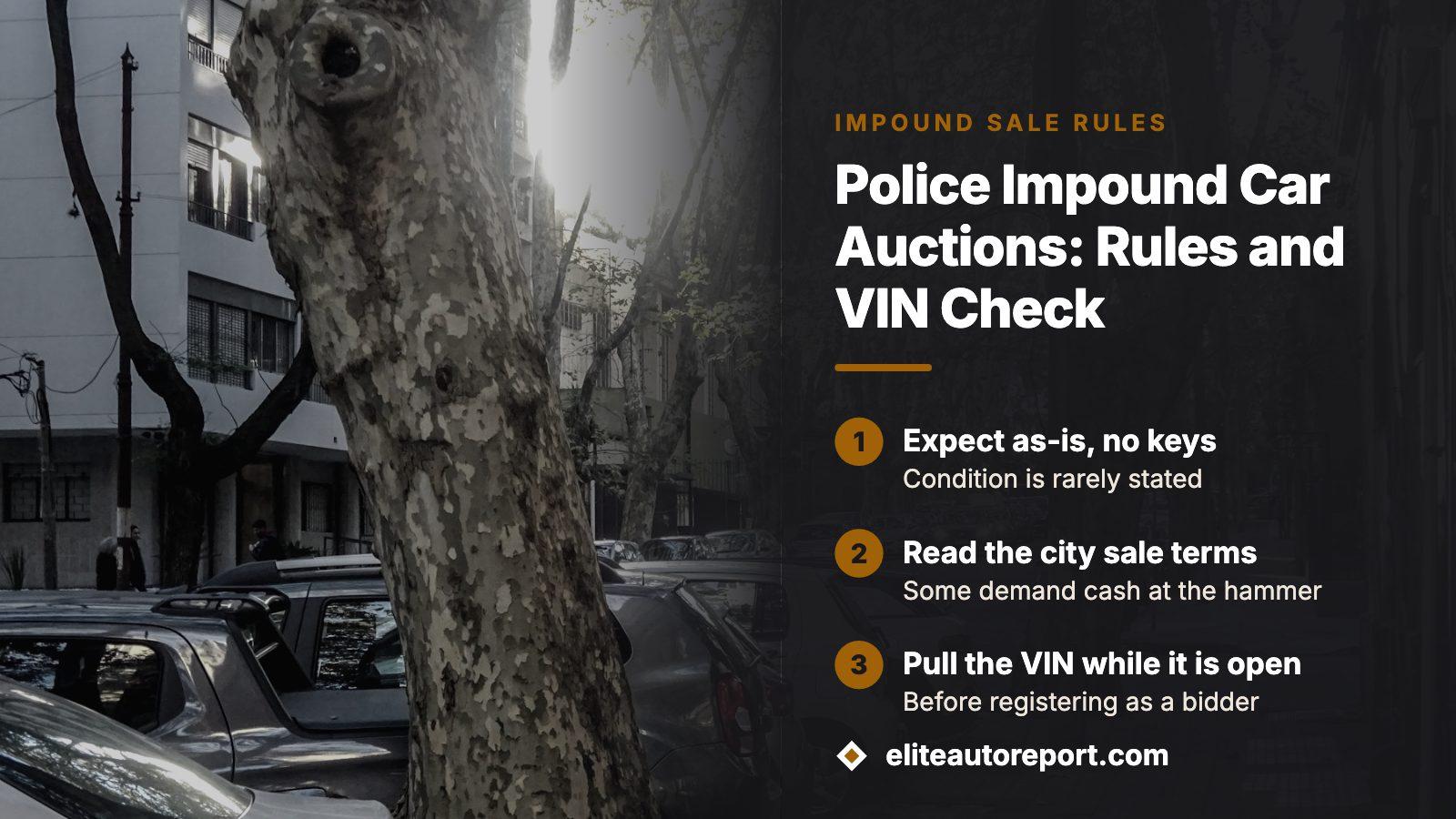
An impound auction sells vehicles left unclaimed after a tow, to pay the debts and fees owed on them. Expect as-is terms, payment at the fall of the hammer, and title paperwork you finish yourself at the DMV. The auction does not vouch for the car, so run the VIN for earlier sales, damage records, photos and title brands before you bid.
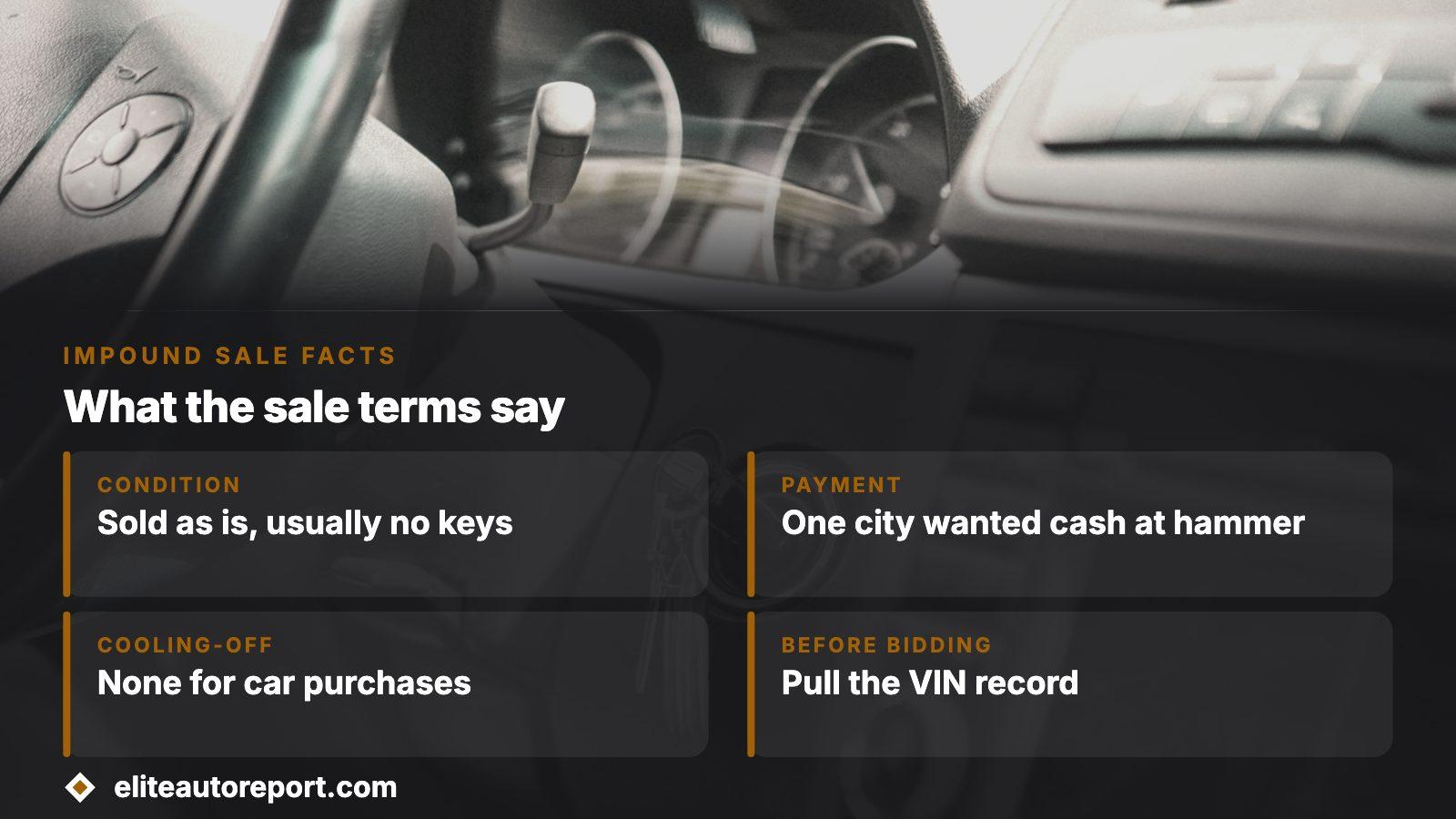
- Condition
- Sold as is, usually without keys
- Payment
- One city wanted cash in full at the hammer
- Before you bid
- Pull the VIN record while a bid is still only an idea
How a towed car ends up in the lane
Nobody picks an impound car for its paperwork. These cars arrive because an owner stopped paying, or never came to get them. New York City's Department of Finance shows the pattern: a towed car that is not redeemed within ten business days of the tow can go to auction, and the money from the sale first covers what the former owner owed. Towing, storage, booting, advertising and the auctioneer's cut come out of the proceeds too. The car is a collateral item, not a showroom unit, and nobody prepared it for you.
Rules differ by city and state, so treat any single city as a sample, not a promise. What stays the same is the shape of the sale: a debt, a deadline, a lot number.
When the lot holds something better than a commuter sedan
Most impound lots are full of ordinary cars. Now and then a premium sedan, a sports car or an older collectible turns up, and those are where a careless bid costs the most. A valuable car with a buried past loses its worth fast once the truth surfaces. Think of a salvage brand, an earlier auction sale with damage photos, or mileage that jumps backward.
Our angle at this site is the record behind the badge. On a car like that, the auction history by VIN is the part you cannot see from the curb: earlier sale dates, the condition noted at each, and photographs taken before any repair. Pull it before the sale, not after.
What one city's sale terms look like
Here is what the New York City Finance page says about its own sales. Yours will differ, so read your local notice, but the themes repeat.
| Topic | What the sample says |
|---|---|
| Who may bid | Bidders 18 or older; the old owner is shut out of buying it back |
| Deposit | None accepted; payment is due as soon as the bid wins |
| Payment | Cash, with sales tax included unless you hold a resale certificate; no credit cards |
| Condition | Sold as is and removed from wherever it is parked; the city promises nothing about year, quality or repair state |
| Keys | Not supplied; the buyer may need a tow |
| Collection | By 5:00 p.m. on sale day or a $20 daily storage fee applies |
| Paperwork | A Certificate of Sale, one per owner, taken to the DMV for a title |
What the seller will not tell you
The same city page says its Sheriff makes no statement about whether a car works, is safe, or has open recalls, and suggests buyers look up recalls by VIN on the federal safety site. It also warns that a lien can survive the sale, so a lender may still come for the car, and that a buyer has no legal recourse against the city, the Sheriff or the auctioneer.
Read that as a list of things to verify yourself. The car's mileage, its brand history and its record at other sales are all questions the sale notice leaves to you.
The DMV may call it salvage
The NYC page adds that the DMV may treat an auctioned car as salvage, which can mean an examination before a title or registration is issued. Find out how your state handles that before you budget for the car.
Pulling the record while the lot is open
Impound lots usually let you walk the rows before the sale, which is when to copy each VIN you care about from the dash or door jamb. Type it into our preview, which costs nothing. The full report afterward is one payment, with amounts on /pricing.
- Snap the VIN plate, then match it to the number printed on any paperwork posted with the lot.
- Look for earlier auction entries, and read the condition notes and photos attached to them.
- Check the title brand history for salvage, flood or junk labels.
- Compare odometer readings across dates and see whether they only go up.
- Look for theft and lien flags, then settle your ceiling price.
Suppose the record shows an earlier sale with heavy damage photos, yet the car in front of you looks flawless. That gap tells you what to ask.

Former patrol cars: a different kind of history
Sometimes the car on the block is a retired police vehicle, not a seized one. Those have their own wear, and a history report may not label them as police use. Take the federal title database. Its consumer view rests on five indicators, among them brands, the last mileage reported, insurer total-loss calls, salvage-yard transfers and occasional theft data. Police use is not one of them.
From an NHTSA owner complaint
In 2013 a Florida owner filed a complaint about a Crown Victoria that had served a Wisconsin police force, bought through a dealer. Within a month, flakes of rust on the garage floor led to a look underneath, where the shaft, exhaust and brake lines were caked. The dealer never answered the emailed photos, so the owner did the repainting personally, five days of work. Lesson: a car from a salt-state fleet needs an underbody look and a recall check, whatever the paperwork says.
NHTSA's recall data supports the worry. A steering shaft corrosion recall covers 2005 through 2011 Crown Victoria Police Interceptors in cold-weather states, and the fix is done free at a dealer.
Legal protection at a government sale
The FTC's Used Car Rule applies at public auctions, binding the dealers and the auction company alike, but not at auctions closed to consumers. It also reaches only dealers moving more than five used cars a year. A government impound sale may fall outside it, so do not assume a Buyers Guide will be on the window.
- As is means any breakdown after the sale is the buyer's problem.
- No federal cooling-off period exists for car purchases, though certain states add one.
- A history report is not a mechanical inspection. Wrecks and flood damage may appear on it; worn parts typically do not.
Before you register as a bidder
Get the sale notice from the agency running the auction and read its payment, collection and title sections first. Decide your top bid including the tow, fees and DMV costs. Then run the VIN on every car you might bid on, and drop any car whose history does not match what you see.
If a car clears the check, you still have the physical inspection and a plan to move it. If it does not, you have saved the price of a mistake.
Where this information comes from
- NYC Department of Finance: vehicle auctions — One city's real terms for as-is sales, payment, collection and title.
- FTC: Dealer's Guide to the Used Car Rule — Where the rule reaches auctions and which sellers it covers.
- FTC consumer advice: buying a used car from a dealer — As-is meaning, cancellation rights and why to inspect.
- NMVTIS: consumer information — What the federal title system shows consumers.
- NHTSA recalls: 2011 Ford Crown Victoria — Steering shaft recall that names police interceptors.
- NHTSA owner complaint 10538335 — owner experience, paraphrased
Sources and photos: Facts checked against the sources above in November 2026. Photos by Nikolai Kolosov, Anastasiia Nelen and tim on Unsplash; diagrams by EliteAutoReport.
Keep reading
- Government Car Auctions: Where to Find Them and What to Check by VINFederal and state sales run on different terms from city impound lots.
- Repo Car Auctions: Buying a Repossessed Car With a VIN CheckAnother way cars reach the block, with a lender behind the sale.
- Auction History by VIN: Photos for Luxury, Exotic and Classic CarsWhat a VIN's sale record and photos show on a high-end car.
- What Happens When You Buy a Car at Auction: Fees, Title and Hidden HistoryInvoice, fees and title after you win.
Frequently asked questions
Can anyone bid at a police impound auction?
Often yes, with limits that vary by agency. The New York City sample allows anyone at least 18, but bars the car's previous owner from buying it back. Some sales are closed to the public or restricted to dealers, so read the notice for the specific auction before you plan around it.
Do impound cars come with a title?
Not in the way a dealer sale does. In the New York City sample you receive a Certificate of Sale, only one per owner, which the DMV exchanges for a title in your name. The DMV may require an examination if it treats the car as salvage.
Can I test drive or get keys?
Do not count on it. The sample city hands over no keys, and its page describes no pre-sale inspection. Plan to look the car over from the outside, check the VIN, and price in a tow.
Does a VIN check replace an inspection?
No. The FTC notes that a history report can reveal wrecks and flood damage but rarely mechanical faults. Use the report for the past and a mechanic for the present, if the sale lets anyone near the car.
What happens if there is a lien on the car?
In the sample city, a lien may outlast the sale, and the lender may take the car back. Run the VIN for lien flags first, and ask the agency how it handles lienholder notice, because buyers there have no legal recourse against the city or auctioneer.
Now check the car itself
The guide explains what to look for. The report shows what this VIN has on record.