THE SHORT ANSWER
Winning a bid produces an invoice that adds the auction's fees to your price. You pay by the stated deadline in an accepted form, and the car is yours as is, without a return window. Titling, tags and transport fall to you. The auction will not tell you where the car has been, so pull its earlier sale dates, damage notes and photos by VIN before you bid.
- Payment clock
- Set sale by sale; one public sale wanted payment in full the same day
- Cooling-off period
- None under federal rules for a car purchase
- Before you bid
- Run the VIN while you can still walk away
Trade lane or public lane: why the kind of auction matters
Two sales that look alike can run on different rules. A wholesale auction serves dealers first: Manheim's Maryland location describes itself that way, and says state law limits the public to select repossessed units. A public auction lets registered consumers bid. The difference matters because the FTC applies its Used Car Rule at public auctions, binding both the dealers and the auction company, but not at auctions closed to consumers. A public sale owes you the Buyers Guide disclosures; a trade-only sale does not.
From registration to the fall of the hammer
Details change from house to house, so here is one real sample, a Thursday public sale at Manheim Maryland.
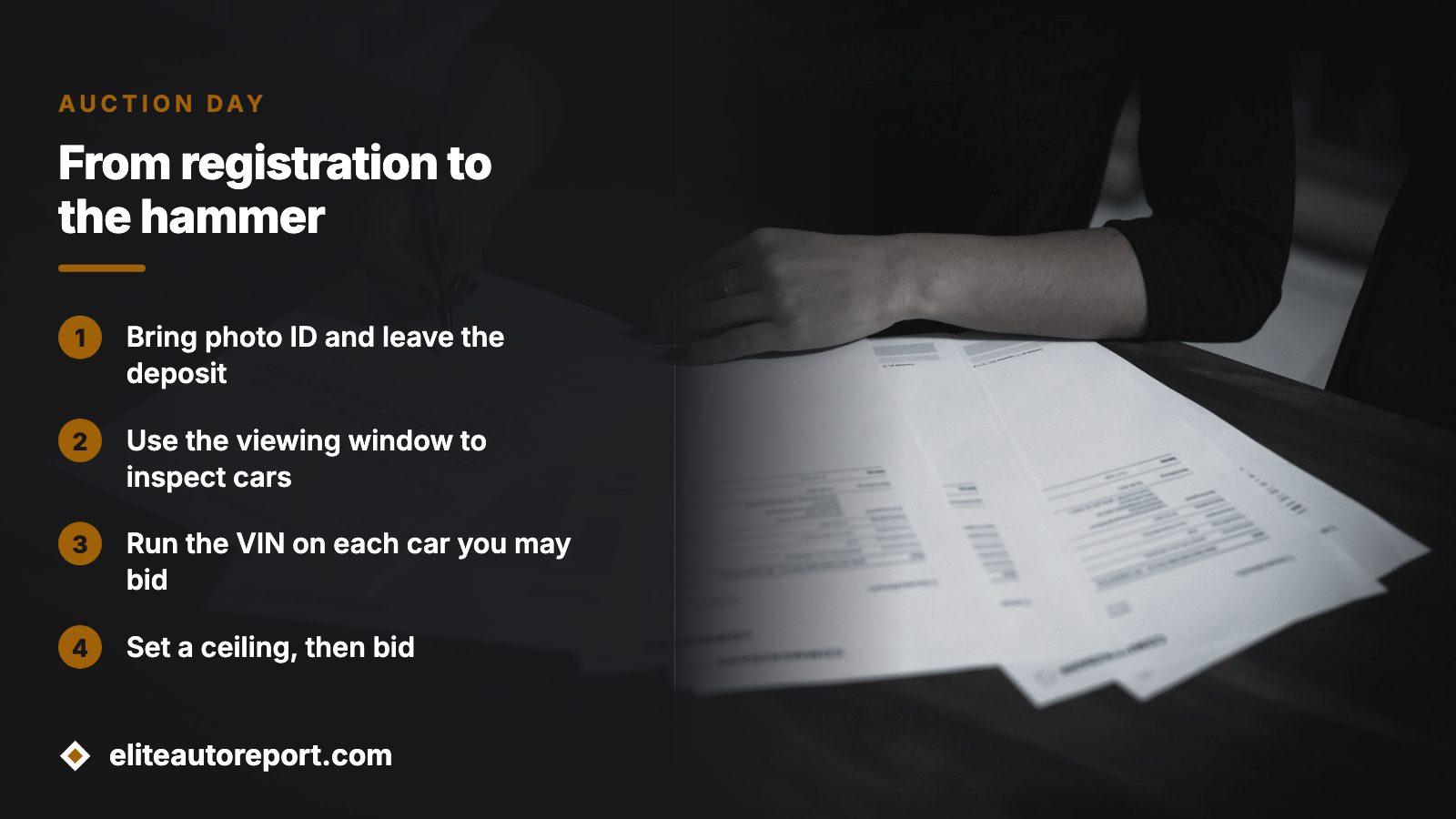
- Bring government photo ID. Nobody under 18 is admitted, and everyone registers as a bidder.
- Leave a deposit. This sale wants $1,000 in blank money orders, no cash, and swaps it for a bidder badge.
- Take the catalog you are issued. It lists only the cars open to the public.
- Use the viewing window, the afternoon before. Cars may not be driven or moved.
- Run the VIN on each car you might bid on, and set a ceiling that already includes fees.
- Bid. If you lose, collect the deposit back at the registration desk.
The guide also bars public buyers from asking licensed dealers for help, on pain of losing the right to attend later sales.
After the win: the invoice, the fees and a short payment clock
The hammer price is not the price. At the Maryland sale, fees based on the sale price and any services performed are added to every vehicle, and the total is printed on the invoice you collect at registration. Payment in full was due that same afternoon, by cashier's check or money order alone.
Other houses set their own fees and deadlines, so find yours before you bid, not after.
Measure the invoice, not the bid
Set your ceiling from the all-in cost: the bid, the invoice fees, state title and registration charges, and getting the car home.
Sold as is, and what the lights say about it
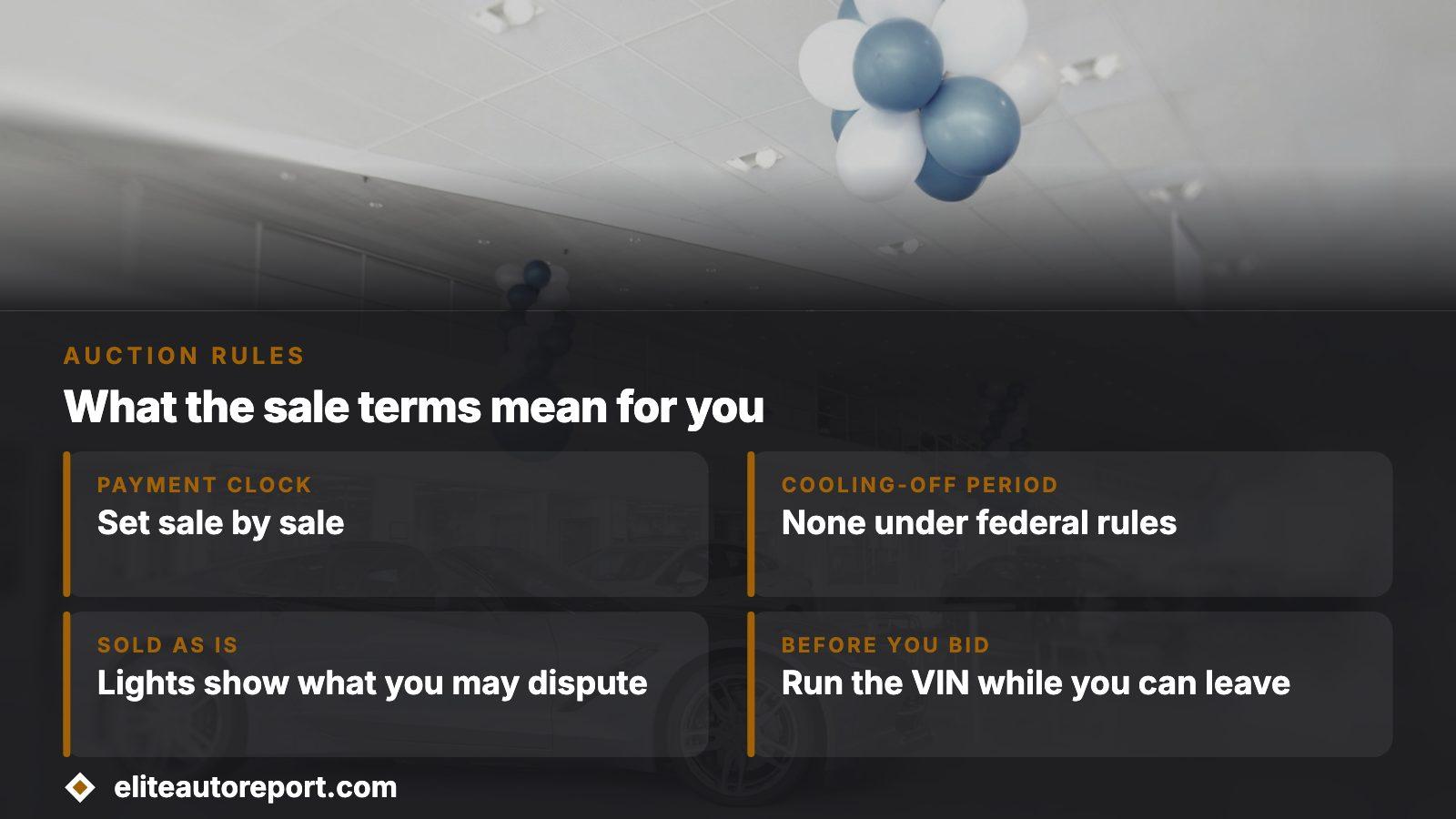
As is means the seller owes nothing toward repairs once the sale closes. The FTC puts the risk squarely on the buyer, and nothing in federal law gives you three days to change your mind. The Maryland public sale boils it down to one line: as is, all sales final.
| Light | What it tells you |
|---|---|
| Green | No known defects, and the seller guarantees the car |
| Yellow | Announced conditions or a limited guarantee narrow your claim |
| Red | Sold as is, with a claim possible only under certain conditions |
| Blue | Title not present at the sale |
Local policy decides which cars sell red by default, using price, model year or mileage, so an older or high-mileage car may arrive red regardless. Dealer buyers at Manheim also have arbitration: 10 calendar days to file on a digital transaction, with remedies such as a price adjustment or a cancelled sale. Ask the desk whether a public sale offers anything similar.
What the car did before it reached the lane
An auction gives you a lot number, a few photos and an announcement, not a past. The federal title database can show title brands, the latest reported odometer reading, an insurer's total-loss ruling and any transfer to a salvage yard. It also has holes: it holds about 87 percent of US vehicles, not every state reports to it, and each state sets its own branding rules, so a clean search can still be wrong.
From an NHTSA owner complaint
A buyer who won an auction on a 2013 Nissan Juke had put down only a holding fee when the mileage on the auction paperwork disagreed with other reports on the VIN. The car read 115,087 miles at purchase, yet a state title record the buyer cites showed 140,000 miles in September 2024. The buyer alleges odometer fraud, an accusation rather than a finding.
Take from it that a mismatch is cheapest to find before full payment. Compare the odometer figure on the paperwork with the VIN's record before you pay in full.
What a VIN report adds on a luxury, exotic or classic car
EliteAutoReport looks for auction sales on record for the VIN and sets sale dates, damage notes and pre-repair photos beside title brands, odometer readings and open recalls. On a high-end car the photos carry the most weight: they show the car as it arrived, before a body shop made it presentable, and they give a marque specialist something specific to inspect. Start with the free preview; a single payment buys the report.
A pre-bid checklist for a high-end car
- Pull the VIN's auction history and hold any old photos against the lot photos, panel by panel.
- Look up open recalls with NHTSA's VIN lookup, which works whatever the title says.
- Screen the VIN with NICB's check for flood damage, theft and salvage declarations.
- Ask whether the viewing window lets you bring an independent mechanic, since a history report cannot stand in for one.
- Settle the payment form and deadline, and book transport before the sale.
No single record settles it. The history report supplies what a walk past the car cannot.
If the car turns out to be wrong
Start by working out which kind of sale it was. A dealer who bought under a light may have an arbitration claim with a clock measured in days; a buyer at a public as-is sale has little formal recourse. Where the problem is a lie rather than a defect, such as mileage contradicted by the sale record, the FTC says to report a dealer you suspect to the FTC, the attorney general in your state or a local consumer protection office. Keep the invoice, your notes and the VIN report together, because the dated auction record does the arguing.
Where this information comes from
- FTC: Dealer's Guide to the Used Car Rule — Backs the point that the rule reaches public auctions but not those closed to consumers.
- FTC: Used cars — Backs the advice on history reports, inspections, recall lookups, NICB checks and reporting a suspect dealer.
- NMVTIS: information for consumers — Backs what the federal title record shows, the coverage figure and the warning about false negatives.
- 49 CFR part 580: odometer disclosure — Backs the mileage statement, the auction company's records and the age exemptions.
- Manheim: Maryland public buyers guide — One auction house's registration, deposit, invoice, payment, tag and as-is terms for the public.
- Manheim: arbitration and sale lights — Backs the light system, the red-light default and the arbitration window.
- NHTSA owner complaint 11699834 — owner experience, paraphrased
Sources and photos: Facts checked against the sources above in November 2026. Photos by Iain, Dimitri Karastelev and Richard R on Unsplash; diagrams by EliteAutoReport.
Keep reading
- Auction History by VIN: Photos for Luxury, Exotic and Classic CarsWhat a VIN's auction record shows, and how to read pre-repair photos on a high-end car.
- Is It Bad if a Car Was Sold at Auction? Luxury, Exotic and Classic CarsWhether a car that went through an auction is a problem, and what to ask the seller.
- Car Auction Results Database: Where Classic Car Results LiveHow collector-car sale results work and how to read them.
- Sample reportA finished report, photos included, to look over before you pay for one.
Frequently asked questions
Can anyone buy a car at an auction?
It depends on the sale. Public auctions admit registered consumers with ID, though some open only part of the stock to them. Dealer-only sales are closed to the public. Read the buyer terms of the specific sale before you travel.
Do you get the title when you buy a car at auction?
Not always on the day. A blue light means the title is not at the sale, and the deadline for producing it comes from the house's local policy. Ask what happens if it is late, and keep your invoice until the title is in hand.
Can you return a car you bought at auction?
Usually not. Public as-is sales are typically final, and no federal cooling-off period applies. Dealer buyers at some houses can file an arbitration claim within a short window, so ask what applies to you before you pay.
What fees come on top of the winning bid?
Fees are added to the hammer price and listed on the invoice. At the public sale cited above they depend on the sale price and any services performed. Amounts differ by house, so get the schedule in advance.
How do I check a car's auction history before bidding?
Enter the 17-character VIN for a free preview, then buy a report once you are serious about the car. An empty result does not prove a clean past, because privately repaired cars and older classics often never reach a recorded sale.
Now check the car itself
The guide explains what to look for. The report shows what this VIN has on record.