THE SHORT ANSWER
Federal agencies sell cars to the public through web bidding, live events or mailed bids. USAGov lists four starting points: GSA fleet sales, GSA Auctions, Marshals Service seizures and Treasury forfeitures. Some cars are well kept fleet units and others are seized and need repairs, so a VIN check for brands, damage records, odometer history and prior auction photos should come before any bid.
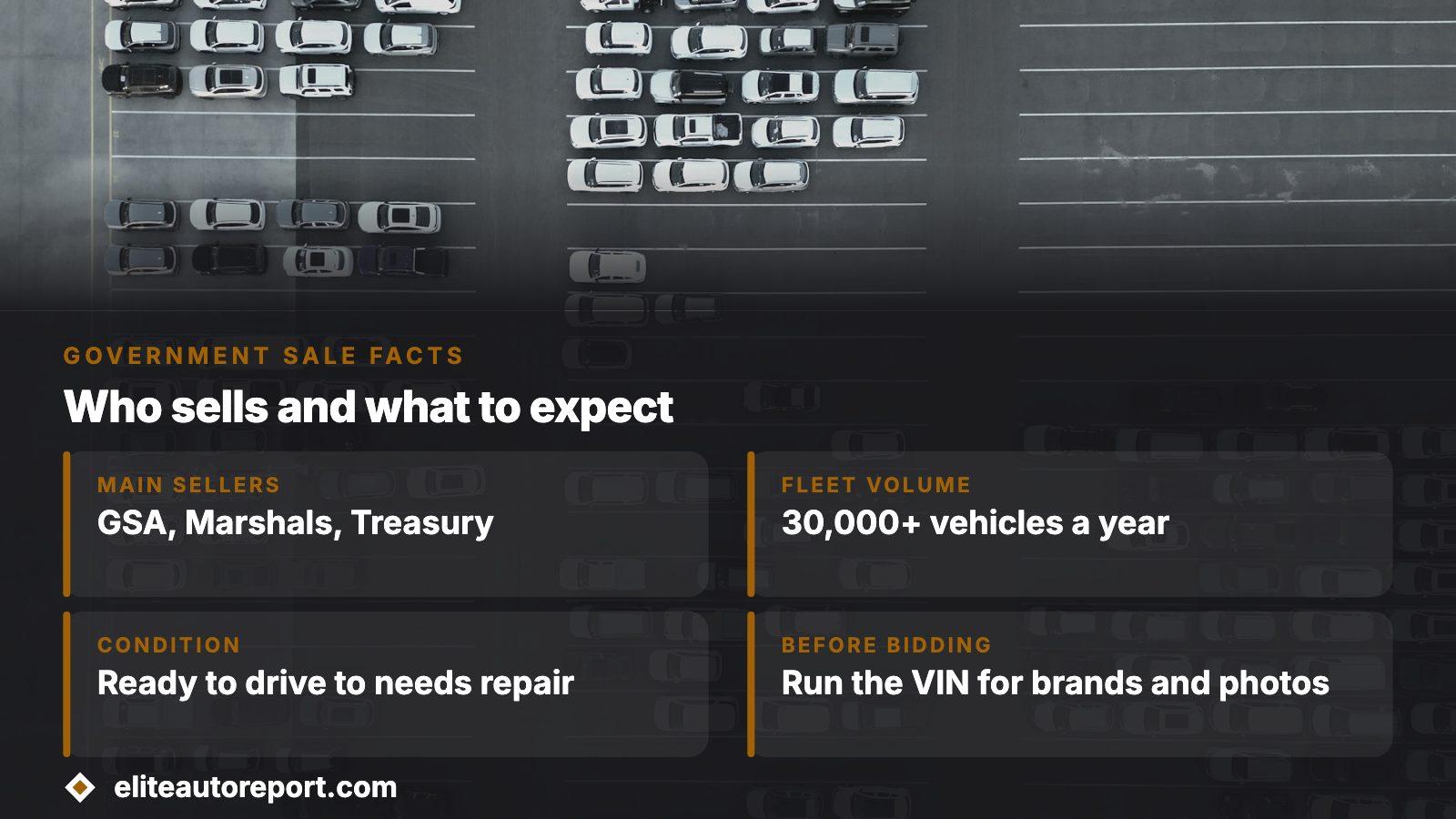
- Main federal sellers
- GSA, US Marshals Service, Treasury
- GSA fleet volume
- 30,000+ vehicles a year
- Condition
- Ranges from ready to drive to needs repairs
- Before you bid
- Run the VIN for title brands and auction photos
Who actually sells cars for the government
There is no single government auction. USAGov describes several channels, and each handles a different kind of car. Cars that GSA Fleet rented out to other agencies reach the public once they hit replacement criteria. GSA Auctions lists vehicles next to other surplus goods. The Marshals Service disposes of what Justice Department agencies and others seized. Treasury handles items forfeited over tax evasion and similar breaches.
Either the owning agency or a contracted auction firm may conduct a given sale, and the format can be a website, a room or an envelope. That detail matters for the VIN work later: the catalog you read is written by whoever runs that sale, not by a neutral party.
What the lots look like, from fleet sedans to seized exotics
GSA says the mix changes from one sale to the next. Expect sedans, wagons, SUVs, vans, pickups, buses, ambulances, heavy trucks, police units and trailers, burning gasoline, diesel or alternative fuels. The GSA Fleet program alone sends over 30,000 vehicles to auction each year.
| Source | What it tends to hold | What to expect |
|---|---|---|
| GSA fleet sales | Cars and trucks retired from federal lease | USAGov calls them good and ready to drive |
| GSA Auctions | Vehicles among many kinds of surplus | Bidding is electronic, lot by lot |
| US Marshals Service | Seized by federal agencies | Condition varies; some need repairs |
| Treasury sales | Forfeited under Treasury law | Condition varies; read each lot |
Our focus is luxury, exotic and classic cars, and the honest answer is that most federal inventory is ordinary fleet metal. A seizure can produce something rarer, which is exactly when a VIN record earns its keep.
How the bidding works on the federal side
GSA's property office lays out the pecking order. Federal agencies have to look at excess items for their own use first, then state and local governments and nonprofits get a turn at surplus. The public gets what is left, and most of it goes to GSA Auctions, where registered bidders can pursue one lot or several inside fixed windows.
The GSA Auctions site refused our automated request, so we have no terms of its sales to report. Fees, payment deadlines and inspection rules are not quoted here. Read them on the sale you are targeting and keep a copy with your bid notes.
Why a government seller is not a clean-history guarantee
A fleet car off a federal lease sounds tidy and a seized car sounds like a gamble. Neither label says a word about brands, old damage or earlier owners. USAGov warns that seized cars may need heavy repairs, but that speaks to condition, not history.
Read the label for what it is
A government sale tells you who owns the car today. The VIN tells you what came before: brands, insurer write-offs, mileage readings and any earlier sale with pictures.
Title brands and the total loss trap
On the Justice Department's NMVTIS site, a brand means a descriptor a state attaches to a title: junk, salvage, flood and the like. Its data arrives from state titling offices, car recyclers, scrapyards and insurance carriers. States do not agree on cutoffs: a repair estimate that earns one state's salvage brand may fall short of another's, and a few states have no flood label whatsoever.
Insurers add their own verdict. One quirk: after a theft goes unsolved for 30 days, a carrier can book the car as a loss. If it is found intact later, that entry is not erased, which is how a perfectly good car ends up flagged. The reverse also holds: a spotless title does not prove a car was never wrecked. The DOJ warns of false negatives, noting coverage of about 87 percent of the national fleet in the text we read.
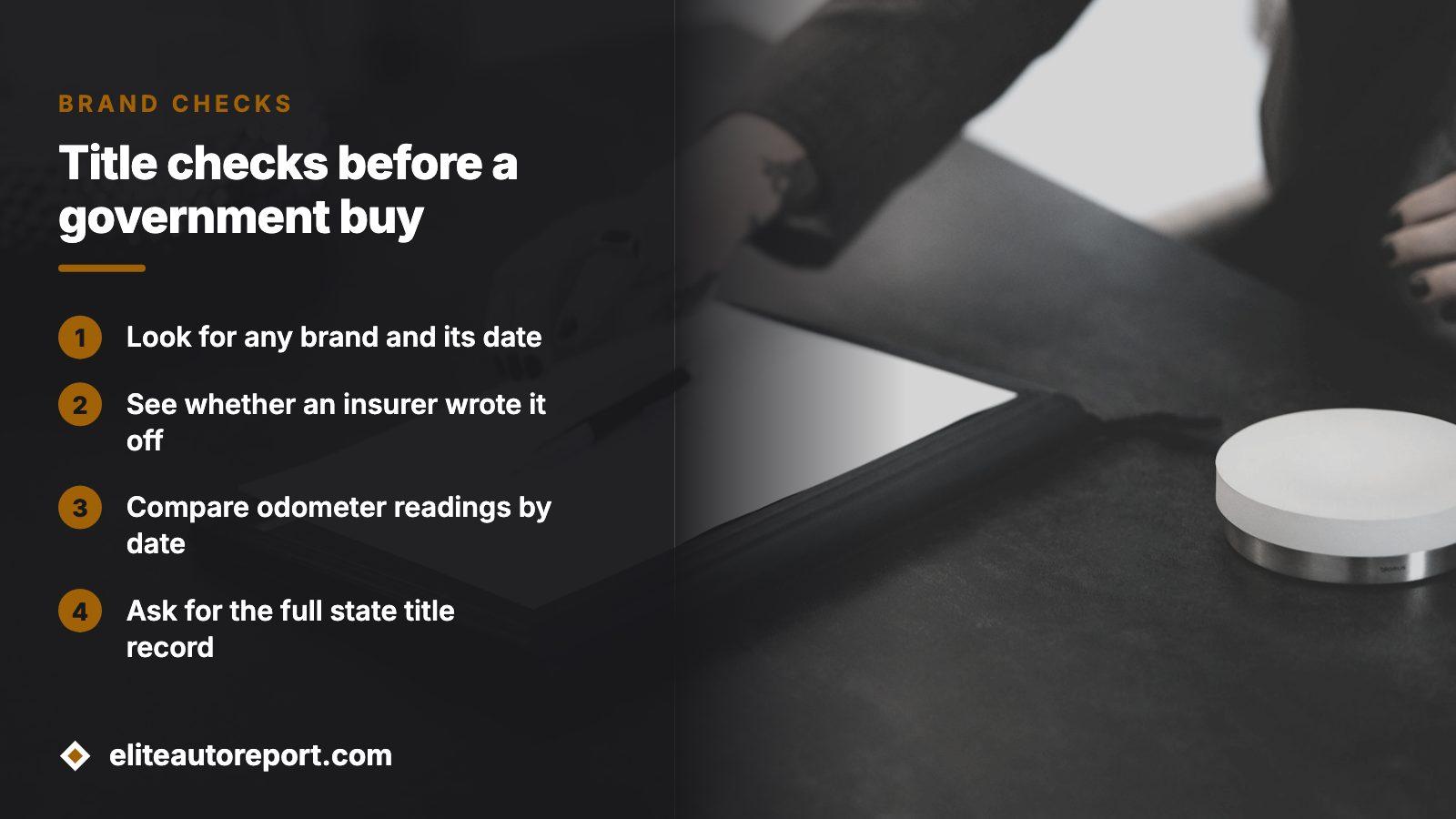
- Any brand at all, plus the date it went on the title.
- Whether an insurance company wrote the car off.
- Compare the odometer readings against the mileage in the lot listing.
- Ask whether the state's full title record says more than the summary does.
Run the VIN before the auction closes
Start with the 17-character VIN printed in the lot listing, or read it off the car if you can walk the lot. A listing that leaves it out needs a question to the seller, never a guess. Type it into our lookup and a preview comes back without payment. The complete report is a later, optional purchase.
For a buyer in this spot, read the brand history first, then damage and insurer entries, mileage readings, plus any salvage-yard or earlier sale record that carries photographs. If the car passed through a dealer or salvage sale in a past life, the pictures often show the damage before anyone repaired it. That is information a lot description rarely carries.
Reading what comes back
Start with brands, then check for contradictions. A clean title paired with a salvage auction record deserves a hard look. A mileage figure that drops between two readings is worse. Treat a record of theft or a lien the same way: ask the seller to explain before you bid, because a government sale may not give you a chance to renegotiate afterward.
- Make sure the number on the car, the listing and the record all agree.
- Read each brand and each insurer write-off entry.
- Line up the odometer readings by date.
- Open the earlier auction photos and compare them with the lot pictures.
- Check open recalls, which the NHTSA lookup also shows.
A report cannot see repairs nobody recorded, and the DOJ itself advises pairing any report with a mechanic's own look. Do both.
Two risks that show up on any auction lot
The NMVTIS site gives two cautionary stories. After Hurricane Katrina, drowned cars were driven to states without a flood label and sold to buyers who saw only clean paint; soaked wiring, airbag sensors included, tends to fail sooner. In Operation Roadrunner, investigators recovered roughly 250 stolen cars wearing VINs copied from lookalike vehicles of the same make, model and year.
Neither problem announces itself in a lot description. A VIN lookup that shows a flood brand from another state, or details that do not fit the car in the photos, is how you catch them.
What the check costs and what to do next
Our preview is at no charge. Buying the report is one payment and creates no subscription; today's options sit on the pricing page. If you are eyeing several lots, a multi-report pack may beat buying singly.
With a clean record in hand, set your own ceiling before the auction opens and stick to it. If the record shows a brand, damage or a lien you did not expect, drop the lot and move on. Plenty of other cars come up every week.
Where this information comes from
- USAGov: Government vehicle auctions — Names the federal sellers and the condition warning.
- USAGov: Government auctions of seized and surplus property — Covers the range of items sold and the agencies behind the sales.
- GSA: Sales of GSA Fleet vehicles — Source for annual volume and the vehicle types.
- GSA: Office of Personal Property Management — Explains who gets first pick of surplus before the public.
- NMVTIS: For consumers — Supports the notes on brands, write-offs, false negatives, flooding and cloning.
Sources and photos: Facts checked against the sources above in November 2026. Photos by Zoshua Colah, Annika Wischnewsky and Iain on Unsplash; diagrams by EliteAutoReport.
Keep reading
- Auction History by VIN: Photos for Luxury, Exotic and Classic CarsWhat a VIN's auction record shows and how to read the photos.
- What Happens When You Buy a Car at Auction: Fees, Title and Hidden HistoryFees, payment and title steps after you win a lot.
- Flood Damage Car Check Before You Bid: A Step-by-Step Guide for Auction CarsHow to spot water damage on a car that went through a sale.
- What to Do After Buying a Car at Auction, From the Paperwork to the PlatesPaperwork and first steps once the car is yours.
Frequently asked questions
Can anyone buy a car at a government auction?
The public can bid on most federal surplus at GSA Auctions after registering, according to GSA. Seized-asset and Treasury sales have their own sites and rules. Read the terms for the specific sale, since eligibility, deposits and pickup deadlines are set by the agency or auction company running it.
Are government auction cars cheap?
We did not find an official price source, so we will not quote one. Fleet units may be ready to drive and seized cars may need repairs, which affects what a fair bid is. Compare the lot against the VIN record, not against a rumor of bargains.
Do government cars have clean titles?
Not automatically. A federal seller can pass along a car that carries a state brand or an insurer total loss entry. Run the VIN and read the brand history, because the sale itself does not promise a clean record.
Can I check a government auction car's history by VIN?
Yes, when the listing shows the VIN, which you should insist on. Our preview comes first, and the paid report adds the damage, odometer and sale detail. If the VIN is missing, ask the seller before you bid.
Does a history report replace an inspection?
No. The Justice Department advises an independent inspection on top of any report. Repairs that were never recorded will not show up, so use the VIN record to rule cars out and an inspection to confirm the ones you keep.
Now check the car itself
The guide explains what to look for. The report shows what this VIN has on record.