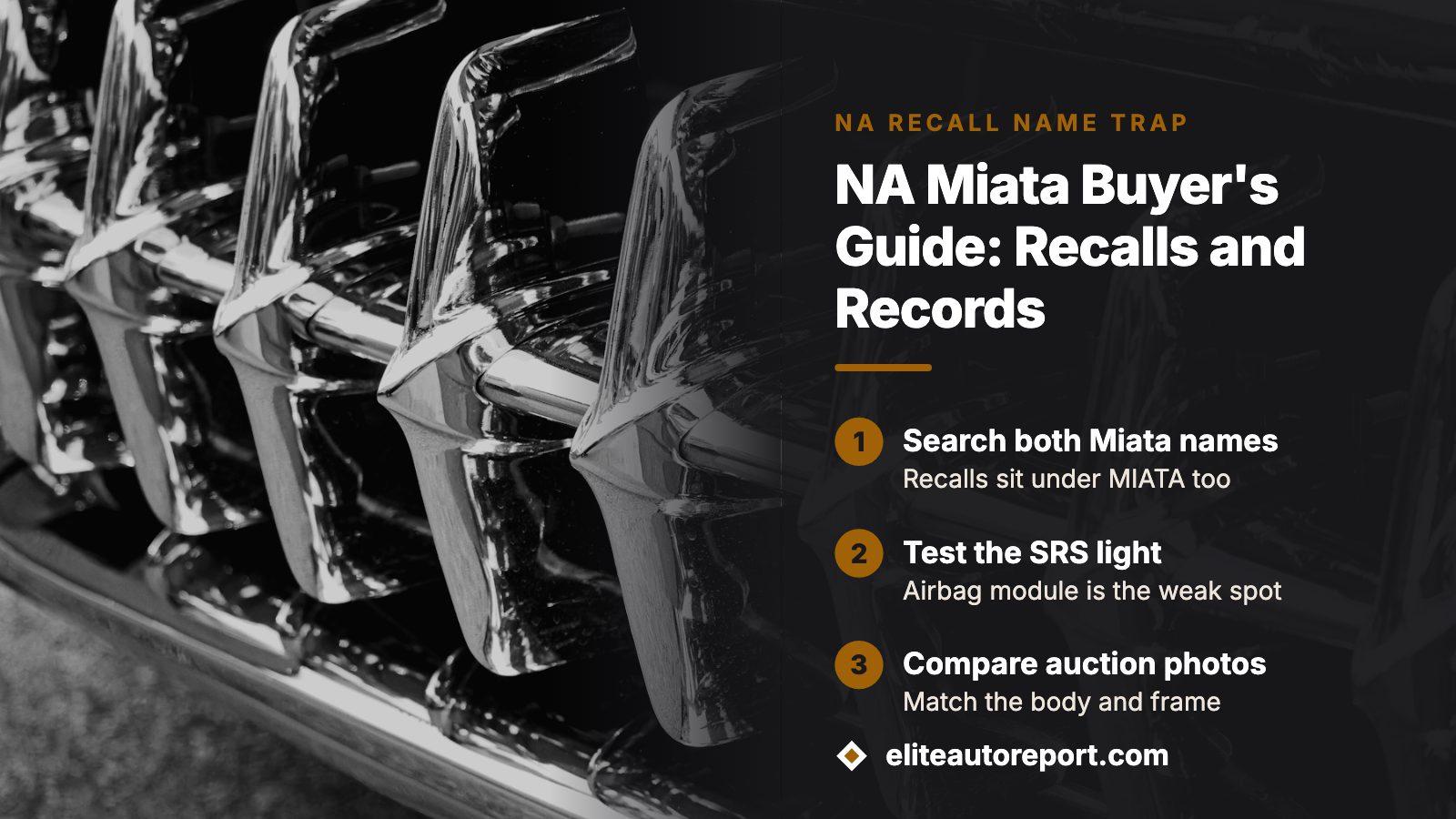
THE SHORT ANSWER
NHTSA holds 192 owner complaint records for 1990 to 1997 Miatas, and the airbag system appears in 74 of them. Recalls are few: a 1991 ABS line, a hardtop hoist, and a 1995 sensor campaign. Search recalls under the name MIATA, not only MX-5 MIATA, then run the VIN for title brands, auction photos and odometer history before you pay.
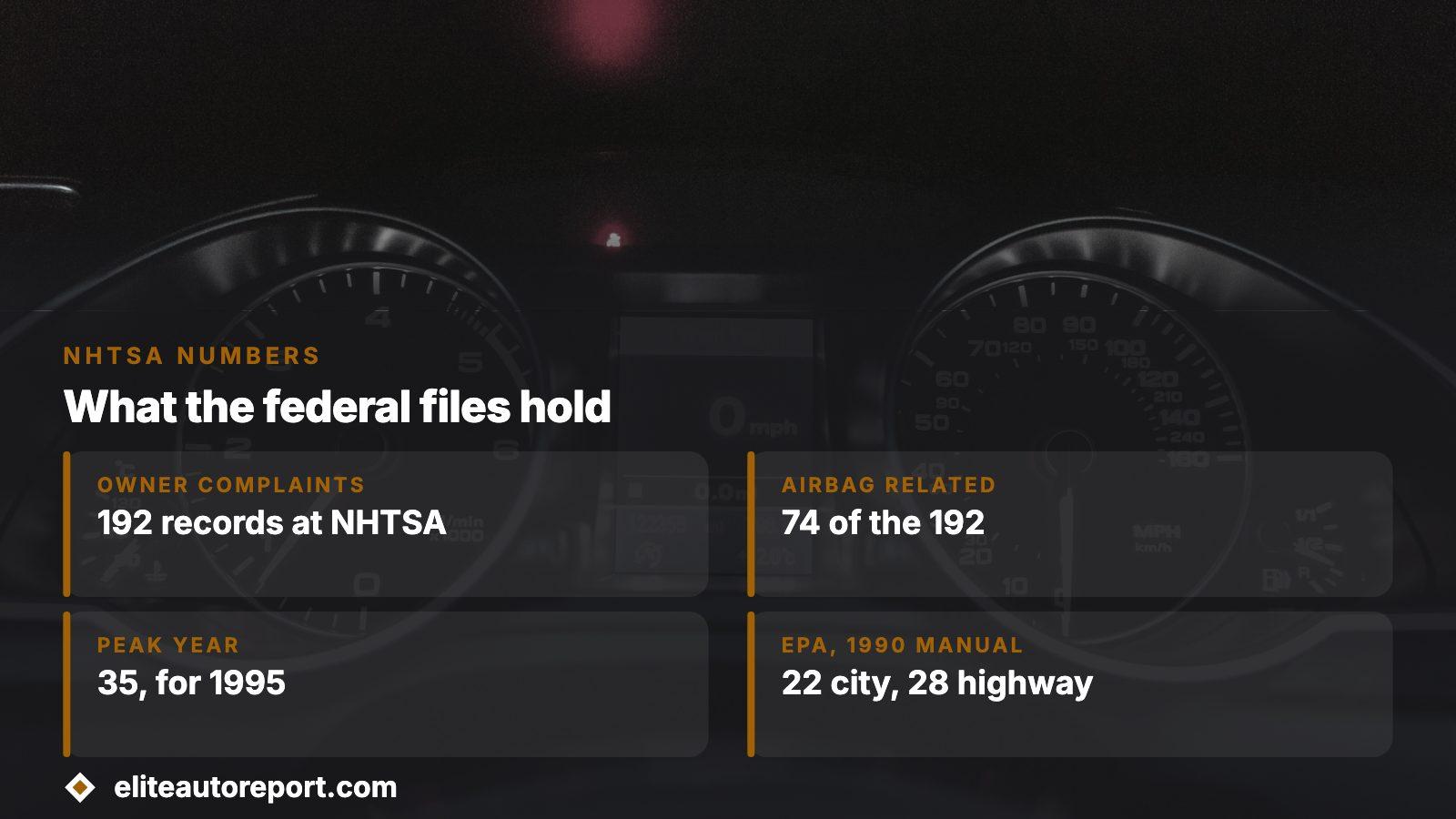
- Owner complaints, 1990 to 1997
- 192 records at NHTSA
- Airbag-related records
- 74 of the 192
- Peak complaint year
- 35, for 1995
- EPA rating, 1990 manual
- 22 city, 28 highway, 24 combined
What federal files say about the NA
Enthusiasts call the 1990 to 1997 cars the NA. Federal databases know nothing of that label. They file the car under make Mazda, with a model year and one of two model names, and I pulled every year from 1990 through 1997 to see what sits under each.
Treat the numbers as hints, not failure rates. A complaint is an owner writing to NHTSA, often years after the event, and nobody knows how many cars were on the road. Still, when one component keeps showing up across eight model years, a buyer should ask about it before looking at paint.
The name trap that hides recalls
NHTSA lists this car as both MX-5 MIATA and MIATA. When I searched recalls under MX-5 MIATA, every year from 1990 to 1997 came back with zero campaigns. Under MIATA, the real campaigns appeared. A buyer who types the longer name and sees an empty list could walk away believing the car has no recall history at all.
Complaints are split the same way, so the totals below add both names together. The lesson applies to the paperwork too: a VIN lookup works from the number itself and does not depend on which spelling a clerk or a database prefers.
The three recalls worth asking about
Mazda North America filed few campaigns for these cars, and the list is short enough to read in full.
| Campaign | Model years | What NHTSA says |
|---|---|---|
| 91V079000 | 1991 | A front ABS return fluid line was connected to a rear one, so fluid from the front brakes goes to the rear system during ABS use. Remedy: replace the ABS systems. |
| 92V159000 | 1990 to 1993 | Plastic buckles on the hardtop hoist accessory kit can break after the hardtop is lifted. Mazda replaces the hoists at no charge. |
| 00V004000 | 1995 | Cars with the SAS sensor unit can deploy air bags in minor undercarriage impacts. Dealers replace the sensor units free. |
Neither name turns up a Mazda campaign for 1994, 1996 or 1997. That is a point in their favor, though the complaint counts below argue against calling them clean.
Where owners complained most
Counts by model year read: 1990 has 31, 1991 has 21, 1992 has 27, 1993 has 13, 1994 has 20, 1995 has 35, 1996 has 32 and 1997 has 13, for 192 in all. The two quietest years are 1993 and 1997, while 1995 and 1996 sit at the top.
Fire is rare in this record. Four records carry a fire flag, two of them from 1995, and 28 carry a crash flag. The pattern is not engines or brakes. After the airbag system, the next components named are electrical, seat belts, engine cooling, power train, tires and the fuel system, each far behind.
The airbag module is the NA's known weak spot
The airbag system appears in 74 of the 192 records: 6 for 1990, 10 for 1991, 6 for 1992, 4 for 1993, 10 for 1994, 19 for 1995, 17 for 1996 and 2 for 1997. Roughly 39 describe a dash warning or a dead control module, and roughly 23 describe a bag firing without a real crash. The 1995 year holds most of the second kind.
The reading is practical. A flashing SRS light on a test drive is not a cosmetic quirk, because owners report that the module may no longer be sold and the fix can chain into several parts. Ask the seller what the light does at startup, and treat a light that never comes on, or a taped connector under the dash, as a reason to negotiate or leave.
From an NHTSA owner complaint
A 1994 owner wrote that the control module quit in 2010 and nothing was sold to replace it. To pass inspection they unplugged the system and rigged a homemade stand-in for the dashboard lamp, then years later tracked down what might have been the last unused module in North America. The takeaway: a lamp that behaves can hide a workaround, so ask who repaired the system and when.
How a flashing light turns into a long repair
From an NHTSA owner complaint
A 1991 owner said the SRS lamp began flashing in 2015. A dealer billed $634.45 for a clock spring and $485.00 for a diagnostic module, and neither cured it. Further parts proved discontinued, used ones could not be installed, and the bag finished up unplugged with its wiring taped. Price any car with an SRS light as if the whole system needs work.
A second owner, of a 1996 car, said a dealer told them no recall covered the car because the campaign applied to late 1995 models, not early 1996 ones. That fits the record above: the sensor campaign lists 1995 alone. A recall check by VIN settles in seconds whether a given car was in scope, rather than relying on a model year guess.
Read the VIN before the listing
NHTSA's decoder handled partial NA patterns well. Each came back with Mazda Motor Corporation as maker, a plant in Hiroshima, Japan, the model MX-5 and a convertible body. The tenth character read L on a 1990 pattern, M on 1991, and P on 1993. A 1990 pattern came back as a 1.6 L four-cylinder.
EPA data lines up with that engine change. The 1990 five-speed manual is a 1.6 L rated 22 city, 28 highway and 24 combined. The 1994 manual is a 1.8 L rated 19 city, 25 highway and 21 combined. If a listing claims a 1.8 L in a 1990 car, or a year that the VIN's tenth character contradicts, stop and ask. Pop-up headlights also separate the NA from the later fixed-lamp car.
What a VIN record adds for a car like this
Cheap sports cars get driven hard, wrecked, rebuilt and resold, and a clean-looking one can hide a salvage sale. An EliteAutoReport check starts with a free preview, and the paid report then shows auction records with photos, title brands, odometer readings and any damage history, so you can compare the photos with the car you are standing beside.
Mazda's own history page notes cumulative production of 250,000 units by November 1992 and 400,000 by November 1996, so plenty of cars changed hands and a long paper trail is normal. The federal title database NMVTIS adds brand history from any state, plus odometer, total loss and salvage records, and it advises an independent inspection alongside the report. Pricing sits on the pricing page, and the report is a single payment.
A short order of checks before you pay
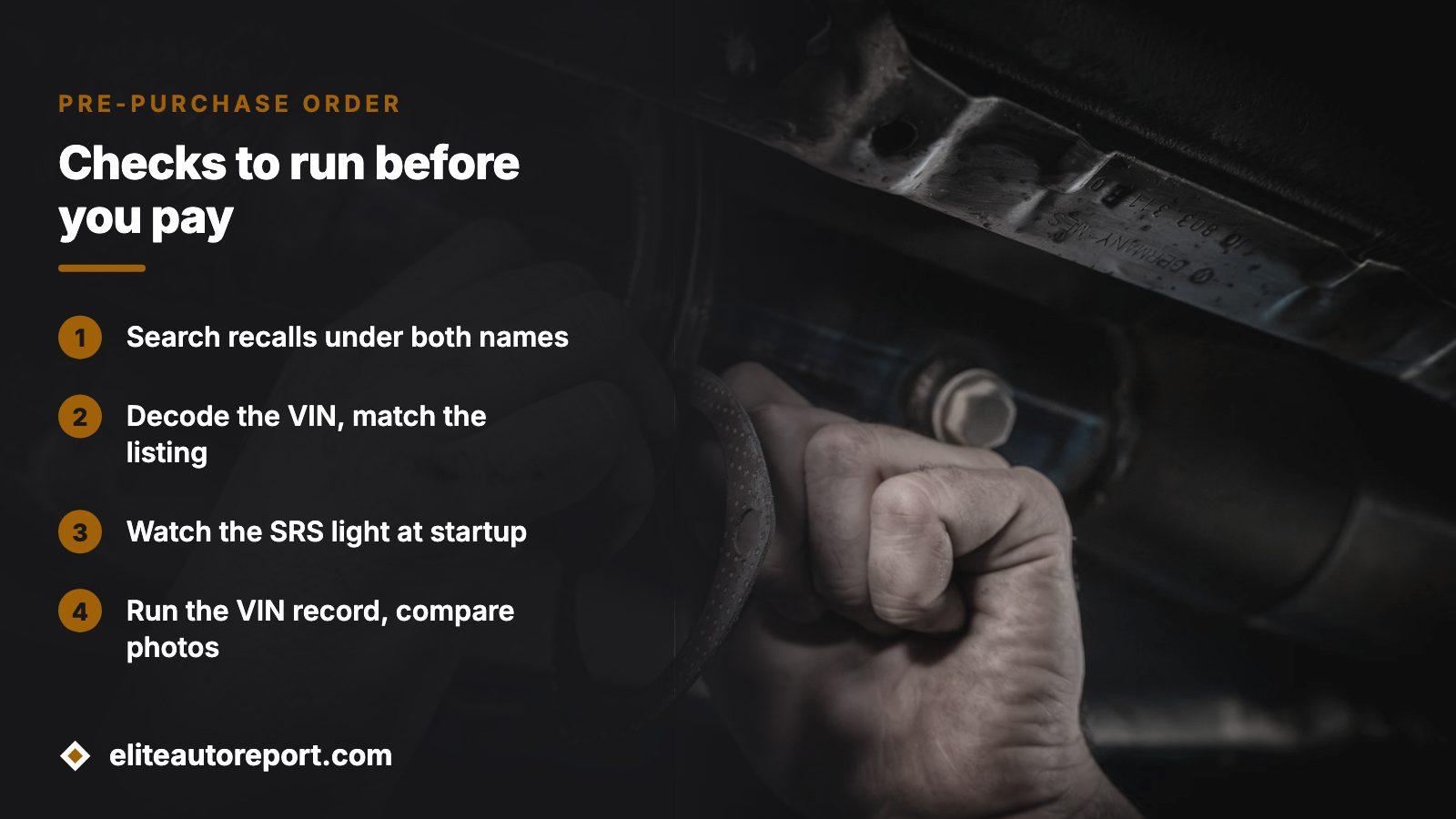
- Search NHTSA recalls under both MIATA and MX-5 MIATA, then confirm by VIN.
- Decode the VIN and match year, engine and plant to the listing.
- Watch the SRS light at startup, and look under the dash for a disconnected or taped connector.
- Run the VIN record and compare any auction photos with the body and frame.
- Have an independent mechanic inspect the car, then negotiate with what you found.
No single record settles a purchase. Read together, they let you decide with open eyes, which is all a buyer can ask of paperwork.
Where this information comes from
- NHTSA recalls API: 1995 Mazda Miata — campaign 00V004000 details and remedy
- NHTSA complaints API: 1995 Mazda MX-5 Miata — owner complaint counts and components
- NHTSA owner complaint 11555114 — owner experience, paraphrased
- NHTSA owner complaint 10957333 — owner experience, paraphrased
- NHTSA owner complaint 11076684 — owner experience, paraphrased
- EPA fueleconomy.gov: 1994 Mazda MX-5 Miata — engine and fuel economy for the later NA
- NMVTIS: understanding a vehicle history report — what the federal title database records
Sources and photos: Facts checked against the sources above in November 2026. Photos by Jacob McGowin, Martin Fennema and Ambitious Studio* | Rick Barrett on Unsplash; diagrams by EliteAutoReport.
Keep reading
- Classic Car Title Search by VIN: What Turns Up and What Doesn'twhat title records show on older cars
- Car Auction Photos by VIN: Find Salvage Sale Pictures Before You Buyhow to read sale photos tied to a VIN
- Mk4 Toyota Supra Buyer's Guide: Records, Recalls and Red Flagsanother cult sports car with its own records
- Car Auction Results Database: Where Classic Car Results Livehow sale results are found and read
Frequently asked questions
Which years count as an NA Miata?
The NA is the first generation, sold for the 1990 through 1997 model years. Mazda's history page says the next generation arrived in 1998 with fixed headlamps, so pop-up headlights mark an NA. The tenth VIN character confirms the year on any car.
Are there open recalls on NA Miatas?
Federal files list a 1991 ABS line campaign, a 1990 to 1993 hardtop hoist campaign and a 1995 airbag sensor campaign. Search under MIATA as well as MX-5 MIATA, and confirm by VIN, since a model year guess can mislead you.
Is a flashing airbag light a deal breaker?
Not always, but treat it as a repair bill and a safety gap. Owners in NHTSA records report discontinued modules and chains of parts. Get a written quote, ask who fixed it before, and weigh the price against a car with a working system.
Does the VIN show the engine size?
A decode can return a 1.6 L four for early cars, and EPA lists 1.8 L for 1994. Match that to the listing and the car itself. A mismatch between engine, year and VIN is worth a direct question to the seller.
What can a VIN check tell me about a Miata that a test drive cannot?
It can show title brands from any state, odometer readings over time, and auction or salvage records with photos. A drive shows how the car feels today, and the record shows what happened before you met it.
Now check the car itself
The guide explains what to look for. The report shows what this VIN has on record.