THE SHORT ANSWER
Toyota calls the fourth generation the A80, built 1993 to 2002. For the United States, NHTSA files cover model years 1993 to 1998: no recalls for 1993 to 1996, one air bag inflator campaign for 1997 and 1998, and 12 distinct owner complaints in all. A clean federal record says little about a specific car, so confirm the airbag work, then run the VIN for title brands, auction photos and odometer readings.
- Toyota's name for the generation
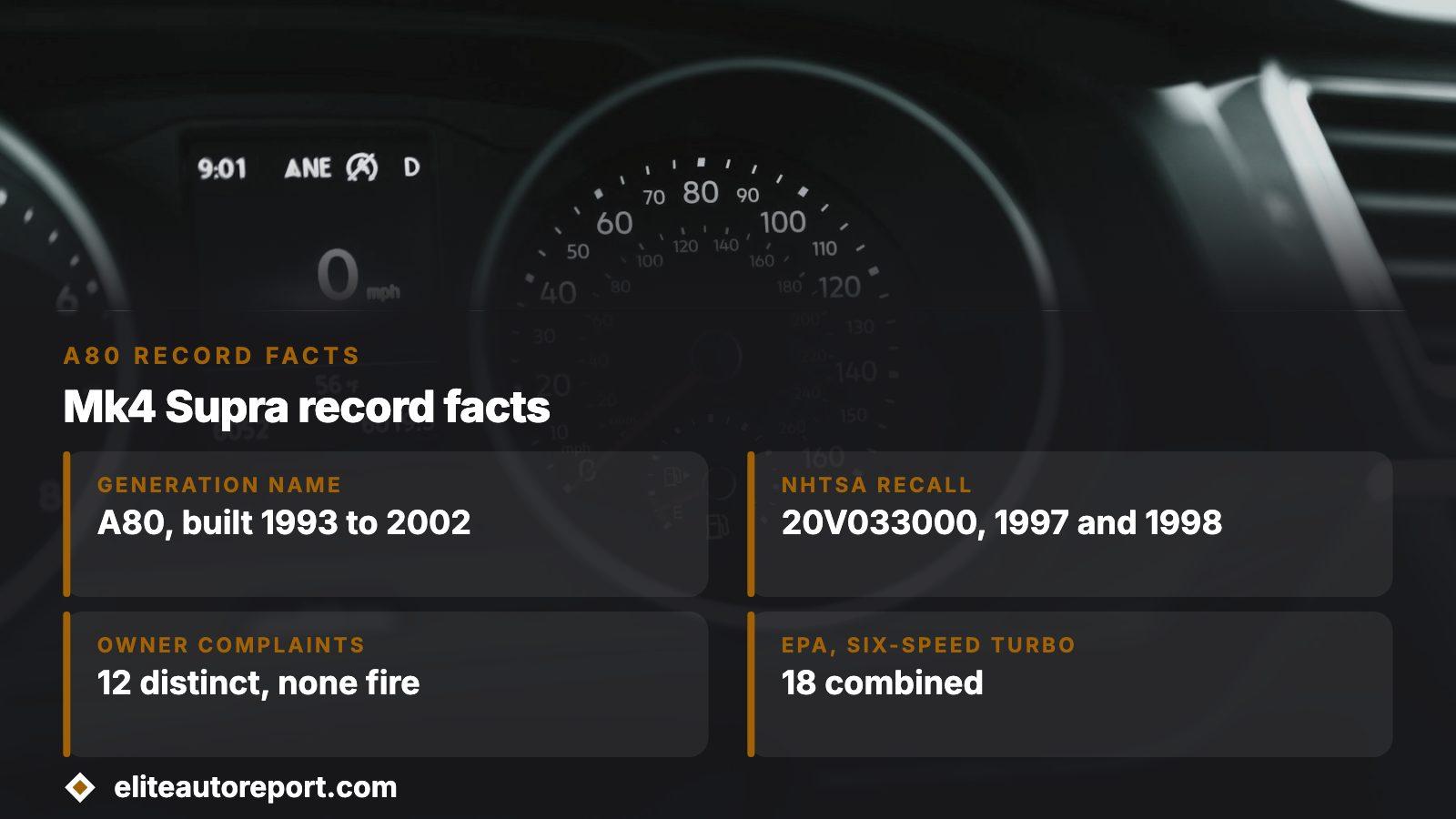
- A80, built 1993 to 2002
- NHTSA recalls, 1993 to 1998
- One campaign, 20V033000, on 1997 and 1998
- Owner complaints, 1993 to 1998
- 12 distinct, none flagged as fire
- EPA rating, 6-speed turbo
- 15 city, 22 highway, 18 combined
What the federal files do and do not cover
Government databases know this car as a Toyota Supra with a model year, nothing more. The labels Mk4 and A80 live in enthusiast circles and on Toyota's own heritage page, which dates the generation from 1993 to 2002. NHTSA's records for American-market cars run from 1993 through 1998, so I read each of those six years directly.
The picture is quiet. That quiet has two readings: the cars were reasonably sorted from the factory, or there are simply few of them and few owners who write to a federal agency. Either way, a short list of campaigns cannot tell you whether the one in the driveway was crashed, flooded or rebuilt.
Recalls by model year
Model years 1993, 1994, 1995 and 1996 return no recall campaigns at all. The 1997 and 1998 cars share a single campaign, opened in January 2020, which is the item to chase.
| Model year | Campaigns in NHTSA API | Notes |
|---|---|---|
| 1993 to 1996 | None | No Toyota campaign returned for the Supra |
| 1997 | 20V033000 | Driver air bag inflator, shared with other Toyota models |
| 1998 | 20V033000 | Same campaign as 1997 |
A blank result for the early years is a fact about the database, not a guarantee. Always type the full number into NHTSA's recall lookup before you hand over money, since new campaigns can appear after a guide like this one is written.
The 1997 and 1998 air bag inflator campaign
Campaign 20V033000 covers certain Celica and RAV4 vehicles along with 1997 and 1998 Supras. The inflators in question do not use the propellant tied to the large Takata recalls. Toyota's filing says a manufacturing problem lets them absorb moisture, so an inflator could rupture or the bag could fill too little.
The remedy is an inspection of the steering wheel serial number, which an owner can start or a dealer can perform, followed by a replacement inflator if the number matches. Toyota says the work costs the owner nothing, and the recall began in August 2020. Ask any seller of a 1997 or 1998 car for the dealer paperwork. If none exists, get the number checked before you drive far.
From an NHTSA owner complaint
A 1994 Supra owner wrote that the 1993 to 1996 headlight housings cloud and yellow with age, and that moisture collects inside. By the owner's account, Toyota had no campaign for it, and the owner worried that dim light and water near wiring made it a safety matter.
Take from it that cosmetic-looking wear on older lamps can affect night driving. Look at the lenses in daylight and again with the lights on.
What owners reported to NHTSA
Across 1993 to 1998, NHTSA holds 12 distinct complaints. Model year 1994 draws the most, with seven, while 1995, 1997 and 1998 have one each and 1996 has none. No complaint is flagged as a fire. Four carry a crash flag, and two injuries are recorded.
- Tires: two Michelin blowouts and one wet-road loss of control after a tire swap.
- Air bags: deployments in two crashes, one ending with a broken arm and facial burns after sudden acceleration into a tree.
- Electrical: a report of the timing retarding and robbing power in warm weather.
- Cooling: a 1998 car that overheated and blew a head gasket.
Small samples mislead. Twelve letters over several decades are signals worth a question, not failure rates.
Overheating and head gasket history
From an NHTSA owner complaint
A 1998 Supra owner described the car overheating on the road, then learning the head gasket had failed. Per that letter, the dealership shrugged it off as typical of the model.
One letter proves nothing alone, but it fits a car that many owners have pushed hard. A cooling failure on a modified engine leaves no mark on a title. A sale record can fill the gap: an auction entry that mentions engine trouble, or fresh photos after a rebuild, may say what the owner's story skips.
Ask for compression and leak-down numbers, coolant condition, and receipts for any head work.
Reading the VIN against the listing
NHTSA's decoder handled a Supra pattern cleanly when I tried it. The 1995 pattern came back as a Toyota Supra built in Japan with a 3.0 L inline six, the 2JZ engine, a Turbo series and 320 horsepower, three doors, and front air bags for driver and passenger. A pattern with the model-year letter for 1994 returned the matching year.
Use that as a test. If a listing says turbo and the decoded series says otherwise, or the year letter disagrees with the title, stop and ask. EPA's own list adds a wrinkle: the 1996 entries show an automatic turbo but no six-speed turbo, and 1998 shows no five-speed manual. A car whose listing does not fit those combinations needs an explanation, though documents can differ from the sticker.
What the VIN check adds for an A80
Sale history is where this site's report helps most on an A80. Plenty of these cars were imported, tuned and passed between enthusiasts, so one number can trail through several owners and sales. The preview of headline records costs nothing. Cost of the detailed report sits on the pricing page, and you pay once, with no subscription attached.
- Auction listings and photos: compare the old pictures with the car you are shown, looking for repaired panels, swapped parts or a different color.
- Title brands: salvage, rebuilt or flood marks, which change value and insurability.
- Odometer readings: a timeline that should climb steadily, not drop or stall.
- Theft and lien records: an unpaid loan or a stolen-vehicle flag that would follow you home.
The Justice Department's NMVTIS site describes a national title database aimed at consumer fraud and unsafe cars, which is a fair reason to check a number instead of taking a seller's word.
A short checklist before you pay
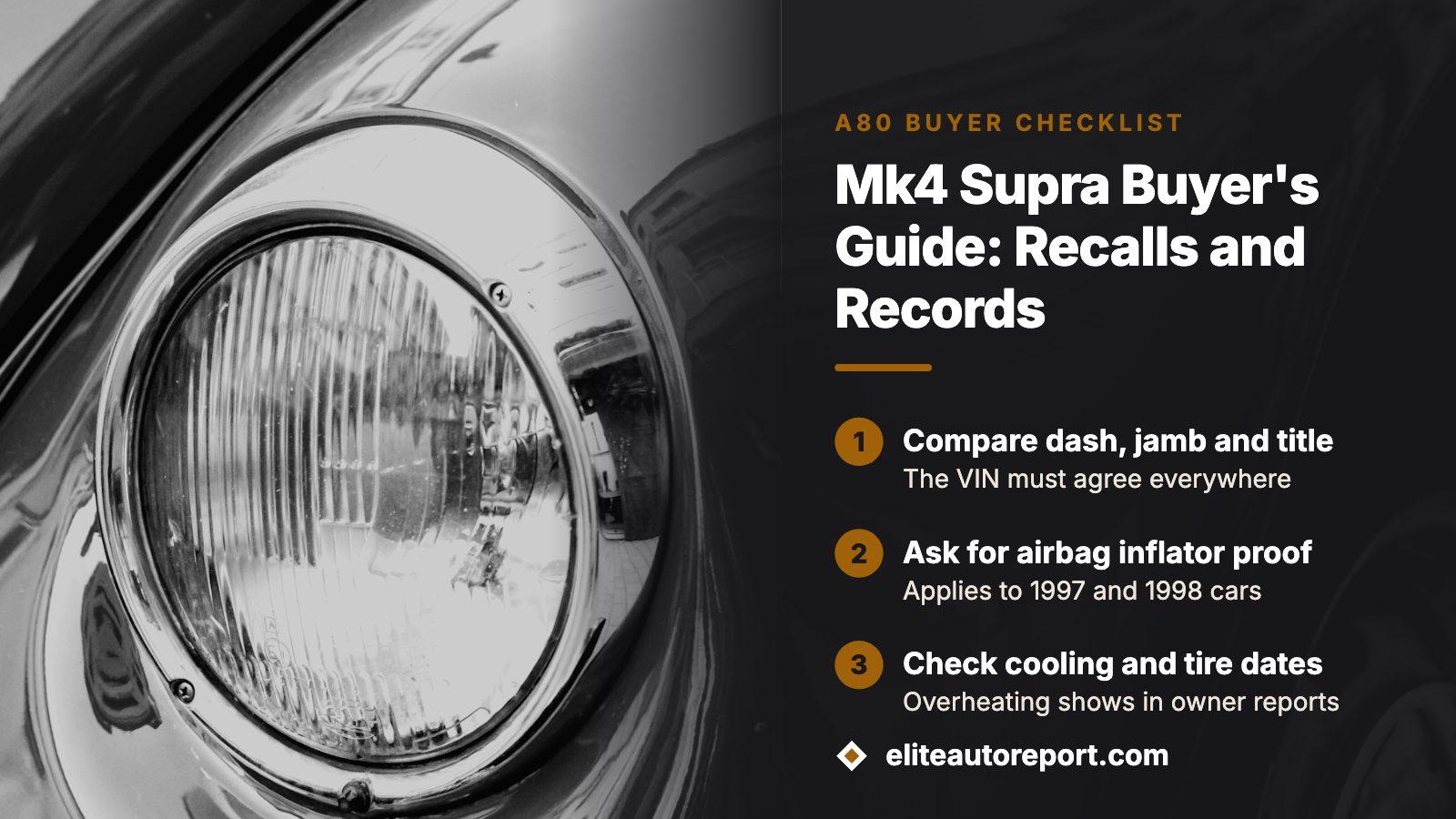
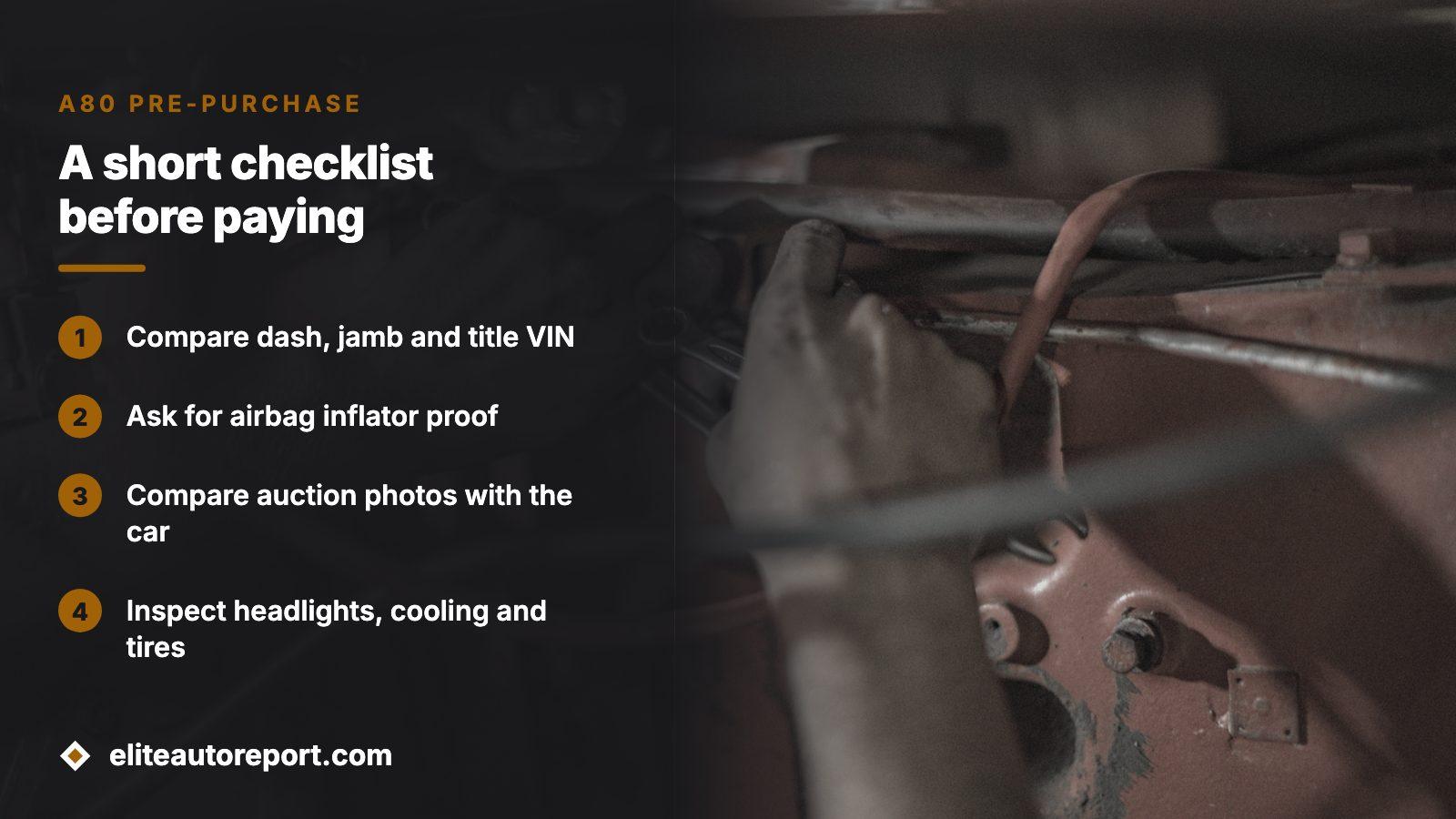
- Compare the VIN on the dash, the door jamb and the title.
- Look the number up on NHTSA and ask for proof of the air bag inflator work on 1997 and 1998 cars.
- Run the VIN check and compare the auction photos to the car.
- Inspect the headlights, the cooling system and the tires, and read the tire date codes.
- Budget for fuel: the EPA lists 15 city, 22 highway and 18 combined for the six-speed turbo cars I checked, on premium gasoline.
If the paperwork and the car disagree, leave. Other Supras exist, and a spotless history beats a costly surprise.
Where this information comes from
- Toyota: Supra heritage page — the A80 name and 1993 to 2002 dates for this generation
- NHTSA recalls API: 1998 Toyota Supra — campaign 20V033000, its defect and remedy
- NHTSA vPIC: VIN decoder — how a Supra pattern decodes
- EPA: fueleconomy.gov 1994 Supra — fuel economy and the transmission lineup by year
- VehicleHistory.gov: NMVTIS — purpose of the federal title database
- NHTSA owner complaint 717513 — owner experience, paraphrased
- NHTSA owner complaint 8012503 — owner experience, paraphrased
Sources and photos: Facts checked against the sources above in November 2026. Photos by Rafał Karoń, Nina Mercado and Nathan Dumlao on Unsplash; diagrams by EliteAutoReport.
Keep reading
- Classic Car Title Search by VIN: What Turns Up and What Doesn'thow title records work for older cars
- First-Gen Acura NSX Buyer's Guide: Recalls, Complaints and VIN Historyanother Japanese sports car with a collector following
- Nissan GT-R VIN Check: Auction Photos, Titles and RecallsVIN checks for the Skyline-lineage GT-R
- Auction History by VIN: Photos for Luxury, Exotic and Classic Carswhat a sale record and its photos can reveal
Frequently asked questions
Which model years count as the Mk4 Supra in the US?
Toyota dates the fourth generation, which it calls the A80, from 1993 to 2002. NHTSA's records for American-market cars run from 1993 through 1998. Check the tenth VIN character against the title and listing, because a mismatched year letter deserves a direct question to the seller.
Are there open recalls on a Mk4 Supra?
For 1993 through 1996, the NHTSA API returns none. The 1997 and 1998 cars fall under campaign 20V033000, a driver air bag inflator issue, with a free inspection and replacement if needed. Enter the full VIN in NHTSA's lookup to see current status.
Does a clean VIN check mean the car is a safe buy?
No. A record shows what was reported, such as brands, sales and odometer readings. It cannot show unreported repairs or hidden wear. Pair it with a pre-purchase inspection by a shop that knows the 2JZ engine, and ask for service receipts.
Can I see old auction photos of a Supra by VIN?
If the car passed through a covered auction, the report can include sale records and photos. Compare them with the car in front of you for repaired panels or swapped parts. Absence of photos only means no covered sale was found.
Is the VIN preview enough before I buy?
Only the preview is free, and it works as a quick filter for obvious trouble. Going deeper means buying the report, a single payment priced on the pricing page. A deposit on a car like this deserves that extra detail first.
Now check the car itself
The guide explains what to look for. The report shows what this VIN has on record.