THE SHORT ANSWER
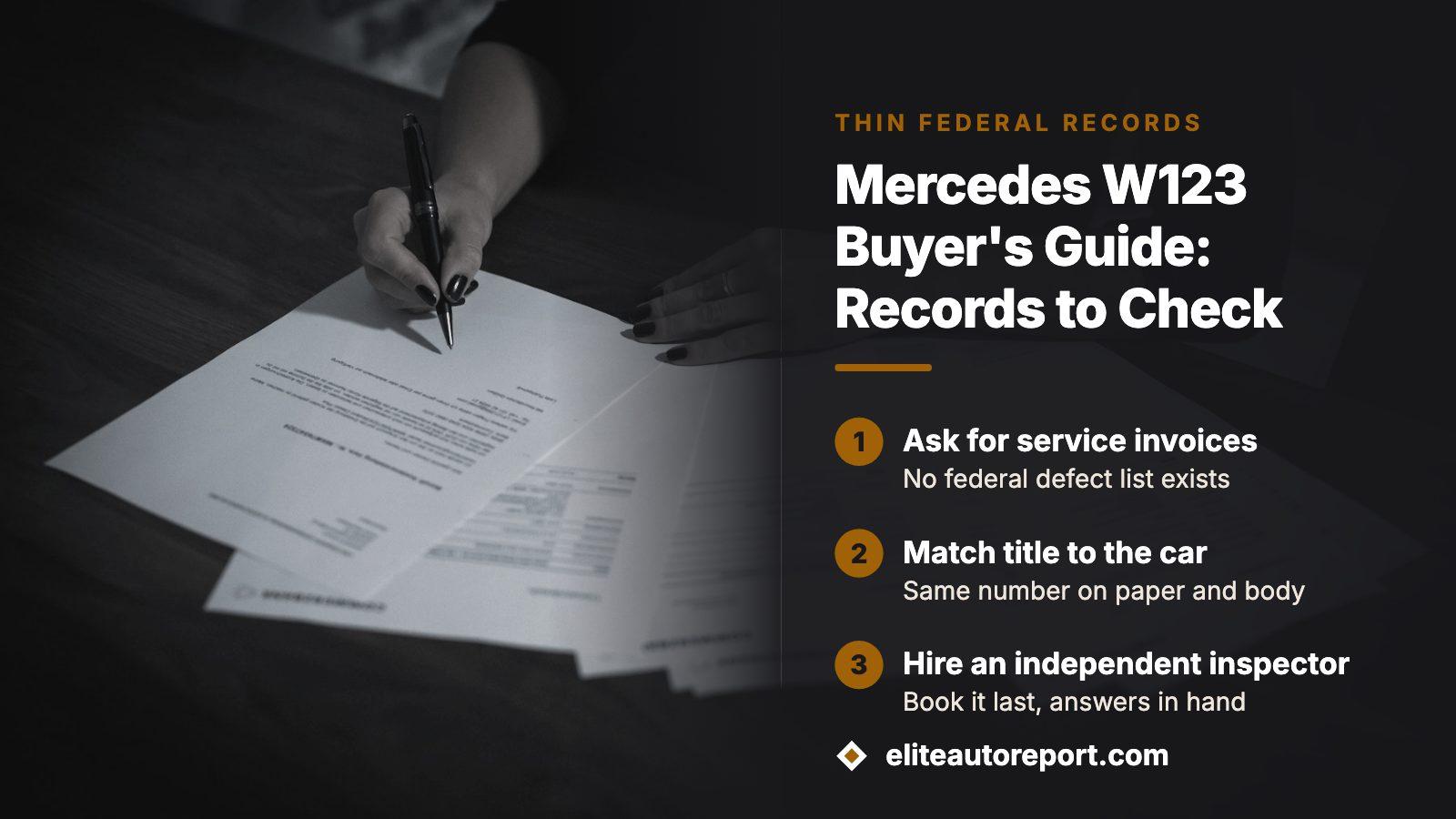
Federal records are thin for the W123. NHTSA lists no recall campaigns and no owner complaints under the 240D, 300D, 300CD or 300TD labels for 1977 through 1985, so there is no federal defect list to lean on. Ask for service invoices, hire an independent inspector, then run the VIN for title brands, odometer history and any auction photos.
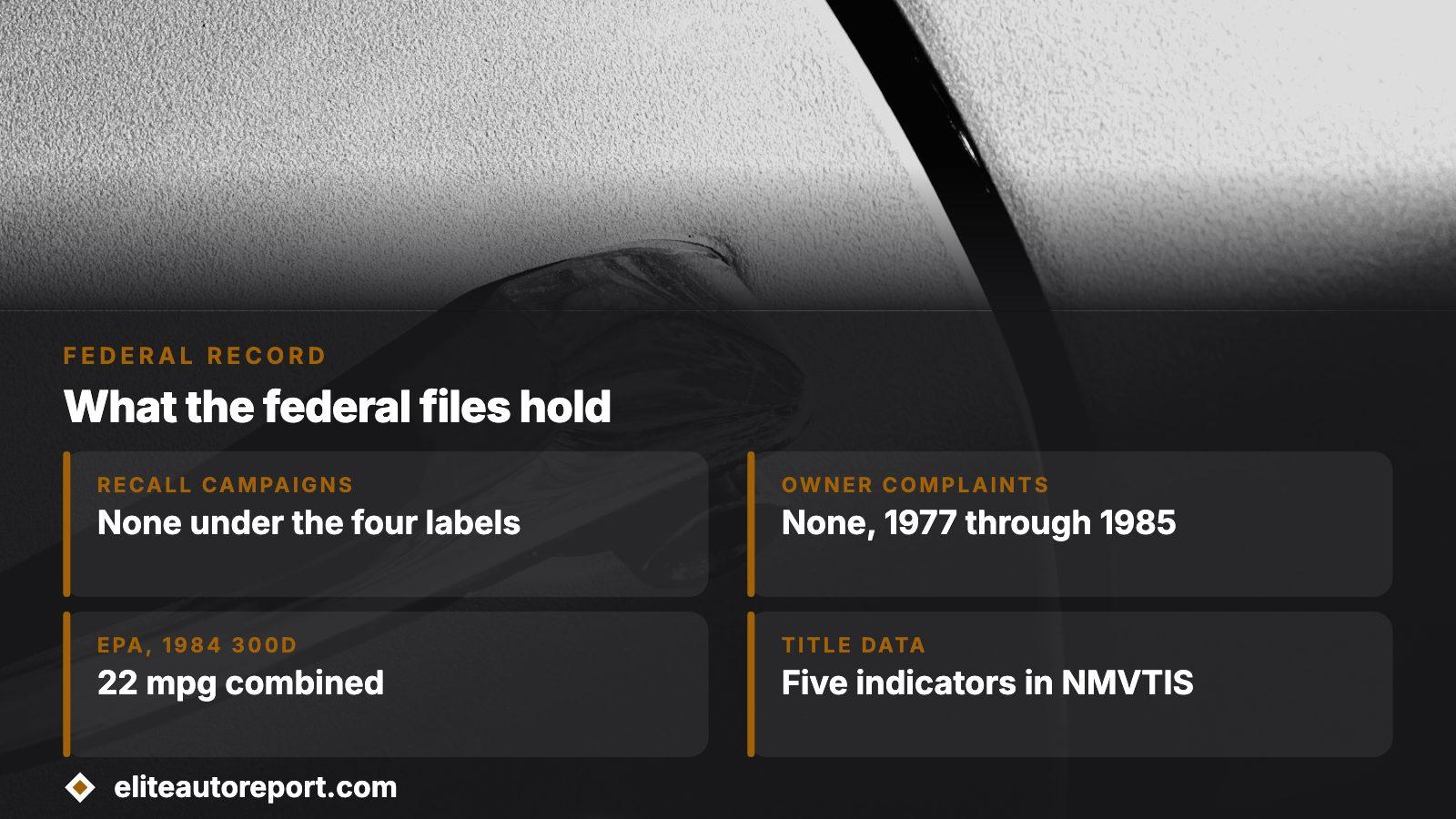
- NHTSA recall campaigns
- None under the 240D, 300D, 300CD and 300TD labels
- NHTSA owner complaints
- None under those labels, 1977 through 1985
- EPA rating, 1984 300D
- 22 mpg combined
- Title data checked
- Five indicators in a federal NMVTIS report
What the federal files hold on these cars
I searched NHTSA's recall and complaint systems myself, using the sales names a W123 would wear: 240D, 300D, 300CD, 300TD, 280E, 280CE and 230, one model year at a time from 1977 to 1985. Bare names such as 240, 280 and 300 got the same treatment for the 1981 to 1985 window. All of it returned zero rows.
An empty result does not show that these cars never failed. It only shows that no filing sits under those names, so a recall lookup on a W123 neither warns nor clears. For a car this old, the history lives in invoices, title records and the metal itself.
How the VIN reads on a W123
NHTSA requires a 17-character VIN on every motor vehicle, and its free decoder, vPIC, relies on data the manufacturers supplied. Usefulness varies by year. For 1980 the Mercedes-Benz list holds only heavy truck names. Passenger names 240, 280, 300 and 380 show up for 1981, while the 1985 list keeps the 300 and no longer carries 240 or 280.
A late car's number may decode to a model and engine size, while an early car's may return little or nothing. A blank result points to age, not to a bogus number. Write down what is stamped or plated on the car, set it beside the paper title, and record any mismatch before price comes up.
Same number in three places
Compare the plate on the car, the title and any registration the seller produces. One wrong character is enough to pause the deal until it is explained.
Which model labels the records use
Owners say W123, but agencies file by sales name. On the EPA's fuel economy site the 1984 and 1985 cars appear as the 300D and 300CD, grouped as compacts, plus the 300TD, grouped with wagons. Each is a three-liter five-cylinder diesel with four forward gears. The 1985 entries add a turbo note and rear-wheel drive.
| Label in EPA listing | Class | 1984 combined | 1985 combined |
|---|---|---|---|
| 300D / 300CD | Compact car | 22 mpg | 19 or 21 mpg |
| 300TD | Station wagon | 22 mpg | 19 or 21 mpg |
Two figures in a 1985 cell mean the EPA published more than one entry for that model, one of them a California version. A seller's quoted mileage should land inside those published ranges.
Paperwork that substitutes for a recall list
With no federal defect file, the seller's folder becomes your recall list. A cared-for diesel sedan usually leaves a trail of dated invoices, parts receipts and shop names. A car with a story and no paper asks you to accept the story on faith.
- Dated service invoices showing the shop and the mileage
- The title, matched to the number on the car
- Receipts for big repairs, with a shop phone number you can call
- Old registration or inspection papers the seller kept
- A previous owner's name, if the seller knows it
The NMVTIS site passes along the same federal advice. Have a mechanic inspect the car, drive it on hills and highways, and ask for the maintenance file. If the seller is a newcomer to the car, find the owner before.
The title and auction trail behind the car
A federal NMVTIS report is built around five checks. Title state and date come first, then brands, the odometer, total loss and salvage. Titling offices attach brand labels such as junk, salvage and flood. Brevity is intended, and the government site treats an empty report as a good result.
At EliteAutoReport the focus is the auction side. Even a well-kept W123 can have crossed a sale lane, and photos from that sale show the car as it stood that day: panels, glass, cabin and sometimes the underside. Sellers' own pictures rarely include that.
Why a clean title is still not enough
Title data reflects what a state or insurer reported. It misses a driveway repair or damage nobody recorded, so pair it with an inspection.
When to run the VIN check
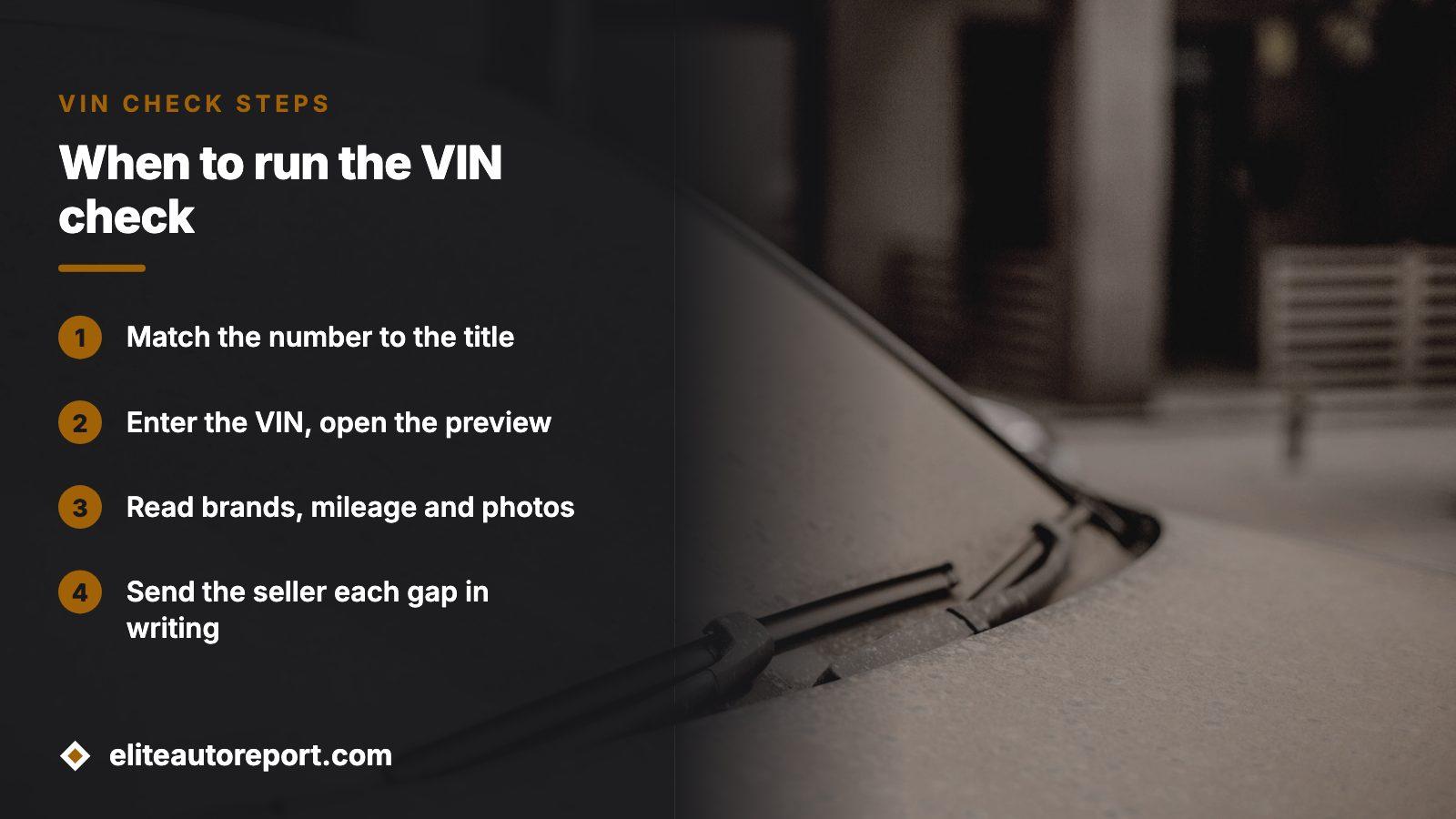
Run it once the paperwork looks plausible and before a deposit or an inspection fee. The preview is free and shows whether records exist; the full report is one payment. A brand, an odometer jump or an auction entry hands you a pointed question for the seller in place of vague worry.
- Write down the number on the car and match it to the title.
- Enter the VIN and open the preview.
- Read the brands, mileage entries and any sale photos.
- Send the seller each gap or surprise in writing.
- Book the inspection last, with the answers in hand.
Report prices sit on the pricing page, and nothing renews on its own.
Reading the result and deciding
A clean report and a thick invoice folder make the best case, and still the inspection decides. A brand, total loss or salvage entry rewrites the car's story and price, and the seller should answer with documents. Mileage that drops from one record to the next is a reason to leave.
Older cars often show gaps simply because few events were reported, and a gap alone proves nothing. Ask what the car was doing then and whether that owner can be reached. Upkeep cost matters too; the maker runs a classic program with genuine parts, so ask a specialist what a given repair involves before committing.
Where this information comes from
- NHTSA: VIN decoder — the 17-character rule and the public decoder
- NHTSA vPIC: Mercedes-Benz models for 1981 — which passenger names the decoder lists by year
- NHTSA recalls API: 1984 Mercedes-Benz 300D — empty result for the W123 labels
- EPA fueleconomy.gov: 1984 Mercedes-Benz models — model labels, classes and mpg
- NMVTIS: Understanding a report — the five title indicators and what a clean report means
- NMVTIS: Used car buying tips — inspection and records advice
Sources and photos: Facts checked against the sources above in November 2026. Photos by Dimitri Karastelev, JavyGo and Linus Belanger on Unsplash; diagrams by EliteAutoReport.
Keep reading
- Where Is the VIN on a Classic Car? Dash, Door, Firewall and Framefind the number on an older car
- Classic Car Title Search by VIN: What Turns Up and What Doesn'tlook into a classic's title before paying
- Matching Numbers Classic Car: How to Verify the Claim Before You Payconfirm the parts belong with the body
- BMW E30 Buyer's Guide: Federal Records and Auction Trailanother older European sedan, with federal data to compare
Frequently asked questions
Does NHTSA list any recalls for the W123?
None turned up under the names I searched. The 240D, 300D, 300CD and 300TD labels, checked year by year, gave no campaigns. NHTSA has nothing filed there, so lean on the car's service records and an inspector.
Which W123 should I buy, the sedan, coupe or wagon?
Federal files cannot rank them. The EPA groups sedan and coupe as compacts and the wagon apart, yet gives all the same 1984 combined figure. Choose on condition and documents, then check each car's own title history.
Will a VIN decoder work on an early car?
Sometimes it will not. The vPIC list for 1980 holds only truck names for this maker, and passenger names begin with 1981. A blank decode on an early number reflects age, so match the number to the title instead.
What does a title report show on a car this old?
A federal report covers title status, brands, mileage, total loss and salvage. It is brief on purpose. A clean result is welcome but cannot replace a hands-on look from someone who knows these cars.
Why check auction history on a classic Mercedes?
Cars pass through sale lanes more often than sellers say. Sale records and photos capture one day's condition and can back up or contradict the owner's account. Start with the VIN preview, then ask about whatever it shows.
Now check the car itself
The guide explains what to look for. The report shows what this VIN has on record.