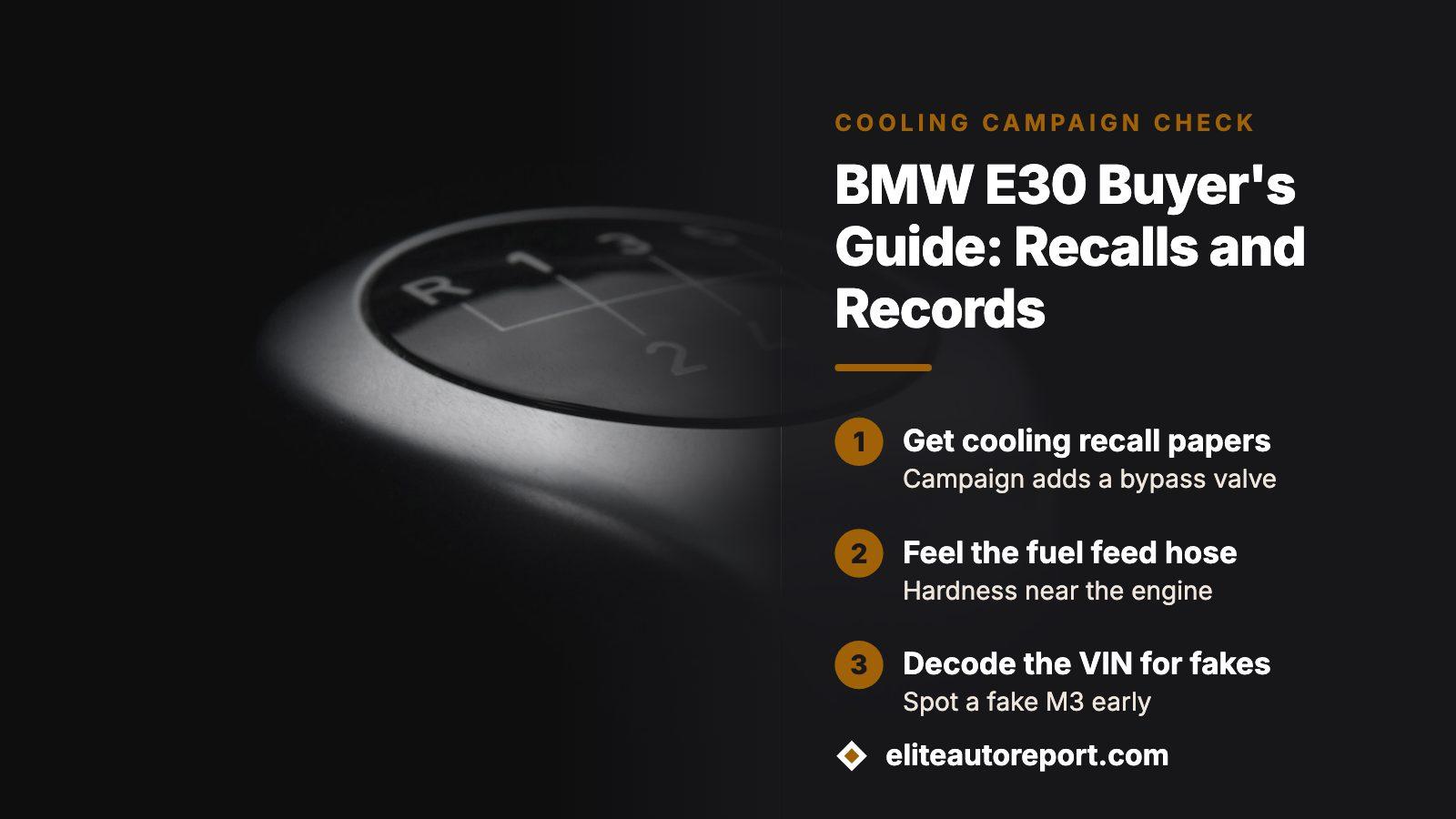
THE SHORT ANSWER
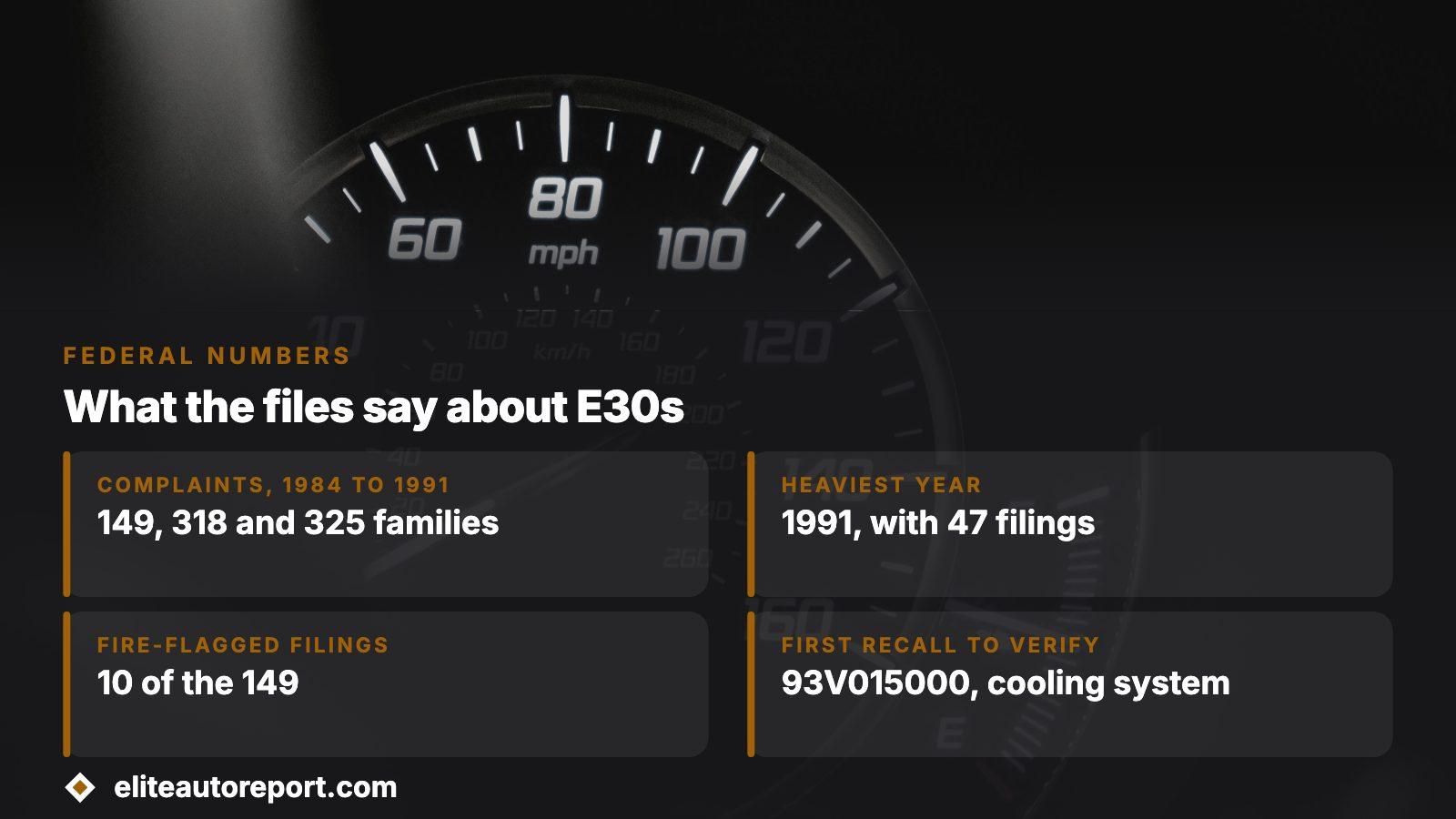
The record that matters most on an E30 is recall 93V015000, a cooling campaign that added a bypass valve and a revised radiator cap. NHTSA holds 149 owner complaints for the 318 and 325 families, and 1991 is the heaviest year with 47. Ask for proof of the cooling work, look at the fuel feed hoses, then run the VIN to see title, damage and sale photos.
- Complaints filed, 1984 to 1991
- 149 for the 318 and 325 families
- Heaviest model year
- 1991, with 47 filings
- Fire-flagged filings
- 10 of the 149
- Recall to verify first
- 93V015000, cooling system
Why you will not find the word E30 in federal data
Owners say E30. The government does not. NHTSA lists these cars as BMW 318, 318i, 318is, 325, 325e, 325i and M3 for model years 1984 through 1991, so any search for the chassis code returns nothing. I queried each label and year through the public recalls and complaints interfaces, then merged duplicates by complaint number.
Entries named 320, 323i or plain 3 Series appear in a few years and could describe a different car, so I excluded them. Treat every count in this guide as a pointer toward trouble spots rather than a failure rate. NHTSA has no idea how many cars were driven, and many owners wrote in years after the event.
The cooling campaign every buyer should chase down
Recall 93V015000 is the one that touches most of these cars. It names the 318 and 325 for most years in the 1984 to 1991 span, and the M3 from 1988 on. NHTSA describes a coolant system component that fails and sends temperature and pressure well past normal.
The listed outcomes include split hoses, a leaking radiator or expansion tank, hoses slipping off their fittings and a cracked heater core end piece. Scalding coolant can reach the driver's right lower leg, and the vapor can cloud the windshield. Dealers were told to fit a thermostatic bypass valve and a new radiator cap with extra overflow capacity.
What to ask the seller
Request the invoice that shows the valve and the new cap. If the engine bay has an original-style cap, no valve and pale crust along the hose joints, assume the work was skipped or has since failed.
From an NHTSA owner complaint
One owner of a 1985 318 wrote that the radiator cap gave out after the recall repair had already been performed, and the car overheated. The lesson for a buyer: a stamped invoice is a start, and the cap and hoses still deserve a hands-on look.
The smaller campaigns, year by year
Several older campaigns sit beside the cooling work. None should scare you off, but each is worth a line on your checklist.
| Campaign | Cars listed | Defect in NHTSA's words, shortened |
|---|---|---|
| 86V138000 | 1985 318 and 325, 1986 325 | Steering column element could come apart after a hard knock, with loss of steering control |
| 86V151000 | 1986 and 1987 325 | Brake light switch could overheat and melt nearby plastic |
| 88V031000 | 1988 325 | Bent dipstick tube bracket could jam the throttle linkage lever |
| 94V066000 | 1989 325, 1990 and 1991 318 | Hardened feed fuel hoses can seep at the engine fitting |
| 91V219000 | 1991 318 | Crankcase vapor can freeze inside the intake boot in cold weather |
| 91V054000 | 1991 318i and 318is | Driver knee bolster fitted wrongly, so the column would not move forward in a crash test |
What owners reported, model year by model year
Across the 318 and 325 families NHTSA holds 149 complaints. By model year the counts run 11, 13, 11, 22, 12, 20, 13 and 47 for 1984 through 1991 in order. Ten of the 149 carry the fire flag, 19 mention a crash, and the injury total is 22.
- Engine and cooling components appear in 46 complaints, far ahead of anything else.
- Visibility problems come next at 24, which fits fogged glass from the coolant failures.
- Speed control shows up 14 times, seat belts 11, electrical and fuel system 10 each.
- Air bag complaints total 7 and cluster in 1991, the busiest year at 47.
The M3 looks calm by comparison. The 1988 car has 2 complaints, both about cooling, and the 1989 to 1991 cars have none on file. A short list can simply mean few cars were registered, so lean on the inspection rather than the tally.
1987 and the electrical fires
Five of the 22 complaints for 1987 are fire flagged, which is half of all fire reports across the generation. They describe a short in the wiring harness, a blaze in the fuse box, engine fires and one fire that began after the car was parked.
From an NHTSA owner complaint
An owner of a 1987 325 described a short in the engine-bay harness that ended in a fire. No recall is attached to it, so inspection is the only defense.
Aged insulation cracks and rubs through. Look at harness routing near the fuse box and firewall; tidy repairs are fine, sloppy splices are a reason to haggle or leave.
When the recall paperwork does not match the car
Recall data on old cars is patchy, and owners have hit snags.
From an NHTSA owner complaint
The owner of a 1988 M3 saw 93V015000 listed for the car, yet BMW's customer line said it was not covered. White residue had formed around the hoses and radiator seams, and the radiator was replaced in 1991.
Dry hoses, a clean expansion tank and radiator receipts beat any database entry.
Decoding the VIN and spotting a fake M3
NHTSA's free vPIC decoder handles many E30 numbers. A partial pattern starting WBAAB5400H returned a 1987 BMW 325 sedan with a 2.7 liter six and the trim shown as E30. A partial pattern starting WBSAK0300J returned a 1988 M3 coupe built by BMW M GmbH. Partial entries trigger warnings, and the decoder depends on what the maker filed, so old cars can come back thin.
Start from the complete number on the car, not the one typed in the ad. An M3 clone is a 325 wearing an M3 badge, and a decode that says 325 exposes it at once.
What an auction-focused VIN check adds
Federal files describe the model. They say nothing about the one car you are considering. A VIN report can list title brands, salvage sales with photos, odometer readings, theft records and open recalls. For a collector car the auction trail is often the most telling piece. Sale photos can reveal rust, repaint or collision damage.
The free preview tells you what the full report would cover for this VIN, so you can judge it before paying once. Pricing is on the pricing page. Coverage on cars this old depends on the state and the record source, so a short report is not proof of a clean past. The federal NMVTIS title database tracks labels like junk, salvage and flood. Flood cars trucked to other states are a known hazard, since saltwater wrecks electronics.
A short checklist before any deposit
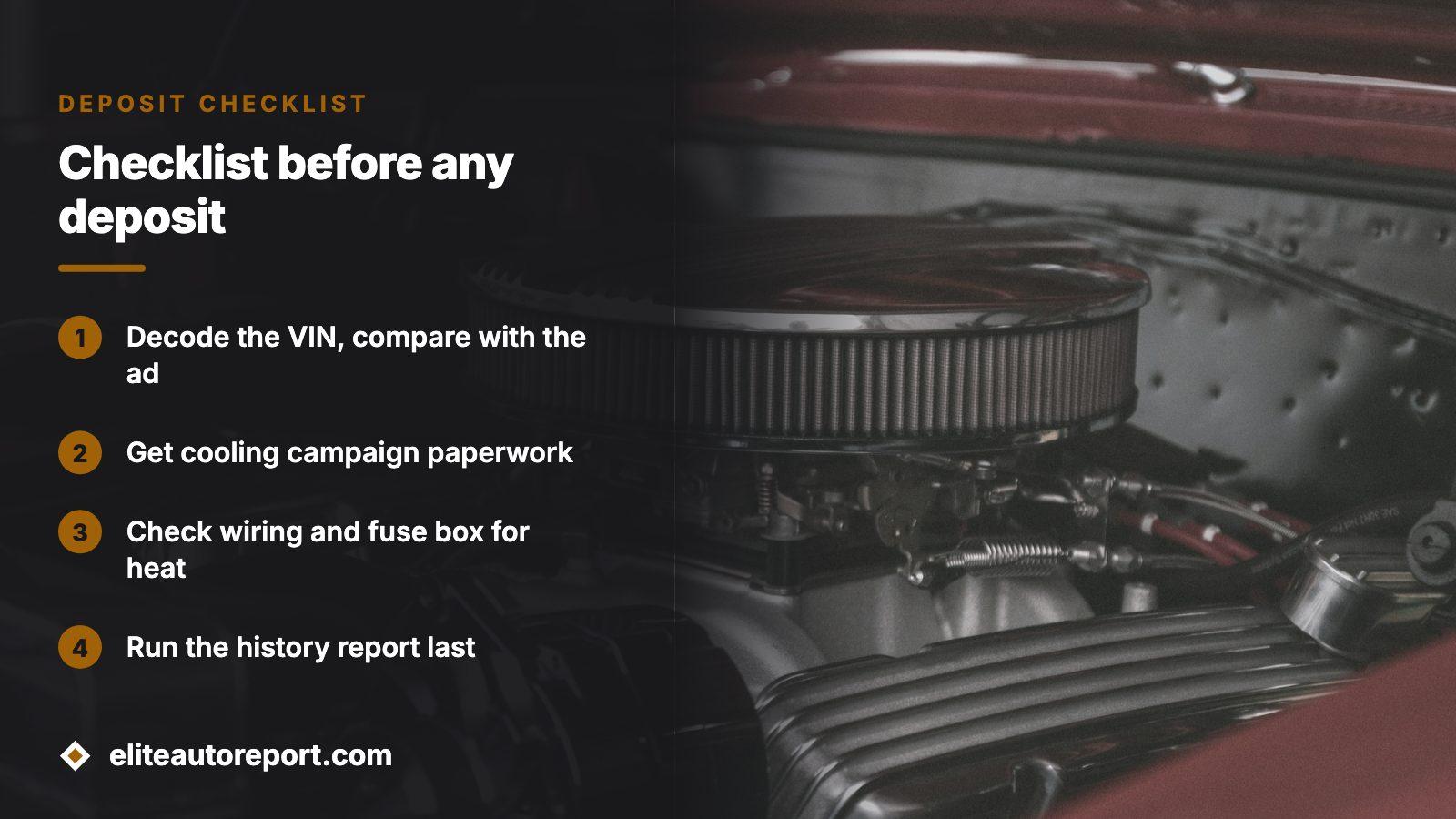
- Decode the complete VIN and see whether model, year and body agree with the ad.
- Get paperwork for the cooling campaign and inspect cap, hoses and radiator seams.
- Feel the feed fuel hose near the engine for hardness or dampness.
- Check wiring and the fuse box for heat marks, especially on a 1987.
- Run the history report once the paperwork lines up.
If the report shows a brand, a sale with damage photos or odometer readings that move backward, the car may still be worth owning. The price and the inspection should simply change to match.
Where this information comes from
- NHTSA recalls API: 1989 BMW 325 — campaign numbers, dates and remedies
- NHTSA complaints API: 1987 BMW 325 — complaint counts, components and fire flags
- NHTSA owner complaint 482366 — owner experience, paraphrased
- NHTSA owner complaint 508309 — owner experience, paraphrased
- NHTSA owner complaint 700839 — owner experience, paraphrased
- NHTSA vPIC VIN decoder — how partial E30 and M3 patterns decode
- VehicleHistory.gov: NMVTIS for consumers — what the federal title database records
Sources and photos: Facts checked against the sources above in November 2026. Photos by Matthias Speicher, Victor Hughes and NATHAN MULLET on Unsplash; diagrams by EliteAutoReport.
Keep reading
- BMW M3 VIN Check: Auction Photos, Titles and Recalls by Yearthe M3 version of this check
- Matching Numbers Classic Car: How to Verify the Claim Before You Payconfirm the engine and body belong together
- Where Is the VIN on a Classic Car? Dash, Door, Firewall and Framelocate the number on an older car
- Classic Car Title Search by VIN: What Turns Up and What Doesn'tlook into a classic's title before paying
Frequently asked questions
Which BMW E30 years are best to buy?
Federal files cannot crown one. 1991 draws the most complaints at 47, and 1987 holds half the fire-flagged filings. The quietest years are 1984 and 1986 at 11 each. A documented service history and a clean title count for more than the model year.
Does every E30 fall under the cooling recall?
No. Campaign 93V015000 names the 318 and 325 for most years and the M3 from 1988, so some cars sit outside it. Type the whole number into NHTSA's recall search, and ask the seller for paperwork proving the valve and cap went on.
Can I decode an E30 VIN at no cost?
Yes. NHTSA's vPIC tool costs nothing and reads many old BMW patterns, giving model, year and engine size. Output for aged cars can be sparse, and a partial number triggers warnings, so it is a first screen and no proof of history.
How can I tell a real M3 from a clone?
Decode the whole number. A genuine M3 should return an M3 coupe from BMW M GmbH, as the partial pattern I tried did. A 325 result or another body style means the badge and the number disagree.
What will a VIN report show for a car this old?
Expect title brands, salvage sales with photos, mileage readings and open recalls where records exist. Data on very old cars varies by state and source, so a sparse report proves little. Always add a hands-on inspection.
Now check the car itself
The guide explains what to look for. The report shows what this VIN has on record.