THE SHORT ANSWER
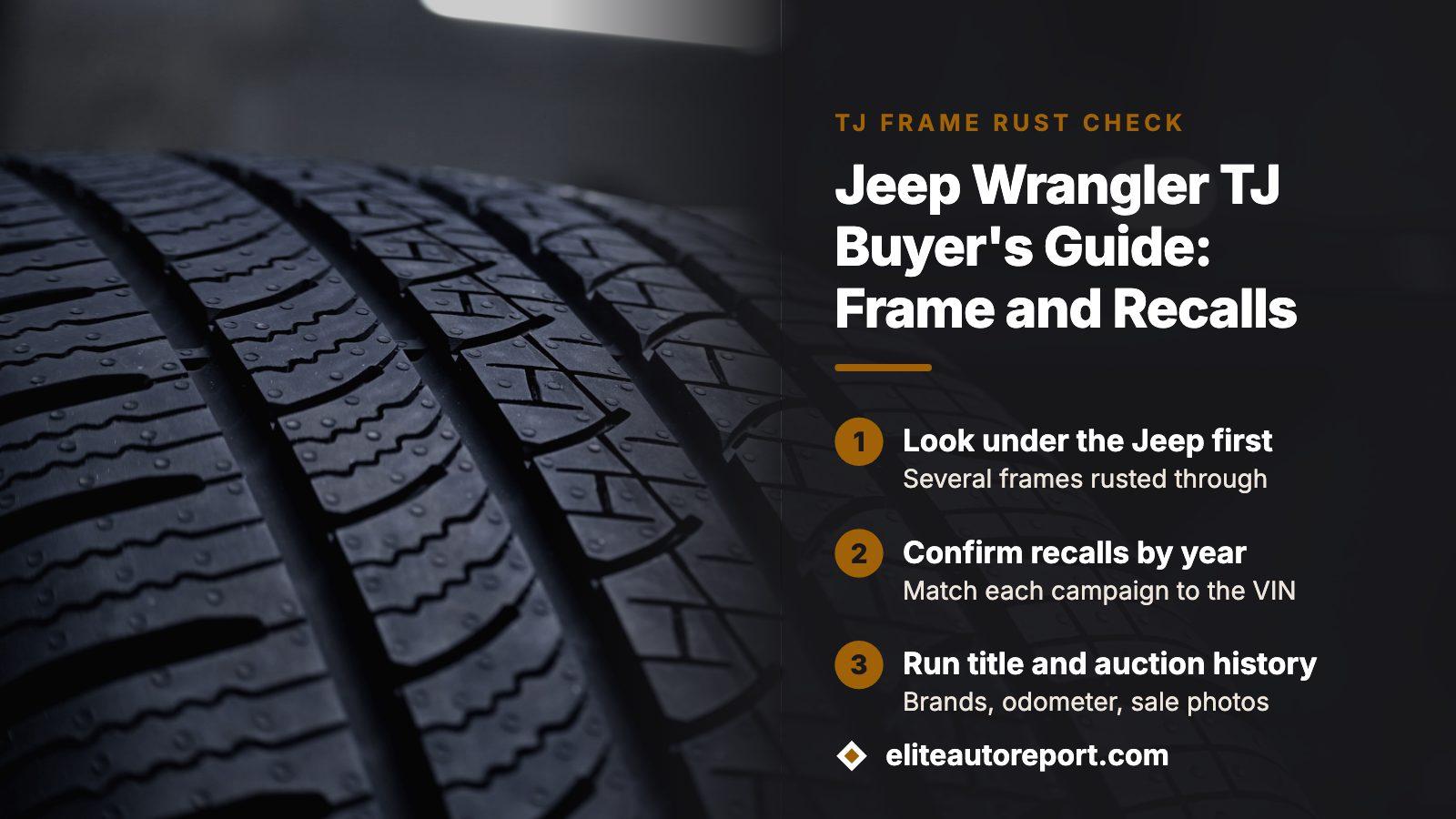
Federal complaint files show the 2000 model year with the most structure complaints, 56, and 2001 next with 38. Look under the Jeep before anything else, because several owners describe frames rusted through. Then confirm the recalls were done for the exact year, and run the VIN for title brands, odometer history and any auction sale with photos.
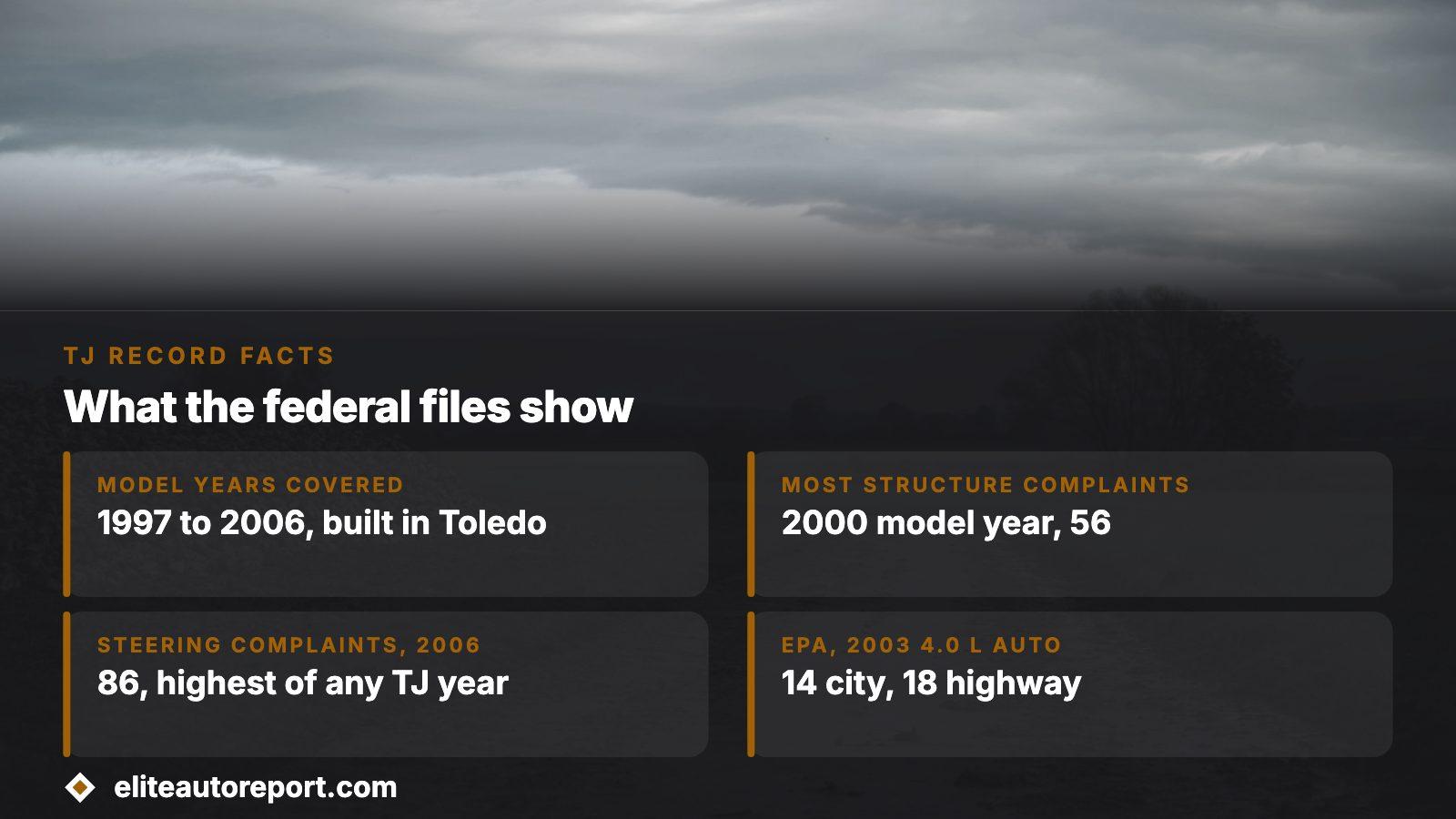
- Model years covered
- 1997 to 2006, built in Toledo
- Most structure complaints
- 2000 model year, 56
- Steering complaints, 2006
- 86, the highest of any TJ year
- EPA rating, 2003 4.0 L automatic
- 14 city, 18 highway, 16 combined
What counts as a TJ in the records
Agencies do not use the enthusiast name. NHTSA files these Jeeps as a Wrangler with a model year, so I pulled 1997 through 2006 one year at a time and counted each record. Decoding sample VINs shows the plant is Toledo for the whole run, and the year letter or digit in the tenth position reads V for 1997, 3 for 2003 and 6 for 2006.
The engine choice matters for running costs. A 1997 listing at fueleconomy.gov offers a 2.5 L four-cylinder or a 4.0 L six, and by 2006 the four-cylinder had become a 2.4 L. The 4.0 L automatic is rated 13 city and 16 highway for 2006, so a heavy right foot shows quickly at the pump.
Frame rust is the first thing to check
Owner complaints filed under the structure heading are not spread evenly. Both the 2000 and 2001 model years stand out, and a large share of the 2000 entries describe rusted rails, rotted crossmember mounts or failed inspections. Treat that as a pattern worth a flashlight, not as proof about any one Jeep.
From an NHTSA owner complaint
The buyer of a 2000 Wrangler from a private seller wrote that the frame turned out to be riddled with holes even though the odometer showed only 114,000 miles. A mechanic called it unsafe, the family had paid 7500 dollars, and they could not afford the repair so the Jeep was parked. The lesson is simple: a clean body and low miles say nothing about the rails, so get under it before paying.
From an NHTSA owner complaint
Another 2000 owner, with under 40,000 miles and no off-road use, felt the rear of the Jeep seem to part from the body while crossing a bridge. A mechanic found rear control arms detached from a frame that had rusted from the inside, leaving nothing solid to weld to. Low mileage and careful use did not protect the steel, so have a shop tap and inspect the rails.
Ask where the Jeep has lived. Road-salt states are the usual suspects, but one complainant said a garage-kept TJ treated with rust protectant every winter still needed a frame swap, so storage habits are only a partial answer.
Complaints and recalls by model year
The table puts three NHTSA measures side by side. Owner letters are not a sales-adjusted failure rate, because the agency does not publish how many were built or still on the road. Use the columns to decide what to inspect, not which year to crown.
| Model year | Owner complaints | Naming structure | Naming steering | Recall entries |
|---|---|---|---|---|
| 1997 | 401 | 27 | 28 | 7 |
| 1998 | 265 | 25 | 15 | 6 |
| 1999 | 213 | 21 | 3 | 5 |
| 2000 | 251 | 56 | 11 | 5 |
| 2001 | 170 | 38 | 10 | 7 |
| 2002 | 108 | 26 | 10 | 6 |
| 2003 | 98 | 3 | 14 | 4 |
| 2004 | 192 | 13 | 67 | 3 |
| 2005 | 650 | 9 | 58 | 2 |
| 2006 | 730 | 12 | 86 | 3 |
The 2005 and 2006 totals are padded by fuel-system entries, so their large counts do not mean those years are the worst. Steering is the column that rises with age: it jumps in 2004 and peaks in 2006.
Recalls worth confirming on your VIN
A campaign number only helps if the repair was done. Ask for a dealer printout or repair order for the ones that match the Jeep's year.
- 1997: 96V060000 and 97V080000 both involve the air bag control module, one for delayed deployment and one for deployment on ignition shut-off. 98V046000 covers a clock spring wire that can break at full lock.
- 1998: 98V023000 covers a brake booster diaphragm that can split, and 98V048000 covers seat belt shoulder loops that were not hardened properly.
- 2000 to 2002: 02V104000 applies to the 4.0 L engine, where debris can collect near cylinder number 3 and dealers fit a manifold shield. 02V075000 covers water getting into the ignition switch.
- 2005 and 2006: 05V460000 on 42RLE automatics, where the park pawl anchor shaft may shift and block Park.
- 2006: 06V147000 on the 6-speed manual's clutch linkage rod, and 15V222000 on the clutch pedal position switch spring, issued in 2015.
A few entries on TJ years are aftermarket campaigns, such as replacement fuel pumps, brake master cylinders and a hardtop roof rack. They matter only if that part was fitted, so ask what has been replaced.
Drivetrain, steering and the owner's story
Across all ten years, power train, suspension, engine cooling and steering are the most-named components. Steering stands out in the later cars: one 2004 owner of an imported right-hand-drive Jeep described violent wheel shake above 50 mph and a vehicle that rocked in crosswinds. Test drive at highway speed and over a bump, and look for worn linkage and loose play.
Cold-start the engine, run the transmission through every gear, and check for leaks. A seller who will not allow a pre-purchase inspection has told you most of what you need to know.
What the VIN shows that a driveway look cannot
A TJ may have been rolled on a trail, flooded in a hurricane or bought at a salvage lot and rebuilt. Paint and a new soft top hide a lot. Federal title data keeps brands such as salvage, junk and flood from any state, and it lists odometer readings so you can spot a rollback.
For a TJ, the useful parts of an auction record are the sale listing and the photos taken before repair, which show the damage as it stood. They are especially valuable when the seller says frame work was cosmetic.
- Title brands carried across state lines
- Odometer readings over the years
- Auction sales with photos of the damage
- Theft and total-loss records
A sensible order for inspecting one
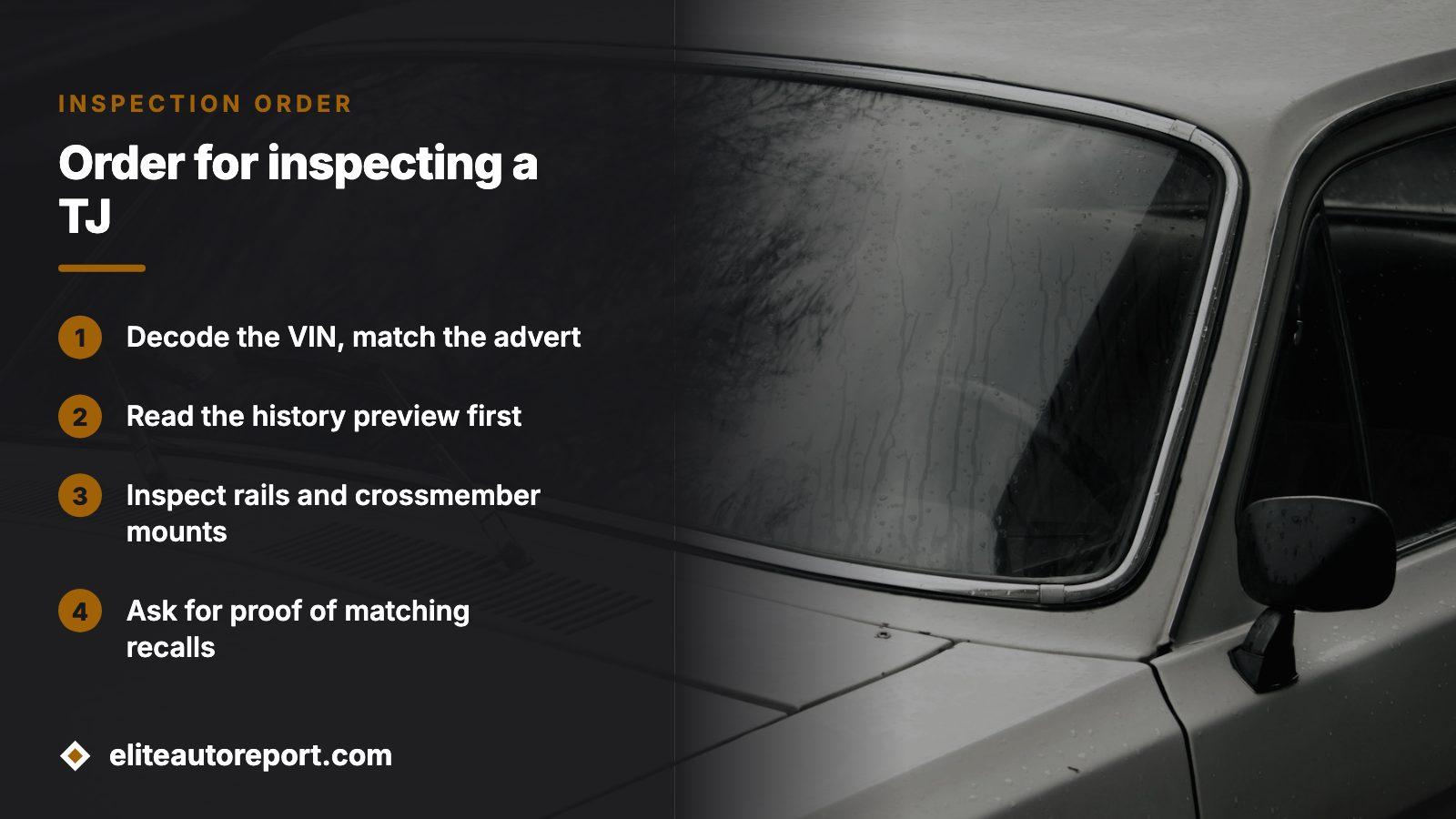
- Decode the VIN and match year, engine and drive to the advert.
- Run the history preview and read any brand, auction or odometer entry before you drive anywhere.
- Put the Jeep on a lift and inspect the rails, crossmember mounts and control arm brackets.
- Ask for proof of the recalls that match its year.
- Drive it at speed, over bumps and through a full turn lock to lock.
- Negotiate from what you found, not from the asking price.
Skipping the second step is the common mistake. A salvage record found after you paid is far more expensive than one found before.
Where this information comes from
- NHTSA recalls API: 2000 Jeep Wrangler — campaigns and remedies by model year
- NHTSA complaints API: 2000 Jeep Wrangler — owner complaint counts and components
- NHTSA owner complaint 11119958 — owner experience, paraphrased
- NHTSA owner complaint 11101873 — owner experience, paraphrased
- NHTSA vPIC VIN decoder — plant and model year from VIN patterns
- EPA fueleconomy.gov: 2003 Wrangler/TJ 4WD — engine and fuel economy figures
- NMVTIS: understanding a vehicle history report — what the federal title database records
Sources and photos: Facts checked against the sources above in November 2026. Photos by Pablo Alvarez, Tigran Shishmanyan and Andrew Dawes on Unsplash; diagrams by EliteAutoReport.
Keep reading
- Jeep Cherokee XJ Buyer's Guide: Recalls, Complaints and Recordsthe boxy Jeep from the same era, with its own record
- Classic Car Title Search by VIN: What Turns Up and What Doesn'thow title records read on older vehicles
- Where Is the VIN on a Classic Car? Dash, Door, Firewall and Framefind the number before you run it
- Auction History by VIN: Photos for Luxury, Exotic and Classic Carshow sale records and photos are read
Frequently asked questions
Which Jeep Wrangler TJ year is best?
The records cannot crown one. The 2003 model year has the fewest complaints at 98 and only 3 about structure, while 2000 has the most structure entries at 56. Frame condition, service paperwork and a clean title history matter more than the year printed on the registration.
What years were the Wrangler TJ?
The TJ covers model years 1997 through 2006. NHTSA lists it as a Jeep Wrangler, and the tenth position of the VIN encodes the year, such as V for 1997 and 6 for 2006. Sample decodes put assembly at Toledo for the whole run.
Does a low-mileage TJ mean the frame is fine?
No. One owner of a 2000 Wrangler with under 40,000 miles reported control arms detached from a frame rusted inside, and another buyer found holes at 114,000 miles. Mileage tells you about the engine, not about steel that has been sitting in damp air.
Is a TJ fuel efficient?
Not very. For 2003, EPA lists the 4.0 L automatic at 14 city, 18 highway and 16 combined, and the 2006 version at 13 city and 16 highway. The four-cylinder options do a little better, but all of them run on regular gasoline.
Can a VIN check show if a TJ was in a flood or crash?
It can show title brands such as flood or salvage, odometer readings, and auction sales with photos where records exist. It cannot see unreported damage, so pair it with a lift inspection by a mechanic who knows these Jeeps.
Now check the car itself
The guide explains what to look for. The report shows what this VIN has on record.