THE SHORT ANSWER
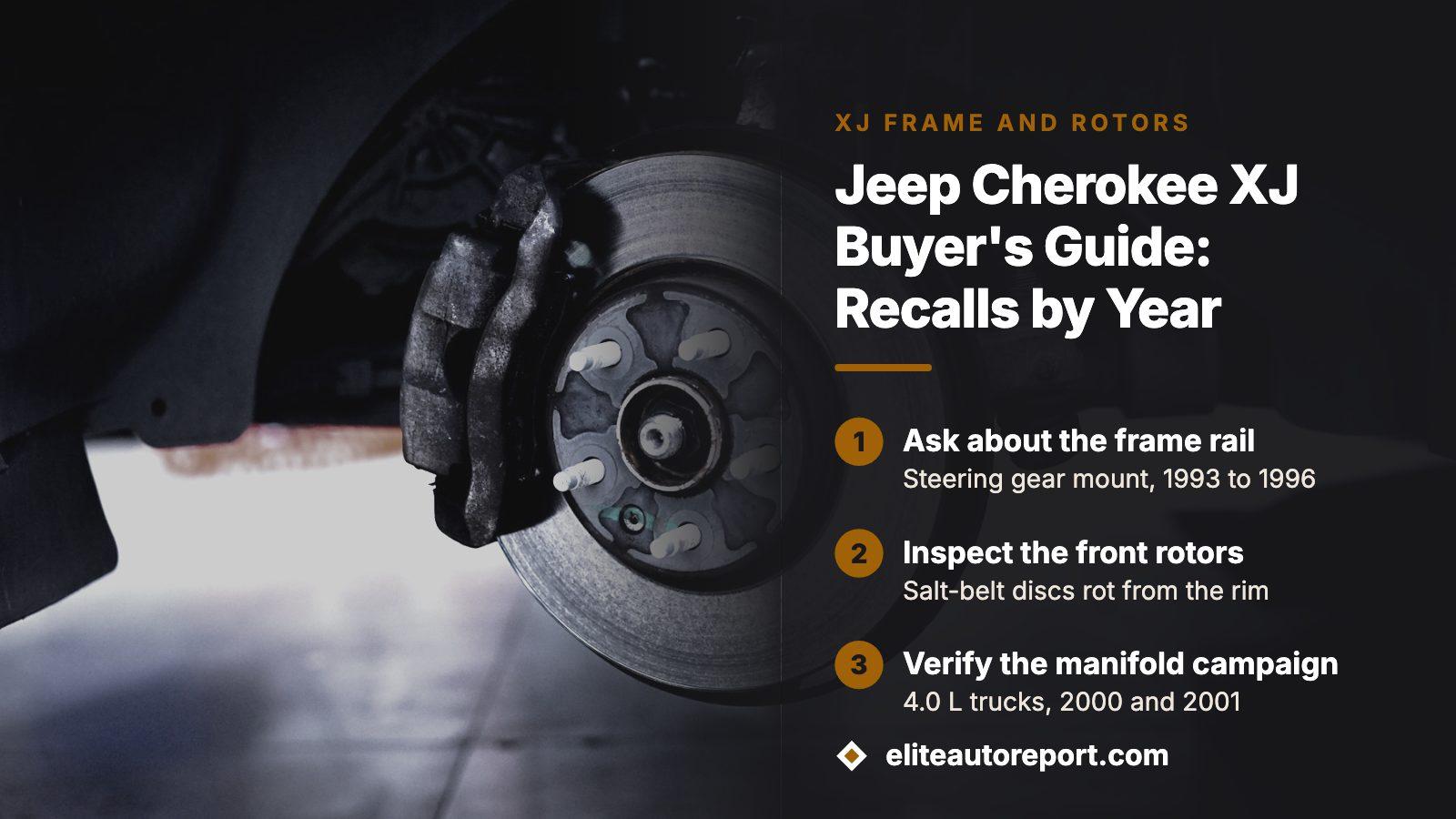
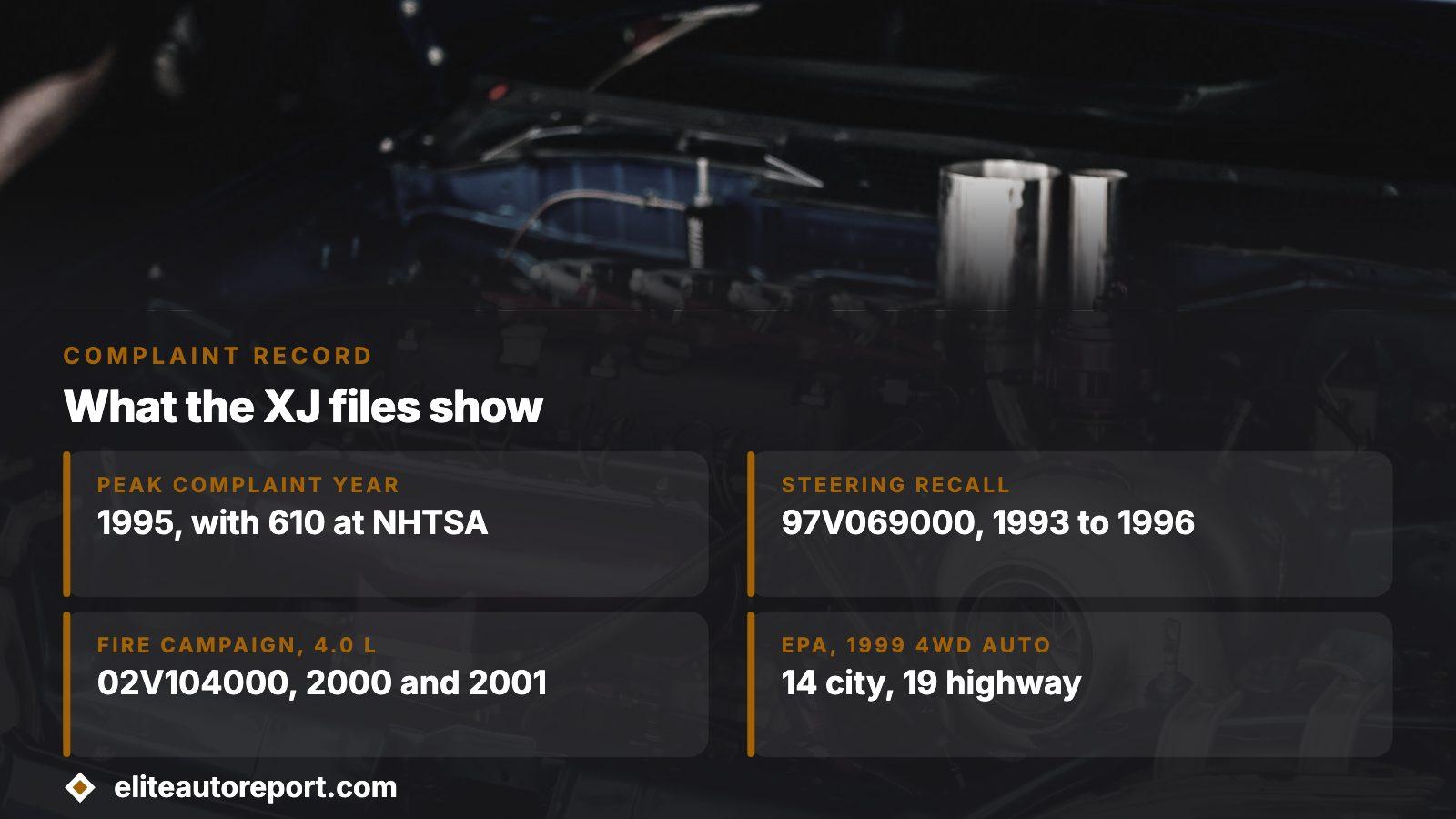
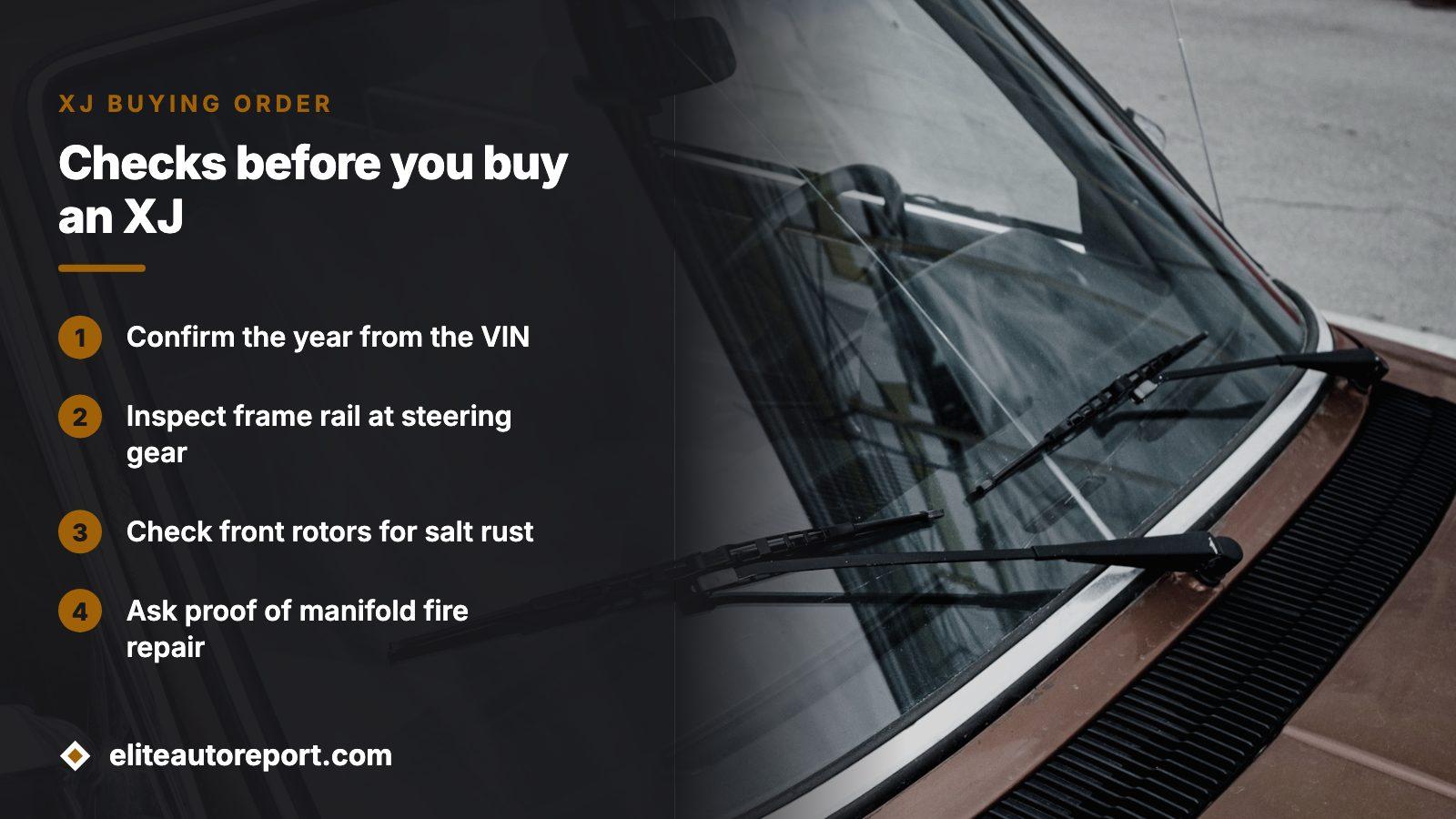
NHTSA files the XJ as Jeep Cherokee, 1984 through 2001. Complaints peak in 1995 at 610, then 1994 at 521 and 1996 at 447. Three issues deserve a direct question to the seller: the 1993 to 1996 steering gear mount on the frame rail, front rotors that rot in salt-belt states, and the 2000 and 2001 manifold fire campaign. Ask for proof each repair was done, then run the VIN for auction history, photos and title brands.
- Peak complaint year
- 1995, with 610 at NHTSA
- Frame and steering recall
- 97V069000, 1993 to 1996
- Fire campaign, 4.0 L only
- 02V104000, 2000 and 2001
- EPA rating, 1999 4WD automatic
- 14 city, 19 highway, 16 combined
How federal files describe an XJ
Government databases never use the enthusiast code XJ. Everything sits under make Jeep, model Cherokee and a model year, so I pulled each year from 1984 through 2001 and read the results myself. One wrinkle: the complaint search for 1997 and later also returns Grand Cherokee records, so the counts below keep only entries whose product is the Cherokee, with duplicate filings removed.
The year 1998 comes back empty in the complaint database, which says nothing about how those trucks behaved. Treat every number as a signal, not a failure rate. A complaint is an owner writing in, often years after the event, and NHTSA has no idea how many vehicles were on the road.
Confirm the year from the tenth VIN character
Year matters because the recall lists shift from one model year to the next. Position ten in the VIN encodes the year, and NHTSA's decoder agreed on every partial pattern I tried: L gave 1990, V gave 1997 and 1 gave 2001. Each came back as a four-door sport utility with the 4.0 L six, built in Toledo.
A decoder complaint about an incomplete number only means the pattern was partial. A full number that decodes to something other than a Toledo-built Jeep Cherokee, or to a different year than the title shows, should stop the conversation until the seller explains.
Engines and what they drink
EPA's data lists a 2.5 L four and a 4.0 L six for these trucks. For a 1990 four-wheel-drive automatic with the six, the rating is 15 city, 19 highway and 16 combined on regular gasoline. A 1999 four-wheel-drive manual with the six reads 15 city, 20 highway and 17 combined, while the automatic of that year is a point lower in town.
Nobody buys an XJ for economy, but the numbers help you spot a listing that claims something unusual. They also tell you which engine the 2000 and 2001 fire campaign covers: only the 4.0 L.
The frame rail that holds the steering gear
Campaign 97V069000, filed April 28, 1997, covers 1993 through 1996. On the assembly line, one weld between a reinforcement piece and the frame rail never got made. Under steering load the attaching bolts can snap or the rail can crack, and NHTSA lists crash risk as the consequence. Dealers inspect the frame and either add reinforcement plates or cut a slot and add the missing weld.
From an NHTSA owner complaint
A 1996 Cherokee owner described a steering gear that failed again and again, with the frame found cracked. She paid roughly $1,000 across three replacements, and the maker told her it would not apply the recall to her truck. The lesson: a recall on paper does not guarantee this particular frame was ever inspected, so put a light on that rail yourself.
Rotors in salt-belt states
Three separate campaigns concern front disc rotors on trucks sold or registered in the northern and mid-Atlantic salt states and the District of Columbia. They are 98V005000 for 1990 and 1991, 99V340000 for 1992 through 1995 and 00V136000 for 1996 through 1999. Corrosion can weaken the stamped steel hub so the cast iron wear surface separates, which cuts braking.
That is a registration question as much as a mechanical one. An Ohio truck of thirty years' standing is not the same buy as a Georgia one, and title and odometer records across states help you tell which you have.
The 2000 and 2001 manifold fire campaign
Campaign 02V104000 was filed April 8, 2002, for the 4.0 L engine only. Debris can collect near the number 3 cylinder where the intake and exhaust manifolds meet, and the campaign names a vehicle fire as the result. The fix is a manifold shield, and owner notices began May 13, 2002.
From an NHTSA owner complaint
A 2001 Cherokee owner wrote in 2021 that the truck lost power at about 10 mph with smoke from the engine and 145,333 miles showing. The dealer reportedly refused repairs on a truck that old and offered only a cover part for the manifold. Old campaigns can outlive the dealers willing to perform them, so ask for the shield receipt before you pay.
Other campaigns that belong on your list
| Campaign | Model years | What NHTSA says |
|---|---|---|
| 84V024000 | 1984 | Rear axle assembly fault could separate an axle and wheel. |
| 86V160000 | 1987 | A manifold stud can chafe the fuel supply hose and cause a leak. |
| 91V063000 | 1990 and 1991 | Crimped anti-lock brake hose ends can let the hose come off. |
| 96V260000 | 1989 to 1991 | Anti-lock hydraulic unit seals wear and can damage the pump motor. |
| 00V105000 | 1997 to 1999 | Road salt can corrode the air bag control module. |
| 97V194000 | 1997 | The fuel gauge sender can read more fuel than is in the tank. |
Right-hand-drive imports carry separate campaigns, 08V056000 and 11V279000, and aftermarket parts such as 1997 to 2001 electric fuel pumps appear under XJ years too. Those matter only if the part is on your truck.
Where owners complained most
Across 4,366 Cherokee records, the busiest years are 1995 with 610, 1994 with 521 and 1996 with 447. The quietest are the first three, with 7, 19 and 21. Crash-flagged filings are highest in 1995 at 91, tied to 71 injuries. Fire flags peak at 40 for 2000, followed by 27 for 1996.
Service brakes lead the component list at 1,100, followed by hydraulic at 1,034, structure at 547 and engine cooling at 528. Read that as a hint about what to inspect, not as a verdict on any single year.
What a VIN history adds for an XJ
Recall files cannot tell you whether this truck was sold after a flood, rolled and rebuilt, or photographed in an auction yard. A VIN history can: sale records with pictures, title brands from any state, and mileage readings that ought to climb steadily. The preview is free, the full report is one payment, and prices sit on the pricing page.
Pair it with the federal files. NMVTIS, the federal title database, keeps brands applied by any state, but it is deliberately concise and does not hold repair or recall information, so an inspection still belongs in the plan.
Where this information comes from
- NHTSA recalls API: 1995 Jeep Cherokee — campaign numbers, dates and remedies, read one model year at a time
- NHTSA complaints API: 1995 Jeep Cherokee — owner complaint counts and component tallies
- NHTSA owner complaint 10211162 — owner experience, paraphrased
- NHTSA owner complaint 11424645 — owner experience, paraphrased
- NHTSA vPIC VIN decoder — year, engine and plant from partial VIN patterns
- EPA fueleconomy.gov: 1999 Jeep Cherokee 4WD — engine options and mileage ratings
- NMVTIS: understanding a vehicle history report — what the federal title database does and does not hold
Sources and photos: Facts checked against the sources above in November 2026. Photos by ün LIU, Max Tokarev and Willian Cittadin on Unsplash; diagrams by EliteAutoReport.
Keep reading
- Jeep Wrangler TJ Buyer's Guide: Frame Rust, Recalls and Recordsthe next Jeep from the same era, with its own record
- Classic Car Title Search by VIN: What Turns Up and What Doesn'thow title brands carry across state lines on older vehicles
- Flood Damage Car Check Before You Bid: A Step-by-Step Guide for Auction Carswhat to check when an older truck passed through a sale lane
- Car Auction Photos by VIN: Find Salvage Sale Pictures Before You Buysee the pictures taken at the sale before you buy
Frequently asked questions
Which Jeep Cherokee XJ years are best to buy?
The files cannot name one, but they show where to look. The 1984 to 1986 trucks draw very few complaints, though few were filed. The 1993 to 1996 years carry the frame rail campaign, and 2000 and 2001 carry the manifold shield campaign. Condition and documented repairs matter more than the year.
Is the Cherokee XJ the same as the Jeep Cherokee in federal records?
Yes. NHTSA and the EPA do not use the XJ label. They file the boxy truck as make Jeep, model Cherokee, for model years 1984 through 2001. Newer vehicles with the same name are different designs, so match the year before you read any recall or complaint list.
How do I tell if the frame rail recall was done?
Ask for the dealer paperwork and look at the rail beside the steering gear with a light, checking for cracks, plates or a fresh weld. The recall covers 1993 to 1996. An owner complaint shows the fix is not guaranteed, so inspect the metal yourself.
Does the 4.0 L engine have a fire recall?
For 2000 and 2001, yes. Campaign 02V104000 covers 4.0 L trucks only, because debris can build up at the number 3 cylinder where the manifolds meet. The remedy is a manifold shield. Ask the seller for the receipt, since the campaign dates to 2002.
Can a VIN history show if my XJ was at auction?
It can show sale records and photos where they exist, along with title brands and odometer readings. The preview is free and the full report is one purchase. Records are not complete for every truck, so treat a clean result as one input beside an inspection.
Now check the car itself
The guide explains what to look for. The report shows what this VIN has on record.