THE SHORT ANSWER
To check an auction car for flood damage, read the lot's title announcements, run the VIN for flood and salvage brands plus earlier sale photos, then inspect the carpet padding, spare-wheel well, seat belts and wiring. A clean record does not clear the car, since an uninsured flood may never leave a brand. Inspect it yourself or send a mechanic.
- Flood brand codes
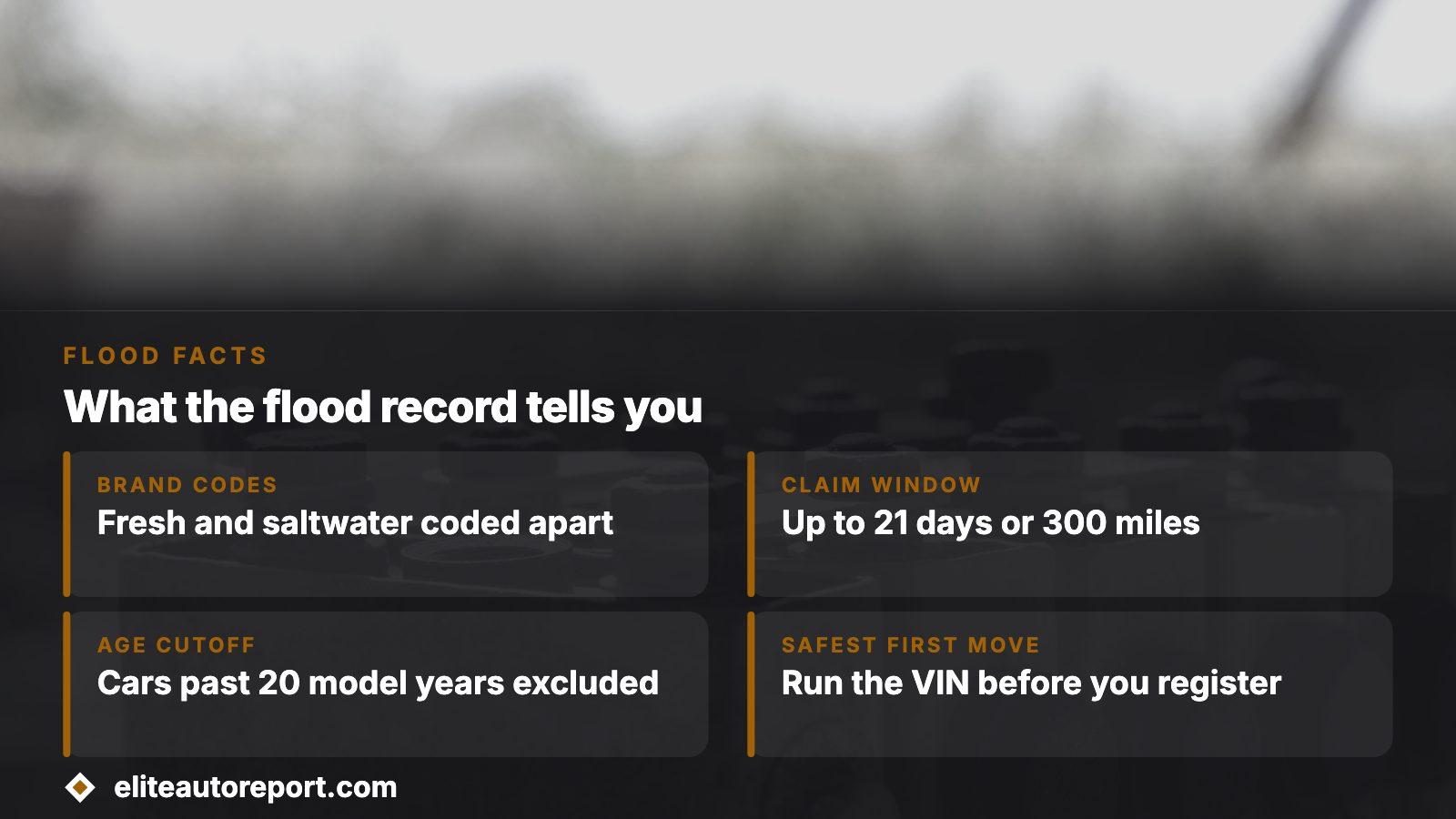
- Freshwater and saltwater are coded separately
- Claim window at one house
- Up to 21 days or 300 miles
- Age cutoff for that claim
- Cars past 20 model years are excluded
Why flooded cars turn up in the sale lane
Water-damaged cars do not stay near the water. According to the FTC, up to half of flooded cars end up back on sale, often after a cleanup and a trip out of state. A federal sheet says truckloads were reportedly hauled out of Louisiana after Hurricane Katrina and sold in the upper Midwest to buyers who may not have known about the saltwater.
An insurer's write-off makes a car salvage, and the federal title system counts salvage auctions among the businesses that must report the salvage vehicles they handle. That trail is only as good as each state's rules.
Step 1: Read what the lot says about its title
Sale lanes run on lights or announcements, and flood sits inside that system. Copart's wholesale arbitration policy, effective October 17, 2025, lists flood damage among the title discrepancies a seller must announce, and says a flood brand is disclosed through a history report the auction supplies.
The same policy sets a floor. Rain through an open window, a car wash, a shampooed carpet, or floodwater that never rose above the rocker panel or reached the cabin needs no disclosure when no components are damaged. A quiet listing proves little. Check the house's own rules, since lights and deadlines differ.
Step 2: Run the VIN before you register to bid
Enter the 17-character VIN while you can still walk away. The federal title record holds each state's brands, the last mileage reported, insurer write-offs and any move into a salvage yard, with no repair history.
| On the record | What it suggests | Your move |
|---|---|---|
| Flood brand | A state logged a water loss; saltwater has its own code | Treat saltwater as the worst case |
| Salvage or total loss, no cause | Flood and collision can both end in a salvage label | Read the sale photos |
| Rebuilt brand | A write-off was repaired; some states use it instead of a flood brand | Learn why it was written off |
| Several states, short span | A pattern tied to title washing | Ask why |
| Earlier auction sale | The car as it looked before repair | Compare with today's photos |
| Nothing on record | No insurer or state logged a water loss | Inspect anyway |
Coverage is the limit. The federal system holds about 87 percent of vehicles, not every state reports into it, and a search can come back falsely clean.
Step 3: Read the photos from earlier sales
On a luxury, exotic or classic car, photos from a past lot are the nearest thing to seeing it before the detailer did. EliteAutoReport pulls a VIN's auction sales on record, with dates, damage notes and pre-repair photos. Zoom in on these:
- A water line or fogging inside headlight and taillight lenses
- Mud, grit or silt around the alternator, starter, relays and harnesses
- Carpet that is stained or mismatched, or brand new in an older car
- Rust on seat bolts and console screws
- Faded door panels, upholstery and seat belts
Set those against the current lot photos. A write-off that now shows fresh carpet and a spotless engine bay raises a question the listing never answers. Photos cannot show corroded connectors, so they only aim the inspection.
Step 4: Inspect the car, or send someone who will
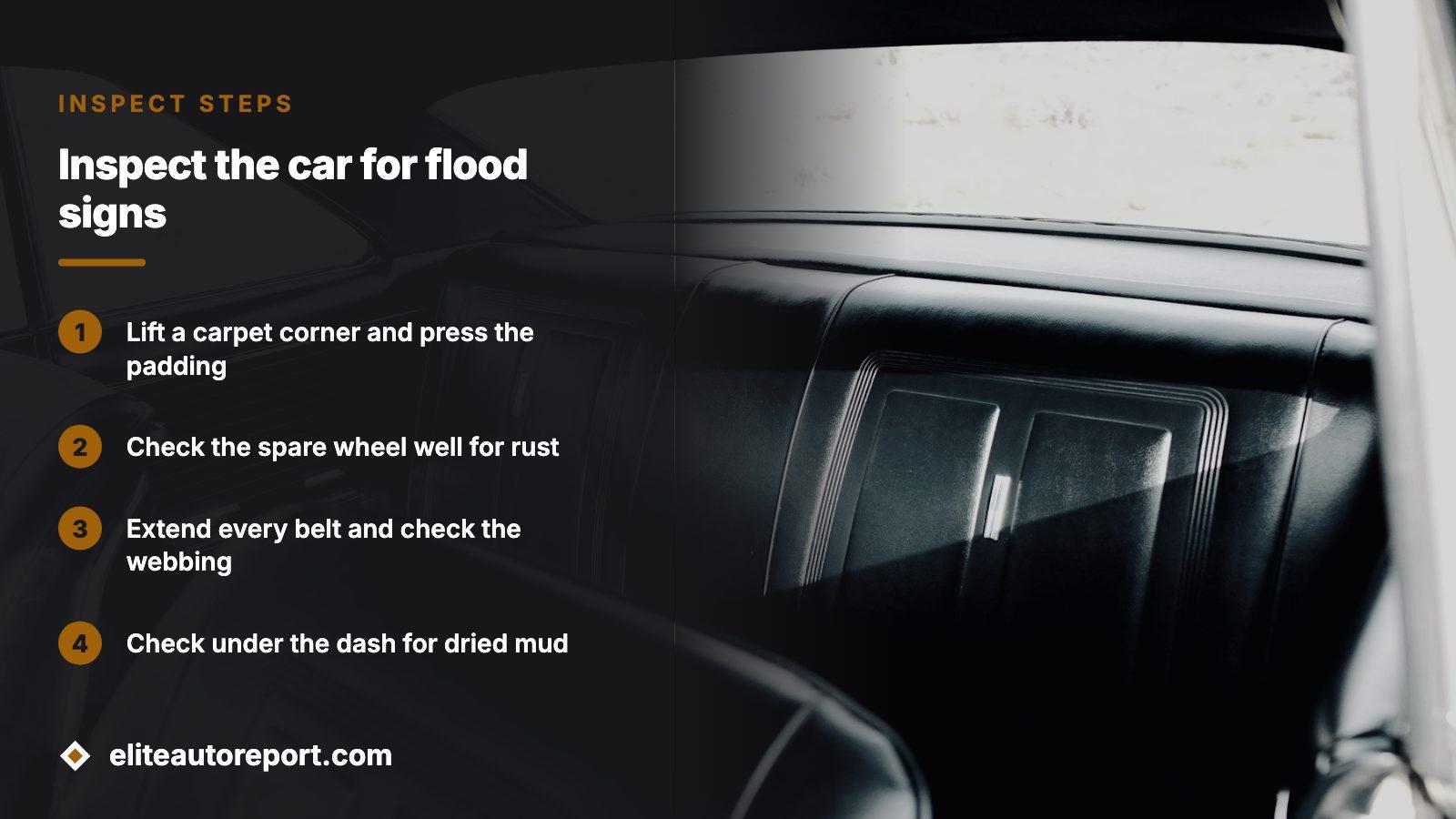
- Lift a carpet corner and press the padding. Wet, muddy or stained underlay is the clearest sign.
- Pull the spare wheel and look in the well for rust, stains or silt.
- Extend every belt fully and check the webbing for fading or a tide line.
- Check under the dashboard for dried mud, and behind harnesses and relays for residue.
- Examine the drain plugs in the floor and door bottoms. Missing or new ones may mean floodwater was let out.
- In the engine bay, look for grit near the alternator and starter and for corroded connectors.
From an NHTSA owner complaint
An owner who bought a 2021 Chrysler Pacifica Hybrid as a certified pre-owned van says the dealer handed over a history report showing no accidents or major repairs. Right after purchase, the owner alleges, the van proved to have hidden flood damage, an old frame-damaging accident and electrical faults that made it swerve on its own, with repairs the owner puts above 20,000 dollars.
Take from it that a clean report is not a flood check. Have a mechanic you trust check the electrical and fluid-holding systems for water, since the FTC warns that water damage can slowly wreck both. Texas's motor vehicle agency adds that no tip list catches every case.
Step 5: Judge how high the water rose and what kind it was
A maker's service bulletin hosted on NHTSA's site starts its triage by asking whether the water climbed past the rocker panels and reached the floor. If so, the electrical parts need close attention. Salt water is worse, being highly corrosive and conductive, and its residue keeps corroding after the car dries.
Why a dry car can still fail
The bulletin lists uneven power delivery, heat that could start a fire and airbags that fire without a crash as possible results of corrosion. The FTC adds that electrical failures may surface only later, perhaps after a short claim window has closed.
Step 6: Know what recourse the lane gives you
Recourse is narrower than most buyers assume. Under Copart's wholesale policy, an undisclosed flood that an inspection could not have found can be arbitrated, but only for damage present at pickup and only within a window of at most 21 days or 300 miles after the sale. The car goes back in the same or better condition, and the buyer carries the risk until the ruling.
A history report you pulled yourself does not support a claim alone, though the auction may look deeper because of one. At a public sale the FTC's Used Car Rule binds dealers and the auction company; at a sale closed to consumers it does not.
Watch the odometer after the sale
Every mile added after the sale counts toward the limit; past 300 miles the car drops out of the process. Track the odometer from pickup.
Where luxury, exotic and classic cars change the odds
| Kind of car | What the policy says | What it means for you |
|---|---|---|
| Late-model luxury car, inside the age limit | Arbitration is open for a flood that was undisclosed and hidden from inspection | Run the VIN first; the claim window is short |
| Hybrid or electric car | High-voltage battery and drive parts sell strictly as is, whatever the light | A flooded high-voltage system is your risk; use a technician certified for them |
| Car beyond 20 model years | Cannot be arbitrated | Earlier photos and your own inspection are the protection |
A car packed with control modules has more places for corrosion to hide, so a marque specialist's eye is worth paying for.
Where the preview and the report fit
Put the VIN in for the preview at no cost and see whether auction, title or damage records turn up. A full report is one purchase with no renewal, and the pricing page has the options.
The report reads what was recorded, so a flood nobody recorded still needs step 4. If a lot shows flood signs, drop it. If a dealer knowingly passed off a flooded car as sound, the FTC says to tell the NICB, the state attorney general and ReportFraud.ftc.gov.
Where this information comes from
- FTC: Don't get swamped buying a flood-damaged car — Backs the flood and salvage title definitions, the inspection signs and the advice on history reports.
- NMVTIS: information for consumers — Backs what the federal title record shows, its coverage figures and the risk of a falsely clean result.
- NMVTIS: who reports — Backs the point that salvage auctions are among the businesses that must report.
- TxDMV: Smart Buyer, checking for flood damage — Backs the physical checks, the rebuilt-brand and title-washing warnings and the mechanic advice.
- Copart: wholesale auction arbitration policy — One auction house's flood announcements, claim window, mileage limit and exclusions.
- NHTSA: Toyota flood-damaged vehicle service bulletin — A maker's guidance on water above the rocker panels, salt water and electrical risks.
- NHTSA owner complaint 11640763 — owner experience, paraphrased
Sources and photos: Facts checked against the sources above in November 2026. Photos by Maxim Tolchinskiy, Wesley Tingey and Stephen Mabbs on Unsplash; diagrams by EliteAutoReport.
Keep reading
- Copart VIN Check: Auction Photos and History for Luxury and Classic CarsHow to run a VIN on a Copart lot and read what comes back.
- Auction History by VIN: Photos for Luxury, Exotic and Classic CarsWhat a VIN's auction record shows, including pre-repair photos.
- What Happens When You Buy a Car at Auction: Fees, Title and Hidden HistoryFees, as-is terms and title paperwork once you win.
- Sample reportA finished report, photos included, to look over before you pay.
Frequently asked questions
How do you check a car for flood damage before an auction?
Read the lot's announcements, run the VIN for brands and earlier sale photos, then check the carpet padding, spare-wheel well, belts, drain plugs and connectors yourself or through a mechanic. A clean record is one input, not a clearance.
Can a VIN check show flood damage?
Only when someone recorded it: a state flood brand, a total-loss ruling or a salvage sale. A flood on an uninsured car, or in a state with no flood brand, may leave nothing to find.
Do auctions have to announce flood damage?
Under the Copart policy cited here, a flood brand is a title discrepancy that must be announced, but minor water exposure below the rocker panel needs no disclosure. Other houses set their own rules, so read the terms first.
Can you return an auction car with flood damage?
Sometimes, within strict limits. Under the Copart policy, an undisclosed flood that inspection could not detect can be arbitrated within up to 21 days or 300 miles, if the car returns in the same or better condition. Cars sold under the red, limited as-is light, and cars past 20 model years, get far less protection.
What is the difference between a flood title and a salvage title?
The FTC describes a salvage title as an insurer's total-loss declaration and a flood title as a car that sat in water high enough to flood the engine bay. States label these cars differently, so a flooded one may carry either.
Now check the car itself
The guide explains what to look for. The report shows what this VIN has on record.