THE SHORT ANSWER
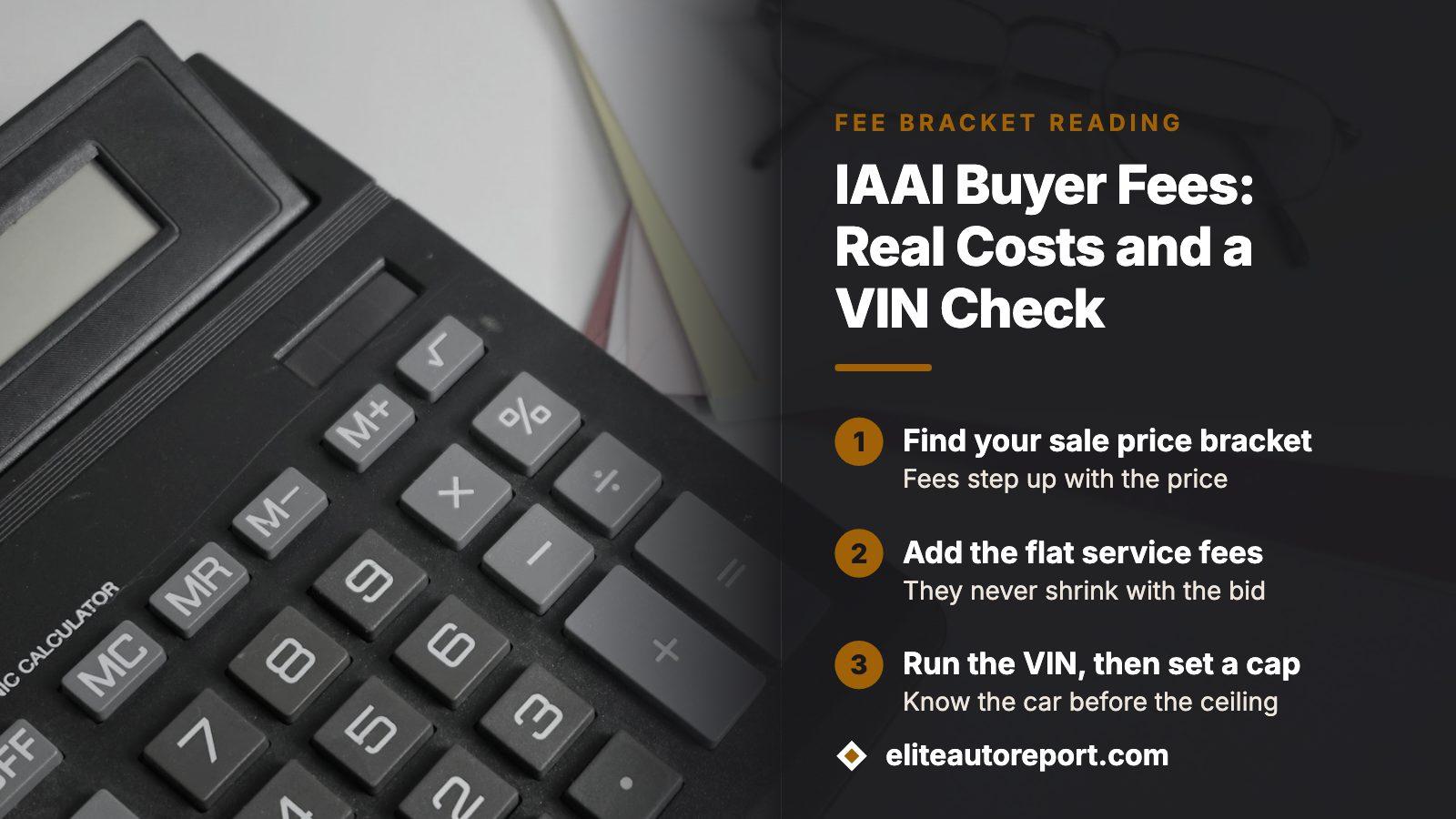
IAA calculates buyer fees from the final sale price, your license type and how much you buy. A non-licensed buyer pays a bracket fee ($375 on a $1,000 car, 7.5% from $15,000 up), a proxy or live online bid fee, a $105 service fee and a $20 title charge. Storage is extra. Confirm the lot's schedule, then check the VIN.
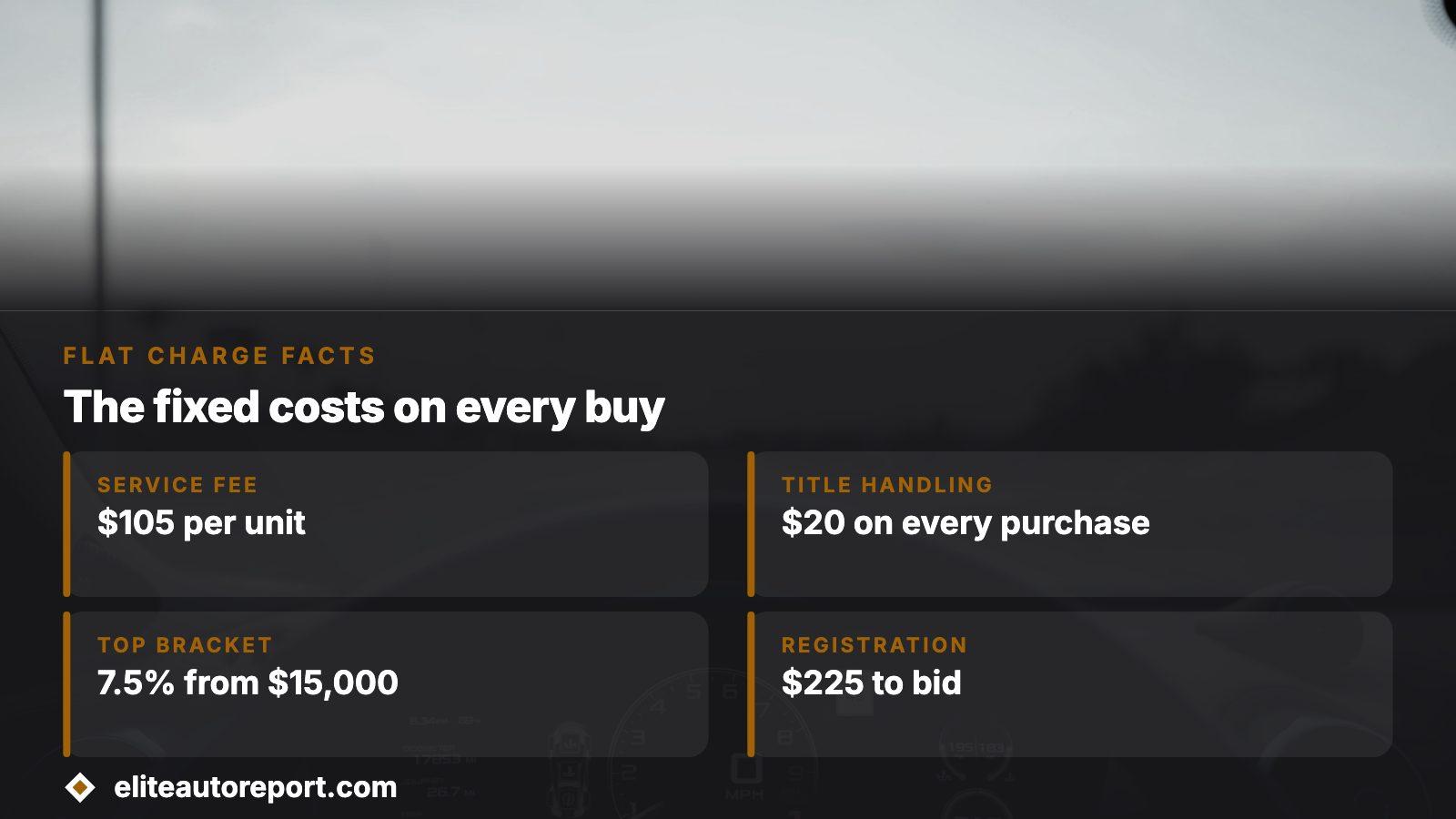
- Service fee
- $105 per unit
- Title handling
- $20 on every purchase
- Top bracket
- 7.5% of sale price from $15,000
- Registration
- $225 to bid on IAA inventory
The layers on an IAA invoice
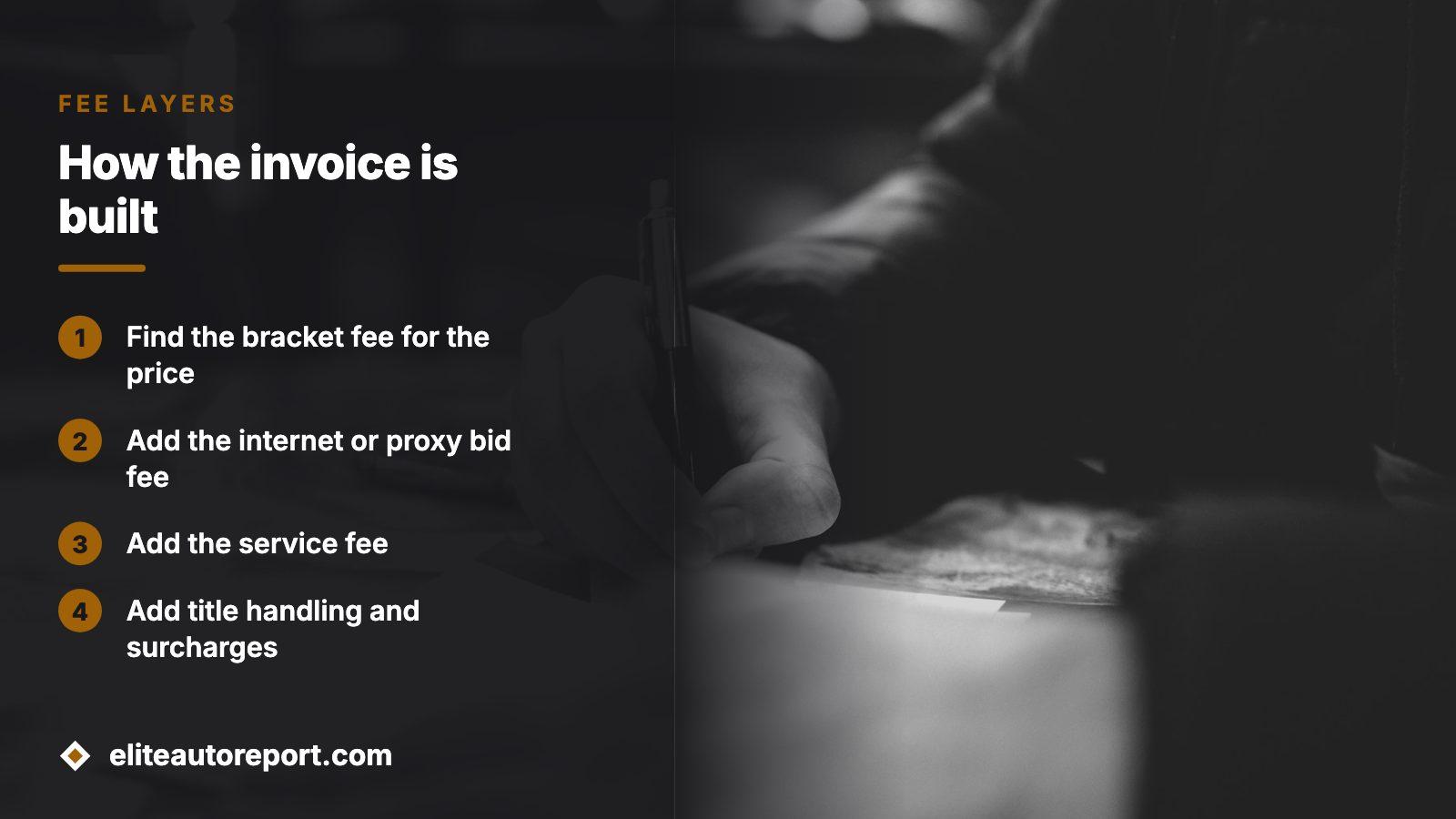
A winning bid at IAA is the base of the invoice, not the total. IAA's fee pages describe a buyer fee tied to the sale price, a separate fee for bidding online or by proxy, a handling service fee, a fuel and environmental surcharge, a title charge and storage that depends on the yard.
EliteAutoReport reads auctions through the history attached to a VIN: earlier sales, photos, the damage noted at pickup. That is where fees interact with value. A rare coupe that hammers high lands in a costlier bracket, so the history has to justify the number before the fees pile on.
- Buyer fee, set by a bracket on the final sale price
- Internet or proxy bid fee, when you win through a bid placed online
- Service fee for handling, imaging and loading
- EH&S and fuel surcharge, which IAA says is not a government tax
- Title-handling charge, plus storage if the car sits
Reading the buyer fee brackets
IAA splits its fee pages four ways: one for licensed accounts, one for private accounts, one for heavy equipment and one for recreational units. The non-licensed table, marked effective November 4, 2024, is the one a private buyer sees. It climbs in steps, then turns into a flat percentage at the top.
| Sale price | Buyer fee (non-licensed) |
|---|---|
| $0 to $49.99 | $25 |
| $50 to $99.99 | $45 |
| $100 to $199.99 | $80 |
| $1,000 to $1,199.99 | $375 |
| $2,500 to $2,999.99 | $610 |
| $5,000 to $5,499.99 | $775 |
| $15,000 and above | 7.5% of sale price |
These are sample rows, not the full ladder. Each bracket has its own line on IAA's page, so find your exact price band. A business license changes the schedule, and so does the volume you buy.
Why your license and volume change the schedule
Buyers with a business license on file fall under the licensed schedule, which splits again by volume. The standard volume tier covers anyone who bought 24 or fewer units, or whose vehicle sales were under $75,000 over the past 12 months, or who runs 5 or more bidder accounts.
The high-volume tier needs all three conditions together: 25 or more units, $75,000 or more in sale price across that same year, while holding under 5 bidder logins. I could not read the licensed bracket amounts as text, so compare them on IAA's licensed page rather than trusting a figure from anywhere else.
Check before you assume
A collector buying one exotic with a private account is on the non-licensed table. A small dealer buying a few cars a year is usually on standard volume. Which schedule applies to you is stated on your account, not guessed.
Bid fees for online and proxy wins
When a car is won through an internet bid, a second table applies. It has one column for proxy bids and one for live online bids, and the live column costs more at every level that charges anything. Bids under $100 carry no bid fee.
| Sale price | Proxy bid fee | Live online bid fee |
|---|---|---|
| Under $100 | $0 | $0 |
| $100 to $499.99 | $40 | $50 |
| $500 to $999.99 | $55 | $65 |
| $1,000 to $1,499.99 | $75 | $85 |
| $2,000 to $3,999.99 | $100 | $110 |
| $8,000 and above | $140 | $160 |
Placing a proxy bid in advance rather than bidding live shaves the fee on a high-priced lot. That is a small saving, but on a six-figure collectible you may bid live anyway.
The flat charges that never shrink
Some charges ignore the price. IAA lists a $105 service fee per unit for handling, covering imaging, pull-out and loading as it decides, and the page marks it effective October 1, 2026. Vehicles it cannot load, heavy equipment for instance, are the exception.
- Service fee: $105 per unit
- Title-handling fee: $20 on all purchases
- Premium imagery set: $10 per unit, charged just where a lot has that photo set
- Storage: no amount published; ask the local branch for the daily cost
On a cheap project car these flat lines are a big share of the bill. On an expensive classic they barely register next to the bracket fee. Registration is separate: IAA says bidding on its inventory needs a $225 fee, paid by credit card or PayPal.
Payment timing and the as-is rules
IAA's Auction Rules give three business days from the sale to pay, say each vehicle carries a buyer fee, and sell every car as is, where is. The same rules tell buyers not to rely on IAA's listing data for mileage, title or condition.
Where the fee meets the risk
Fees are fixed, but the car's condition is not. IAA says it does not promise its vehicle details are accurate or complete, and it advises getting a Carfax or similar report before bidding. A fee schedule tells you what you will pay; it does not tell you what you are buying.
Run the VIN before you set a ceiling
Work backward from fees. Take the most you would pay all-in, subtract the bracket fee, the bid fee, the service and title charges, and any storage you expect, and what remains is your real maximum bid. Then test that number against what the VIN shows.
- Copy the 17-character VIN from the lot page and enter it in the preview.
- Read the auction and salvage entries, photos and odometer readings in the full report if the preview looks workable.
- Compare the damage description and title brand with the lot's listing.
- Lower your maximum bid for anything the listing left out, then add the fees.
You see the preview at no charge, and the full report is paid once with nothing recurring. Options are on the pricing page. Title and salvage data in these reports draws on NMVTIS, which can miss records from entities that have not started reporting, so an empty result is encouraging but not a guarantee.
Where this information comes from
- IAA: buyer fees — how IAA says fees are calculated and the four schedules
- IAA: non-licensed buyer fees — bracket, bid fee, service and title amounts quoted here
- IAA: licensed buyer fees — volume tier rules for licensed buyers
- IAA: how to register — registration fee and accepted payment
- IAA: auction rules — payment timing, as-is sales, data accuracy
- NMVTIS: information for consumers — what federal title data covers and where it can be incomplete
Sources and photos: Facts checked against the sources above in November 2026. Photos by Cht Gsml, Owen Michael Grech and Dennis Eusebio on Unsplash; diagrams by EliteAutoReport.
Keep reading
- IAAI VIN Check: IAA Auction History for Luxury, Exotic and Classic CarsWhat an IAA lot's VIN search shows on a luxury car.
- Copart Fees: What a Winning Bid Really Costs Before You Check the CarHow the other big salvage auction bills its buyers.
- Copart vs IAAI: Which Auction a Car Came From and What to CheckThe two auctions side by side for a buyer.
- What to Do After Buying a Car at Auction, From the Paperwork to the PlatesPickup, paperwork and title steps after a win.
Frequently asked questions
How much are IAAI buyer fees?
It depends on the sale price, your license type and your volume. For a non-licensed buyer the fee is $375 on a $1,000 to $1,199.99 sale and 7.5% from $15,000. Add a bid fee, a $105 service fee and a $20 title charge, then check the schedule for your lot.
Do IAA fees differ for licensed and non-licensed buyers?
Yes. IAA keeps four schedules: licensed accounts, private accounts, heavy equipment and recreational units. Licensed buyers also split into standard and high volume, so the same car can carry a different fee depending on whose account wins it.
Is there a fee for bidding online?
Winning through an internet bid adds a proxy or live online bid fee. Both are $0 under $100, and the live fee is higher: $50 versus $40 at $100 to $499.99, and $160 versus $140 from $8,000. Check the current table on IAA's page.
Are storage fees included in IAA's buyer fee?
No. IAA's page publishes no daily storage amount and tells buyers to ask the local branch. Collect the car inside the payment window, which the Auction Rules set at three business days from the sale, so storage does not start adding to your cost.
Can a VIN check tell me the fees on a car?
No, IAA sets those. A VIN check shows what the car has been through: earlier auction listings, photos and odometer readings. Use it to decide your top bid, then subtract the fees from that number to see what the car is worth to you.
Now check the car itself
The guide explains what to look for. The report shows what this VIN has on record.