THE SHORT ANSWER
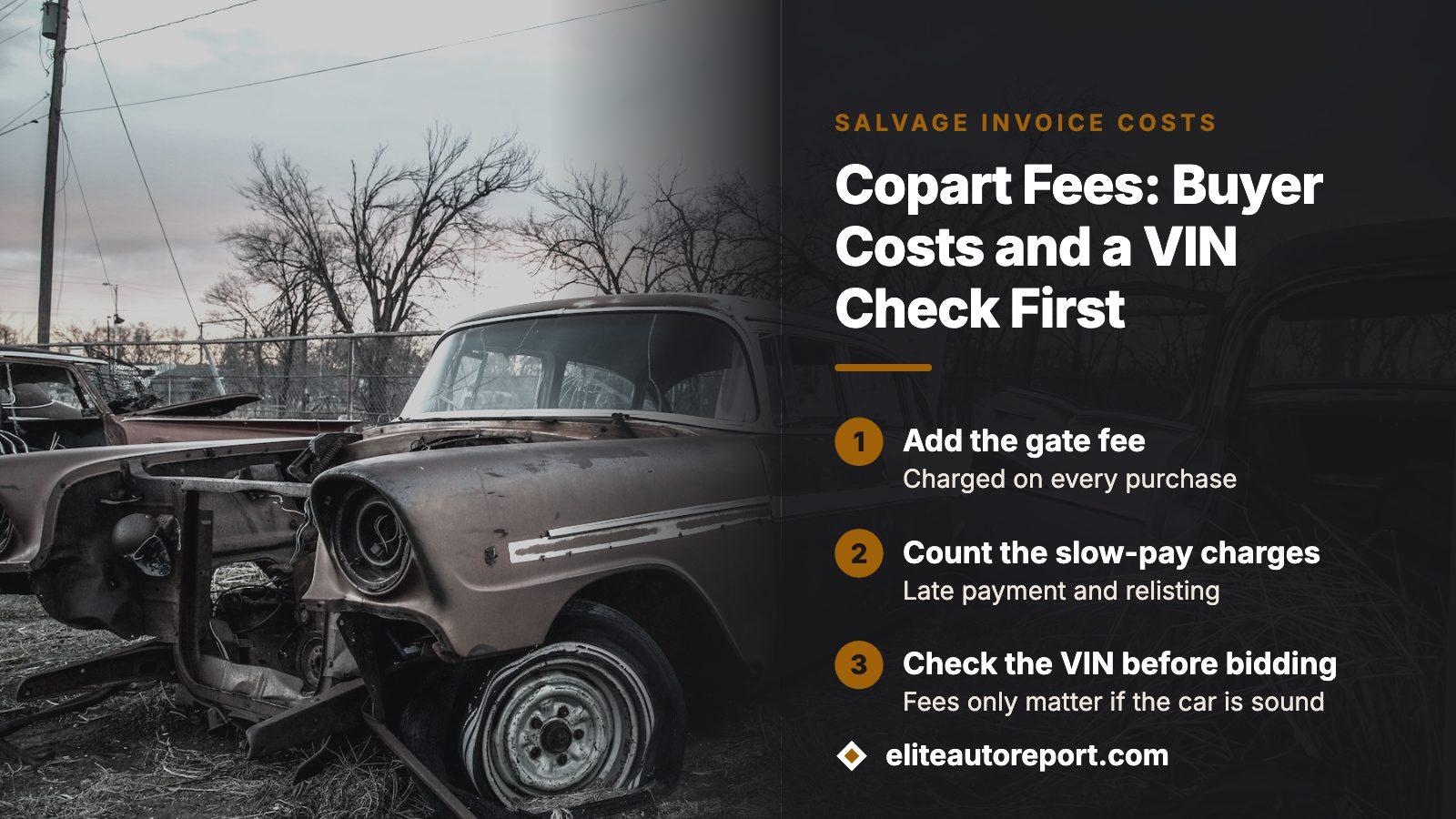
Copart bills a bidding fee that depends on the final bid, vehicle type, title group and payment method, then adds a $79 gate fee and a virtual bid fee for online bids. Late payment, relisting, storage and title shipping can follow. Read Copart's own tables for your lot, and look up the VIN first to learn what the car has been through.
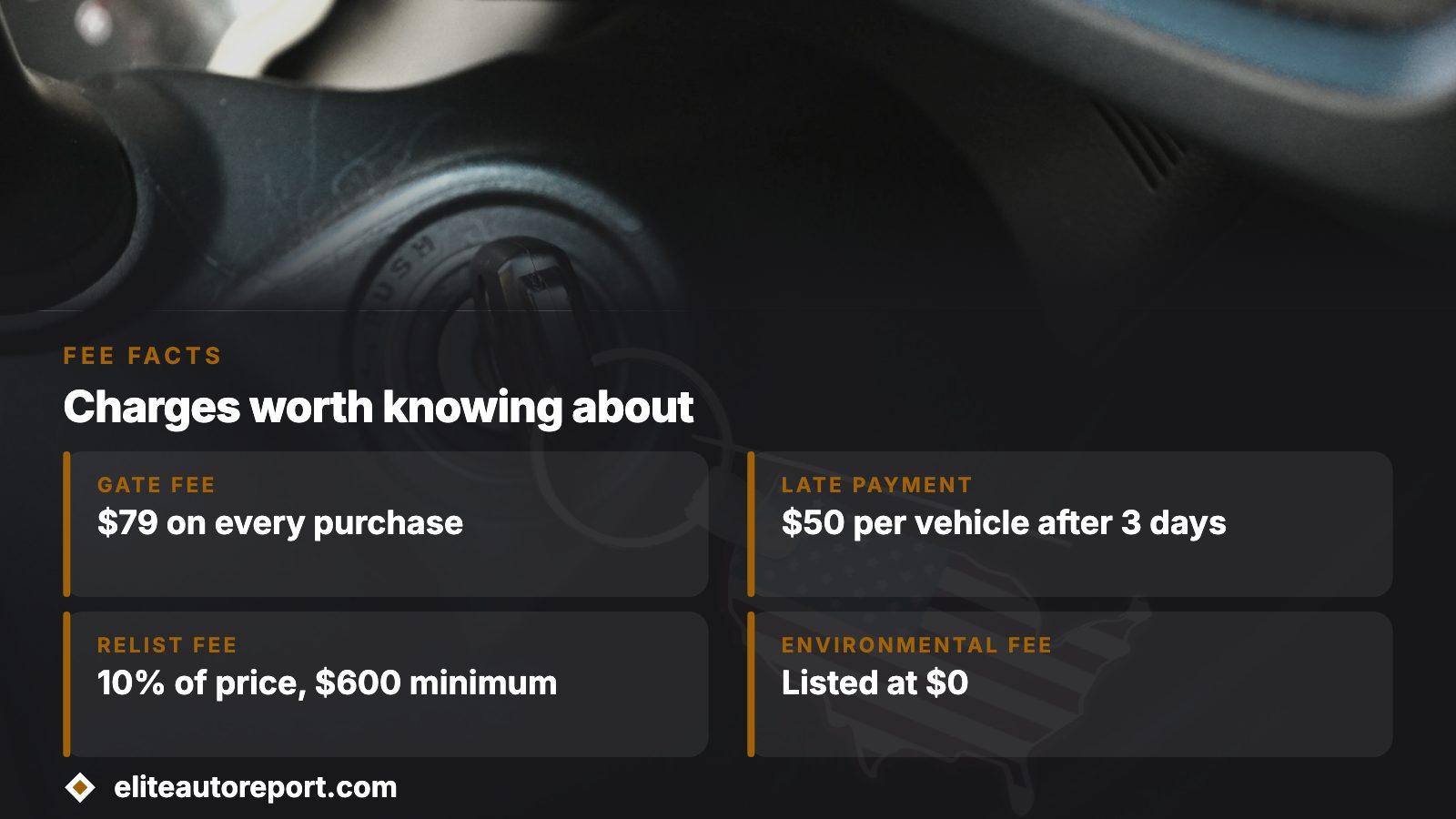
- Gate fee
- $79 on every purchase
- Late payment
- $50 per vehicle after 3 business days
- Relist fee
- 10% of the sale price, $600 minimum
- Environmental fee
- Listed at $0
Where the extra money comes from on a Copart invoice
A hammer price is only the start. Copart's member fee page lays out a bidding fee, a gate fee, a virtual bid fee and a handful of conditional charges, and every one of them lands on your invoice for a single car. Buyers who only watch the bid number tend to be surprised at checkout.
At EliteAutoReport we look at auctions from the other side of the screen: the history behind a car, its photos and its earlier sales. Fees matter most there, because exotic and classic cars attract higher bids, and higher bids move you into the pricier brackets.
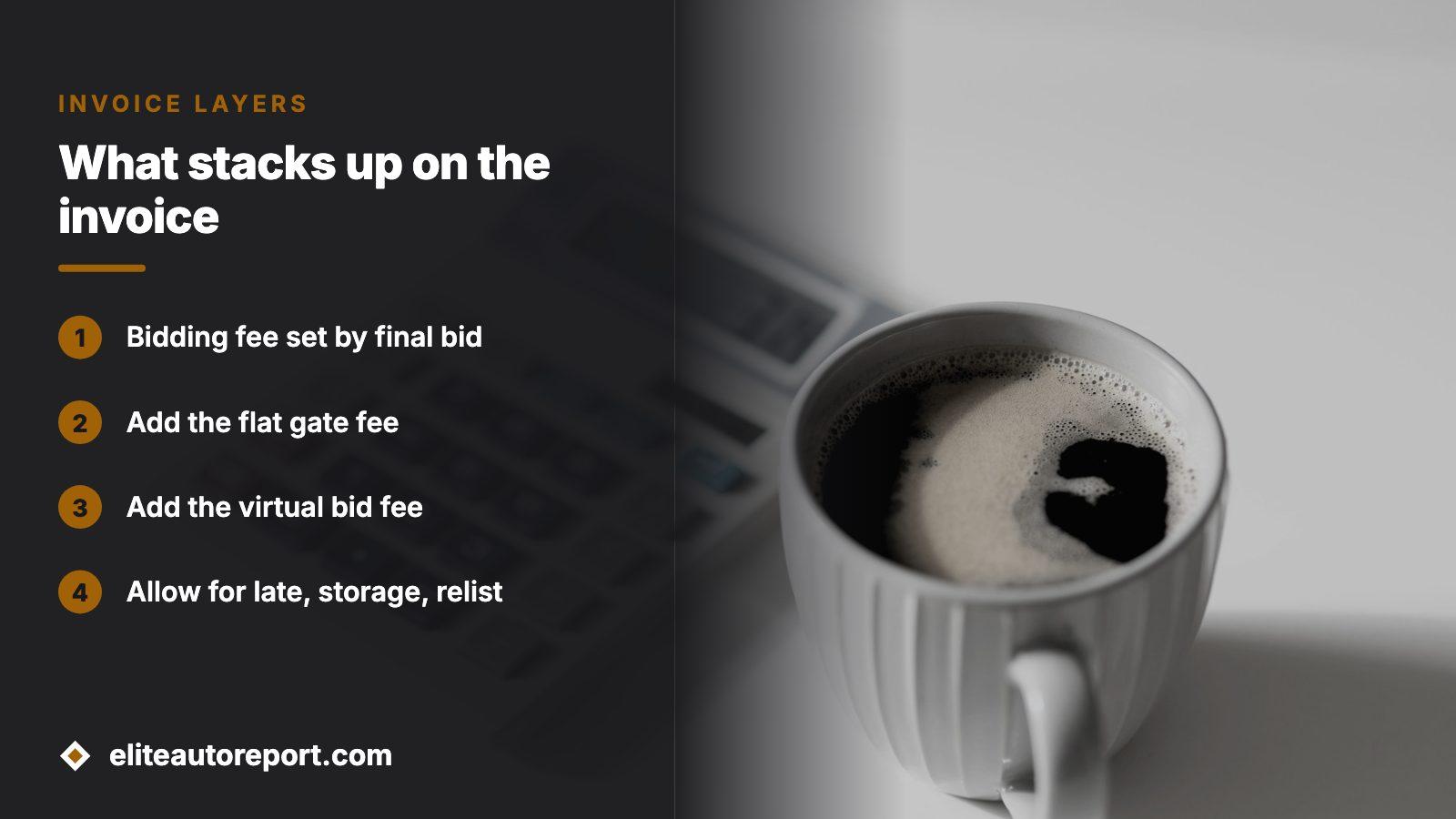
- Bidding fee, set by the final bid price
- Gate fee, a flat charge on all purchases
- Virtual bid fee, for bids placed on any device
- Late payment, storage, relist and finance charges, only when they apply
- Title shipping, if you want the title mailed
How the bidding fee is worked out
Copart does not use one rate. Its page publishes separate tables by vehicle type (standard, or heavy equipment such as RVs, buses and box trucks), by title group (clean or non-clean) and by how you pay. The title group for a specific lot appears in a tooltip on its details page, so check that before you work out a total.
Low brackets are flat dollar amounts. On a clean title, a final bid between $50.00 and $99.99 carries a $45.00 fee when you pay with secured funds and $50.00 with unsecured funds. Higher tables move to a percentage of the final bid, and the percentage differs by table, so reading the right one matters.
| Example bid bracket | Title group | Secured funds | Unsecured funds |
|---|---|---|---|
| $50.00 to $99.99 | Clean | $45.00 | $50.00 |
| $1,000.00 to $1,199.99 | Clean (first table) | $325.00 | $385.00 |
| $2,500.00 to $2,999.99 | Non-clean | $610.00 | Check the page |
Why the way you pay changes the total
Copart sorts payment into two camps. Debit card, wire transfer and MoneyGram are secured. Credit cards, Apple Pay, Google Pay and PayPal count as unsecured, and in every bracket I read the unsecured fee ran higher for the same bid.
A few options, cash and company checks among them, need approval first. If you plan to pay with a card for convenience, price the same lot both ways. On an expensive car the gap is large enough to justify a wire transfer.
Do the arithmetic before bid day
Pick your maximum bid, find its bracket for that vehicle type and title group, then add the gate and virtual bid fees. That sum is what you will really pay.
Gate fee and virtual bid fee on top of the bidding fee
Each purchase carries a $79 gate fee, which Copart says pays for administration and for bringing the car to the loading area. A cheap car gets no discount on it.
Bidding on a phone, tablet or computer adds a virtual bid fee based on your high bid. Pre-bids are free under $100, then run from $39 up to $129 at $8,000 and above. Live bids are free under $100 and run from $49 up to $149 at the same top bracket.
- Pre-bid, $100 to $499.99: $39
- Pre-bid, $500 to $999.99: $49
- Live bid, $100 to $499.99: $49
- Live bid, $500 to $999.99: $59
Charges that only hit if you move slowly
The invoice must be settled inside 3 business days, sale day included, or Copart bills $50 for each vehicle. Storage charges vary by yard and are listed on Copart's location pages, so ask where the car sits before you win it.
The harsher penalty is the relist fee. Leave a lot unpaid past 8 calendar days and Copart puts the car back up for sale. You are charged 10% of what it sold for, never less than $600, and a deposit on file gets drained first.
A fee you can avoid
Relisting punishes a buyer who wins a car and then finds something ugly in its history. Learn the car's past before bidding, and the invoice is the only surprise left.
Title shipping, financing and the zero-dollar fee
Titles can be mailed, up to 10 from one location, at $15 through the postal service or $20 through FedEx, once a Limited Power of Attorney is filed. Collecting a title in person costs $20 handling each.
Buying through a finance company tied to Copart adds a $69 flooring service fee. An environmental fee appears on the page too, but it is listed at $0 and leaves your math alone.
Look up the VIN before the fees start counting
Fees are the cost of entry; history tells you if entry is worth it. A VIN search through EliteAutoReport hunts for auction sales on file, damage notes, photos taken before repair, title brands and odometer readings, so you can see whether the car has crossed a salvage block before.
For a rare Italian coupe or a restored muscle car, a record of an earlier insurance total loss changes the number you should bid, or whether you bid. The preview is free; a full report is one payment with no subscription, and prices sit on the pricing page.
- Copy the 17-character VIN off the lot listing.
- Run the preview and scan for auction or salvage entries.
- Open the full report if the car is a serious candidate.
- Set your maximum bid after fees, not before.
For the national title database behind many of these records, see VehicleHistory.gov, an official Department of Justice site.
Where this information comes from
- Copart: Member fees — every fee, bracket and deadline quoted here
- VehicleHistory.gov (NMVTIS) — official federal site for title history data
Sources and photos: Facts checked against the sources above in November 2026. Photos by Leo_Visions, Ben Wicks and Jake Kling on Unsplash; diagrams by EliteAutoReport.
Keep reading
- Copart VIN Check: Auction Photos and History for Luxury and Classic CarsWhat a Copart VIN search finds on a luxury car.
- What Happens When You Buy a Car at Auction: Fees, Title and Hidden HistoryThe wider process of buying at auction.
- What to Do After Buying a Car at Auction, From the Paperwork to the PlatesPaperwork and steps once you have won.
- PricingHow report purchases work on this site.
Frequently asked questions
What is Copart's gate fee?
A flat $79 sits on every Copart purchase, whatever the final bid. Copart says it pays for administration and moving the car to the loading area, so a low-priced car feels it most.
Do Copart fees change with the payment method?
Yes. The fee tables are split into secured methods, such as debit card and wire transfer, and unsecured methods, such as credit card, Apple Pay and PayPal. In the brackets I read, unsecured funds cost more for the same bid, so compare both on your lot.
What happens if I do not pay in time?
Copart charges $50 per vehicle once 3 business days pass. After 8 calendar days unpaid, the lot is relisted and you owe 10% of the final price, $600 at minimum, taken from any deposit.
Is there an environmental fee?
Copart lists an environmental fee, but its fee page currently shows it as $0 per item sold. Fees can change, so confirm the figure on the live page for your lot.
Can a VIN check help me plan my bid?
It cannot show the fee for a lot, since Copart sets that. It can show earlier sales, damage notes and photos on record, which helps you decide your maximum bid and whether the car deserves one.
Now check the car itself
The guide explains what to look for. The report shows what this VIN has on record.