THE SHORT ANSWER
Copart charges a yearly membership in tiers, with a free guest level for browsing. IAA charges one registration fee to bid. Both sell mostly insurer cars through online bidding, and both let you search by VIN. IAA's rules say plainly that its data may be wrong and every car is sold as is. For a luxury or classic car, the VIN check matters more than the choice of auction.
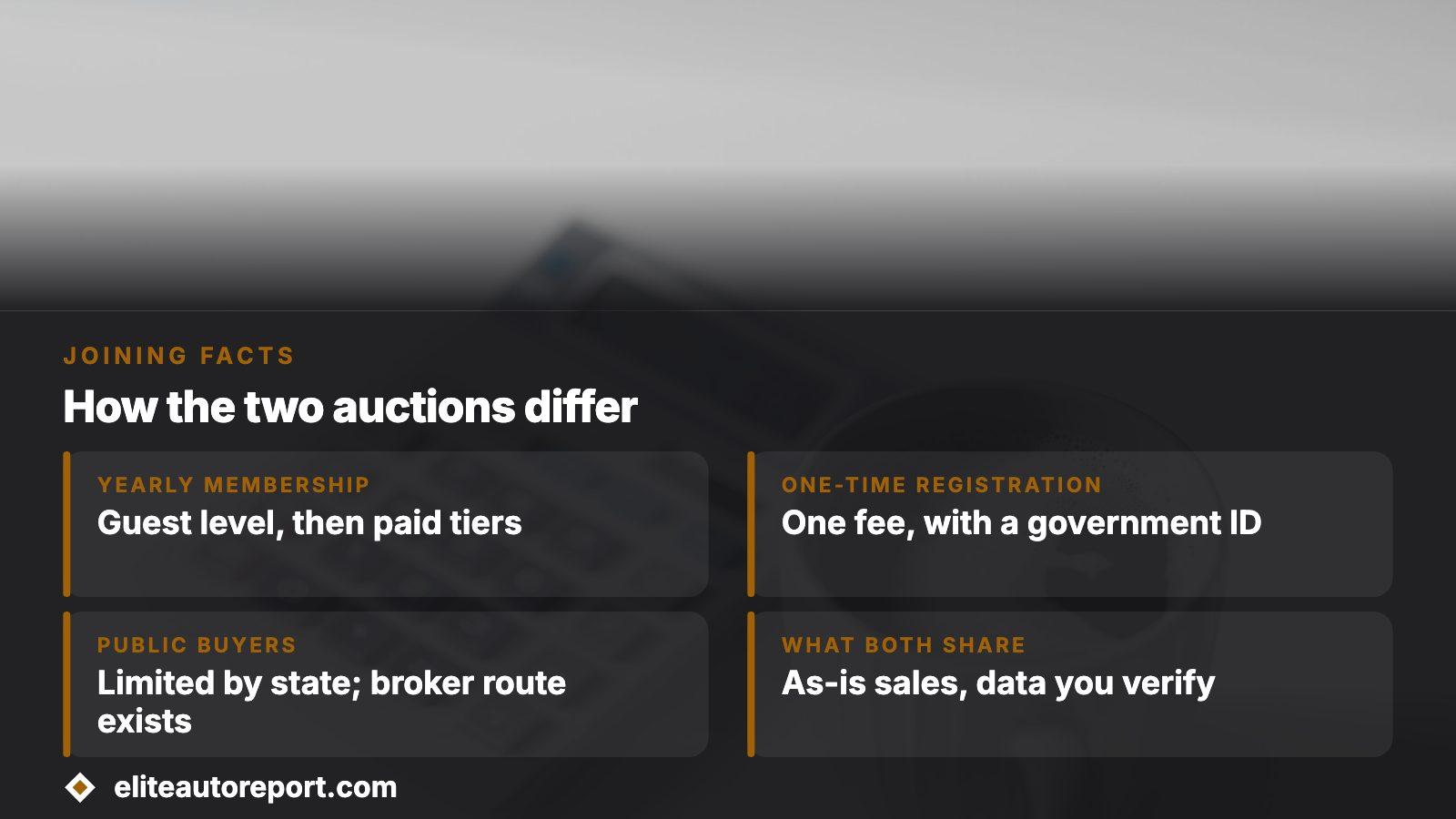
- Join Copart
- Free guest level; paid Basic and Premier tiers to bid
- Join IAA
- One registration fee to bid, with a government ID
- Public buyers
- Limited by state at IAA; Copart offers a broker route
- What both share
- As-is sales and listing data you must verify yourself
Two auctions, one shared problem
Copart and IAA do the same job. An insurer pays out on a wrecked, flooded or stolen car, and the car goes to an online sale where dismantlers, rebuilders, dealers and some private buyers bid. Copart's own annual report to the SEC says insurers supplied 79% of the vehicles it processed in fiscal 2026, with dealers, charities, rental companies and banks making up the rest.
The shared problem is for whoever buys the car later. A pretty car on a dealer lot or a private listing may have passed through either auction, and the seller may not say so. For a Ferrari, a Porsche or a clean-looking classic, that single sale can matter more than anything on the odometer. A VIN check is how you find out which lot, if any, handled the car.
How you join: membership versus registration
The two companies charge for access in different ways. This table reflects each company's own pages as I read them on the day I wrote this, so confirm the current terms before paying anyone.
| Point | Copart | IAA |
|---|---|---|
| Cost to bid | Yearly tiers: Basic at $99 and Premier at $249 | One registration fee of $225 for all IAA inventory |
| Browsing only | Free guest level with watchlist and alerts | Search is open, but bidding needs a paid account |
| Deposit rules | Basic bids up to $2,000 with no deposit | Not stated on the page I read |
| Refund | Within 7 days of paying | Not stated on the page I read |
| ID | Government photo ID before buying | Government ID, plus proof of address if the ID has none |
Copart's higher tier also raises the daily bidding ceiling, which matters if you chase several cars at once. IAA mentions three membership tiers, but the comparison chart did not come through as text, so I leave them out.
Who may actually bid on a car
Many readers assume anyone with a card can buy any wreck. Not so. Copart says it sells mainly to licensed dismantlers, rebuilders, repair licensees and dealers, plus exporters and the public, and it runs a broker program in which a registered member buys on a public buyer's behalf.
IAA is more specific. A private individual may bid only on sales the public is allowed into, and that differs from state to state; every vehicle page carries a Who Can Bid list to settle it. In a state that does not allow public buying, an individual must hire a broker or open a business account. A trade license from some other line of work generally leaves you with the private buyer's reach.
Check the title rules in your state
Whether you may bid is one question. Whether you may register a car that comes with a salvage brand is another, and your state DMV answers it. Settle both before you put in a bid.
What each listing promises, which is very little
IAA is blunt about this in its auction rules. Every car sells as is, where is, with no warranty. IAA says it takes on no duty to confirm that its information is accurate or complete, and it tells buyers not to bid on the strength of details such as the VIN, the mileage, the title, the airbags, the images or whether the car starts.
A listed key or catalytic converter only means the part was seen at check-in. Mileage discrepancies are the buyer's problem, and the buyer is asked to verify the title type and brand before repairs begin.
I could not open a comparable rules page for Copart, and its annual report says nothing on as-is terms. Treat that as a gap in what I could confirm, not as proof of kinder terms. Assume the same caution at both.
Photos, 360 views and what they leave out
Both operators put real effort into pictures. Copart reports that it was putting photos of its lots online as early as 2001, and in 2020 it rolled out 360-degree views inside and outside the car. IAA offers its own 360 view and engine-start clips. For a buyer in another city, these are the only way to look at the car.
A set of photos still shows only the angles someone chose. IAA states that images are not meant to show full condition and that a damage description is not exhaustive. Undercarriage, frame and water damage are the usual hidden items.
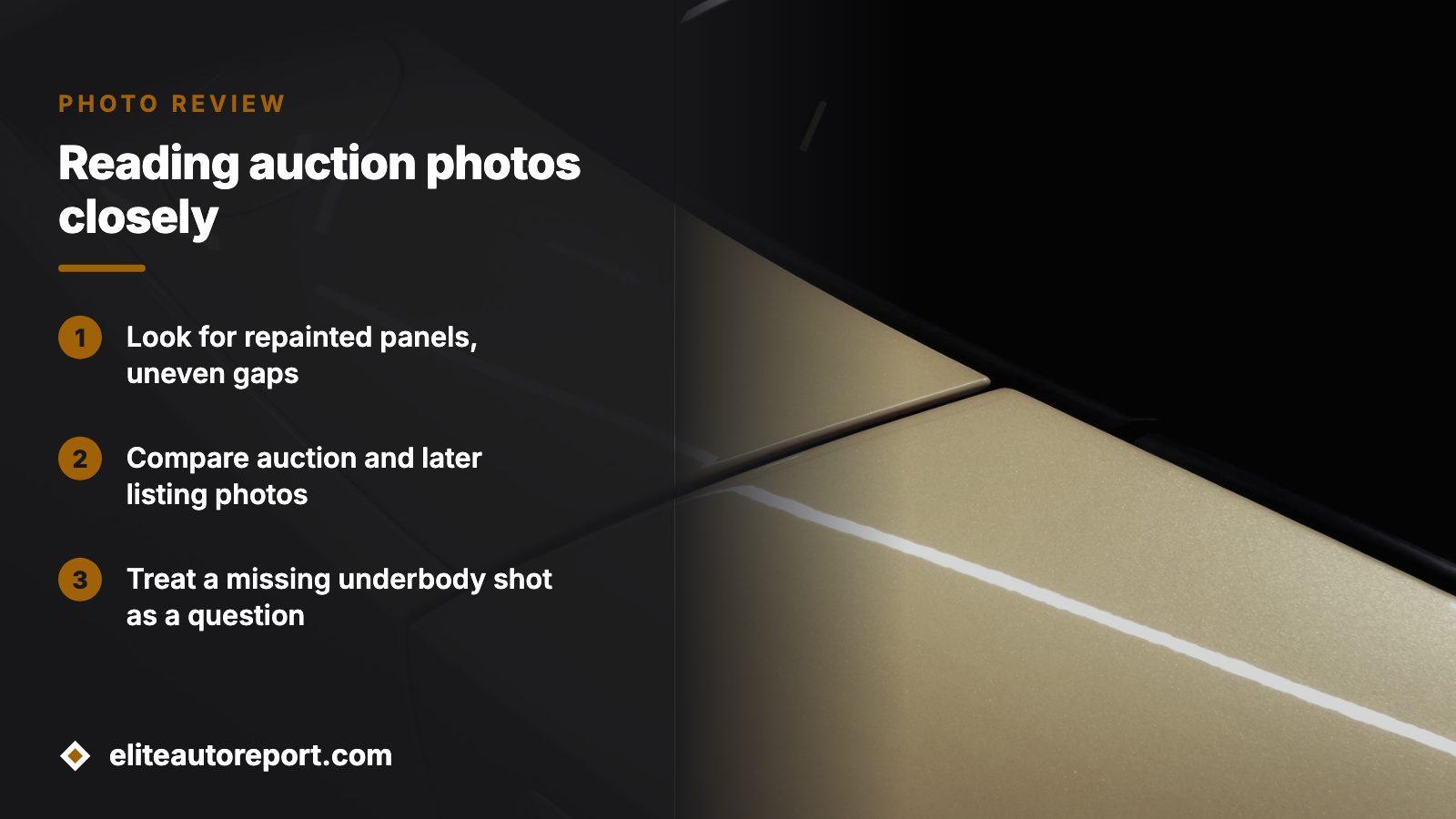
- In the close-ups, check each panel edge for mismatched paint and uneven gaps instead of trusting the hero shot.
- Compare photos from the auction with photos in a later sale listing.
- Treat a missing interior or underbody shot as a question, not a pass.
What a VIN check adds that neither auction gives you
Searching a VIN on either auction site tells you what that company holds for that lot. It does not tell you whether the same car was sold at the other auction first, what its title looks like in the state it now lives in, or whether the mileage ever rolled back.
A history report works across sources. The auction section shows a past sale and its photos, and beside it sit title brands, odometer readings, damage records, theft entries and open recalls. That is the view an auction listing cannot give, since each lot page covers one sale.
Federal title data helps too, with limits. The government's own title database, NMVTIS, still lacks some reporters, and it admits that gap can produce a clean-looking search for a car that has a past.
What happens when the auction past surfaces late
The risk of skipping the check is not hypothetical. An owner who filed a safety complaint with NHTSA showed how a quiet auction history can come back years later.
From an NHTSA owner complaint
An owner of a 2014 Tesla Model S wrote that they bought the car at a US auction and shipped it abroad. After more than 2 years of driving, recall letters arrived, but the maker's local service refused the work because of an old accident record, even though the damage had been repaired in the US. The owner said airbag and steering concerns were left open.
The lesson for you: an old accident or auction record can limit service and resale long after the sale. Learn it before buying, not after.
Warning signs, costs and your next move
Walk away or lower your offer when the seller will not share the VIN, when the photos show a loss type that the story does not mention, or when a clean title and a salvage record both exist for the same car. Federal guidance says a state may brand a car one way while another state does not, so a clean title in one place is not the end of the question.
To run the check, copy the full VIN from the dashboard or the paperwork and enter it on EliteAutoReport. Starting the preview costs nothing; a full report is paid for once, and the pricing page has the amounts. When you have several candidates, a pack of reports saves repeat orders. Then add an independent inspection, because no report sees under the car.
Where this information comes from
- Copart: membership and vehicle search — membership levels, deposit limit and the VIN search box
- Copart Inc. annual report, fiscal 2026 — who sells, who buys and how bidding works
- IAA: how to register — registration fee, ID and public buyer limits
- IAA: auction rules — as-is terms and the data disclaimers
- NMVTIS: information for consumers — what federal title data covers and where it falls short
- NHTSA owner complaint 11317366 — owner experience, paraphrased
Sources and photos: Facts checked against the sources above in November 2026. Photos by Iain, Franck V. and Ben Wicks on Unsplash; diagrams by EliteAutoReport.
Keep reading
- Copart VIN Check: Auction Photos and History for Luxury and Classic CarsHow a VIN search works on the Copart side.
- IAAI VIN Check: IAA Auction History for Luxury, Exotic and Classic CarsThe same lookup for IAA records.
- What Happens When You Buy a Car at Auction: Fees, Title and Hidden HistorySteps and risks if you plan to bid yourself.
- PricingWhat a report or a pack costs, paid once.
Frequently asked questions
Is Copart or IAAI better for a first-time buyer?
Neither is better by default. Copart sells access by yearly tier and says it serves the public through a broker route. IAA charges one registration fee and limits private buyers by state. Check which cars your state lets you bid on first, then compare the fees for the specific car you want.
Can I search a car by VIN on both?
Copart's home page has a combined VIN and lot number box. The IAA pages I read describe filters by type, make and damage, and I did not see a VIN search described. A history report by VIN is the dependable way to find either auction's record.
Are cars from these auctions sold with a warranty?
IAA says all cars sell as is, where is, with no warranty. I could not confirm Copart's wording from a page I opened, so ask before bidding and assume no promises about condition, mileage or hidden damage.
Is a clean title proof that a car never went through an auction?
No. Total loss labels and brands vary by state, and a car can be sold by an insurer without carrying a brand. Federal title data also has gaps, so a clean result is useful but not final. Pair it with an auction history check and an inspection.
How do I check a car I did not buy at auction?
Copy the VIN off the car or its paperwork and open the free preview on EliteAutoReport. Should the car seem worth chasing, the paid report adds auction photos, brands and mileage records in one place, and an independent mechanic should still look at it.
Now check the car itself
The guide explains what to look for. The report shows what this VIN has on record.