THE SHORT ANSWER
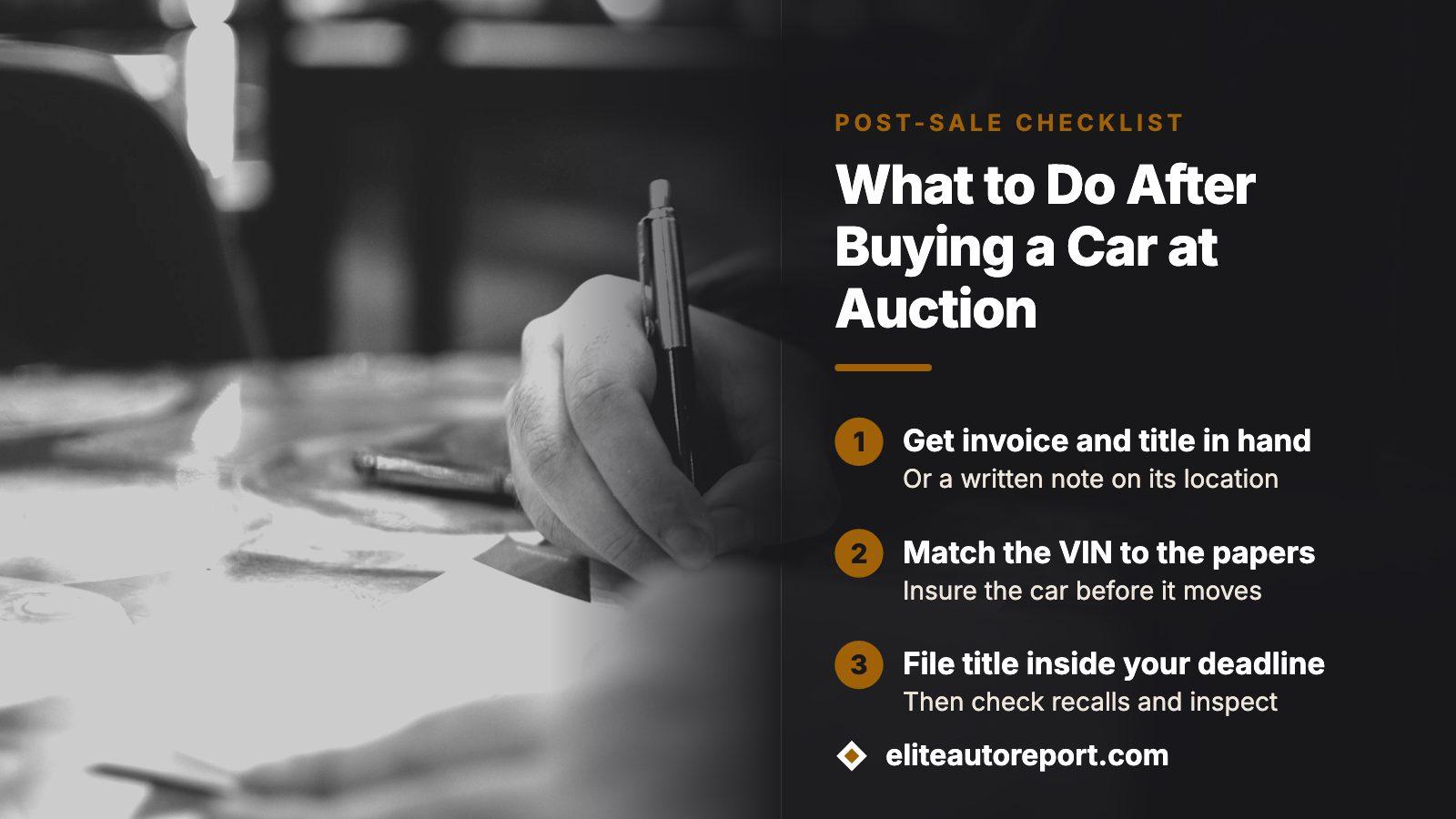
Collect a paid invoice and the title, or a written note of where the title is. Read the VIN on the car against the papers, and insure the car before it moves. Pull its auction history and photos by VIN the same day, since some claim windows last only days. Then file the title inside your state's deadline, check open recalls and book an independent inspection.
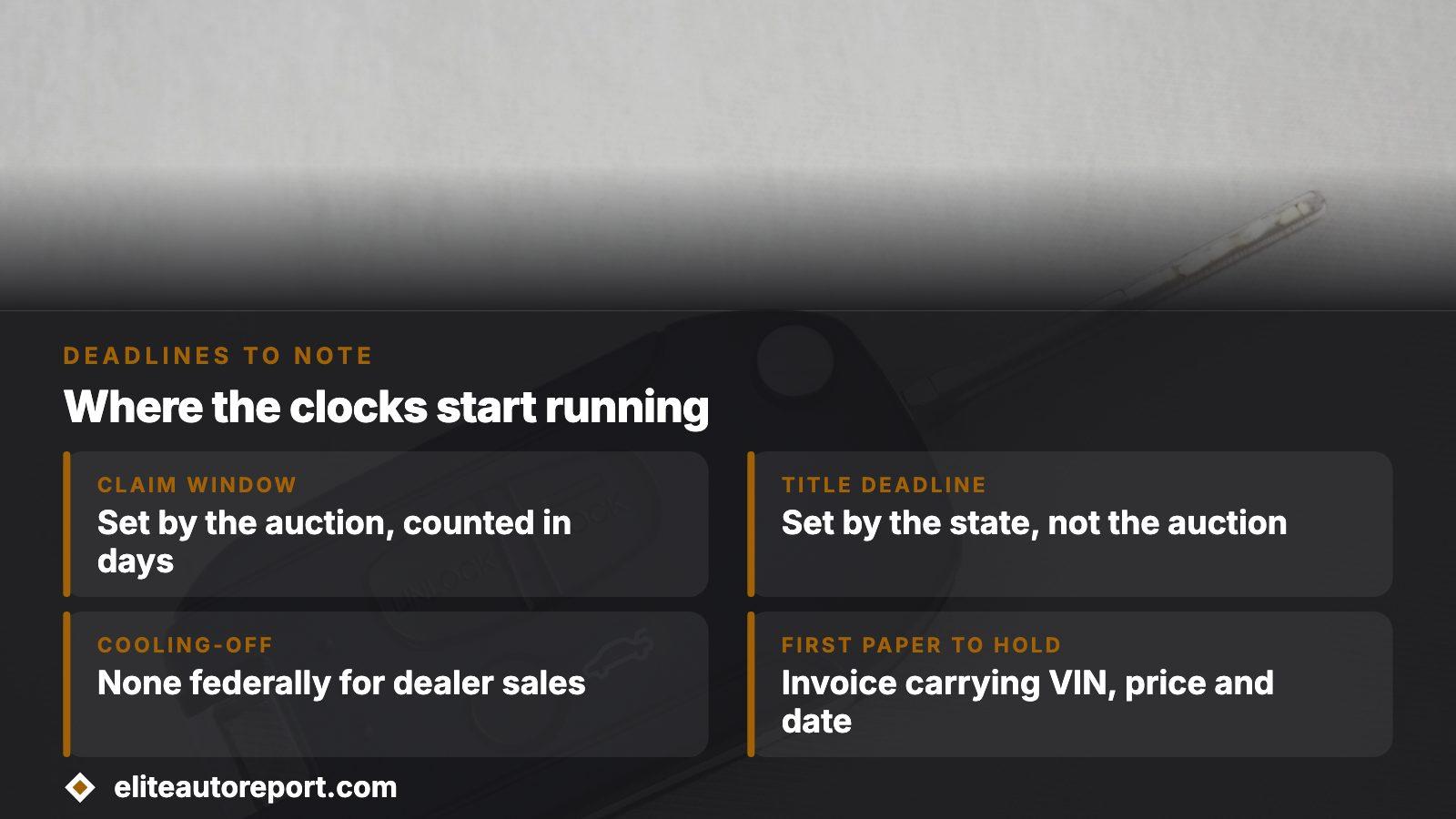
- Claim window
- 10 calendar days at one auction house's digital sales
- Title deadline
- 30 days from the sale date in Texas; other states differ
- Cooling-off
- No federal three-day right to cancel for dealer sales
First hours: get the paper in your hands
Before the car leaves the lot, gather what proves the sale.
- A paid invoice that carries the VIN, the price and the day of sale.
- The title, or a written note saying where it is and when it will arrive.
- A lien release, if a lender ever held the car.
- Notes on what the auctioneer announced as the car sold, light color included.
Texas counts its title deadline from the day of sale, and tells buyers to keep a record of who sold the car and its VIN. Other states count their own way, but the date on your invoice starts every clock. A missing title on a rare car can mean a bonded-title process later.
Read the VIN off the car and hold it against the papers
Bring the paperwork out to the car. Write down the VIN exactly as stamped on the car, then lay it next to the title and the invoice: the three must agree down to the last digit and letter.
NHTSA's public decoder returns the make, model, model year, body class, engine and build plant tied to a VIN, and it flags a number whose ninth character fails the check-digit math. A coupe where the lot sheet said convertible deserves a call that same day. The data comes from the manufacturers, and the decoder does not handle years before 1981, so an older classic needs a marque specialist to read its numbers.
Pull the sale record and the photos while the clock runs
An auction win differs from other purchases here. The car may well have crossed a lane before, and its earlier sale dates, damage notes and photos show what it looked like then. EliteAutoReport searches for auction records on a VIN and lines them up with the title brands, mileage readings and open recalls on file, so you can hold old photos against the car in your garage, panel by panel. Run the VIN for the free preview, then decide whether the report, bought once and without a subscription, is worth it.
Know the limits. The federal title database lists 87 percent of the US vehicle fleet, and states contribute unevenly, with more than half reporting, so a car with a rough past can still search clean. History reports also tend to skip mechanical problems. An empty result helps without settling anything.
Claim windows are short, and some are counted in days
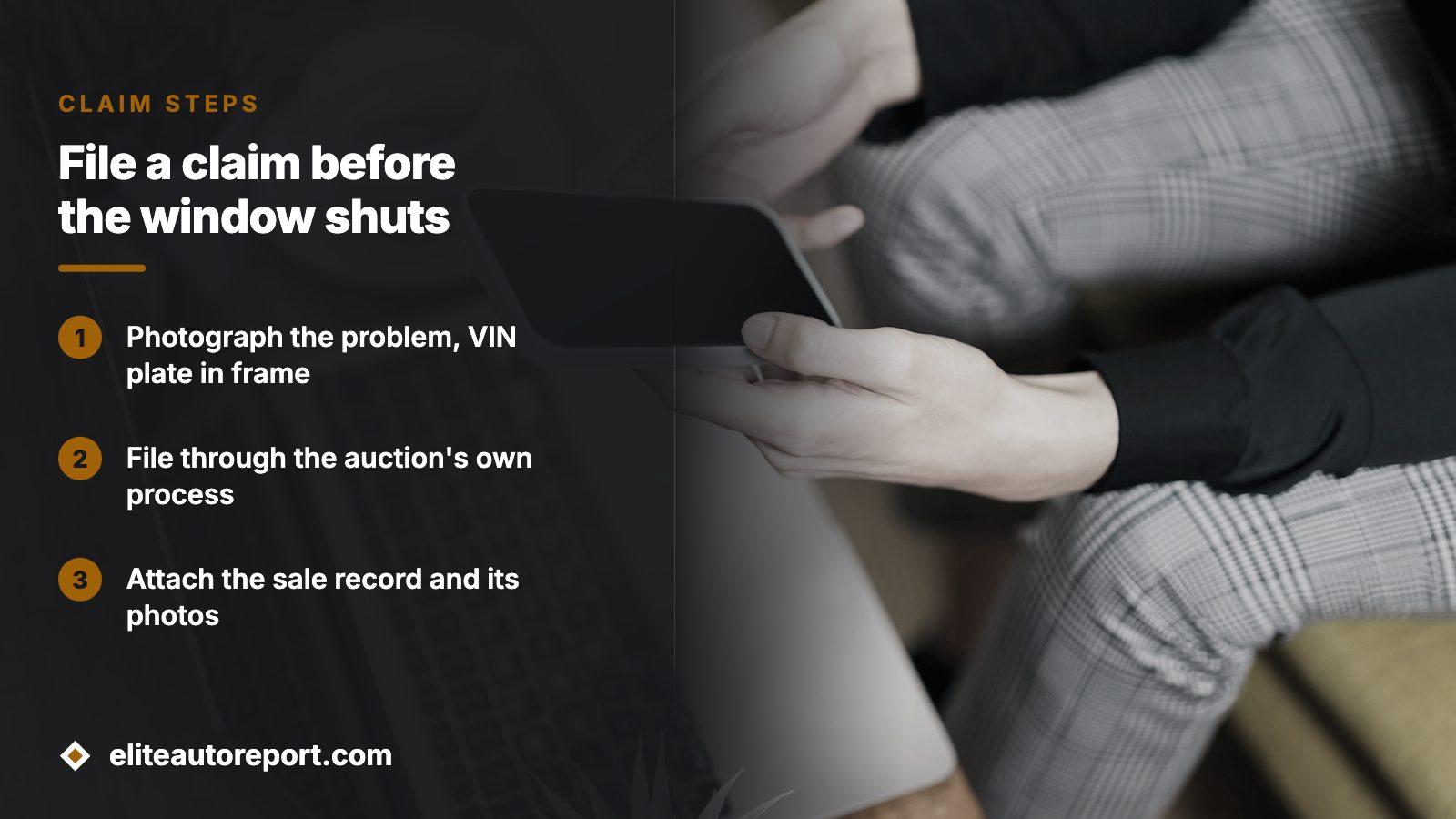
Manheim's arbitration page is a useful yardstick. It covers buyers whose car carried undisclosed problems or arrived without its title, and the filing period is brief: 10 calendar days for a digital transaction. Once a case opens, the papers, the car and the title are due within 5 calendar days of the specialist's request. A successful claim can end in a lower price or a canceled sale. Lane sales use colored lights, and a red light means sold as is, which narrows what you can claim.
- Photograph the problem the day you see it, VIN plate in frame.
- File through the auction's own process before its window closes.
- Attach the sale record and its photos from the VIN report.
Outside arbitration the position is blunt. The FTC notes that no federal rule hands a dealer-sale buyer three days to cancel, and that an as-is sale leaves repair bills with the buyer.
Insurance and the trip home
Insure the car before it moves. Texas asks for proof of liability coverage to title and register a car, and a buyer without it may apply for title only. Give the insurer the VIN and say plainly if the title carries a brand.
When a seller has removed the plates, Texas offers a transit permit for the drive to the county office: no fee, 5 calendar days, once per sale, proof of insurance required. Salvage and nonrepairable vehicles are excluded.
Title and registration: the state sets the pace
Titling is a state matter. Texas is one worked example, drawn from its dealer and private-sale rules, so look up your own deadline the day you win.
| Step | Texas example |
|---|---|
| Deadline | 30 days, counted from the date of sale; penalties for filing late |
| Papers | Signed title, Form 130-U, any lien release |
| Insurance | Proof of liability coverage, or apply for title only |
| Tax | 6.25% applied to the larger of two numbers: your price or the state's standard presumptive value |
| Wait | 20 business days minimum before the title arrives; call the state if 30 business days pass |
A car with a lender's lien sends its title to the lienholder, not to you.
When the title is missing or the car carries a brand
A car that sold with its title absent usually cannot be registered yet. Texas offers a bonded title to a buyer who holds the car but not the paper: a $15 fee, proof you own it (a bill of sale, for instance), and a surety bond sized at half again the value of the car. It is closed off if a recorded lender's release cannot be obtained.
Brands add a second hurdle: Texas lists salvage, rebuilt, junk, water damage, odometer and gray market among its title brands.
From an NHTSA owner complaint
An owner who bought a 2007 Mercedes-Benz ML350 at auction in late 2023, with a salvage title, wrote that the SUV could not go to the inspection center for plates. Rain water had damaged a rear control module, knocking out the lights, seats, key fob, radio, wipers and rear gate.
Price the road to plates into the next bid. If you have already won a branded car, read its VIN record for the brand and any water notes before you pay a transporter.
Recalls, and whether the maker will work on the car
Check the VIN against NHTSA's recall database the day you win. The FTC points buyers to it as a free search for open recalls, meaning campaigns the maker has not finished repairing. Counts add up on late-model luxury cars: NHTSA's recall data lists 9 campaigns for the 2014 Tesla Model S.
From an NHTSA owner complaint
An owner who bought a 2014 Tesla Model S at a US auction and shipped it abroad wrote that recall notices from the maker's US arm arrived after more than two years of driving. The local service center then declined the recall repairs because of the car's earlier accident history, a record the owner says was fixed in the US.
That is one owner's account, not a finding against anyone. Ask the nearest franchised dealer, before you ship or spend, whether it will work on a car with this history. The accident detail is what a VIN's auction record supplies.
Get a specialist to look at it before you spend
No history report replaces a mechanic. The FTC recommends paying an outside mechanic to inspect the car, certified or not, and having the mechanic put the findings, a repair estimate and the VIN in a written report. A mechanical inspection is also a different thing from the state's safety inspection. For an exotic or a classic, the right person is a marque specialist. Hand over the sale record's damage notes, and keep the written estimate as evidence if a claim window is still open.
Where this information comes from
- FTC: Buying a used car from a dealer — Backs the no-cooling-off point, the as-is risk and the advice on an independent inspection with a written report.
- NMVTIS: information for consumers — What the federal title record covers, the coverage figures and why a clean search can mislead.
- NHTSA: VIN decoder — What a decode returns, the check digit, the manufacturer-supplied data and the 1981 limit.
- Texas DMV: buying or selling a vehicle — One state's title deadline, papers, tax, insurance proof and transit permit, with the state's no-title and temporary-plate pages.
- Manheim: arbitration — One auction house's claim windows, sale lights and possible outcomes.
- NHTSA owner complaint 11602503 — owner experience, paraphrased
- NHTSA owner complaint 11317366 — owner experience, paraphrased
Sources and photos: Facts checked against the sources above in November 2026. Photos by Owen Michael Grech, Jakub Żerdzicki and Shadow Photography on Unsplash; diagrams by EliteAutoReport.
Keep reading
- What Happens When You Buy a Car at Auction: Fees, Title and Hidden HistoryThe steps before the win: registration, fees, as-is terms and what to check before bidding.
- Auction History by VIN: Photos for Luxury, Exotic and Classic CarsWhat a VIN's auction record shows and how to read the old photos.
- Classic Car Title Search by VIN: What Turns Up and What Doesn'tTitle questions that come with older and collector cars.
- Sample reportA finished report, photos included, to look over before you pay for one.
Frequently asked questions
How soon must a car won at auction be titled?
Each state sets its own. Texas gives buyers 30 days from the date of sale and can penalize a late filing. Ask your motor vehicle agency the day you win, and count from the date printed on your invoice.
Can I return a car I bought at auction?
Usually not. No federal rule gives dealer-sale buyers three days to cancel, and an as-is car leaves repair costs with the buyer. Some trade auctions run arbitration, and one house allows 10 calendar days on digital sales, so ask the desk what applies.
Do I need insurance before driving an auction car home?
Treat it as a yes. Texas wants proof of liability coverage to title and register a car, and its transit permit also asks for proof of insurance. Call your insurer with the VIN before the car moves.
What if the seller never sends the title?
Start with the auction, because a title that never arrives can be a reason to file a claim inside its window. If it cannot be produced, some states offer a bonded title. Texas asks the buyer to hold the car, show ownership and buy a surety bond.
How do I check a car's history after I have already bought it?
Enter the 17-character VIN for a preview, then buy the report if the details matter. Hold the auction photos and odometer readings up against the car itself. A clean result is not proof, since not every business reports.
Now check the car itself
The guide explains what to look for. The report shows what this VIN has on record.