THE SHORT ANSWER
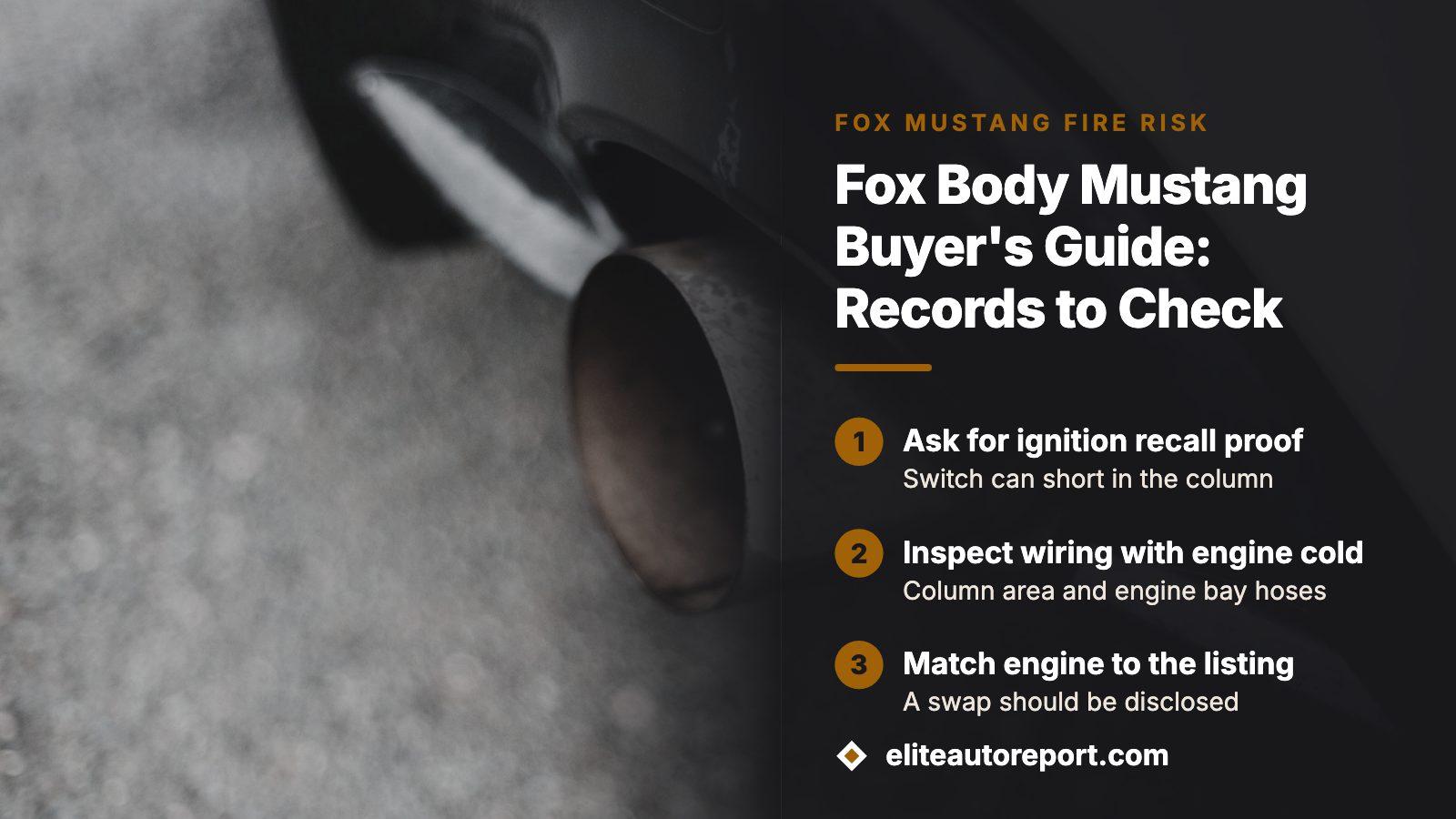
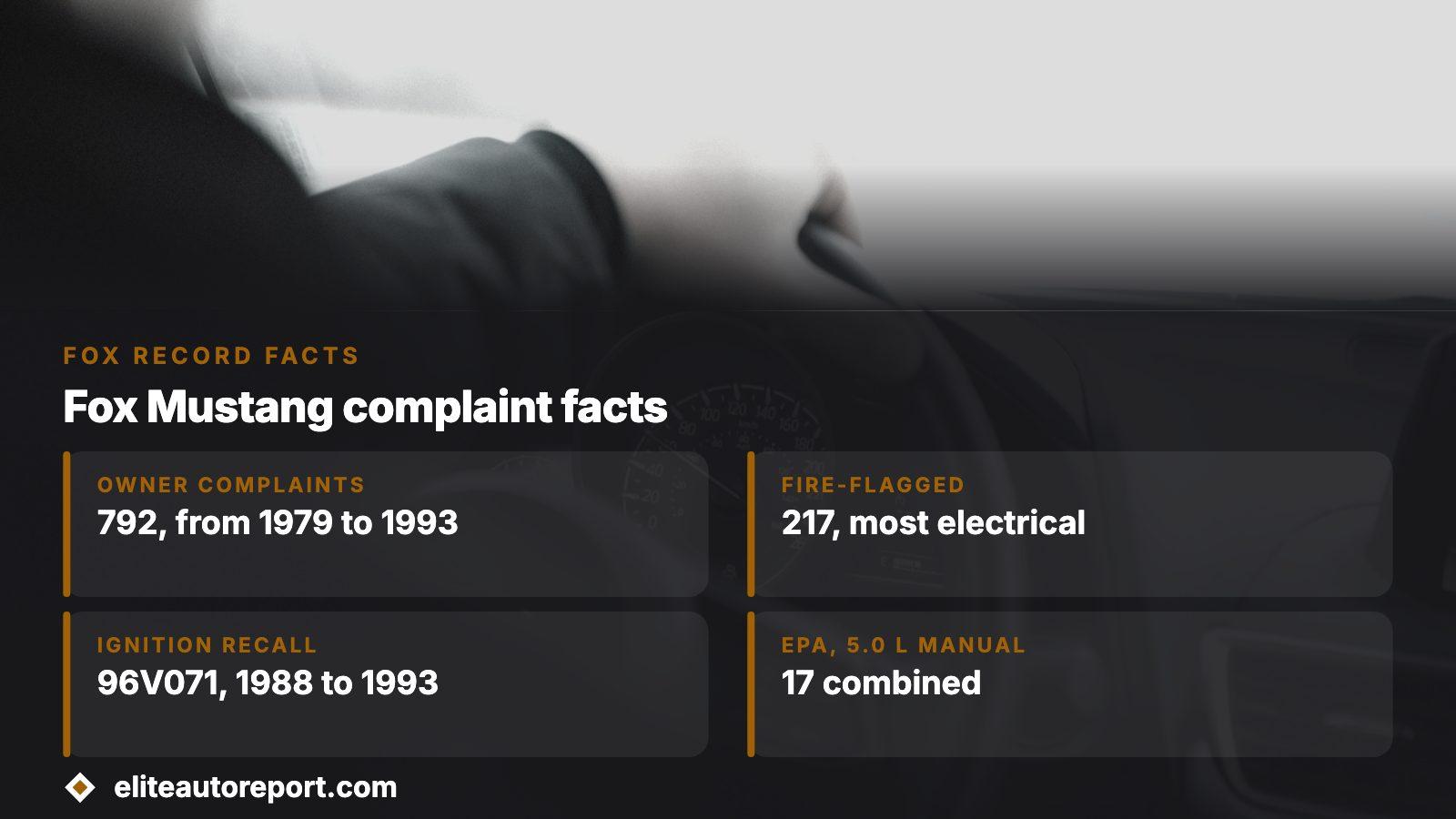
NHTSA holds 792 owner complaints for Ford Mustangs from model years 1979 through 1993. Of those, 217 mention a fire and 166 of the fires point at the electrical system. The big vehicle recall is 96V071, an ignition switch that can short and burn in the steering column, covering 1988 through 1993. Before you buy, confirm the recall was done, then run the VIN for title brands and auction photos.
- Owner complaints, 1979 to 1993
- 792 at NHTSA
- Fire-flagged complaints
- 217, most naming the electrical system
- Ignition switch recall
- 96V071, model years 1988 to 1993
- EPA rating, 5.0 L manual
- 15 city, 22 highway, 17 combined
What the federal records can and cannot tell you
Government databases have no entry called Fox body. The nickname belongs to enthusiasts, so recalls and complaints sit under make Ford, model Mustang, one model year at a time. For this guide I pulled every year from 1979 through 1993 and read the results myself.
Two limits apply. The complaint file is owners writing in, not a measured failure rate, and most of the cars were already old when the filings came in. The recall file, meanwhile, mixes Ford campaigns with notices from aftermarket parts companies. A careful buyer keeps those apart, because a Ford campaign applies to the car as built, while a parts recall only matters if someone bolted that part on.
Start with the number stamped on the car
Cars from this era carry a 17-character number, and the tenth position stands for the model year. NHTSA's free decoder reads it back to you. When I fed it a made-up number with the right pattern, it returned a 1990 Ford Mustang hatchback, an eight-cylinder 5.0 L engine and a Dearborn plant, and it complained that the ninth character failed the check-digit math. Change that tenth character and the answer changed to 1983.
Use that behavior as a quick filter. A seller's listing should match what the decoder says about the body, engine and year. A number that fails the check digit, or decodes to a four-cylinder when the car has a V8, is a reason to ask hard questions before you drive anywhere with a deposit.
The recalls that matter, by era
The earliest cars in the file carry the longest list of Ford campaigns. Later cars have fewer, but the later ones touch fire risk, which is why they get the closest look.
| Campaign | Model years | What NHTSA says |
|---|---|---|
| 79V117 | 1979 | A brake pedal pin was not heat-treated as specified, so the pedal could come off the push rod. |
| 84V119 | 1984 | A carburetor throttle shaft can stick part open. Dealers replace a closure link. |
| 87V139 | 1986 and 1987 | A fuel line coupling may not be fully engaged. Fix: retainer clips over the couplings. |
| 96V071 | 1988 to 1993 | The ignition switch can short, overheat and burn near the steering column. Dealers replace the switch. |
| 91V048 | 1991 | A soft park cam may not hold an automatic in park, so the car could roll. |
| 93V159 | 1993 | A badly formed fuel rail tube can crack and leak. The rail gets replaced. |
Several of these date from a different decade, so ask for paperwork showing each was completed. Parts-company recalls on replacement headlamps and corner lamps also appear on every year from 1987 on, and those are refunds from the lamp maker, not Ford repairs.
The ignition switch problem in owners' words
Recall 96V071 was filed in 1996, years after the last of these cars left the factory, so plenty of owners never received a notice. The complaint file shows what that gap looked like on the ground.
From an NHTSA owner complaint
One 1988 Mustang owner reported getting the switch replaced by a dealer for the recall in May 1996, then losing the car to flames a year later. A firefighter blamed electrical trouble. For this owner, a finished recall was no guarantee.
Take that as a reason to look past the sticker. Ask for the dated repair order, check the column and dash wiring for heat damage or amateur splices, and read any history entries for fire or insurance losses.
What the fire complaints add up to
Of the 792 complaints filed across these model years, 217 are flagged as fires. The biggest block, 166, names the electrical system, which covers the ignition switch, alternator and wiring. Another 12 name the fuel system and 9 name steering. By year, the file peaks at 41 fire-flagged records for 1988, with 1989 and 1990 close behind at 35 and 34.
From an NHTSA owner complaint
A 1987 Mustang owner reported parking in a garage, stepping away briefly and coming back to smoke from under the hood. The car caught fire and part of the house burned. A fire marshal told the owner a fuel line had popped loose and sprayed gasoline across a hot engine, and the car was a total loss.
That story lines up with the fuel line coupling recall on 1986 and 1987 cars. If you are looking at one of those years, ask whether the retainer clips were ever fitted, and look at every rubber hose and coupling in the engine bay.
Powertrains and what they cost to run
EPA lists the same four combinations for 1987, 1990 and 1993: a 2.3 L four-cylinder or a 5.0 L V8, each with a 5-speed manual or a 4-speed automatic, all rear-wheel drive and on regular gasoline. The V8 with a manual is rated 15 city, 22 highway and 17 combined. The four-cylinder manual rates 21, 26 and 23 for 1990, and 19, 27 and 22 for 1993.
- Match the decoded engine to what is under the hood. Many of these cars have had engine work, and a swap should be disclosed, not discovered.
- Odometer figures on cars this old are easy to doubt, so compare dated readings across sales and inspections.
- Expect the V8's thirst in your running budget, and test the clutch and shifter on any manual.
What auction history can show on a modified Fox
Plenty of these cars have lived hard lives, from drag strips to track-day walls. A car with a clean title can still have passed through a salvage auction, and photos from that sale show the damage as it looked before anyone fixed it.
That is where a VIN report earns its keep. EliteAutoReport pairs the number with auction sale records and photos, odometer readings, title brands and theft entries where they exist. Older cars can have thin files, so a blank result does not prove a quiet past, but a sale entry with images gives you something concrete to compare against the car as it sits today.
Title brands and the federal title database
NMVTIS is the federal title database behind most history reports, built to catch title fraud and stop stolen cars returning to sale. A salvage or rebuilt brand on a Fox body can cut the value hard and complicate insurance, so find out before the deposit, not at registration.
The preview tells you whether records exist for the number. The full report is a one-time payment, with no subscription, and it is a sensible expense when a car costs more than a weekend project. Seeing a brand early lets you renegotiate, or walk.
A sensible order of checks before you pay
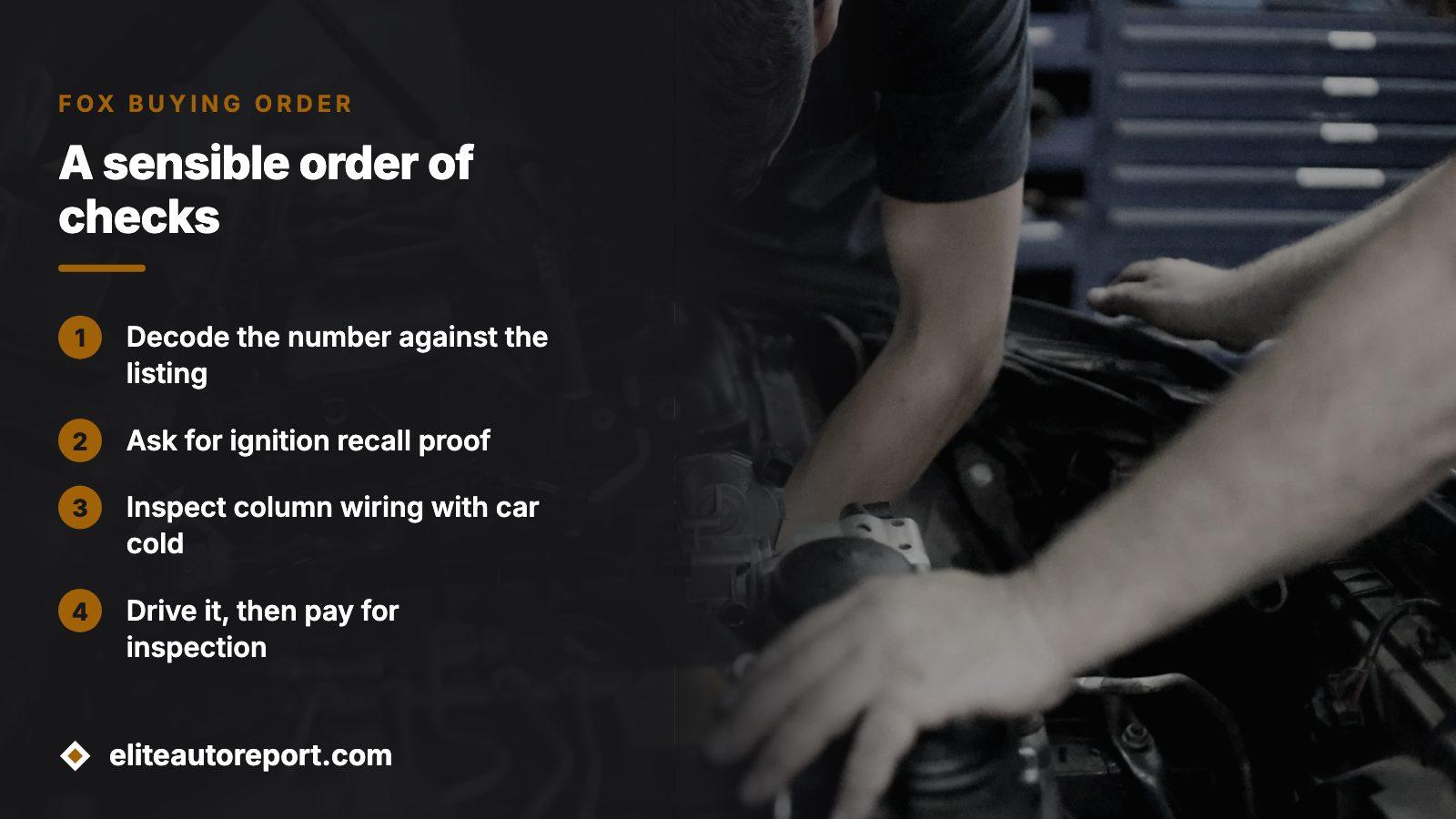
- Decode the number and compare year, body and engine against the listing.
- Run the VIN report and read title, auction, photo and odometer entries.
- Ask for proof that the ignition switch recall and any fuel line or fuel rail recall were done for that year.
- Inspect wiring around the column and the engine bay hoses with the car cold.
- Drive it, then pay for an independent inspection before any money moves.
Paperwork problems are the quickest to find, so they should end a bad deal first.
Where this information comes from
- NHTSA recalls API: 1990 Ford Mustang — campaigns, dates and remedies for the years covered
- NHTSA complaints API: 1988 Ford Mustang — complaint and fire counts by model year and component
- NHTSA owner complaint 812552 — owner experience, paraphrased
- NHTSA owner complaint 803024 — owner experience, paraphrased
- NHTSA vPIC VIN decoder — how the tenth character and check digit behave
- EPA fueleconomy.gov: Ford Mustang 1990 — engine options and mileage ratings
- VehicleHistory.gov — what the federal title database is for
Sources and photos: Facts checked against the sources above in November 2026. Photos by Erik Mclean, Mustafa Sheikhmouss and Miles Loewen on Unsplash; diagrams by EliteAutoReport.
Keep reading
- Where Is the VIN on a Classic Car? Dash, Door, Firewall and Framefind and read the number on an older car first
- Matching Numbers Classic Car: How to Verify the Claim Before You Payconfirm the engine and body belong together
- Classic Car Title Search by VIN: What Turns Up and What Doesn'tadd the state title record to your checks
- Car Auction Photos by VIN: Find Salvage Sale Pictures Before You Buysee how sale photos show past damage
Frequently asked questions
Does NHTSA list Fox body Mustangs under that name?
No. Federal recall and complaint systems file them as Ford Mustang by model year, so search make Ford, model Mustang and the year on the title. Results will include anything Ford sold under that name that year, so read each entry for the specific part or system.
Which recall should I check first?
Campaign 96V071, the ignition switch, because it covers 1988 through 1993 and the risk is fire near the steering column. After that, check the fuel line coupling campaign for 1986 and 1987 and the fuel rail campaign for 1993. Ask for repair orders, not verbal assurances.
Are Fox body Mustangs prone to catching fire?
Owner filings include 217 fire-flagged records out of 792, mostly electrical. That is a complaint count, not a rate, since NHTSA does not know how many cars were on the road. It is enough to justify a wiring inspection and recall proof before purchase.
Will a VIN report show if one was sold at a salvage auction?
It can show sale records, photos and odometer readings where they exist. Older cars sometimes have sparse files, so treat a clean result as one input and not a guarantee. The preview shows whether records are on file before you pay for the full report.
Is the V8 hard on fuel?
EPA rates the 5.0 L with a manual at 15 mpg city, 22 highway and 17 combined, using regular gasoline. The four-cylinder manual is rated 23 combined in 1990 and 22 in 1993. Real mileage depends on condition, tires, gearing and how the car has been modified.
Now check the car itself
The guide explains what to look for. The report shows what this VIN has on record.