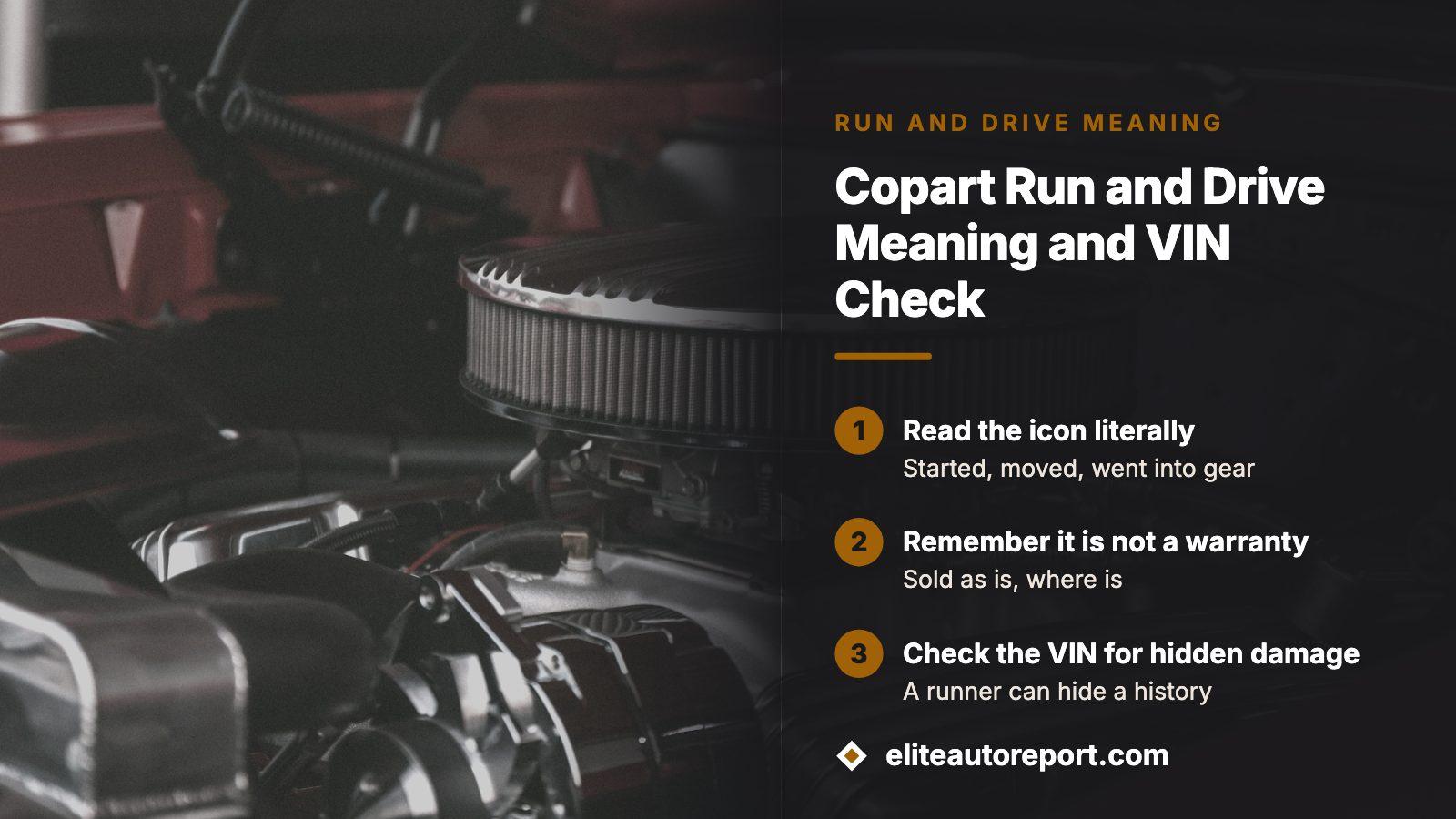
THE SHORT ANSWER
Copart run and drive means that when the lot was inventoried, the car fired up alone or on a jump box, took a gear and rolled ahead. Copart states plainly that this is no guarantee the car is roadworthy or will still do those things at sale or pickup. Treat it as a starting clue, then read the damage notes, photos and VIN history.
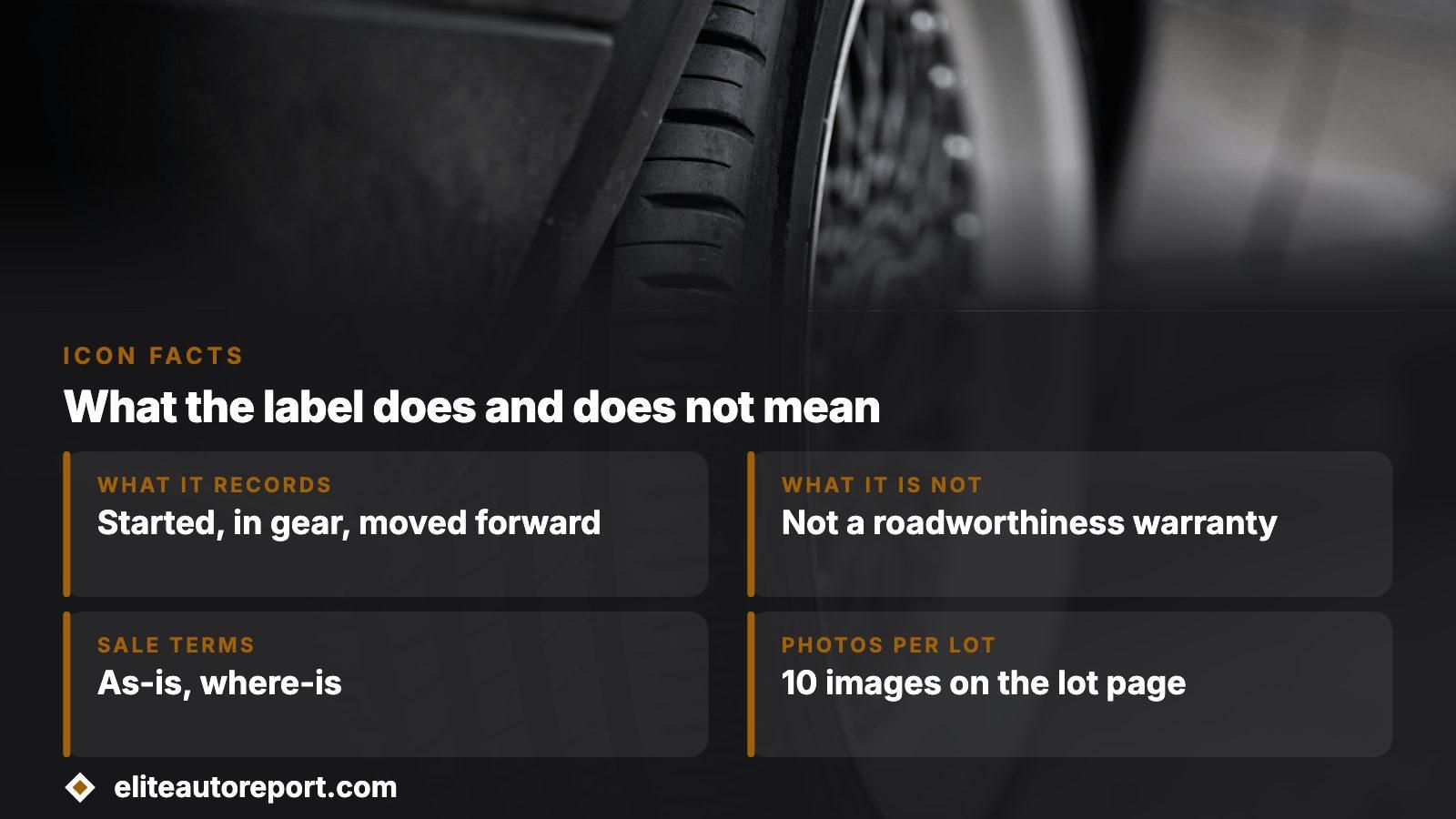
- What it records
- Started, went into gear, moved forward at intake
- What it is not
- Not a warranty of roadworthiness at sale or pickup
- Sale terms
- All lots sold as-is, where-is
- Photos per lot
- 10 images on the lot page
The plain meaning of the Run and Drive icon
Copart's help center spells the label out in three steps. At the time the car was inventoried, the car fired up, either by itself or with a jump box attached, then took a gear and rolled ahead. That is the whole test. Nobody drove it down the road, checked the brakes, or looked at the transmission under load.
The same help page adds a disclaimer that matters more than the definition. The designation is not a representation that the vehicle is roadworthy, and it does not promise the car will start, engage a gear or move when you show up. A lot that earned the icon on a Tuesday can sit through a wet week in a yard and behave differently by the time the buyer arrives.
So read the icon as a record of a past event. It is useful because it separates cars that moved from cars that never turned over, but it says nothing about why the car came to auction in the first place.
Run and Drive versus the Engine Start Program
Copart uses a second, narrower badge. The Engine Start Program note says Copart verified that the vehicle started and ran at idle when it arrived at the facility. It makes no claim about gears or movement, and it repeats that nothing is guaranteed at sale or pickup. Once the car leaves the premises, the buyer owns it as is.
| Label | What was observed | What is left open |
|---|---|---|
| Run and Drive | Started, engaged a gear, moved forward | Road behavior, brakes, steering, later changes |
| Engine Start Program | Started and ran at idle on arrival | Whether it can be driven at all |
| No start label | Nothing claimed | Everything, including the engine itself |
A car with only the engine badge may still drive fine, and a car with neither may be a simple dead battery. The labels sort risk; they do not price it for you.
How the label shows up in the sale lanes
Run and Drive is also a sorting bucket. Copart's glossary assigns item numbers by category, with Run and Drive lots occupying blocks of numbers in lanes A and B, separate from the salvage blocks. An auction usually runs about four lanes at once, so a bidder who wants a running car has to join the lane where those item numbers come up.
The practical effect is timing. If you are watching a lot, check its item number on the lot page under sales information so you do not sit in the wrong lane while your car sells next door.
Sold as-is, where-is
Copart says every vehicle it sells goes as-is, where-is, with no representation that it is roadworthy, mechanically sound or kept at any set level of quality. The Run and Drive icon sits inside that rule, not above it.
What a running car can still be hiding
A car can move forward and still be a poor purchase. Frame damage, a rollover, a flood, a fire or a replaced VIN may all sit behind a car that cranks on the first try. Copart's damage codes name these conditions, among them front end, rollover, water or flood, burn and frame damage reported, plus missing or altered VIN.
Those codes carry their own warning. Copart says they reflect known or reported damage only, disclaims their accuracy, and tells members to inspect lots themselves. For a six-figure Porsche or a restored classic, a code is a pointer to go look closer, not a finding.
- Water cars often start and drive, then fail weeks later in the wiring and electronics.
- Cars with reported frame damage can be run forward in a lot and still track badly on the road.
- Stripped lots may carry the icon yet lack parts the listing photos make you assume are there.
Run the VIN before you bid on a luxury or classic
The lot page shows ten photos and basics such as title type, odometer, damage notes and keys. It does not show where the car has been since. Entering the 17-character VIN into EliteAutoReport searches for earlier auction sales, damage notes and the pictures taken before any repair, next to title brands and reported mileage.
Find the VIN on the lot page itself, on the lot page, and on the car itself if you are viewing it, in the usual spots near the windshield and the driver's door. Compare the two characters by character; if they differ, drop the lot.
- Paste the lot's VIN into EliteAutoReport and read the free preview.
- See whether auction records, title brands or odometer entries exist.
- Open the full report only if the preview shows something worth reading.
- Set the report beside the lot photos and damage codes before you set a maximum bid.
Reading the result against the listing
Start with the odometer. Copart classes readings as actual, exempt, not actual, or exceeds mechanical limits, and only the first can be taken at face value. Then compare the damage on the listing with any earlier sale on the VIN: a car that has been through an auction twice deserves a second look at why.
Federal title data matters here too. NMVTIS, run by the Justice Department, is the national title database behind most brand checks, built to catch fraud and unsafe cars before a sale.
Little history is not good history
Older classics and repaired exotics may have little electronic history. No record means no record found, and the car still needs an in-person inspection.
Paying for the check
You see the preview without paying. Going further means one purchase for a report, or a pack if you are weighing several lots, and nothing renews afterward. Amounts sit on the pricing page. Set against a bid, a tow and the repairs a hidden flood or bent frame would bring, it is a small line item.
A short list before you place a bid
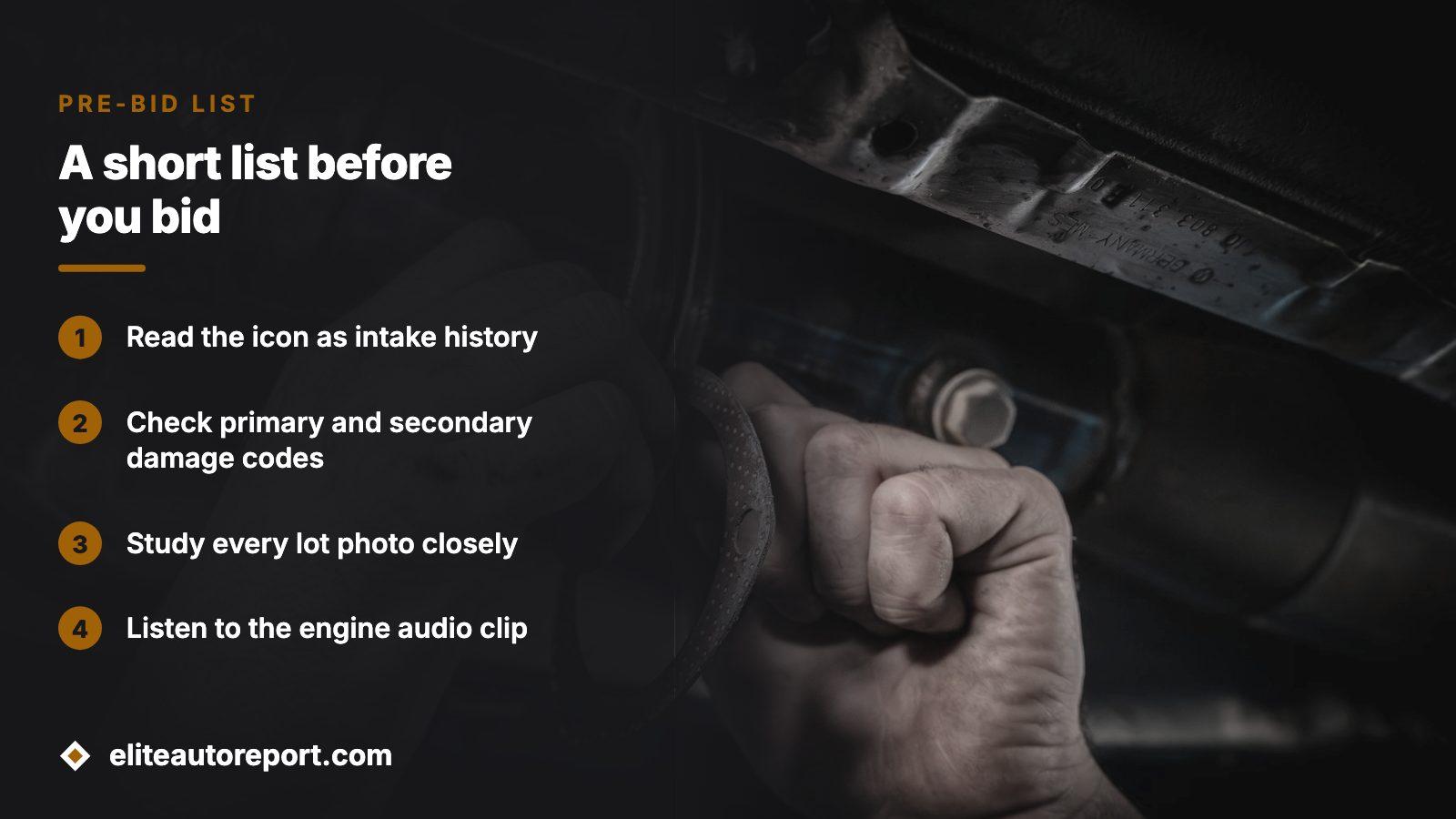
- Read the Run and Drive note as intake history, not condition at pickup.
- Check the damage codes, primary and secondary, and the odometer type.
- Study all ten photos, looking at panel gaps, glass and the underside.
- Listen to the engine audio clip if the lot has one.
- Run the VIN and compare earlier records with the listing.
- Budget for a tow or a flatbed in case the car will not go under its own power.
If you cannot see the car yourself, a local inspector or mechanic near the yard is cheap insurance on anything exotic.
Where this information comes from
- Copart Help Center: Vehicle Icons — source of the Run and Drive and Engine Start definitions and their disclaimers
- Copart Help Center: Glossary of Common Terms — lane and item number blocks, as-is terms, odometer descriptions
- Copart Help Center: Types of Conditions — damage codes and Copart's accuracy disclaimer
- Copart Help Center: Understanding the Lot Details Page — what a lot page lists and how many photos it carries
- NMVTIS, Bureau of Justice Assistance — purpose of the federal title information system
Sources and photos: Facts checked against the sources above in November 2026. Photos by Victor Hughes, Martin Fennema and engin akyurt on Unsplash; diagrams by EliteAutoReport.
Keep reading
- Copart VIN Check: Auction Photos and History for Luxury and Classic Carswhat a Copart sale on a VIN shows and who is allowed to bid
- Copart Damage Types: What a Lot's Damage Label Really Tells Youdecode the primary and secondary damage codes on a lot
- Car Auction Photos by VIN: Find Salvage Sale Pictures Before You Buyhow pre-repair auction pictures are matched to a VIN
- Buying at Copart With No License: Your Options and the VIN Checkthe registration and broker options for public buyers
Frequently asked questions
What does run and drive mean on Copart?
It means that when the car was inventoried, it fired up, by itself or with a jump box, took a gear and rolled ahead. Copart notes this is no guarantee about roadworthiness or about how the car behaves at sale or pickup, so it works as a clue rather than a condition report.
Is a Copart run and drive car safe to drive home?
Not automatically. The label never covered brakes, steering, tires or structure, and Copart sells everything as-is. Many buyers have a car trucked home or inspected first, particularly when the damage codes mention front end, water or frame trouble.
Does run and drive mean the engine is good?
No. It shows the engine ran and the car moved at intake. Oil starvation, a weak transmission or flood damage can all sit behind that. The engine audio clip and an independent inspection say far more than the icon.
How is run and drive different from engine start?
The Engine Start Program only confirms the car started and held idle on arrival. Run and Drive adds that it went into gear and moved forward. Neither one is promised at pickup.
Will a VIN report show whether a Copart car ran?
A VIN check will not confirm whether a car starts. It can show earlier auction sales, damage notes, pre-repair photos, title brands and odometer history, which tell you whether the story on the listing holds up.
Now check the car itself
The guide explains what to look for. The report shows what this VIN has on record.