THE SHORT ANSWER
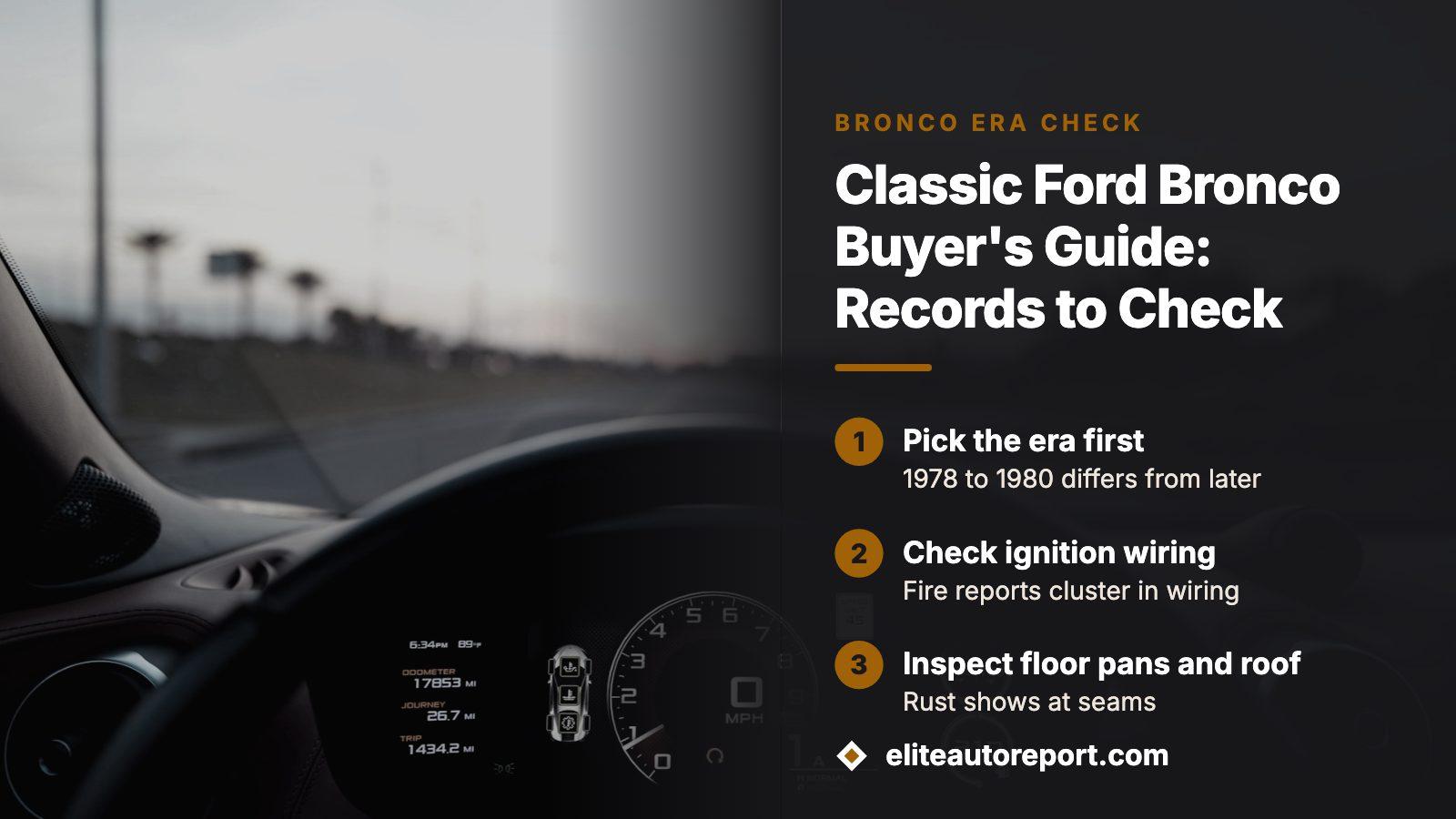
Start with the era. For 1978 to 1980, look at transmission park mechanisms, steering knuckles and wheels. For 1987 to 1996, which holds most owner reports, look at ignition and cruise-control wiring, floor pans and roof seams. NHTSA files 729 complaints and 37 recall campaigns under the Bronco name for 1966 to 1996. Then check the VIN for title brands, auction photos and odometer entries.
- Owner complaints on file
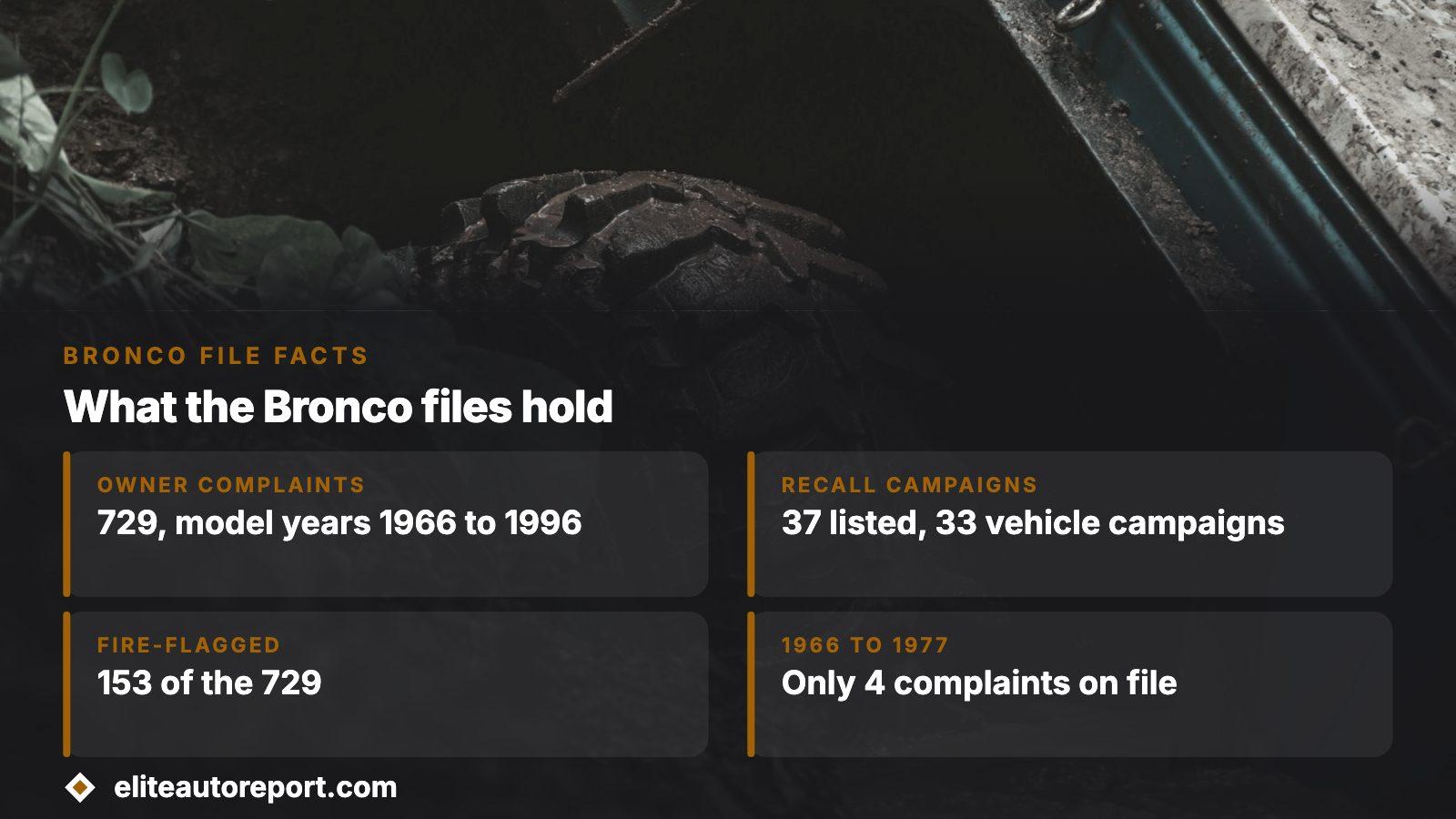
- 729 distinct, model years 1966 to 1996
- Recall campaigns
- 37 listed, 33 of them vehicle campaigns
- Fire-flagged complaints
- 153 of the 729
- Complaints for 1966 to 1977
- Only 4, so early trucks are thinly documented
What NHTSA's Bronco files cover, and where they go quiet
For this guide I went through NHTSA's Bronco recall and complaint files year by year, 1966 to 1996, and collapsed the duplicates. The result is 729 distinct owner complaints and 37 recall campaigns. Four of those campaigns are parts-maker or equipment actions, such as aftermarket fuel pumps and replacement lamps, so 33 concern the trucks themselves.
The spread is lopsided. Only 4 complaints cover 1966 to 1977, 2 cover 1978 and 1979, 64 cover 1980 to 1986, and 659 cover 1987 to 1996. A truck from the first decade is not safer for having a short file. Nobody was reporting to the agency in volume yet, so an early Bronco needs a closer physical inspection, not a lighter one.
Early numbers do not decode like modern ones
NHTSA's decoder refuses model years before 1981. I fed it a 1975 entry and it returned an error reading Invalid Year Submitted, with zero results. An empty decode on a truck from that period is expected and says nothing bad about it.
Later trucks are easier. Ford's owner recall lookup takes a 17-digit number, but it only searches campaigns started since January 1, 2004, which leaves a 1980s Bronco with a gap. Use NHTSA's recall search for the older campaigns, and match the number on the dash, the door and the title before you pay anyone.
Recall campaigns, grouped by era
| Era | Campaigns on file | What they concern |
|---|---|---|
| 1966 to 1976 | 6 | Brake pedal linkage, steering drag link, tires, power steering, exhaust. Only a component and date are recorded. |
| 1977 to 1980 | 12 | Automatic transmission park parts, steering arm knuckles, wheel welds, brake pedal pin, rear axle shafts |
| 1983 to 1987 | 6 | Seat hardware, belt anchors, fuel hose clamps, carburetor throttle shaft, fuel rails, fuel line couplings |
| 1988 to 1996 | 6 | Ignition switch, door latch cable, 4x4 transfer case, front bumper nuts, parking brake, tire label |
| Issued 2005 to 2008 | 3 | Cruise-control deactivation switch and wiring on trucks built in the 1990s |
Every remedy NHTSA lists is a dealer repair at no charge. The record cannot tell you whether a given truck got the work, so ask for invoices. Several campaigns, such as the cruise-control ones, were issued long after these trucks left the factory, so a collector Bronco can still carry an unfinished fix.
The fire reports cluster in the wiring
Of the 729 complaints, 153 are flagged as involving a fire. Ninety-one of those sit under the electrical system and 28 under speed control. Ford's 1996 campaign covers the ignition switch on 1988 to 1991 trucks, which could short inside, smoke and possibly burn near the steering column. A separate 2005 campaign covers the cruise-control deactivation switch on 1994 to 1996 trucks.
- Look at the steering column and under-dash wiring for melted insulation or amateur splices.
- Ask whether the ignition switch was ever replaced, and by whom.
- Check the cruise-control switch and its harness for heat marks near the brake master cylinder.
- Be wary of a clean engine bay over charred or patched wires.
A burned truck that was repaired may also have been through a total-loss claim, which is the kind of event the next sections cover.
Floor pans, roof seams and rust on the 1987 to 1996 trucks
Nine complaints describe cracked floor pans, mostly at the driver's seat mounts on 1989 and 1990 trucks. Four describe cracks over the doors along the rain gutters, and 29 mention rust. These are body problems a recall file will not repair for you, so crawl under the cab and press on the floor.
From an NHTSA owner complaint
An owner of a 1990 Bronco wrote that the floor under the driver's seat had cracked where the seat bolts on, so the seat shifted and bounced. They noted that a dealer had fixed the same fault on their 1989 truck as a recall repair, yet they could not find any recall record for either year.
Take from this that a dealer fix and a recall record are different things. A repair may have been made without a trace in the federal file, so ask the seller what was welded, and when.
From an NHTSA owner complaint
An owner of a 1994 Bronco described cracks and rust at the rain gutters on both sides, and said it was the second Bronco of theirs to do it. The dealer sealed the cracks, the sealer flaked off, and Ford told them no fix existed.
A fresh bead of seam sealer on the roof edge is worth a question.
Park pawls, steering knuckles and the transfer case
The late 1970s campaigns read like a checklist of what to test on a drive. Several concern the automatic transmission's park mechanism, where a defective part could stop the pawl from engaging or releasing. One covers steering arm knuckles that might crack and free the tie rod, and two cover steel wheels with poor welds.
A 1993 campaign addressed a transfer case built with the wrong shift motor, which might drop out of four-wheel high and leave the truck free to roll as though in neutral. A 1986 and 1987 campaign added retainer clips to fuel line couplings that might not be fully engaged. On any of these, park on a slope, test the parking brake, and shift through every 4x4 range.
What a title and auction record adds
The federal title database, NMVTIS, reports on five things: where the vehicle is titled and since when, brands, odometer, total loss and salvage. It says 87 percent of the national fleet is in the system, but a clean answer can still be a false negative, and some states do not title older vehicles at all. For a Bronco from the 1970s, expect thin results and say so to the seller.
From an NHTSA owner complaint
A 1989 Bronco owner filed a complaint after learning the truck was tied to a floorboard crack recall. Checking its history, they found a salvage record and a junk title, which they assumed cancelled the recall coverage, and they asked NHTSA what came next.
That owner's belief is theirs and not a rule, but the surprise is the point. A salvage or junk brand can sit unseen behind a tidy paint job. EliteAutoReport runs on auction history and photos by VIN, so a Bronco that once crossed an auction block may show sale photos of its earlier condition, along with brands and odometer readings. Start with the free preview. If it looks promising, the paid report is one purchase, with amounts listed on the pricing page.
A short order of operations before you bid
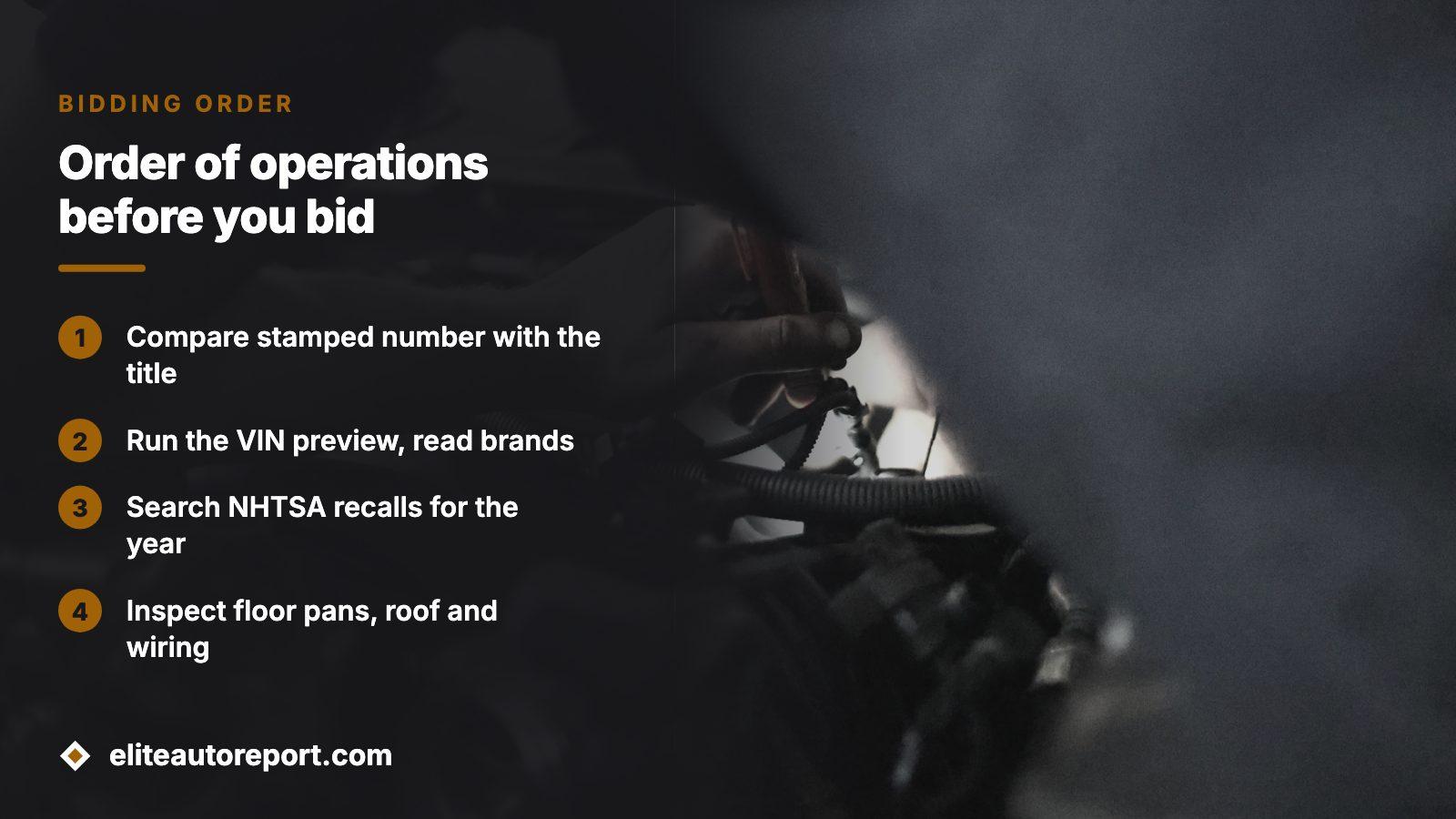
- Compare the stamped number on the truck with the title and every document the seller hands over.
- Run the VIN preview and read the title brands, odometer entries and any auction photos.
- Search NHTSA's recalls for the model year and ask for proof of each repair.
- Inspect floor pans, roof seams, wiring and the transmission park position yourself or hire someone who can.
- Walk away if the paper trail and the metal tell different stories.
If a truck passes the first three steps, the physical inspection becomes a confirmation rather than a rescue. If it fails the VIN check, you saved the trip.
Where this information comes from
- NHTSA: 1990 Ford Bronco recalls and complaints — recall campaigns and owner complaint counts by model year
- NHTSA vPIC vehicle API — decoder behavior for older model years
- NMVTIS: understanding a vehicle history report — the five indicators in a federal title report
- NMVTIS: information for consumers — coverage figures, false negatives and age exemptions
- Ford: recall lookup — which recalls its VIN search covers
- NHTSA owner complaint 10291340 — owner experience, paraphrased
- NHTSA owner complaint 705166 — owner experience, paraphrased
Sources and photos: Facts checked against the sources above in November 2026. Photos by Dennis Eusebio, Mustafa Sheikhmouss and Johann Noby on Unsplash; diagrams by EliteAutoReport.
Keep reading
- Classic Car Title Search by VIN: What Turns Up and What Doesn'tTrace the title history of an older vehicle.
- Chevy C10 Buyer's Guide: What Federal Records Flag Before You BuyCompare the records of another collectible 4x4-era pickup.
- Car Auction Results Database: Where Classic Car Results LiveSee how classics show up in auction records.
- Car Auction Photos by VIN: Find Salvage Sale Pictures Before You BuyLook at sale photos tied to a VIN.
Frequently asked questions
Does NHTSA list recalls for a classic Ford Bronco?
Yes. Under the Bronco name, the recalls interface returns 37 campaigns for 1966 to 1996, 33 of them vehicle campaigns. The earliest entries carry only a component and a date, so confirm details with a Ford dealer and ask the seller for repair invoices.
Which Bronco years draw the most owner complaints?
The 1990s. Model years 1994, 1995 and 1996 hold 104, 109 and 99 complaints, and 1989 holds 85. Complaints cluster around electrical faults, brakes and speed control. Treat them as an inspection list, because the agency has no count of trucks actually on the road.
Can I decode an older Bronco VIN with NHTSA's tool?
Not before model year 1981. The decoder returns an error for earlier years. For those trucks, rely on the title, the data tags on the truck and Ford-specific references, and compare them with each other before paying.
Does a VIN check work on a 1970s Bronco?
Results can be thin, because federal title data is incomplete for older vehicles and some states exempt them from titling. That is why the free preview comes first. If it shows title, odometer or auction entries, the full report may be worth buying.
Are old Bronco recalls still free to fix?
NHTSA lists the remedies on these campaigns as dealer repairs at no charge, but it does not state any remaining deadline. Ask a Ford dealer about a specific truck and check what its recall lookup covers.
Now check the car itself
The guide explains what to look for. The report shows what this VIN has on record.