THE SHORT ANSWER
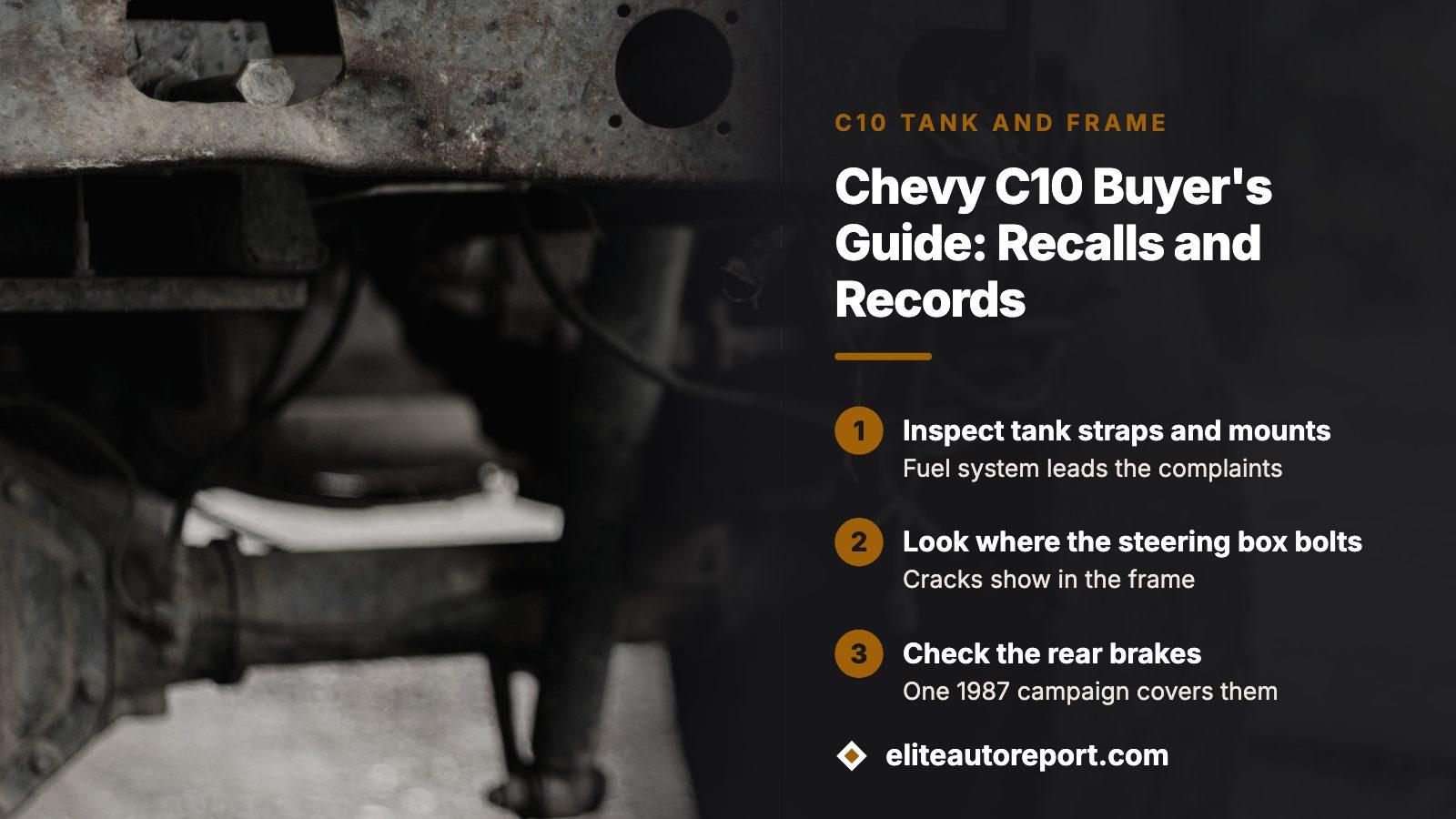
On a C10, check three things before you talk price: the fuel tank and its mounting, the frame where the steering box bolts on, and the rear brakes. NHTSA holds 45 distinct owner complaints under the C10 name, 20 of them about the fuel system, and one 1987 campaign covers the rear brakes on 1985 and 1986 trucks. Then run the VIN for title brands, auction photos and odometer history.
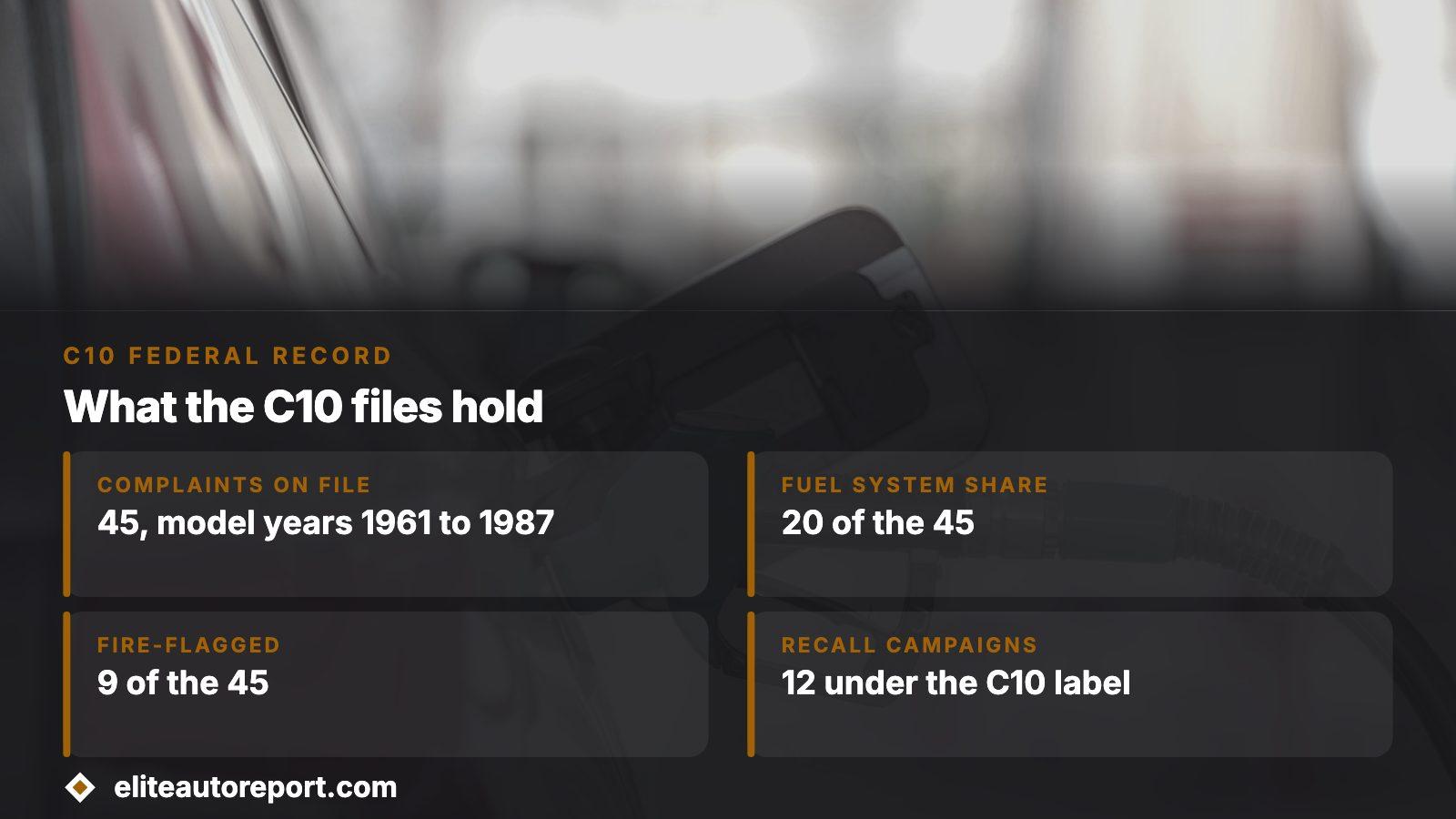
- Owner complaints on file
- 45 distinct, model years 1961 to 1987
- Fuel system share
- 20 of the 45
- Fire-flagged complaints
- 9 of the 45
- Vehicle recall campaigns
- 12 under the C10 label
What NHTSA means by C10, and what it leaves out
NHTSA files these pickups under the label C10, with complaint records running from model year 1961 through 1987. I pulled every year and merged repeats by ODI number, leaving 45 distinct owner complaints. Just 2 predate 1976, so the federal files tell you almost nothing about the earliest trucks, and a quiet record there proves little.
Yearly counts are small. Model years 1985 and 1986 lead with 7 each, then 4 apiece for 1977, 1979, 1981, 1982 and 1983. Treat them as pointers for your inspection, not failure rates: NHTSA has no idea how many trucks were driven, and many owners wrote years later.
The recall campaigns on file, in one table
The recalls interface returns 12 distinct vehicle campaigns for the C10 label. A thirteenth entry, an equipment recall on racing-brand oil filters, concerns a part you may have bought, not the truck. The table leaves out a 1970 hubcap record and a 1971 speed control record that carry only a component name.
| Campaign | Model years | What NHTSA records |
|---|---|---|
| 67V005000 | 1967 | Brake hoses, lines and fittings |
| 74V027000 | 1973, 1974 | Brake vacuum power assist |
| 74V065000 | 1974 | Brake fluid |
| 77V171000 | 1977 | Standard front suspension fitted where heavy-duty was specified |
| 77V178000 | 1976, 1977 | Accelerator pedal rod could snag the mat and hold the throttle open |
| 81V118000 | 1981 | Spare wheel one inch wider than the approved rim width |
| 81V148000 | 1981 | Brake fluid below the boiling point requirement |
| 82V128000 | 1982 | Drum balance weights touching aluminum wheels, lug nuts loosening |
| 83V045000 | 1982 | Differential pinion shaft locking screw could work loose |
| 87V043000 | 1985, 1986 | Wrong size rear brake assemblies installed |
Every remedy NHTSA lists was a free dealer repair. The data cannot say whether a given truck ever had the work, so ask for paperwork and treat a missing invoice as an open item, especially for the 1977 front suspension and the 1985 and 1986 brakes.
The fuel tank is the biggest cluster in the files
Of the 45 complaints, 20 sit under the gasoline fuel system, and 9 mention fire. Several owners describe a tank hung outside the frame rails and fear a side impact. Others report a seam leak, a tank cover that let sand collect until the steel rusted through, and rusted supports that let a tank vibrate against its own mounting.
- Look at the tank straps, supports and any cover or shield for flaking rust or packed dirt.
- Check the ground under the truck after it has sat overnight, and sniff the cab for fuel odor.
- Ask when the tank was last replaced and who did it.
A new tank is no defect, but a truck that leaked or burned once may carry damage elsewhere, which is where its history helps.
Frame cracks behind the steering box
A 1979 truck and a 1983 truck each drew a complaint about the frame cracking or tearing at the steering gear box mount, and one owner reports losing steering control while driving. Two filings are no pattern, but the failure is serious enough for a flashlight check on every candidate.
From an NHTSA owner complaint
The owner of a 1983 C10 wrote that the steering box bolts had pulled through their mounting holes. The frame around them was torn and twisted, and the owner called the metal fatigue obvious, with steering play growing to a dangerous level.
Slide under the cab, find the steering box and study the rail around it for hairline cracks, stretched bolt holes and welded patches. A patch means someone fixed a problem, so ask what caused it and whether the truck was ever in a collision.
Brakes: one recall, two complaints and a paperwork question
Campaign 87V043000 says improper size rear brake assemblies were installed on 1985 and 1986 trucks, and that stopping distance could exceed the federal limit. The fix was swapping in the right size. A 1981 campaign dealt with brake fluid, and a 1967 campaign with hoses and lines.
From an NHTSA owner complaint
A 1985 C10 owner said an emissions station found the rear brakes were not working and that the truck needed an axle brake assembly. At 140,000 miles, the owner said the brakes had never worked properly since the year of purchase.
An owner of a 1981 truck blamed a front hose retainer bracket crimped so tightly the hose plugged and the truck pulled sideways. On a test drive, brake firmly from moderate speed and note any pull. On a 1985 or 1986, ask whether the rear assemblies were replaced.
Towing, heat and the drivetrain
The most vivid complaint in the set comes from the owner of a 1986 half-ton who was towing a pontoon boat at 65 mph when fire broke out underneath. The owner suspected transmission fluid had overheated and sprayed from the dipstick tube.
From an NHTSA owner complaint
The owner described a two-owner truck that had been dependable and well kept, with no warning before several bangs underneath. An extinguisher and two gallons of water put the fire out, and the insurer did not total the truck.
Take from it that a tidy truck can still run a hot transmission, so check fluid color and smell, look for wet pan seams (a 1978 complaint blamed leaking pan bolt threads) and ask how it was used. The 1982 differential campaign is another record to match against service receipts.
What a VIN check adds that the federal files cannot
NHTSA's files hold only what makers and owners reported. They will not show that a truck crossed an auction block after a crash, carried a salvage brand in another state or had sale photos posted. Those records attach to the VIN, and on a classic pickup they separate a clean survivor from a rebuilt one.
Odometer history matters too. A 1986 owner reported a speedometer failure showing far less mileage than the truck had driven, so a mileage claim on a forty-year-old truck needs a second source. Flood history counts as well; the Justice Department's NMVTIS program posts flood damage notices to the businesses that report to it.
Older numbers can return thin records, so start with the free preview. The full report is one purchase with no subscription, and plans are on the pricing page.
Decode the number first, then run the check
NHTSA's vPIC decoder takes a complete VIN or a partial one, using an asterisk wherever a character is unknown, and entering the model year lets it handle older ranges. NHTSA advises always supplying the year. My decode of a 1985 C10-style partial number returned a pickup with hydraulic brakes and a model year warning.
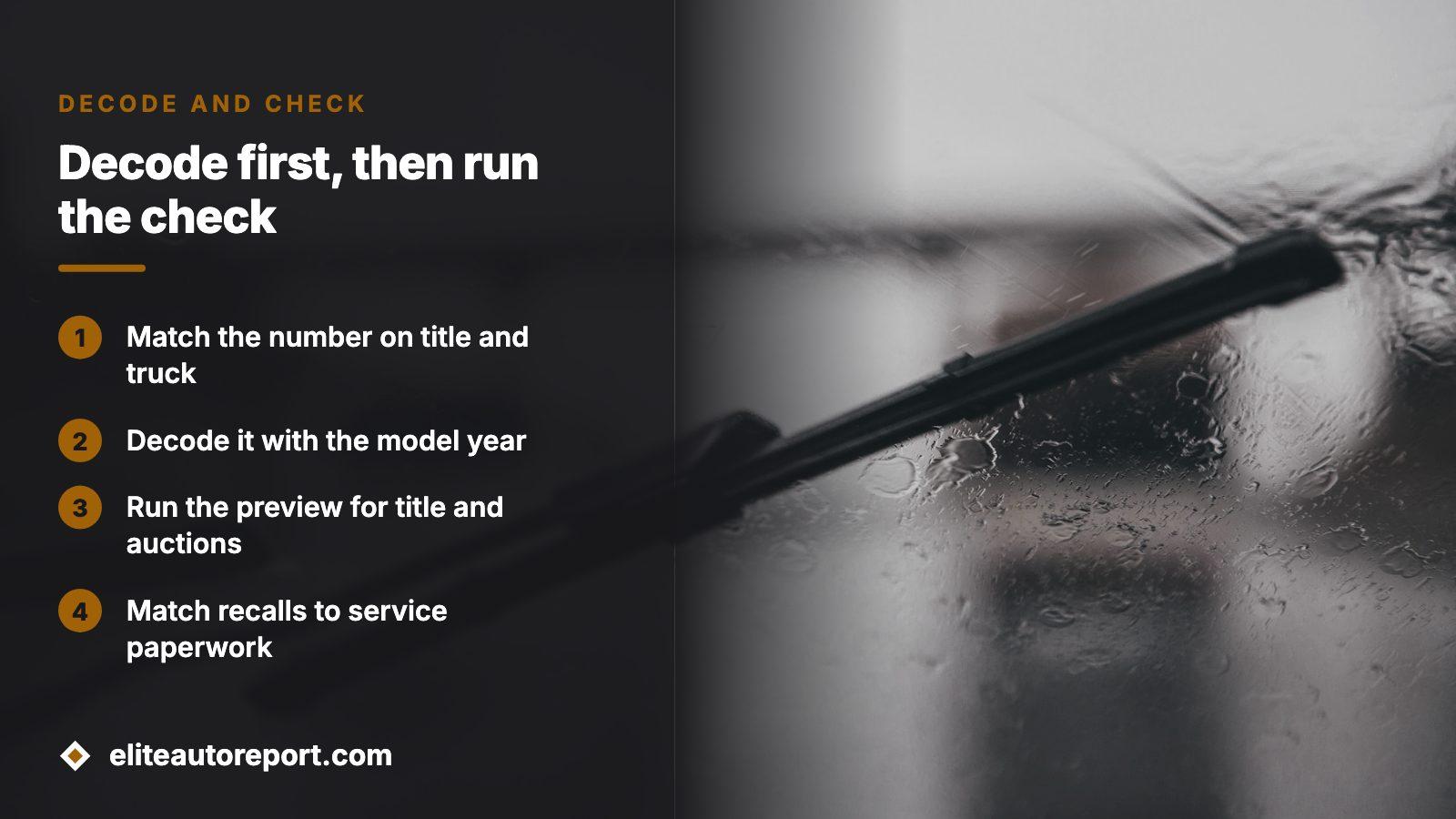
- Copy the number from the title and from the truck itself, and confirm they match.
- Decode it with the model year entered, and compare the result to the ad.
- Run the preview to see title, auction and odometer records for that number.
- Match any recall in the table above to service paperwork before you make an offer.
A mismatch among title, decode and truck is a reason to slow down.
Where this information comes from
- NHTSA recalls API: Chevrolet C10 by model year — campaign numbers, components and remedies for the C10 label
- NHTSA complaints API: Chevrolet C10 by model year — owner complaint counts by year and component
- NHTSA vPIC VIN decoder API — how partial VINs and model years are decoded
- VehicleHistory.gov: NMVTIS consumer page — what the federal title system is for and its flood notices
- NHTSA owner complaint 720334 — owner experience, paraphrased
- NHTSA owner complaint 10198611 — owner experience, paraphrased
- NHTSA owner complaint 708488 — owner experience, paraphrased
Sources and photos: Facts checked against the sources above in November 2026. Photos by Zoshua Colah, Thibault Valjevac and engin akyurt on Unsplash; diagrams by EliteAutoReport.
Keep reading
- Where Is the VIN on a Classic Car? Dash, Door, Firewall and FrameFind the number on a truck old enough that its plate may be hard to read.
- Classic Car Title Search by VIN: What Turns Up and What Doesn'tTrace the title history of an older vehicle.
- Check a Truck VIN Number for Auction History, Photos and Salvage RecordsSee how pickups show up in auction records.
- Car Auction Photos by VIN: Find Salvage Sale Pictures Before You BuyLook at sale photos tied to a VIN.
Frequently asked questions
Does NHTSA list recalls for a Chevy C10?
Yes, under the label C10. The recalls interface returns 12 distinct vehicle campaigns across the model years in its files, from a 1967 brake hose campaign to a 1987 rear brake assembly campaign. Older entries carry only a component and date, so confirm details with a dealer or the maker's records.
What goes wrong most often on a C10, according to owners?
Of the 45 distinct complaints NHTSA holds, 20 concern the fuel system, mostly leaks, rusted tanks and fire worries after a side impact. Brakes, tires and frame cracks near the steering box follow. These are owner reports, so use them as an inspection list rather than a ranking of reliability.
Can I decode a C10 VIN with NHTSA's tool?
Often, yes. The vPIC decoder takes a full or partial number and, with the model year entered, can decode older ranges. Expect gaps, and treat any warning about the model year seriously. Compare the decode with the title and the truck before relying on it.
Will a VIN check work on a classic truck?
It depends on the number and the records tied to it. Coverage on older numbers can be thin, which is why the free preview comes first. If the preview shows title, auction or odometer entries, the full report is worth considering. If it shows little, lean harder on paperwork and an in-person inspection.
Are old C10 recalls still free to fix?
NHTSA's records list the dealer remedies on these campaigns as no charge, though they are silent on any remaining deadline. Ask a Chevrolet dealer about a specific truck, and ask the seller for invoices showing the work was done.
Now check the car itself
The guide explains what to look for. The report shows what this VIN has on record.