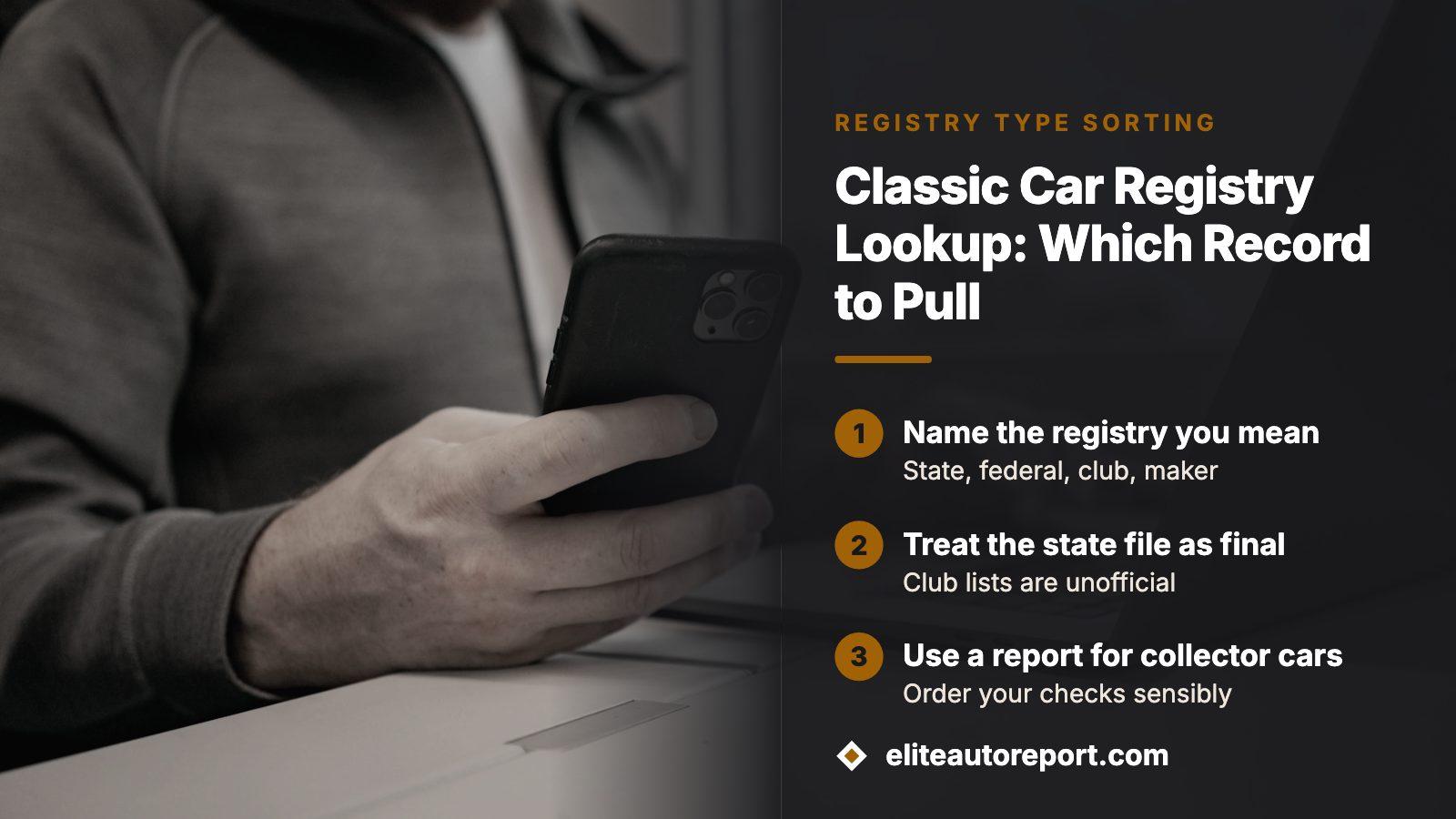
THE SHORT ANSWER
Start with the state that last titled the car, because it holds the ownership record. Add a federal title-brand check through NMVTIS, then a club or maker registry if one exists for the model. For a car with a standard 17-character VIN, a VIN report adds mileage entries and auction photos. A pre-1981 serial number needs the paper trail instead.
- Federal check
- NMVTIS holds five entries, from title state to salvage flag
- Decoder cutoff
- NHTSA's decoder rejected a 1967 serial number as pre-1981
- Not covered
- Repairs and recalls are outside an NMVTIS report
Four records people mean by registry
Someone searching for a classic car registry lookup usually wants one of four things, and mixing them up wastes weeks. The sorting below is the useful part of this page.
| Record | Held by | Answers |
|---|---|---|
| State title and registration file | The state agency that issued the title | Who owns it, whether a lien is recorded, what the title says |
| Federal title-brand data | NMVTIS, run for the Department of Justice | Whether any state branded it junk, salvage or flood |
| Club or maker registry | A marque club or the manufacturer | Whether this chassis is known to the enthusiast community |
| Auction and sales history | Auction houses and salvage pools | What the car looked like when it last sold |
Only the first carries legal weight. The others are evidence, useful for building a picture before you pay, but none replaces the title in your hand.
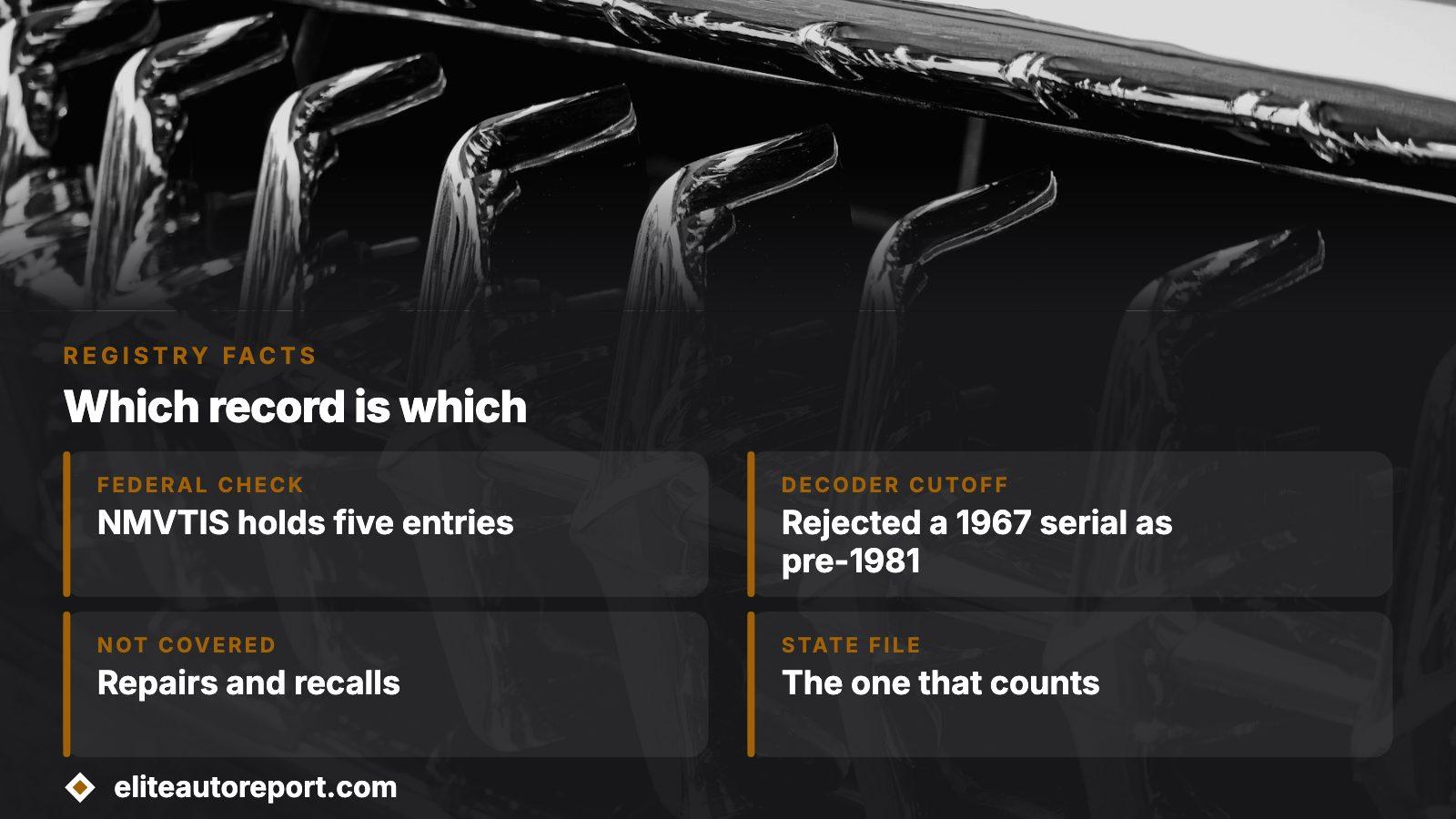
The state file is the one that counts
Ownership lives with the state. Every agency keeps its own file, and the Justice Department warns that procedures and recorded detail differ from one state to the next. A few excuse older vehicles from titling altogether, so a very old car may come with only a registration certificate.
Ask the agency in the state shown on the paperwork what it will release to a buyer and under what permitted use. Expect the answer to vary, and check the current process on the agency's own pages rather than trusting a forum post about how it worked in another state.
Paperwork that does not match
Texas offers a bonded title for buyers whose ownership papers are incomplete or wrong. A car never titled there needs a law enforcement identification number inspection on form VTR-68-A, done by an auto theft investigator, which the state agency does not perform itself.
What the federal layer adds
NMVTIS is the Justice Department's pooled database, fed by the states, insurers and scrapyards. The report is brief by design and holds just five entries. Those are the current titling state with a date, any brands applied, the latest odometer figure, a total-loss flag and a salvage flag.
Its value on an old car is the brand trail. A brand can disappear from a paper title if the car crosses into a state that never asked the earlier ones. The pooled database keeps the label anyway and any state can look it up, so a spotless title can still sit on top of a past brand.
- Repairs, recalls and servicing are left out.
- The duty on insurers and scrapyards to report started in 2009, so older events may never have been filed.
- A blank result most likely means nobody reported anything, which is different from a spotless car.
Club and maker registries: useful, unofficial
Many models have a club, a maker archive or a volunteer database that tracks surviving chassis numbers. These can confirm that a car is known, sometimes with its original colors and past owners. Each sets its own entry rules and holds whatever its members submitted.
Treat a registry listing as a lead. A club entry is not a government record, it can be out of date, and a missing entry says little, since plenty of genuine cars were never reported. If a seller waves a registry certificate around, ask who issued it and what they checked.
We could not open the major historic-vehicle register pages for this guide, so we do not describe any specific registry's rules. Read each one's own site before relying on it.
When the number is not a modern VIN
Federal rules set a 17-character format, and NHTSA's own decoder shows where the line falls. We sent it a 1967-style number with model year 1967 and it returned zero results with a pre-1981 error. A modern-style number returned a result row.
So a database lookup by number works for later classics, such as a late-eighties sports coupe or a nineties truck. For an earlier car, the serial number is a chassis plate or body tag that no VIN database indexes. You work from the title, the state file, the club registry and a physical inspection.
Quick test
Count the characters. Seventeen means a VIN check can search it. Fewer means start with the state agency and the paperwork.
Where a VIN report fits for a collector car
EliteAutoReport is built around auction history and photos by VIN, with a focus on luxury, exotic and classic cars. For a classic with a standard VIN, the free preview shows whether a record exists before you pay. Opening the full record is a separate paid step, with the amounts shown on the pricing page.
The photos matter most on a collector car. A repainted, polished example can look flawless in a listing, while an earlier auction record may show the panel damage underneath. Compare those pictures with the car in front of you.
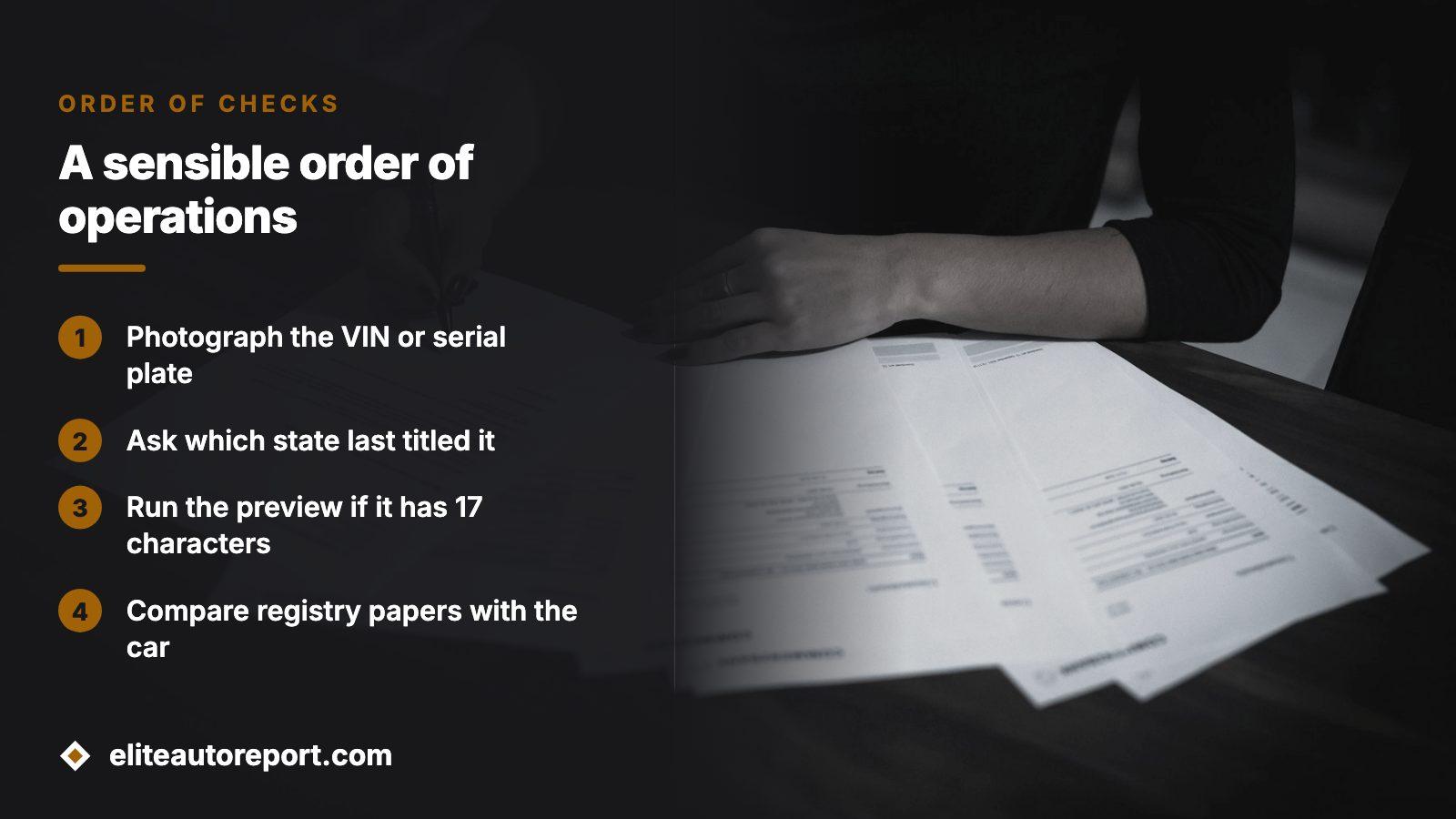
A sensible order of operations
- Photograph the VIN or serial plate and compare it with the title and registration.
- Ask the seller which state last titled the car, then request that state's record through its process.
- Run the VIN preview if the number has 17 characters, and read any brand, mileage jump or auction entry.
- Search the relevant club or maker registry and note what it says and who runs it.
- Book an independent inspection, something the Justice Department's guidance recommends strongly next to any report.
Skipping step one is the classic mistake. A mismatch between plate and paperwork is the red flag that every later check inherits.
Red flags worth walking away from
- A seller who cannot say which state titled the car.
- A registry certificate with no issuer, or one that cannot be verified with the club.
- Plate numbers that differ from the paperwork, or a plate that looks re-riveted.
- A brand on one state's record that the current title does not show.
- Auction photos showing damage the seller never mentioned.
One of these can have an innocent cause. Two together is a reason to stop and ask for documents before any money moves.
Where this information comes from
- NMVTIS: understanding the report — Lists what a federal report holds and leaves out, and urges an inspection.
- NMVTIS: consumer guidance — Backs the brand-washing and state-difference points.
- NMVTIS: frequently asked questions — Source for the 2009 reporting start and for empty results.
- NHTSA vPIC decoder — Our own test of a pre-1981 number against the decoder.
- TxDMV: bought a vehicle with no title — Example of a state route for faulty ownership papers.
Sources and photos: Facts checked against the sources above in November 2026. Photos by Anastasiia Nelen, Dimitri Karastelev and Jacob McGowin on Unsplash; diagrams by EliteAutoReport.
Keep reading
- Classic Car Title Search by VIN: What Turns Up and What Doesn'tHow title brands and mileage entries turn up on an older car.
- Where Is the VIN on a Classic Car? Dash, Door, Firewall and FrameFind the number before you search anything.
- Matching Numbers Classic Car: How to Verify the Claim Before You PayConfirm the parts and the plate belong together.
- Car Auction Results Database: Where Classic Car Results LiveRead what an earlier sale record can and cannot tell you.
Frequently asked questions
Is there a national registry of classic cars?
No single one. Ownership records sit with each state, federal title-brand data sits in NMVTIS, and clubs or makers run their own unofficial lists. You combine them. The state file carries legal weight, while a club entry is only a lead that needs checking with whoever runs it.
Can I look up a classic car by its serial number?
Only if it has a standard 17-character VIN. NHTSA's decoder rejected a 1967-style number as a pre-1981 attempt. For earlier cars, work from the title, the state's own record, a club registry and an in-person inspection of the chassis plate.
Does NMVTIS cover old cars?
Only what was reported to it. Reporting by insurers and scrapyards started in 2009, and a few states excuse older vehicles from titling. A blank answer usually means nothing was filed, so never read it as proof the car has a clean past.
Are club registry certificates proof of authenticity?
No. They record what members submitted under that club's own rules, and a missing entry says little. Ask who issued the certificate and what they verified, then confirm it with the issuer directly instead of trusting the paper from the seller.
What does a VIN check add for a classic?
For a car with a 17-character VIN, the free preview shows whether records exist. The paid report can include auction history with photos, which reveal pre-repair damage a polished listing hides. It supplements the state title file and an inspection, and replaces neither.
Now check the car itself
The guide explains what to look for. The report shows what this VIN has on record.