THE SHORT ANSWER
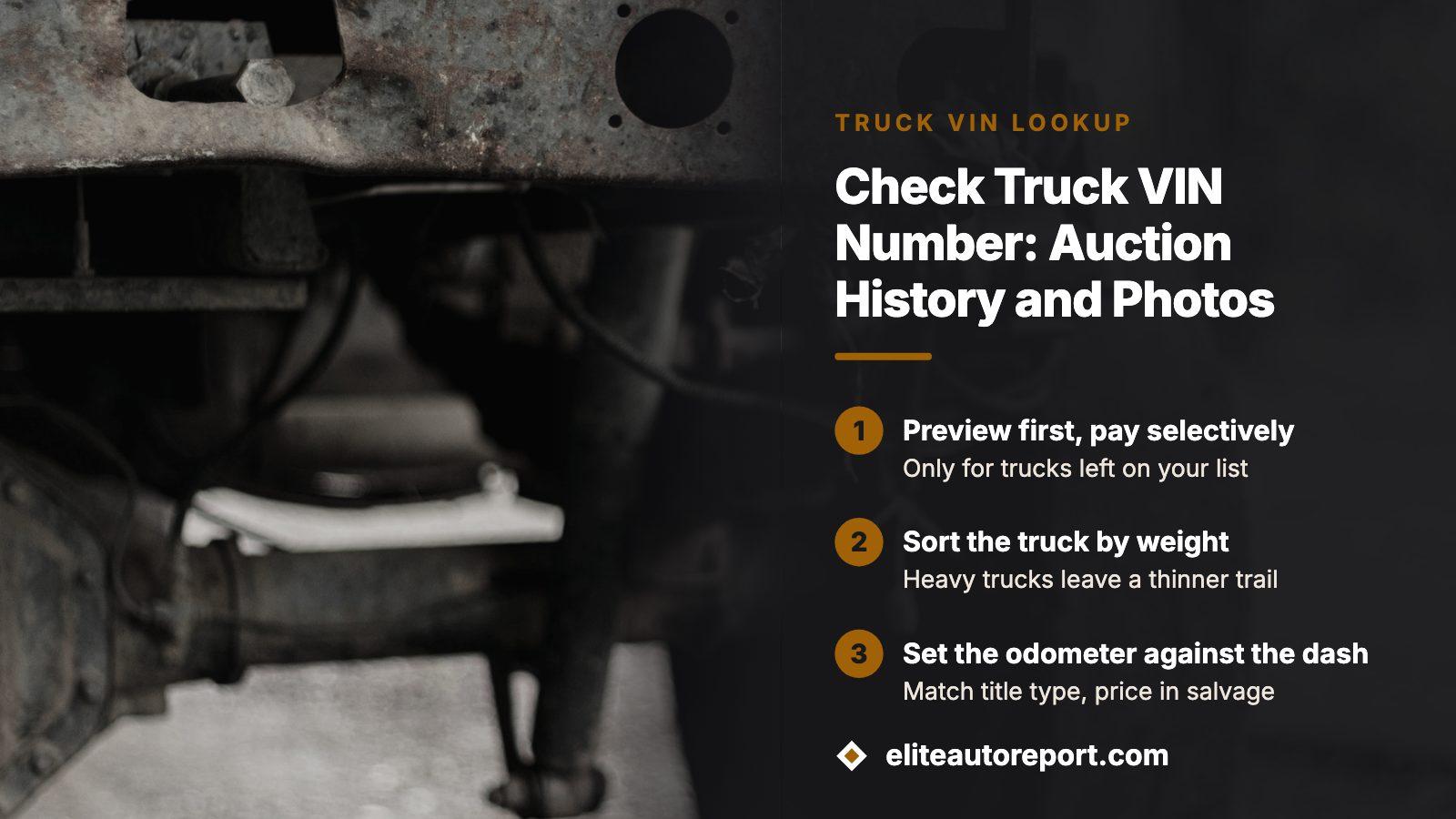
Run the VIN through the free preview, then pay for a report only on the trucks that stay on your list. EliteAutoReport looks for auction sales and sets dates, damage notes, mileage and photos beside title brands and recalls. Federal salvage reporting is written for vehicles under 10,000 pounds, so heavy trucks leave less behind, and trucks older than the 17-character format cannot be searched. An empty result only says the search found nothing.
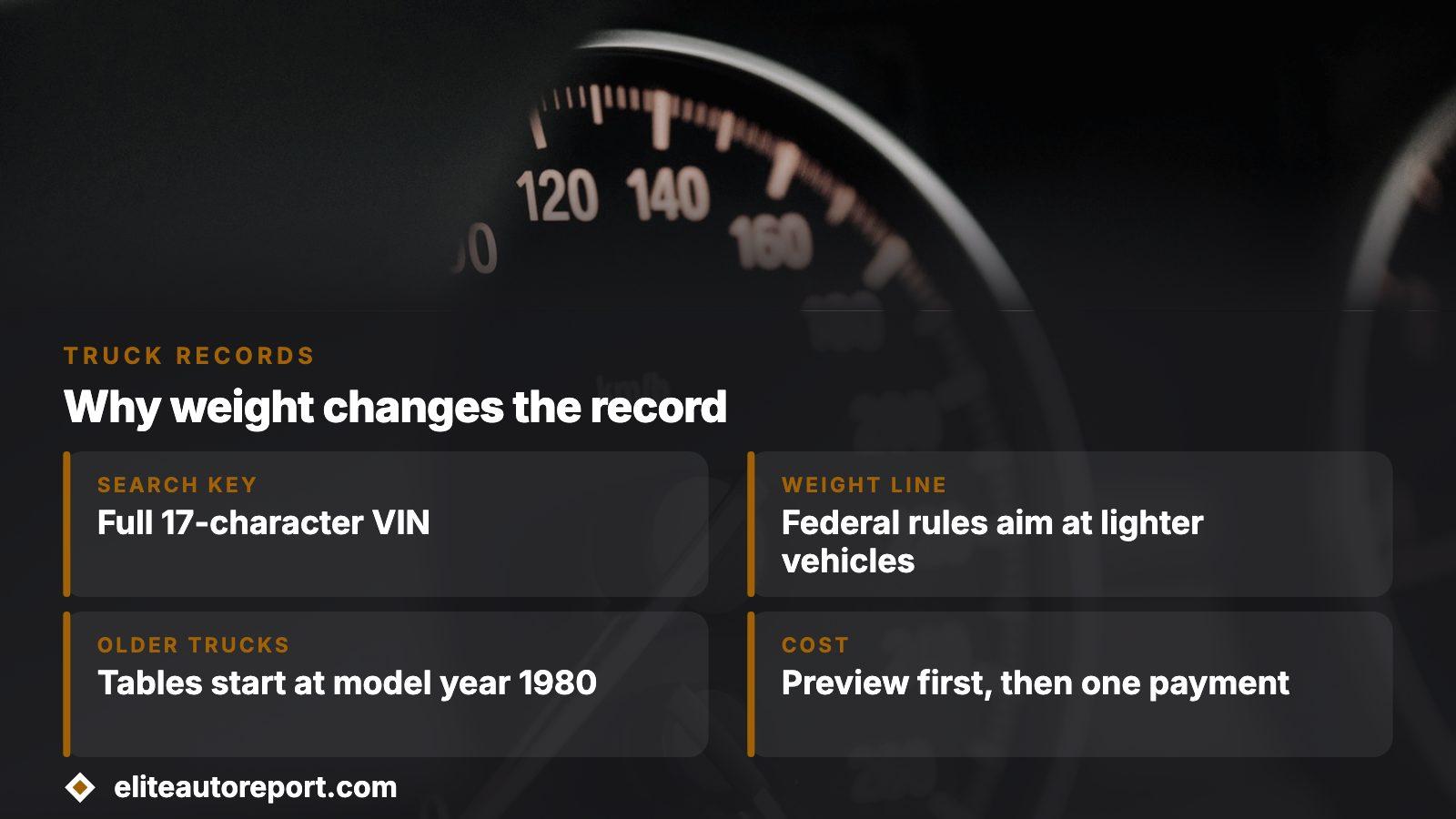
- Search key
- The full 17-character VIN
- Cost
- Free preview, then one payment per report or pack
- Weight line
- Federal salvage reporting is written for vehicles under 10,000 lb
- Older trucks
- The federal VIN tables start at model year 1980
What an auction search turns up on a truck
A truck reaches an auction for the same reasons a car does, and a frequent one is an insurance claim. When repairs would cost more than the truck is worth, the insurer writes it off and the wreck goes to a salvage sale. Federal reporting rules list salvage auctions among the entities that must file.
| Entry in the search | Why it matters on a truck |
|---|---|
| Sale date and title type | A fixed point, and the paper the truck sold on, to measure later repairs and retitling against |
| Damage notes | Names the area hit; a second note often hints at what the structure took |
| Odometer at sale | A dated reading to hold against the dash |
| Photos | The truck as it arrived, before paint and parts hid anything |
EliteAutoReport sets each sale it finds beside open recalls, title brands and market value. Luxury trims, exotic builds and classic restorations are where the photos matter most.
Step 1: Find the number on the truck, not in the advert
A light pickup (10,000 pounds or less) must show its VIN to someone outside who looks in at the left windshield pillar. The format rule says nothing like that for heavier trucks. On a cab and chassis or a medium-duty box truck, try a fixed plate or the maker's label at the driver's door, which also states the weight rating. Check what you copied against the title and the advert, and make the seller explain any mismatch before you go further.
Step 2: Test the number before you search it
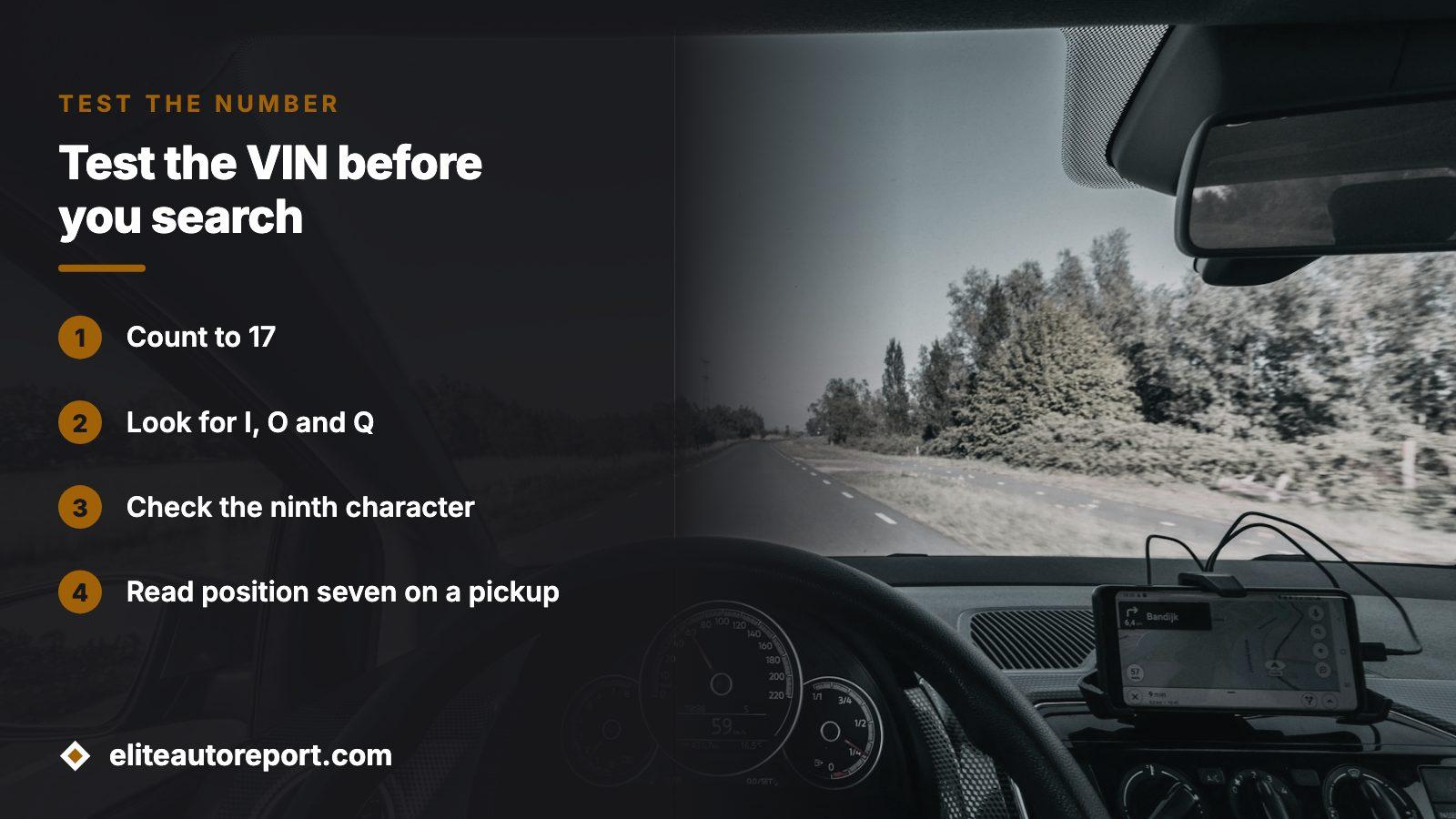
- Count to 17. A shorter string is a typo or a truck older than the standard.
- I, O and Q are not used in this format, so one of them signals a misread or doctored character.
- The ninth character, a digit or X, comes from the other sixteen through a weighted sum divided by 11. One wrong character elsewhere usually breaks it.
- On a light pickup, position seven is a letter and the last five are digits; a heavier truck needs digits only in its last four.
- Position ten is the model-year code. On a light truck, a letter in seventh place puts the year between 2010 and 2039, a number between 1980 and 2009.
Step 3: Sort the truck by weight before you trust a blank
The federal salvage-reporting duty is written for automobiles, and the definition it borrows draws a weight line: four wheels, rated under 10,000 pounds. Work trucks, which the statute puts between 8,500 and 10,000 pounds unless the truck is a medium-duty passenger vehicle, are carved out. The rating on the door label tells you how much to read into silence.
| Rated weight (GVWR) | Inside the federal salvage definition? | Mileage statement at sale |
|---|---|---|
| Under 8,500 lb | Yes, for a street pickup | Required unless age-exempt |
| 8,500 to 10,000 lb | Often not, since work trucks are carved out | Required unless age-exempt |
| 10,001 to 16,000 lb | No | Required unless age-exempt |
| Above 16,000 lb | No | Not required |
Outside the definition is not the same as invisible, since some states send data on all motor vehicles, heavy equipment included. Still, a blank on a heavy truck proves less than one on a half-ton.
Step 4: Read the photos with a truck in mind
The photos carry more than the one-line damage note, and a truck gives them extra places to look.
| In the photo | What it points to |
|---|---|
| Bed floor buckled or rails bent inward | A hard hit behind the cab, so check the frame rails there |
| Cab corner crushed, roof pillars bent | A rollover or heavy side impact, and a cab straightened afterward |
| Front end folded back to the radiator support | Impact into the structure, with airbags and sensors to replace |
| Silt in the footwells or a tide line on the seats | Water exposure, whatever the damage note says |
Step 5: Set the odometer entry against the dash
An auction entry carries a dated reading, and so does each title transfer. Lay them in order: mileage should only climb.
From an NHTSA owner complaint
The owner of a 2015 Toyota Tundra described buying it in a private sale with 127,056 miles showing. A history report obtained afterward listed 385,472 miles, and the owner called it odometer fraud in the NHTSA filing. The gap surfaced only after the payment, so line up every dated reading first.
Some trucks need no mileage statement at all. Above 16,000 pounds it is waived, and age waives it too: a truck from the 2010 model year or older needs none after its tenth birthday, counted from January 1 of that model year, while newer model years wait twenty years. Then the auction entry may be the only dated mileage you can find.
Step 6: Match the title type, and price in salvage
Compare the title type at sale with the title in the seller's hand. States brand damage by their own rules: one may call a truck salvage where another sees damage under its threshold, and some have a flood brand while others have none. Once a state applies a brand, the federal record keeps it, which is how a washed paper title gets caught.
A total-loss label does not always mean a wreck. An insurer may write off a stolen truck that stays missing past 30 days, and if it turns up unhurt, an auction can still sell it in sound shape.
From an NHTSA owner complaint
The owner of a 2016 Chevrolet Silverado 1500 reported the steering turning by itself at about 87,000 miles. A private mechanic would not touch it with a recall open, and a dealer refused the recall work because the truck carried a salvage title. A salvage entry can follow a truck into the service lane, so learn of it before buying.
Step 7: Classics and restored trucks, where the search runs out
Collector trucks sit at the edge of every database. The federal VIN tables begin at model year 1980, so an older truck carries a number outside the pattern a search expects.
- A short or non-standard number cannot be searched, so lean on old titles, dated receipts and restoration photos.
- An insurer's monthly filing looks back over five model years at most, and a privately paid repair leaves no claim at all.
A blank result is not a clean bill
On a recent half-ton, no auction entry is mild reassurance. On an older restored truck it proves little, so rely on title history, restoration photos and a specialist's inspection.
What it costs, and your next move
The preview is free. One payment buys a report on one VIN and nothing renews. What one report or a bundle costs is listed on the pricing page. Read a sample report first if you want to see the layout.
- Save auction photos the day you find them; listings come down, and sellers grow vaguer once the pictures are gone.
- Compare title type, sale date and mileage with the seller's paperwork, and ask about every gap.
- Pay for an independent inspection and point the shop at the areas the photos flagged. The federal title system itself urges one alongside a report.
Where this information comes from
- NMVTIS: information for consumers — Backs brand history, state differences, false negatives, heavy-equipment reporting and the unrecovered-theft total loss.
- 28 CFR part 25, subpart B: NMVTIS reporting — Backs who must report, salvage auctions as reporting entities and the five-model-year window.
- 49 U.S.C. 32901: definitions — Backs the weight line in the automobile definition and the work-truck band.
- 49 CFR part 565: VIN requirements — Backs the format tests, the windshield rule for light trucks and the year codes starting at 1980.
- 49 CFR 580.17: odometer disclosure exemptions — Backs the heavy-truck and age exemptions from stating mileage at sale.
- NHTSA owner complaint 11769125 — owner experience, paraphrased
- NHTSA owner complaint 11712798 — owner experience, paraphrased
Sources and photos: Facts checked against the sources above in November 2026. Photos by Zoshua Colah, Sander Jeurissen and CHUTTERSNAP on Unsplash; diagrams by EliteAutoReport.
Keep reading
- Auction History by VIN: Photos for Luxury, Exotic and Classic CarsThe main guide to auction records by VIN on luxury, exotic and classic cars.
- Car Auction Results Database: Where Classic Car Results LiveWhere collector-vehicle results are kept, and why a VIN search often misses older lots.
- Sample reportSee a finished report, auction photos included, before you pay for one.
- PricingRates for one report or a larger bundle, each bought once.
Frequently asked questions
How do I check a truck VIN number for auction history?
Read the 17-character number off the truck, run the format tests, then enter it for a free preview on EliteAutoReport. If the truck stays on your list, the report shows any auction sales on record, with damage notes, mileage and photos.
Does a truck VIN check show auction photos?
Where the truck sold through an auction that kept its images, yes, set beside the damage notes. A truck that never went to auction has none, and heavy work trucks are less likely to appear.
Does a VIN check work on a classic pickup?
Only with a full 17-character number. The federal VIN tables begin at model year 1980, and older trucks carry numbers outside that pattern, so rely on the title, dated paperwork and restoration photos.
Does a salvage record mean I should walk away from the truck?
Not automatically, since plenty of rebuilt trucks run well. Price it as rebuilt, use the photos to direct a frame and cab inspection, and confirm a shop will service it.
If the search finds no auction history, is the truck clean?
Not proven. Heavy trucks sit outside the federal reporting duty, states report unevenly, and a privately paid repair leaves no claim. Treat a blank as one input, then check the title, the mileage entries and the truck itself.
Now check the car itself
The guide explains what to look for. The report shows what this VIN has on record.