THE SHORT ANSWER
Go to the operator that sells the kind of car you care about: Copart or IAA for insurance and salvage lots, Manheim for dealer wholesale, and houses such as RM Sotheby's for collector cars. Each posts its own sale times, and final prices may need a member login. A top bid is not always final, since a seller can turn it down the next business day. To follow one particular car, search by VIN.
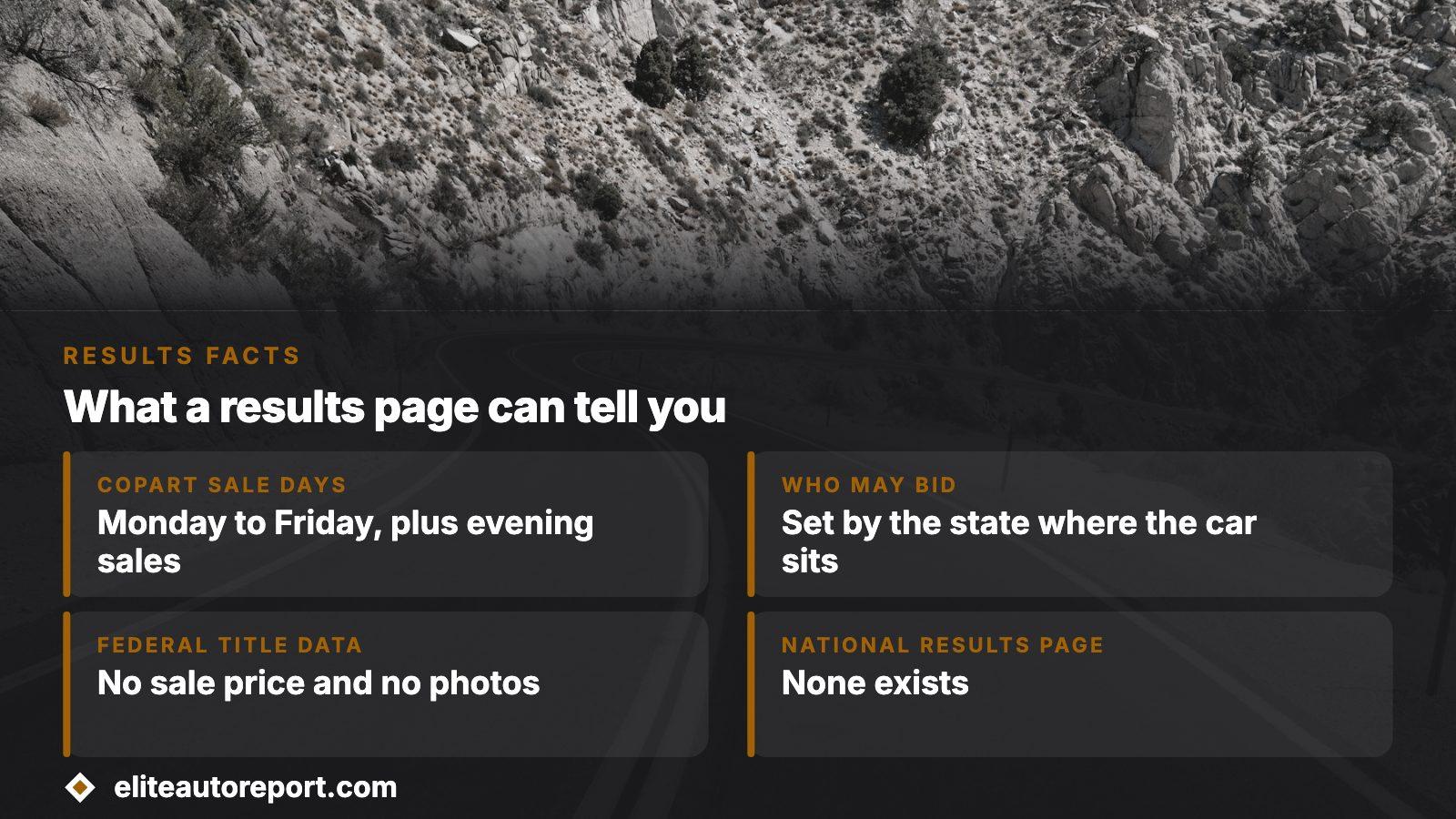
- Copart sale days
- Monday to Friday, plus evening Night Cap Sales
- Who may bid
- Set by the state where the car sits
- Copart top bid
- On some lots a seller may accept or reject it a business day later
- Federal title data
- No sale price and no photos
Why one national results page does not exist
American car auctions are separate businesses with separate calendars. An insurance total loss, a dealer trade-in, a repossession and a collector Ferrari each go to a different seller's sale, and each seller publishes only its own list. Finding today's results is a sorting job: work out which kind of auction handled the car in front of you.
| Kind of sale | Examples | Who can bid | Where times and outcomes show |
|---|---|---|---|
| Insurance and salvage | Copart, IAA | Registered members; some lots open to the public, the rest tied to state licensing | The operator's list of the day's sales, plus a page per lot |
| Dealer wholesale | Manheim | Licensed dealers and commercial buyers, with a few public locations | Each location's sale details page |
| Collector and luxury | RM Sotheby's and similar houses | Registered bidders | A results archive, sale by sale |
Reading Copart's list of today's sales
Copart's Today's Auctions page is the nearest thing to a live schedule in this trade. Each sale shows a start time, yard, region, sale type, lane and item count, and the day is split into sales running now and sales still to come. When this page was updated, on a Thursday in November 2026, 55 sales were live and 97 more were queued behind them.
Copart says its sales run Monday through Friday, most starting between 9 a.m. and 2 p.m. CST, with evening Night Cap Sales at 8 p.m. CST from Monday to Thursday.
Check the time zone
When we opened the list, every start time was printed as GMT+0. Per Copart's glossary, each sale time follows the clock at the yard where the car is stored. Confirm which zone your view uses before planning around a sale.
What 'sold' can mean once the bidding stops
At the block, the top bid is not always the last word, as Copart's own definitions show.
| Sale type | What happens | What it does to a result |
|---|---|---|
| Pure Sale | No minimum or reserve; the top bidder at the close wins | The cleanest outcome, settled when bidding ends |
| On Approval | The seller can accept or reject the top bid by 7:45 p.m. PST on the following business day | A bid that looks like a win can still be turned down |
| Minimum Bid | If the minimum is missed, the seller gets the same window, and a rejected car can run again | A no-sale may return in a later auction |
| Pre-Bid | Placed before the sale opens and wins if nobody beats it live | A price can be fixed before the lane starts |
IAA has a second act too. Sellers and buyers can trade offers on an 'If Bid' right after a car leaves the block, and Timed Auctions keep a car open for roughly 24 hours before the live sale, each with its own deadline and reserve. Read any sold figure as one lot at one moment, then look for a later listing of the same car.
Dealer-only, public and licensed: who sees which lots
Who may bid decides what is on your screen. Copart says a membership level changes nothing here, because the law of the state where the car sits sets the rule. A buyer without the right license is pointed to a broker or to lots marked No License Required. IAA gives every vehicle page a list of eligible bidders and an Available to Public filter.
Manheim's terms keep its main sales to licensed dealers, banks, manufacturers, rental companies and other commercial buyers purchasing for resale. It does run public sales at 15 locations: attendance is open to licensed drivers who are at least 18, each location writes its own registration rules, and every sale is as is with no test drives.
Where luxury, exotic and classic lots turn up
On the salvage side, high-end cars sit in their own pockets. Copart's glossary describes CrashedToys as salvaged powersport machines plus exotic cars from Ferrari, Lamborghini and Alfa Romeo, with extra photos and notes, sometimes a video, and a different fee structure. IAA's public page has tiles for Luxury and Classics. Look in those corners first.
Collector houses work differently. RM Sotheby's keeps a sales archive with a year picker from 2026 back to 2002 and a View Results link per sale, with its online Sealed sales listed beside the live ones. You need the sale name and, for one car, the lot.
Reading the lot page before you trust it
A Copart lot page gives ten photos, the VIN, the title type, an odometer, two damage codes and a retail value. Each field has a catch.
- Odometer: ACTUAL, EXEMPT, NOT ACTUAL and EXCEEDS MECHANICAL LIMITS mean four different things, and only the first says the reading is believed true.
- Damage codes: they record known or reported damage only, and Copart says they should not be relied on for bidding. The list includes water or flood, frame damage and replaced or altered VIN.
- Retail value: the seller supplies it, and IAA says the same of its actual cash value. Neither company vouches for the figure.
- Title status: an expected future date means Copart awaits DMV title processing; title pending means it lacks the title.
- Photos: ten images show one moment, and IAA advises a third-party inspection when pictures fall short.
What the federal record holds and what it leaves out
Salvage auctions sit under federal reporting rules. The NMVTIS FAQ names salvage pools, salvage auctions and other auctions handling salvage vehicles, and puts the duty on any yard taking in five or more junk or salvage cars a year. A yard files intake details: the VIN, the date it received the car, who it came from and what became of it.
A consumer report built from those filings carries title data, odometer, theft, brands and salvage or total-loss history. A sale price and photos are not on that list, and the system holds no repair history. States also report on their own timetables, a few instantly and others days later. A clean federal result does not replace the auction listing.
Following one car by VIN instead of by the day
Daily results show what sold. A VIN shows what happened to one car. The two meet when you are eyeing a specific luxury or classic car and want its auction trail: sale dates, listing photos, the damage description at intake and the mileage at each stop.
- Copy the full VIN from the car and from the paperwork, and confirm the two match.
- Enter it in the preview here. The preview is free and shows whether salvage or auction records exist; the full report adds photos and dates and is a one-time purchase.
- If a record turns up, compare its photos and dates with what the seller has told you.
- Inspect the car in person, or hire an independent inspector, before any money moves.

Where this information comes from
- Copart: Today's auctions — supports the layout of the day's list, sale days and Night Cap times
- Copart help center: glossary of common terms — supports sale types, approval windows, labels, photo count and CrashedToys
- IAA: auctions open to public buyers — supports public-buyer filters, bidder lists on vehicle pages and the Luxury and Classics tiles
- IAA help center: glossary of terms — supports Timed Auctions, If Bid offers and seller-supplied value
- Manheim: public auctions — supports public sale locations, attendance rules and as-is terms
- RM Sotheby's: auction results archive — supports how a collector house lays out past results by year and sale
- NMVTIS: frequently asked questions — supports who reports salvage, what a title report holds and its update timing
Sources and photos: Facts checked against the sources above in November 2026. Photos by Patrick von der Wehd, Wesley Tingey and Will Truettner on Unsplash; diagrams by EliteAutoReport.
Keep reading
- Auction History by VIN: Photos for Luxury, Exotic and Classic CarsHow a car's auction record is built, and what it shows.
- Car Auction History Prices by VIN: Luxury, Exotic and Classic CarsThe next question once you have a VIN: what the car sold for.
- Car Auction Results Database: Where Classic Car Results LiveHow collector houses print results and premiums.
- Copart VIN Check: Auction Photos and History for Luxury and Classic CarsTracing a car that passed through Copart.
Frequently asked questions
Where can I see car auction results today?
Open the operator's own list. Copart posts Today's Auctions with start times and lane counts, IAA's vehicle pages list the auctions a car will appear in, and collector houses such as RM Sotheby's keep a results archive by sale. Sold prices may need a member login, so a VIN search is the practical route for one car.
What time do US car auctions start?
It depends on the operator. Copart says its sales run Monday through Friday, most starting between 9 a.m. and 2 p.m. CST, with Night Cap Sales at 8 p.m. CST from Monday to Thursday. IAA's Timed Auctions open about 24 hours before the live sale. Copart ties each time to the yard's clock, so check the zone.
Can anyone bid at a US car auction, or only dealers?
Both exist. Manheim's main sales are for licensed dealers and commercial buyers, though 15 locations run public sales. Copart and IAA admit public buyers on lots marked for them, and state law decides the rest. A broker can bid where a license is required.
Why did a car I watched sell and then show up again?
A top bid on a lot with a minimum or an approval clause is not final. At Copart the seller can still accept or reject it by 7:45 p.m. PST on the following business day, and a rejected car can run in a later auction. Keep the photos and dates from both listings.
Does a history report show auction results and photos?
Federal NMVTIS data flags salvage and total-loss history but lists no sale price or photos, and it has no repair history. Our report can add auction and salvage records with their photos where a record exists. The preview is free, and the full report is a one-time purchase.
Now check the car itself
The guide explains what to look for. The report shows what this VIN has on record.