THE SHORT ANSWER
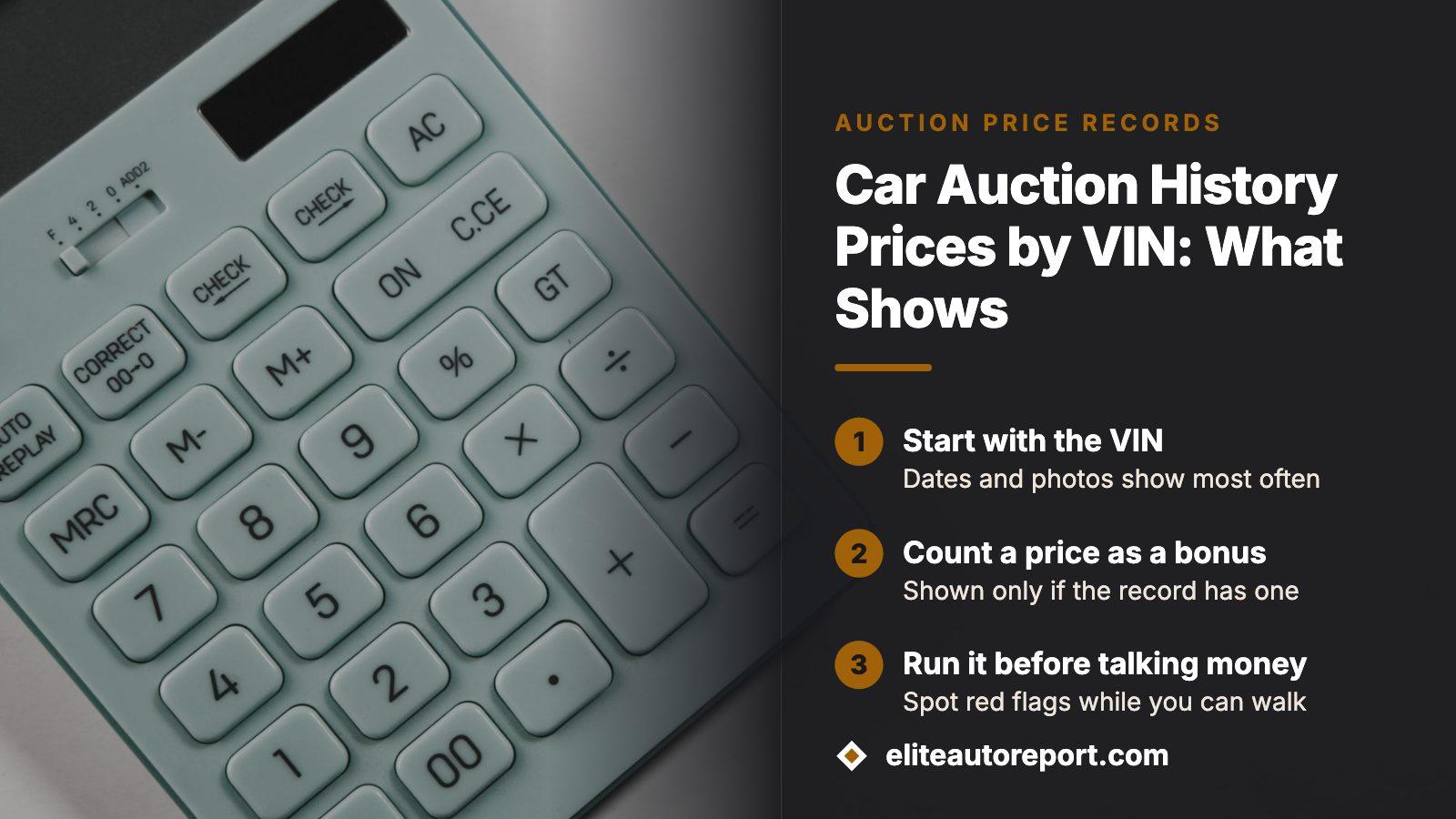
Type the 17-character VIN into EliteAutoReport to start the free preview, then buy the report if you want the auction section laid out beside title brands, odometer readings and recalls. Dates, photos and damage notes are what auction records carry most often. A sale price or bid shows only when that record includes one, so treat it as a bonus and never as the reason to run the check.
- Search key
- The full 17-character VIN
- Sale price
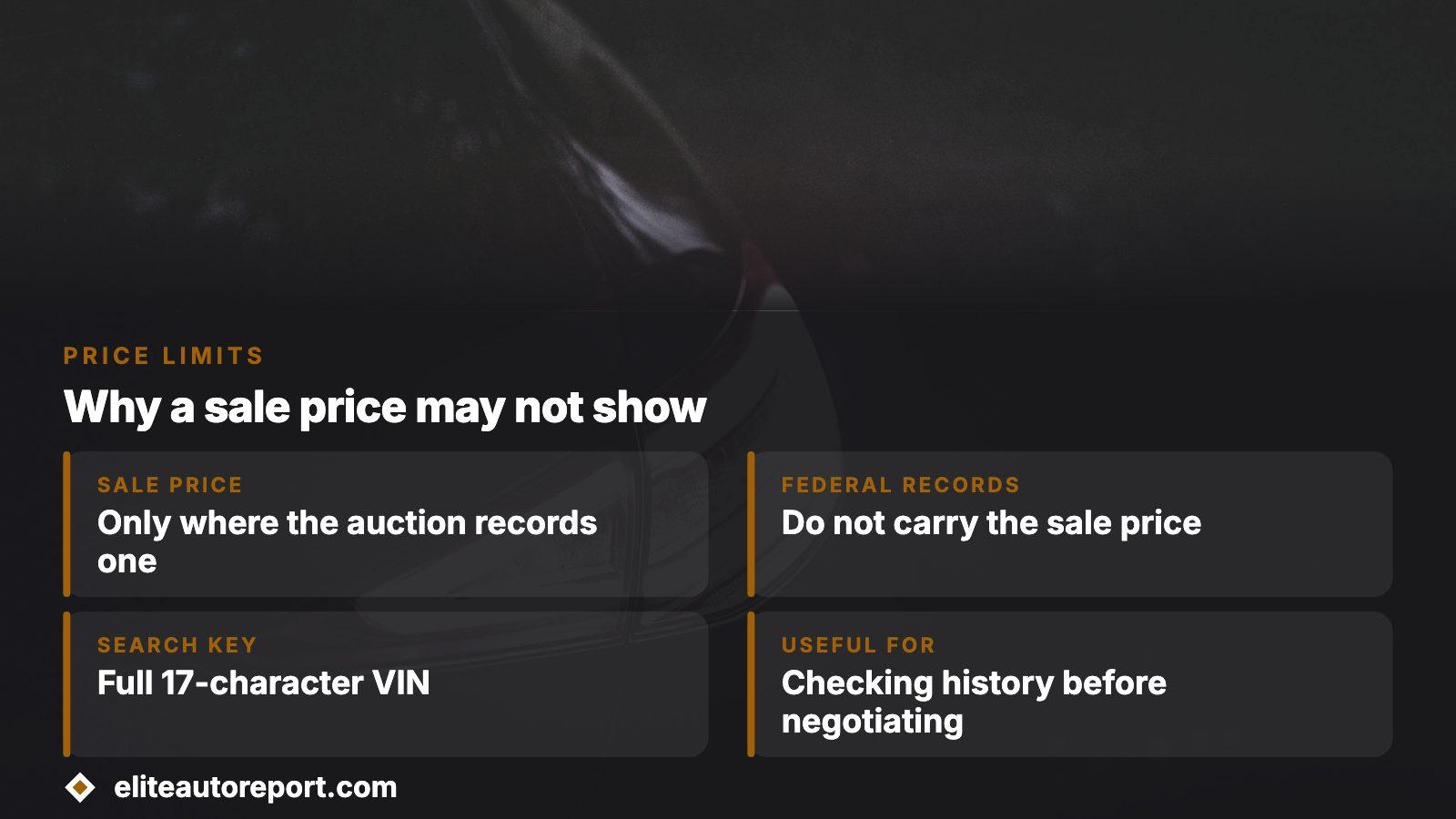
- Only where the auction's own record carries one
- Cost
- Free preview, then one payment per report or pack
What a VIN search can pull from an auction record
An auction record exists only if the car actually crossed a block or a lane, so a collector car that changed hands by handshake leaves nothing behind. When a record does exist, this is the realistic range.
| Item | What a record often holds | What it will not tell you |
|---|---|---|
| Sale date | The day the car was offered or sold | Why the owner let it go |
| Photos | Pre-repair pictures, where the auction kept them | Anything the camera angle skipped |
| Damage notes | A primary and sometimes a second damage label | How well a later repair was done |
| Odometer | The reading taken when the car came in | Whether that reading was true |
| Price or bid | A figure, only if that listing published one | A figure on every row |
Why the federal records cannot hand you the sale price
Start with what the public databases hold. The federal title system stores title data, the latest odometer reading, brands, theft history and salvage history, and its own FAQ names repair history as something it leaves out. Auction companies must keep the previous owner, the buyer, the VIN and the odometer reading from the day the car arrived, for five years. Neither list includes a sale price.
That leaves the figure with whoever ran the sale. Whether it is shown at all is that company's decision, which is why one lot can come back with a photo and a date but no number while another carries all three.
Where a price does get published, and what it means
Each kind of sale talks about money differently. At a wholesale lane such as Manheim's, the sale light matters more than the number: red means sold as is, and local policy can send a car to the red lane automatically based on price, model year or mileage. IAA sells total-loss and clear-title cars alike, asks bidders to register as buyers, and lets them filter by title type, damage type and type of loss claim. Its pages list Luxury and Classics among the categories, so a high-end car with a lane photo is not unusual.
Collector houses are the ones that publish results, usually by lot. The footnote on a results page should say whether a figure includes the buyer's fee, so read it before you compare two lots.
Running the check before you talk money
The whole thing takes a few minutes, and it belongs before the test drive.
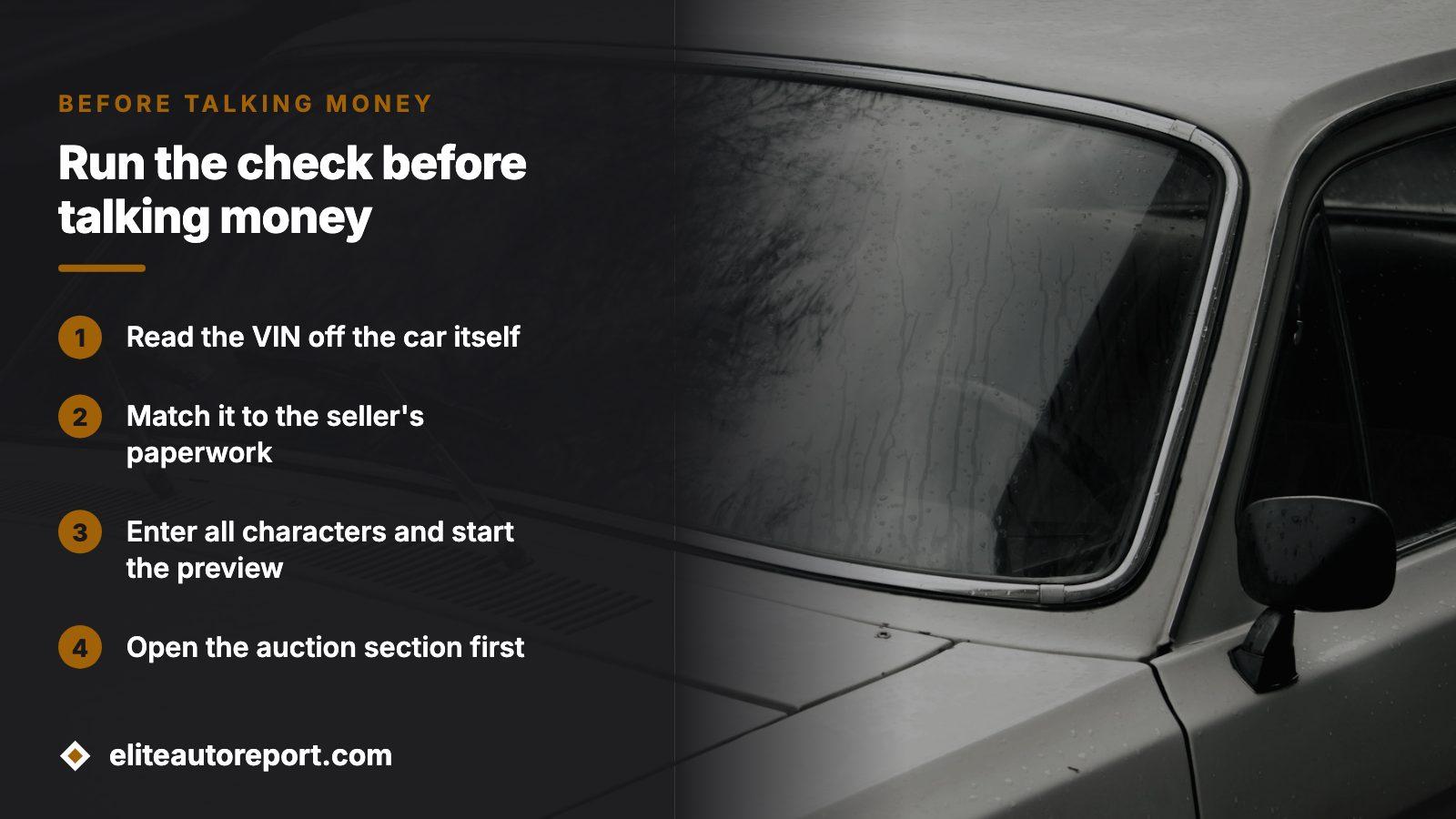
- Read the VIN off the car itself. The plate is placed by the left windshield pillar so someone outside can read it, whereas a typed number in an ad can contain a typo.
- Match it to the seller's paperwork. A written mileage statement must carry the VIN, so a different number in the packet is a reason to stop.
- Enter all 17 characters and start the free preview.
- Open the auction section first, then set the dates and odometer readings against the seller's story.
- Ask about every entry you find. A clear answer costs the seller nothing; a vague one is information.
Reading an auction record on a luxury or exotic car
On a high-end car the interesting question is rarely the price. It is whether the car ever sat in a lane with its front end open, and what was done afterward. The photos answer that better than any label.
The federal title system adds a caution worth keeping. A total-loss label does not always mean a wreck, because standards differ by state and a recovered car in good condition can carry one. A car with that label may also be sold at auction in good running order. Treat any record as a reason to look harder, never as a ruling.
Line up three things: the sale date, the odometer reading at that sale, and what the damage notes say. Then hold them up against the car on the lot and against the title record at the state that issued it.
Red flags worth a hard stop
- An auction entry the seller never mentioned, especially one with damage notes.
- An auction odometer reading above what the dash shows today.
- Photos of structural or airbag damage on a car described as having had only paint work.
- A new title from another state soon after an auction sale. Washed brands can push a buyer into paying above fair market value.
- A price far under what similar cars ask, with no explanation anywhere on the record.
From an NHTSA owner complaint
One owner filed a complaint over a 2019 Ford Escape bought from a dealer who, the owner says, never disclosed a total loss. The state records show the odometer frozen at 73,539 miles from a Tennessee title to an Ohio one, yet an OBD-II scan read above 86,278. The owner traces it to a December 2024 crash that ended in a salvage call at auction, followed by a Rebuilt title with no disclosure.
It is one owner's account, not a finding, but it shows the pattern: a mileage that stops moving and an auction date that sits in the wrong place. A report that lists both side by side puts that in front of you before the signature.
Classic and older exotic cars: where the trail thins
The federal VIN rule's year-code table for older cars starts at 1980, so a pre-1980 classic may not carry a standard 17-character number at all. NHTSA's decoder mentions older ranges, but it draws on manufacturer submissions, not on sale history.
Mileage records thin out as well. A car of model year 2010 or older stops needing a written mileage statement once 10 years have passed since the first of January of its model year; for newer cars the wait is 20 years. Collector sales are posted by lot, not by VIN, so a lot sheet and a VIN record answer different questions: the first says what the house promised, the second what the paper trail holds.
Cost, and the sensible next moves
Start with the free preview. Payment happens once per purchase, and you can take one report or buy a multi-report set of 3, 5 or 10 when several cars are on your list. Nothing renews behind it, and the pricing page carries the figures.
- Ask the seller for the original auction photos and any repair invoices.
- Have a specialist for that make inspect the car. The federal title system says its data is not a complete record and recommends an independent inspection.
- Read the state title record, which the same agency tells buyers to consult before they pay.
Where this information comes from
- NMVTIS: frequently asked questions — what the federal title database stores and what it leaves out
- NMVTIS: information for consumers — total-loss labels, washed brands and why to read the state title record
- 49 CFR part 580: odometer disclosure requirements — what auction companies keep per sale, the mileage statement and its exemptions
- 49 CFR part 565: vehicle identification number requirements — how a VIN is built and where it must be readable
- Manheim: arbitration and sale lights — what the sale lights announce at a wholesale auction
- IAA: used vehicles — where its inventory comes from, buyer registration and vehicle categories
- NHTSA owner complaint 11761195 — owner experience, paraphrased
Sources and photos: Facts checked against the sources above in November 2026. Photos by Sasun Bughdaryan, Tigran Shishmanyan and Maurice Sahl on Unsplash; diagrams by EliteAutoReport.
Keep reading
- Auction History by VIN: Photos for Luxury, Exotic and Classic CarsHow an auction history check by VIN works and what its pre-repair photos can show.
- Car Auction Results Database: Where Classic Car Results LiveHow collector-car results are posted and how to read them.
- Sample reportA finished report to look over before you buy one.
- PricingWhat a single report or a larger pack costs, paid once.
Frequently asked questions
Can the VIN alone tell me what a car fetched at auction?
Sometimes. A price or bid appears only when the auction's own listing carries one, and federal title and salvage reporting does not ask for it. A VIN search is better at confirming that a sale happened, when, at what odometer reading and with which photos. For a collector car, pair it with the house's published result for that lot.
Does an auction record mean the car was wrecked?
No. IAA's own pages describe clear-title inventory with little to minor damage, drawn from donations, finance companies, rental fleets and dealers. The warning signs are a salvage title type, a real damage label, photos that show harm, and a seller who never mentioned the sale.
Why does the odometer reading at auction differ from the dash?
Auction companies record the reading on the day the car arrives, so it is a dated snapshot. A higher number there than on the dash now is worth chasing through the state title record and the mileage statements. A lower one may only mean the car has been driven since.
Will a collector auction result appear in a VIN search?
Not reliably. Collector houses post results by lot and catalog entry, and many classics never carried a standard 17-character number. If the car has one and the sale was recorded, the auction section may pick it up. Otherwise rely on the lot listing, provenance papers and an expert inspection.
Is a history report enough before I buy a high-end car?
No. The federal title system says its data is not a complete record and recommends an independent inspection. Hire a specialist for the make, ask for a written estimate that includes the VIN, and use any gap between the report and the car in the price talk.
Now check the car itself
The guide explains what to look for. The report shows what this VIN has on record.