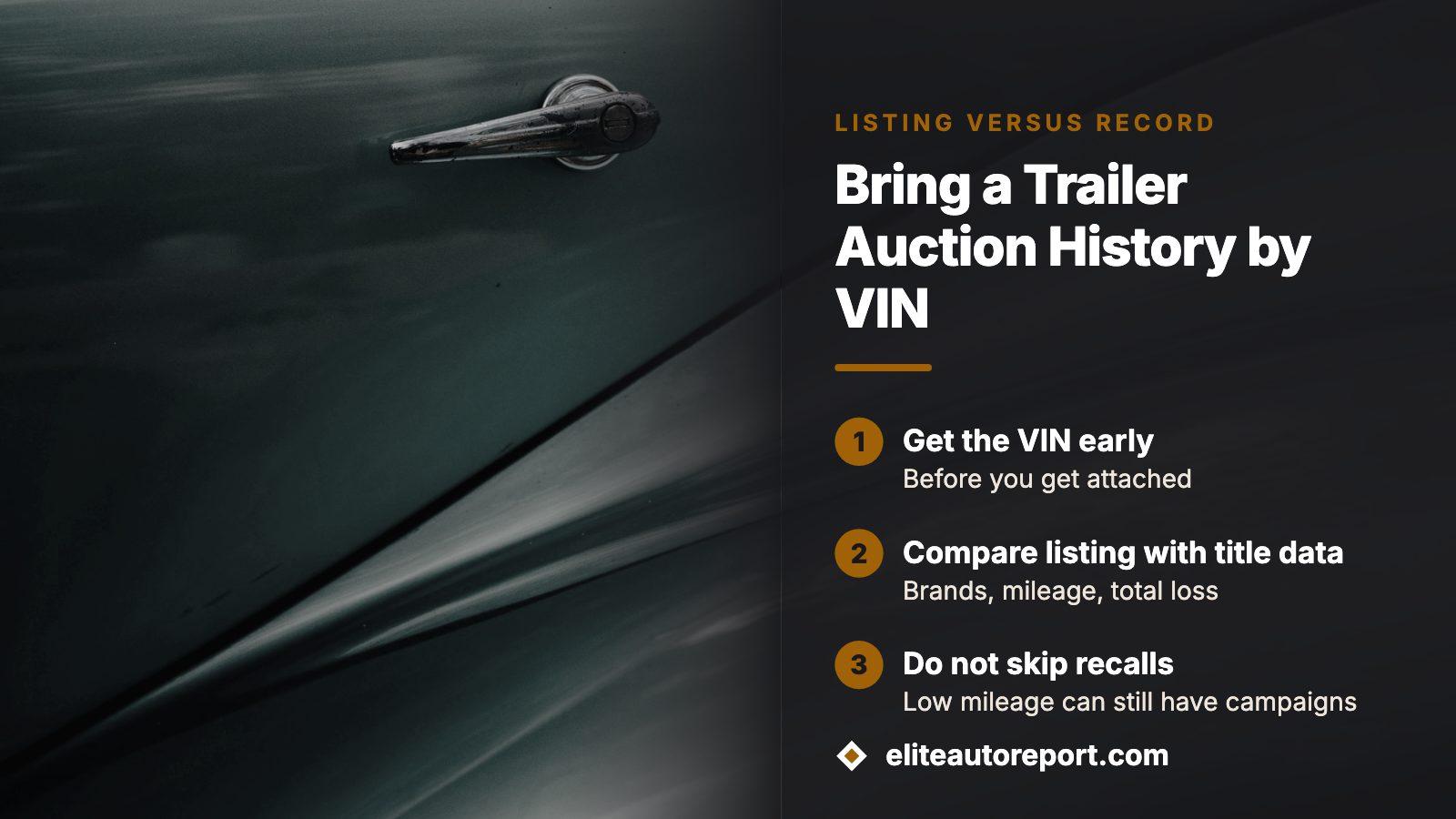
THE SHORT ANSWER
To check the history behind a Bring a Trailer car, copy the VIN from the listing, then run it through a title and salvage check, the federal recall lookup and a full report. Compare the title brands, odometer readings and any auction records against the listing's story. The preview costs nothing and lists which record types turned up.
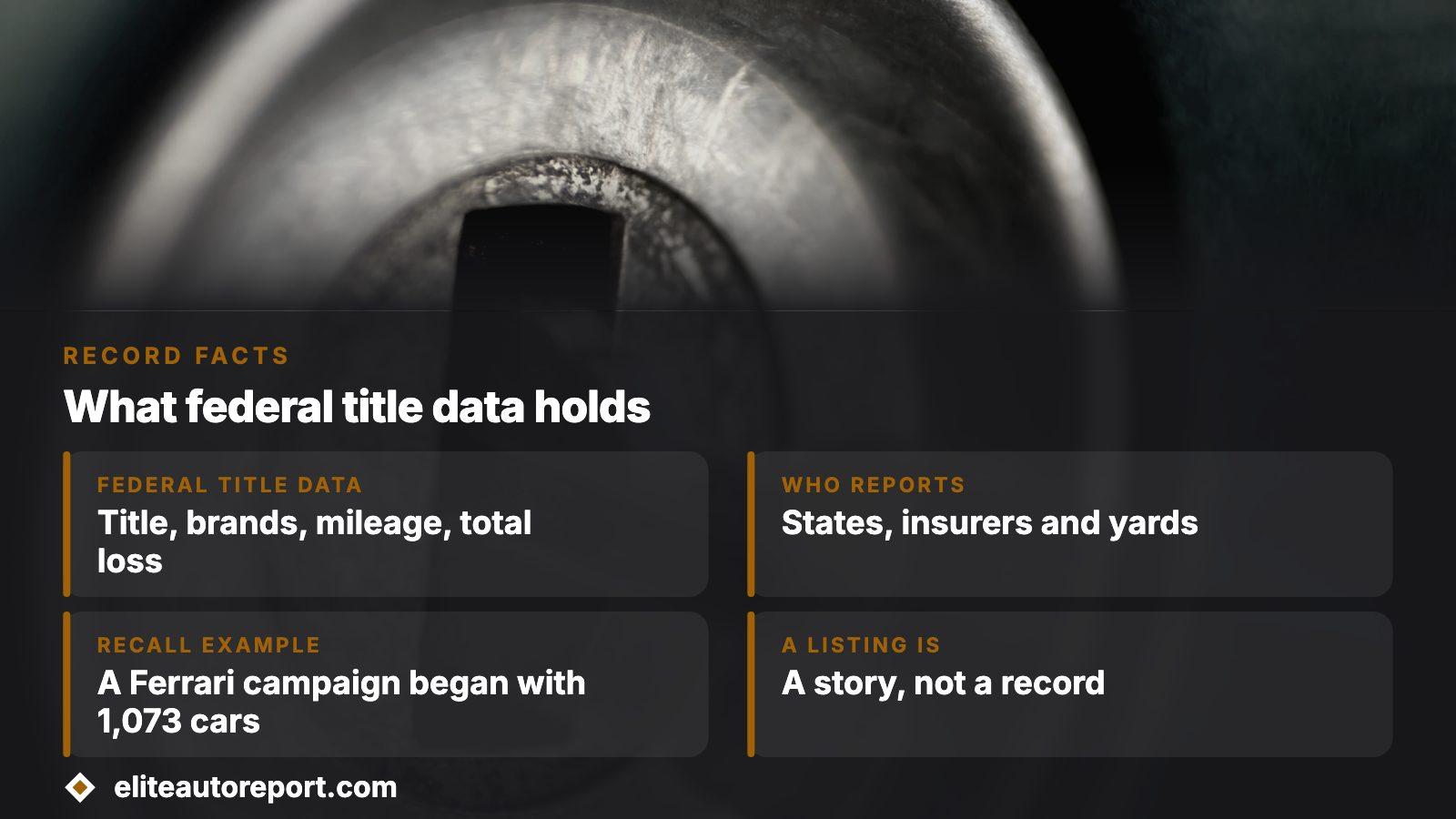
- Federal title data
- Title, brands, mileage, total loss, salvage
- Who reports to it
- States, insurers and yards that handle wrecks
- Recall example
- A 2013 Ferrari air bag campaign began with 1,073 cars
A listing is a story, a VIN is a record
Enthusiast auction pages are good at photographs, service notes and seller commentary. They are not a government record, and nobody audits them against a state title file. A seller can be completely honest and still not know that a previous owner took a total loss payout in another state.
That gap is why the VIN matters on a car you found through an online auction. It lets you ask a different set of questions: was this title ever branded, did the odometer ever go backwards, did the car pass through a salvage yard, and is a safety recall still open on it. None of that depends on how persuasive the write-up is.
One caution up front. We could not open Bring a Trailer's own pages while preparing this guide, so we do not describe its fees, its listing layout or its results archive. Read those on the site itself, and use this page for the part that sits outside any listing: the records tied to the number stamped on the car.
Get the VIN before you get attached
Most listings print the full 17 characters in the body or in a photo of the dash plate. Copy it from the text if you can, since a number read off a photograph is easy to mistype. After that, compare it with the plate visible on the car in the pictures, and with the title once the seller shares it.
- The typed number and the photographed number should agree exactly.
- An older classic may carry a shorter number than 17 characters, so ask the seller how the car is titled.
- A listing with no VIN at all deserves a direct question before you bid or bring a deposit.
NHTSA publishes a decoder built on data from manufacturers, and it takes an optional model year for older vehicles. Run the number through it. If the decoded make, body or engine contradicts the headline, stop and ask the seller why.
What the federal title system can and cannot tell you
The Justice Department operates the federal title database known as NMVTIS. Its consumer pages describe a short report with five parts: the title's current state and latest issue date, any brands, the last recorded mileage, a total loss entry if one exists, and a salvage entry if one exists. Brands are descriptive tags from state agencies, and the database remembers a tag even after the car moves to a different state.
Entries come from state titling offices, insurers, wrecking yards and auto recyclers, all of whom must file under federal law. The agency is candid about limits: a report with nothing in it is good news, the format is intentionally brief, and repair logs and recall notices belong to private providers or NHTSA.
Read a clean result carefully
A spotless title record only means no brand or total loss was reported. It cannot say whether someone repaired the car, and it is silent on paint, panel fit or deferred work. Add a specialist's inspection from someone who knows the marque.
Where an auction record can appear without a brand
A federal rule, 28 CFR 25.56, requires yards that handle junk or salvage cars file a monthly inventory with the title system. Each line lists the VIN, the day the yard acquired the car, the party it was acquired from and its fate, meaning crushed or sold onward. A car that sat in such a yard, even briefly, can leave that footprint.
This is the reason an exotic with a spotless listing can still surprise you. A damaged supercar is often repaired because the parts and the resale value justify it. If the repair was documented and the title never branded, the yard and auction trail may be the only place the damage shows, along with photographs taken before the work.
We search for those records by VIN. Whether a given car has one depends on the data, and no report can promise coverage of every platform or every sale, so treat a missing record as an absence of evidence, not proof.
Mismatches that should slow you down
| What you see | What it may mean | Next step |
|---|---|---|
| Listing says never damaged, record shows a salvage entry | An undisclosed loss or a repaired wreck | Ask for repair invoices and photos |
| Odometer reading lower than an earlier record | Rollback, a replaced cluster or a data entry error | Request service receipts with mileage |
| Title issued recently in a new state | A retitle that may have dropped a brand | Check each prior state's records |
| Open safety recall on a late-model exotic | Remedy never performed | Book the free fix with the maker's dealer |
One line on its own may be harmless. Several together, or a seller who stops replying when you ask, is the pattern to take seriously.
Do not skip recalls on a low-mileage car
Garage queens are the cars most likely to carry an unperformed recall, since nobody visited a dealer. NHTSA's records for the 2013 Ferrari 458 show how it plays out. Take Campaign 18V040000. It began with 1,073 Ferraris from model year 2013, spanning several models, sold or registered in listed states, because of a passenger air bag inflator. In May 2018 it grew by 826 more cars nationwide. Dealers swap the passenger frontal air bag assembly without charge.
A second campaign, 14V487000, from July 2014, applies to 2010 through 2014 Ferrari 458 Italia and Spider cars built from March 5, 2010 to May 20, 2013, whose secondary front trunk latch may fail to release. Dealers fit a replacement part, again at no charge. Both are public, and both are tied to the VIN, so a recall check takes a minute and can change how you bid.
How to run the check on our site
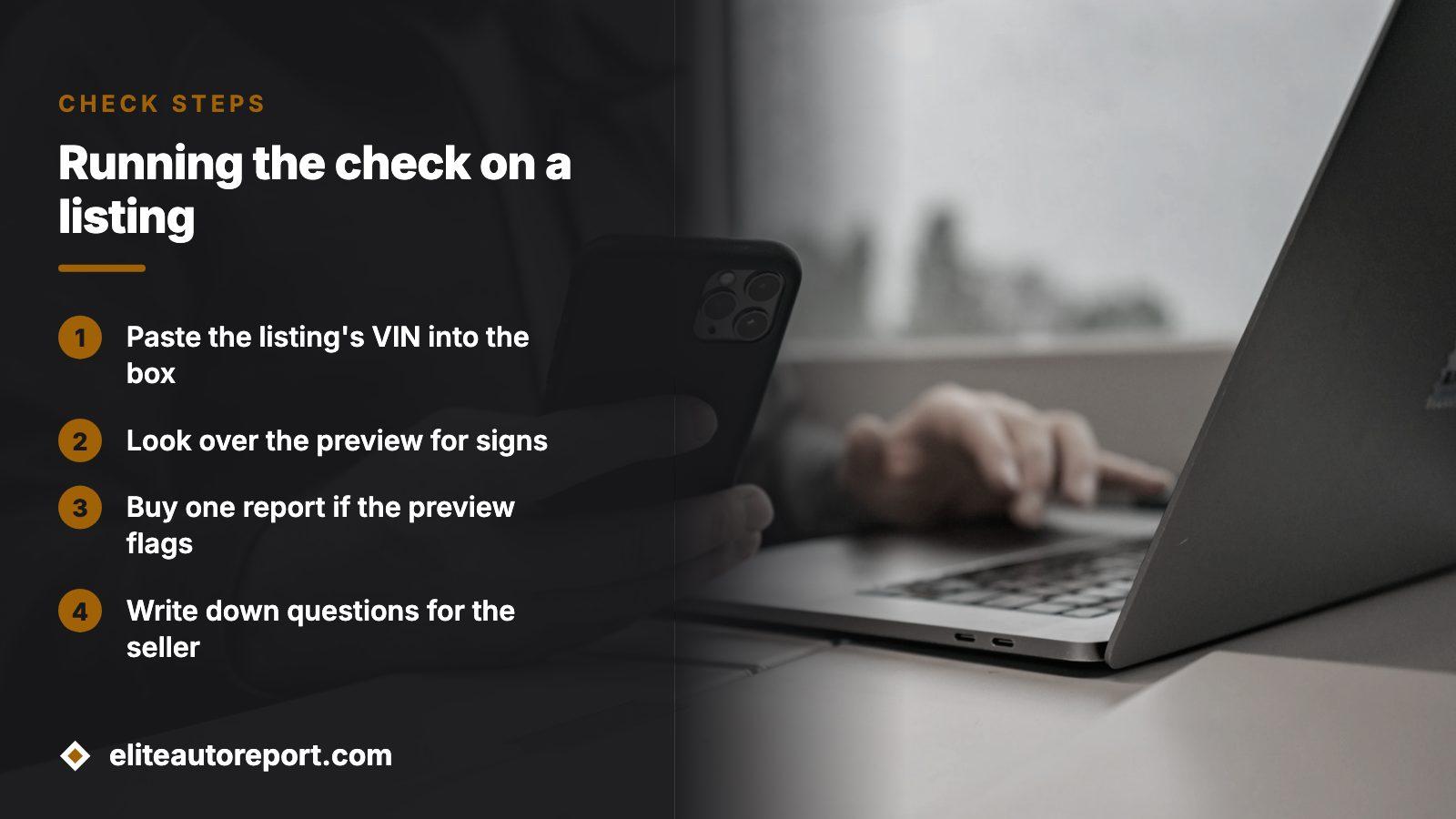
- Paste the VIN from the listing into the box on the home page.
- Look over the preview, which costs nothing, for the list of record types found for that car.
- Buy one report if the preview shows something worth reading. If you are weighing several cars, a pack covers them.
- Set the report beside the listing and mark every point where they disagree.
Buying a report is a single payment, never a recurring plan; see the pricing page for the options. We lean toward luxury, exotic and classic cars, so the auction photos, title and odometer sections are the ones to read first.
What to do after the VIN check
Official advice for used-car shoppers stays the same: pay an independent mechanic to look it over, drive it in different conditions, get the service history, and call the prior owner if you can. For a remote purchase, hire a specialist near the car to do the inspection and send photos.
- Write down your questions from the VIN check and send them to the seller before bidding closes.
- Keep the seller's answers in writing.
- Walk away if the title, the odometer and the story cannot be reconciled.
Where this information comes from
- NMVTIS: Understanding an NMVTIS vehicle history report — the five indicators and what the system leaves out
- NMVTIS: Used car buying tips — inspection and test-drive advice for buyers
- Federal rule on monthly yard inventories (28 CFR 25.56) — what yards must send the title system each month
- NHTSA: vPIC vehicle API — how VIN decoding works and the model year option
- NHTSA: Ferrari 458 recalls — the two recall campaigns used as an example
Sources and photos: Facts checked against the sources above in November 2026. Photos by Anshul Gurjar, Anastasiia Nelen and Derek Nelson on Unsplash; diagrams by EliteAutoReport.
Keep reading
- Auction History by VIN: Photos for Luxury, Exotic and Classic Carsthe broader guide to reading auction records by VIN
- Car Auction Results Database: Where Classic Car Results Livehow collector-car houses lay out their results
- Car Auction History Prices by VIN: Luxury, Exotic and Classic Carswhat a recorded sale price can and cannot tell you
- Is It Bad if a Car Was Sold at Auction? Luxury, Exotic and Classic Carshow to tell whether a specific car went through an auction
Frequently asked questions
Can I look up a Bring a Trailer car by its VIN?
In the way that matters for buying, yes: the number in the listing leads to the title, salvage, mileage and recall records for that car. We could not confirm how the auction site searches its own archive, so use its tools for that and ours for the records.
Does a spotless title prove the car was never wrecked?
No. It means no brand or total loss reached the title system. Cars get fixed after insurance claims without ever being branded, so photos, service invoices and an inspection still matter on an expensive purchase.
What if the listing shows no VIN?
Get it from the seller in writing before bidding. Without it, title, salvage and recall records cannot be checked. A very old car may have a shorter number than 17 characters, so ask how it is titled.
Is the VIN check on your site free?
You pay nothing for the preview. The complete report is a different purchase, made once, with no ongoing plan; the pricing page lists the choices.
Are recalls part of an auction history check?
They are a separate record, but worth running on the same VIN. The federal title system does not hold recall data, while NHTSA does, and low-mileage collectibles often have recall work nobody has done.
Now check the car itself
The guide explains what to look for. The report shows what this VIN has on record.