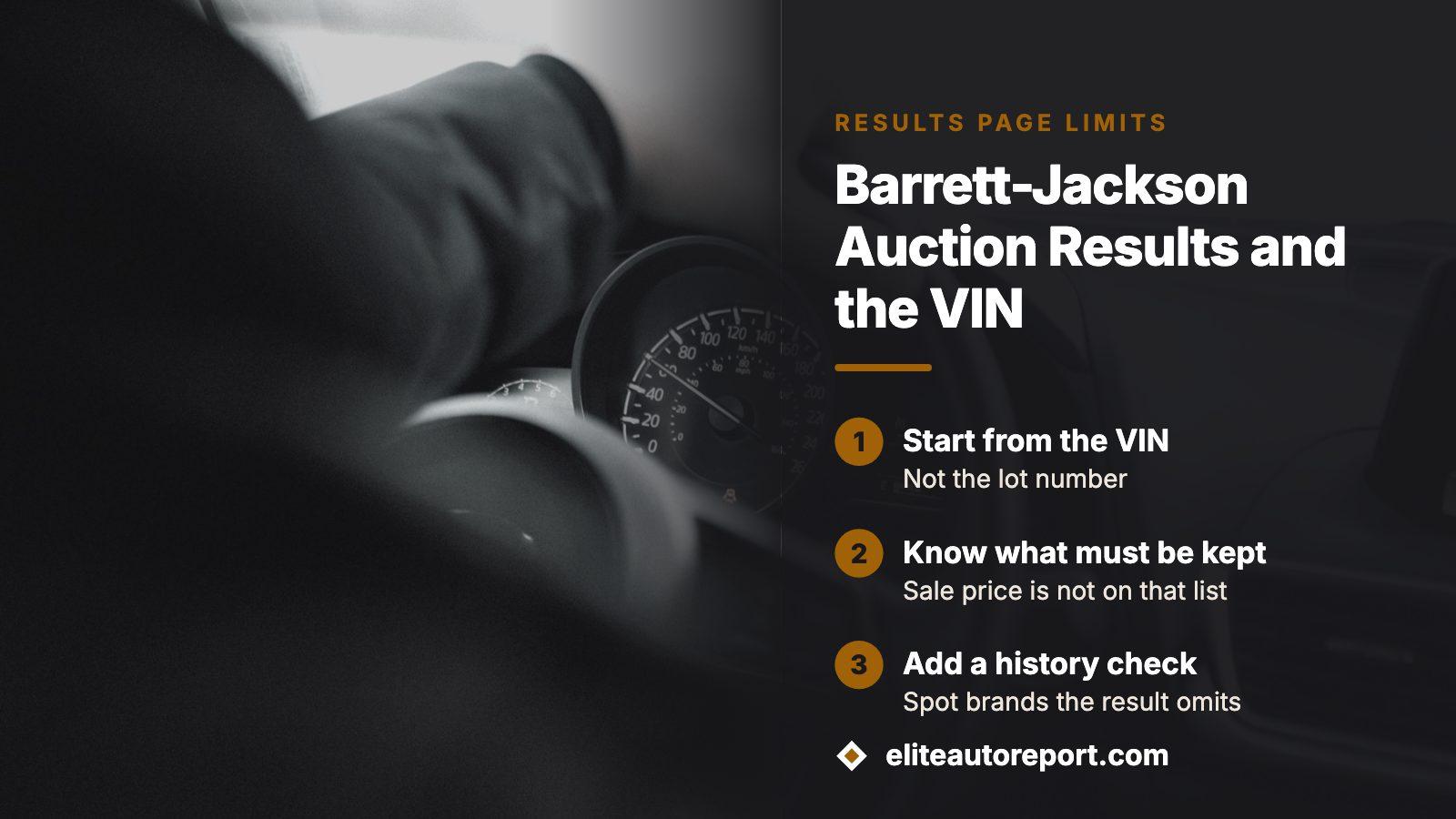
THE SHORT ANSWER
Search the auction house's own results pages for the lot, since only that source reflects what the house recorded. Then take the VIN and check it separately for title brands, salvage or total loss entries, odometer readings and open recalls. A gavel price proves a car found a buyer. Any past wreck, rebuild or mileage tampering is a separate question.
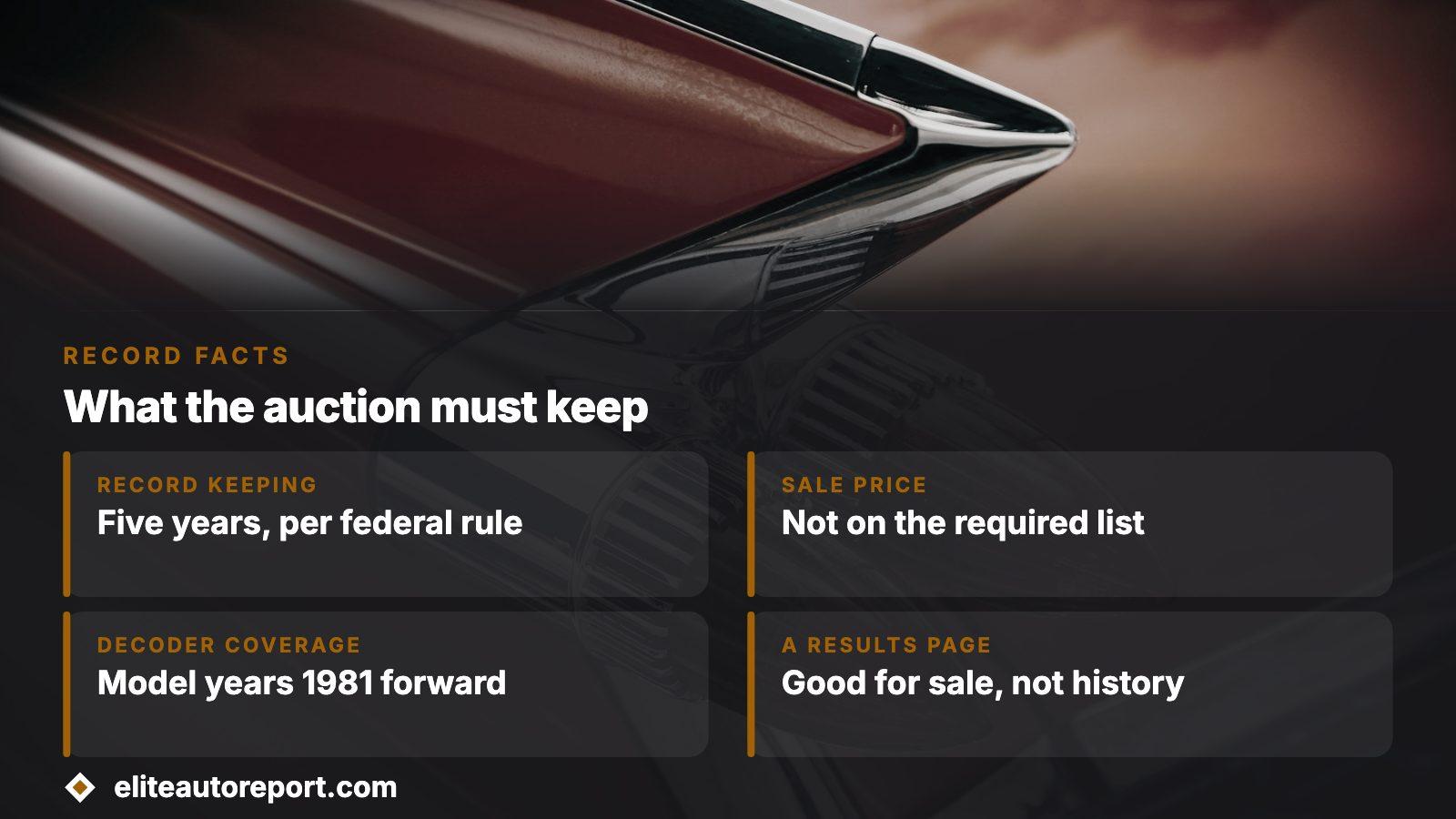
- Auction record keeping
- Five years, per federal rule
- Sale price in that record
- Not on the required list
- VIN decoder coverage
- Model years 1981 and forward
What a results page is good for, and where it stops
A results page answers a narrow question: did this lot sell, and at what number. For anyone tracking collector values or trying to learn what a certain model brings, that is useful. For a person about to buy a specific car, it is only the start of the homework.
Nothing on a sale record vouches for the car's past. A convertible with a spectacular story can carry a rebuilt brand from a state two owners back, and the bidders in the room may not have known. The paperwork follows the VIN, not the hammer.
A note on sourcing. The auction house's website blocked our automated requests while we prepared this guide, so we are not quoting any lot, price, fee or schedule from it. Read those on the site yourself. This page covers the part outside any catalog: the public and industry records attached to a vehicle identification number.
Start with the VIN, not the lot number
A lot number identifies a place in one sale. The VIN identifies the car, wherever it goes next. If you are researching a car that crossed a block, get the VIN from the catalog entry, the seller, or the car's own plate and title, and make sure all three agree.
- Copy the VIN from the listing and from the car or its title paperwork.
- Compare the two character by character, since a mismatch is itself a finding.
- Decode it to confirm the model year, body and engine match what was advertised.
- Run the history preview to see which record types exist.
- Buy the full report once the preview lists entries you want to read.
Decoding has a boundary worth knowing. NHTSA's vPIC decoder is aimed at 1981 and newer vehicles and skips anything built before the 1980 VIN standard. A muscle car from the sixties will not decode there, and its chassis number needs a marque specialist.

What the auction company is required to keep
Federal odometer rules make auction companies hold a short list of facts for five years after each sale: the previous owner's name, the buyer's name, the VIN, and the mileage on the day the company took possession. Those records exist for odometer fraud enforcement, and the buyer cannot simply request them.
The required list does not include the sale price. So a price you read on a results page comes from the auction house's own publishing choices, not from a federal file you could pull for yourself, and a history report should not be expected to repeat it.
Why this matters for a flip
If a car sold once, then reappears at another sale, the VIN lets you line up the two entries and compare mileage between them. If the second figure is lower, ask the seller to explain it; it is not a rounding error.
What the history check adds to a sale record
Our angle is auction history and photos by VIN, with attention to luxury, exotic and classic cars. The check pulls together records that never appear in a sale catalog, and a few of them change the value of a rare car overnight.
| Record | Why a collector cares |
|---|---|
| Title brands | A rebuilt or salvage brand stays with the car and cuts its worth |
| Salvage and auction entries with photos | Shows damage that may predate the cosmetic restoration you are admiring |
| Odometer readings | Lets you spot gaps or drops between reports |
| Theft and lien records | A car with an unpaid lien can complicate the transfer |
| Open recalls | Safety campaigns nobody finished on a late-model exotic |
Coverage varies by car and by how many owners and states it has passed through, so treat the preview as a map of what exists before you buy the report.
Reading the results: red flags that matter
Federal title data comes from state agencies, insurers and yards that handle wrecked vehicles. The Justice Department oversees the system with AAMVA, the association that has operated it since 1992. Salvage pools and salvage auctions are among the businesses expected to report, and insurers report too when they write a car off.
- An insurer write-off or salvage-yard entry for a car billed as untouched.
- Mileage that drops between two dated records.
- A recent retitle in a new state with no explanation.
- Paperwork showing a different VIN than the car itself wears.
- Photos from a salvage sale showing damage the seller never mentioned.
Each of these calls for a pause and a request for repair invoices, though not always for walking away.
What no report can tell you
The federal title system does not hold repair history. The system's own FAQ points buyers toward a separate inspection plus other data sources first, and a collector car deserves that more than a commuter sedan.
A clean record is not an inspection
No brand and no total loss only means nothing was reported. It says nothing about paint, panel gaps, frame repair done off the books, or whether numbers on the engine and body belong with the car. Have a specialist look at it in person.
If a state title record is what you need, the state motor vehicle titling agency can provide a complete copy of a specific record. Ask the seller for permission, since the title is theirs.
Price of the report, and your next moves
Begin with the preview at no charge; it shows what categories of records the number turned up. Reading the full thing means paying once, with nothing recurring, and the /pricing page carries today's figures. Anyone weighing several cars before an event may prefer a pack.
- Get the VIN from the catalog entry and from the car.
- Run the preview and see what categories show up.
- Buy the report if brands, auction photos or odometer gaps show up.
- Bring the findings to the seller and to your inspector.
- Decide on a maximum price only after the checks come back.
Where this information comes from
- 49 CFR part 580: odometer disclosure requirements — what auction companies must keep and for how long
- NMVTIS: frequently asked questions — who reports, and what the system leaves out
- NHTSA vPIC: VIN decoder — decoder coverage by model year
Sources and photos: Facts checked against the sources above in November 2026. Photos by Miles Loewen, Jakub Żerdzicki and Clem Onojeghuo on Unsplash; diagrams by EliteAutoReport.
Keep reading
- Mecum Auction Results: How to Look Up a Sale and Read Itthe same steps for a different collector auction house
- Car Auction Results Database: Where Classic Car Results Livehow to read collector sale results more broadly
- Auction History by VIN: Photos for Luxury, Exotic and Classic Carsthe full guide to auction records tied to a VIN
- Matching Numbers Classic Car: How to Verify the Claim Before You Payconfirming the engine and body belong with the car
Frequently asked questions
Can I find Barrett-Jackson auction results by VIN?
Use the auction house's own results pages for what a lot sold for, since we could not open them to describe their search tools. Separately, the VIN lets you check title brands, salvage entries, odometer readings and recalls, which a results page does not carry.
Does a Barrett-Jackson sale prove the car has a clean past?
No. A sale shows a car found a buyer, nothing more. Title brands, total loss entries and odometer problems come from state and insurer records, so check them by VIN no matter how well the car was presented on the block.
Is the sale price part of a vehicle history report?
Not as a rule. The federal list of records an auction company keeps covers owner names, the VIN and the mileage when it took possession, and it does not include price. Look up the price on the auction house's own site.
Will the check work on a pre-1981 classic?
The federal decoder targets 1981 and later models, so older cars may not decode and records may be thinner. Run the number anyway to see what exists, and add a marque specialist's inspection and the state title record.
Do I pay for the preview?
Not for the preview. That first look is the only part without a charge, and it names the kinds of records found. Going further means a one-time purchase of a single report or a pack, never a subscription. See /pricing for current amounts.
Now check the car itself
The guide explains what to look for. The report shows what this VIN has on record.