THE SHORT ANSWER
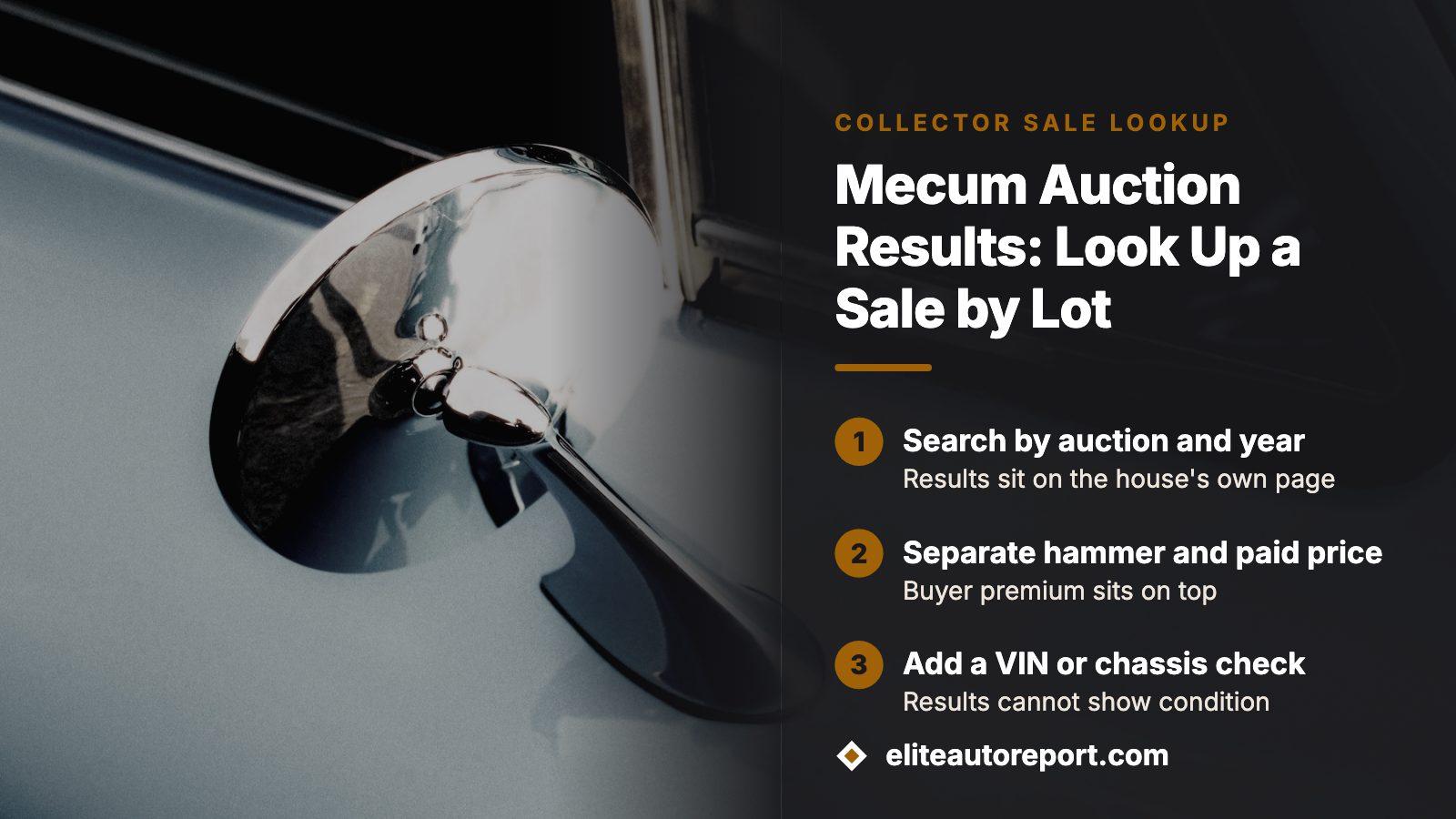
Open the results page on Mecum's own site, pick the auction, then filter sold lots by make, model or year. The hammer price is not the total the buyer paid, because a premium of 10 to 12 percent is added for cars. Mecum does not inspect lots and sells everything as-is, so a result says little about condition. For the car's history before the sale, run the VIN through a preview check first.
- Where results live
- Mecum's results page, searched by auction, make, model and year
- Buyer premium on cars
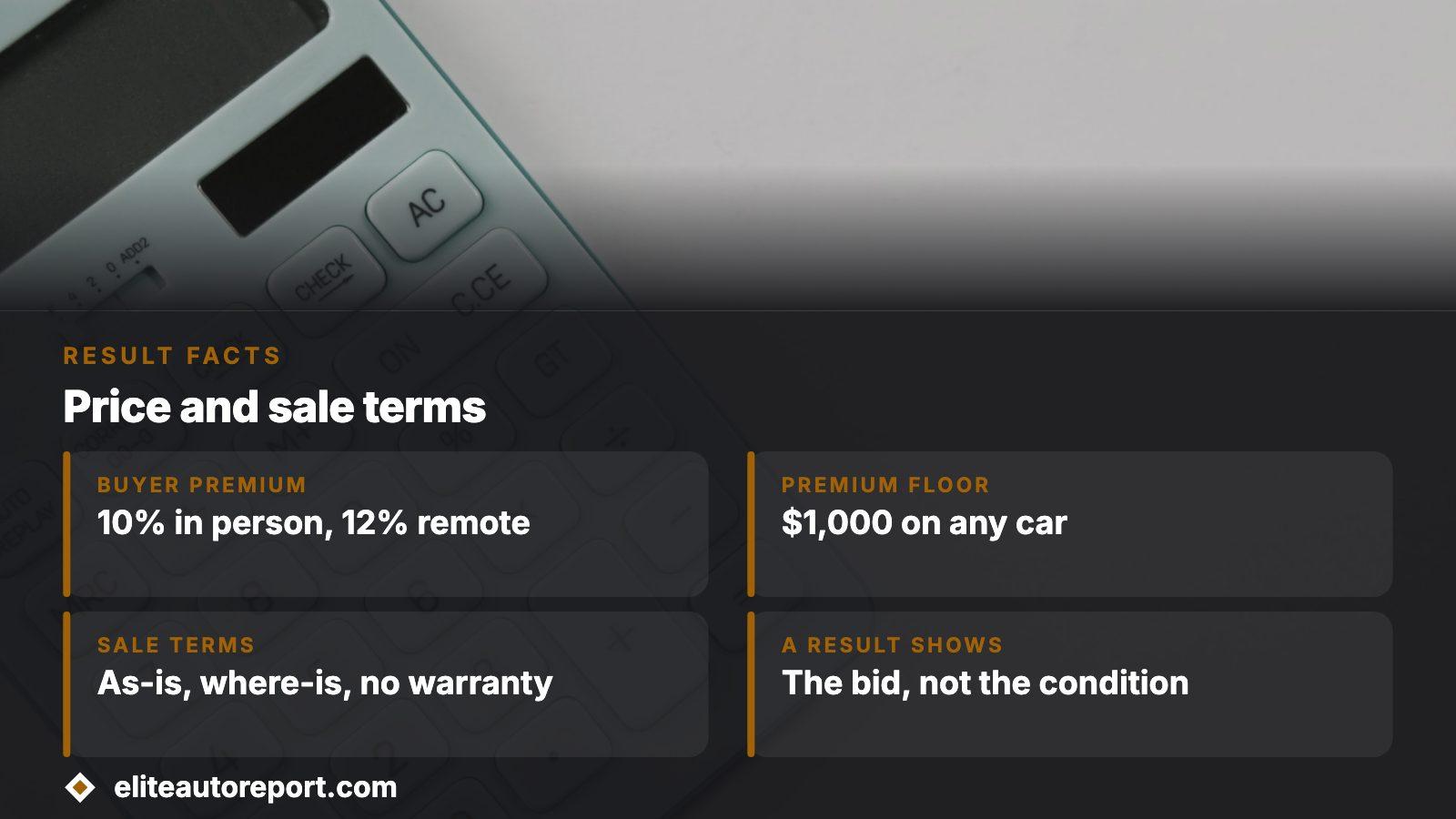
- 10% in person, 12% by phone or internet
- Premium floor
- $1,000 on any car
- Sale terms
- As-is, where-is, no warranty
Finding a sale on Mecum's own site
Start at the source. Mecum's results page describes itself as the place to view sold lots from live and past auctions, and it says you can narrow them by auction, make, model, year and more. Beside it, the schedule page shows the next events and a short row of recent ones, each with its own results link.
Mecum holds a dozen-plus sales annually in different cities, so the first decision is which sale your car crossed the block at. If you know the city and year, go straight to that auction's page and filter to sold lots. If you only know the make and model, use the main results search and sort by year.
- Open the results page and choose the auction by city and year.
- Filter to sold lots, then to the make or model you want.
- Open the lot and note the lot number, the date and any description of the car.
- Write down the VIN if the lot page or the seller shows it, so you can check it elsewhere.

Hammer price versus what the buyer paid
A Mecum buyer pays the hammer price plus a buyer premium. Mecum's FAQ sets the premium for collector cars and motorcycles at 10% for someone bidding in person and 12% for phone or internet bidders, with a floor of $1,000 on a vehicle and $500 on a motorcycle. Road Art, the signs and memorabilia side of the business, carries a higher rate.
| How the buyer bid | Premium on a car | Floor |
|---|---|---|
| In person | 10% | $1,000 per vehicle |
| By telephone | 12% | $1,000 per vehicle |
| By internet | 12% | $1,000 per vehicle |
So a six-figure hammer price turns into a total with five more figures on top, before tax, title and transport. When you compare a Mecum result with a price from another house or a private sale, check whether the figure you are looking at is the bid or the total.
What "sold" means, and what a no-sale hides
Per Mecum's FAQ, a reserve is the seller's floor, and reserves stay private. Lots marked No Reserve sell to the highest bidder whatever that bid is. So a modest result on a no-reserve lot may only show that few people were bidding that day, while a high one may reflect a bidding war between two people who both wanted that exact car.
A car that fails to sell on the block is not always finished. A team Mecum calls The Bid Goes On keeps pitching it to registered bidders for 21 days at minimum after the sale ends. That means a lot marked unsold may change hands later at a figure the results page never shows. If you are tracking one specific car, treat an unsold line as an open question, not a final one.
Reading a gap
If a car you are researching shows no result at all, it may have gone unsold, sold after the sale, or sold at a different auction. Check the neighboring sales before you decide it was never offered.
As-is sales: what a result cannot tell you
Mecum says inspection is not its job. It arranges the sale for consignors, and each vehicle goes as-is with no warranty attached. The company urges bidders to inspect in person before bidding, and it allows remote bidders to ask a Mecum representative on site to look at a car for them or to hire their own inspector.
That changes how you read a past result. A big number does not certify the car, and neither does a famous name on the consignment list. The lot description is the seller's account, and the price is a crowd's reaction to it. Neither records repairs, hidden damage or a title problem.
- A result shows the bid, not the condition.
- No warranty means problems found later are the new owner's to solve.
- Photos on a lot page show the car at the sale, not its past.
- A repaint or a swapped engine will not appear in a price.
How a VIN check fits in
A results archive follows lots. A VIN follows the car. For a car built from 1981 on, the 17-character VIN lets you pull records that exist apart from any one auction: brands on the title, mileage readings, salvage and auction entries with their photos, and open recalls. Run it on the car you are considering, not only on a car like it that sold well.
The federal record trail is thinner than people expect. Federal odometer rules make an auction company hold onto a short file for five years: previous owner, buyer, VIN and the mileage when the car arrived. The price is not part of that file. NMVTIS, the federal title database, also says it does not hold repair history, and it suggests an independent inspection alongside any report.
With a luxury, exotic or classic car, EliteAutoReport's preview lets you see what is on file for that number before paying. Our focus is auction history and photos, so look there first.
Older cars and chassis numbers
Mecum's catalog leans toward classic and collector vehicles, and many of them predate the modern VIN format. NHTSA's decoder covers cars from the 1981 model year onward and skips anything built to the earlier standard. A muscle car from the sixties usually carries a shorter serial that a standard decoder cannot read.
For those cars, a VIN check is less useful than a careful read of the lot description, the title and any documentation the seller supplies. For anything from 1981 onward, such as a late-model supercar or a modern collectible, the full VIN works and the check is worth running. When the stamped number and the paperwork disagree, ask why before bidding.
Before you bid on a Mecum lot
Anyone can buy at Mecum once registered, and none of its auctions requires a dealer license. Anyone planning to spend above $50,000 has to prove funds before approval, with choices that include a bank letter, an ACH profile, a $5,000 deposit or approved financing. Mecum accepts cash, check, certified funds or wire for vehicles, and cards only for Road Art.
Registration stays open through each auction, but Mecum recommends finishing it ahead of time. Pre-bidding is available on most lots, and you can set a maximum proxy bid so the system bids for you up to your limit.
- Read the lot description and look at every photo.
- Get the VIN, then run the preview check on it.
- Inspect the car yourself or hire someone who will.
- Work out the total with the premium for your bidding method.
- Set your ceiling before the lot crosses the block.
Running the check and what it costs
Enter the number and you see the preview at no charge. When the car's history looks worth reading, pay for one report, or for 3, 5 or 10 together if several lots interest you. Each purchase is a single payment with no subscription. Our pricing page lists the current rates.
Read the result against what the auction page told you. If a lot description says nothing of damage and the report shows a salvage entry or an odd odometer jump, that mismatch is your signal. Ask the consignor to explain it in writing before the sale, or move on to another lot.
Where this information comes from
- Mecum Auctions: auction results — how sold lots are searched and what the page offers
- Mecum Auctions: frequently asked questions — premium rates, as-is terms, reserves, bidder verification and payment
- Mecum Auctions: auction schedule — events per year and the recent-results row
- NHTSA vPIC: VIN decoder — which model years the decoder covers
- 49 CFR part 580: odometer disclosure — what records auction companies must keep
- NMVTIS: frequently asked questions — what the national title database does not hold
Sources and photos: Facts checked against the sources above in November 2026. Photos by Linus Belanger, Alejandro Escamilla and Sasun Bughdaryan on Unsplash; diagrams by EliteAutoReport.
Keep reading
- Car Auction Results Database: Where Classic Car Results LiveHow other collector houses publish results and price their premiums.
- Barrett-Jackson Auction Results: What a Sale Doesn't Tell YouThe same question for Barrett-Jackson sales.
- Auction History by VIN: Photos for Luxury, Exotic and Classic CarsHow an auction history check by VIN works and what its photos can show.
- PricingWhat a single report or a larger pack costs, paid once.
Frequently asked questions
Where can I see Mecum auction results?
On Mecum's own results page, which lists sold lots from live and past auctions and lets you search by auction, make, model and year. Each recent auction also has its own results link on the schedule page, so you can go straight to a city and year.
Does the Mecum result price include the buyer premium?
Treat it as the bid unless the page says otherwise. Mecum's FAQ describes the premium as an amount added to the hammer price and paid by the buyer. Check the lot page and the FAQ before comparing it with a total from another source.
Can anyone buy a car at Mecum?
Yes, after registering. Mecum says bidding is open to the public and no dealer license is needed. Above $50,000 in planned spending, Mecum also wants proof of funds, such as a bank letter or a deposit, before it approves registration.
Are Mecum cars inspected or guaranteed?
No. Mecum says it does not inspect vehicles and gives no warranties; everything sells as-is. Inspect the car yourself before bidding, or hire a professional, and run the VIN to check the title and damage record.
Can I look up a Mecum car by VIN?
Mecum's results are searched by auction, make, model and year, not by VIN. To follow one particular car, ask the seller or read the lot page for the VIN and run a check on it. Cars built before 1981 may carry shorter serial numbers that standard decoders cannot read.
Now check the car itself
The guide explains what to look for. The report shows what this VIN has on record.