THE SHORT ANSWER
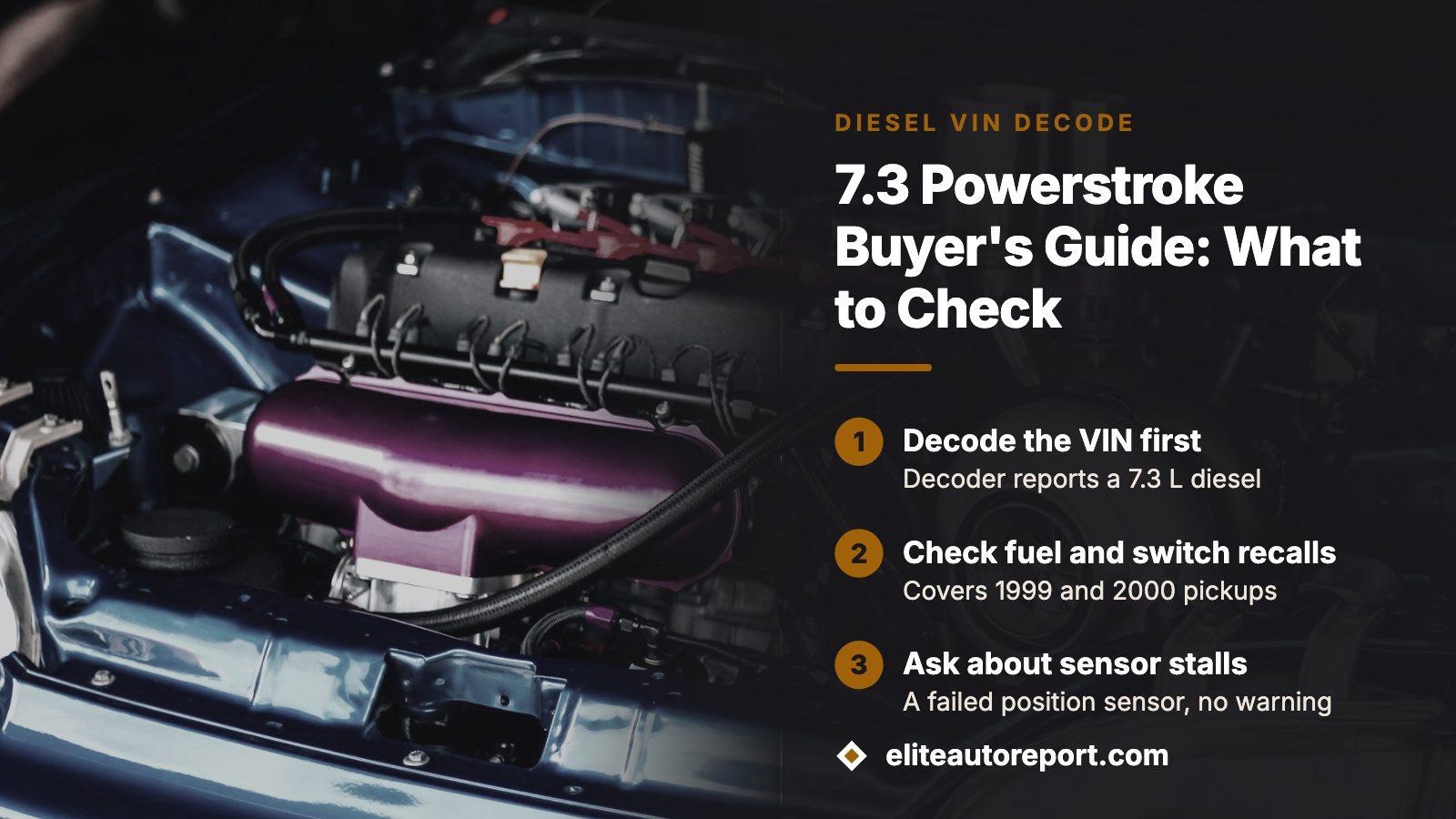
Decode the VIN first: NHTSA's decoder reports a 7.3 L diesel when the truck is one. Then check the fuel-system recalls for 1999 and 2000 pickups, the speed control switch campaign, and owner reports of sudden stalls from a failed position sensor and of fuel leaking in the engine valley. Finish with auction history and photos before you pay.
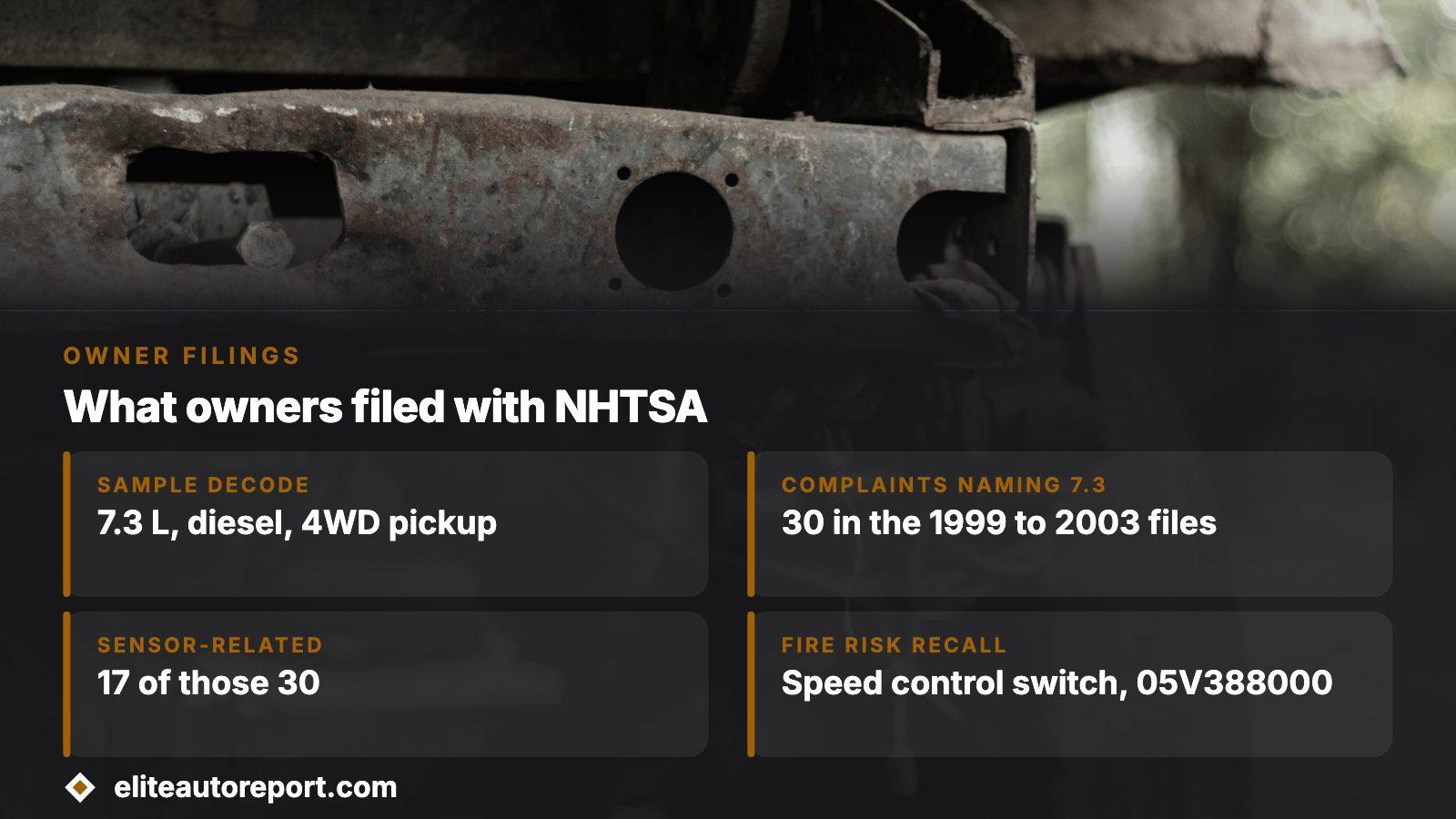
- Sample decode
- 7.3 L, diesel, 4WD pickup
- Complaints naming the 7.3
- 30 in the 1999 to 2003 files
- Of those, sensor-related
- 17
- Fire risk recall
- Speed control switch, 05V388000
Let the VIN confirm what is under the hood
Nobody should trust a badge or a listing headline on a truck this age. Hoods get swapped, trim gets mixed, and sellers copy descriptions from the last ad. NHTSA's decoder is a better judge. I ran two sample numbers for 1999 Super Duty pickups through it. An F-350 came back as a four-wheel-drive diesel pickup with a 7.3 L engine in weight class 2H, and an F-250 returned the same engine in class 2G.
In both samples the eighth character was the letter F. Treat that as an observation, not a rule, and decode the number on the actual truck. Copy it from the dash plate and the title; if the two differ, that is its own problem. Watch 2003 trucks especially: that year's recall records include a campaign for the next diesel, the 6.0 L, so a 2003 listing needs the decode more than any other.
Recalls that reach the diesel pickups
NHTSA's recall file returns a long list for these models, but much of it is gasoline-engine or lighting paperwork. These are the entries I read that name diesels or apply to every engine.
| Campaign | Trucks and problem | Remedy |
|---|---|---|
| 99V093001 | 1999 pickups built from January 5, 1998 to March 21, 1999: bed bolts could shift in a crash and spill fuel | Retaining cables between bed and chassis |
| 99V219000 | Gas and diesel pickups with 8 foot beds: front tank strap could cut the tank | Dealer repositions the strap isolator |
| 05V388000 | Pickups with speed control: deactivation switch can overheat, smoke or burn | Switch disconnected, later a proper fix |
| 01V258000 | 2000 and 2001 models: wiper motor switch can overheat and ignite its cover | Replace the gear case cover |
| 02V068000 | Manual transmission pickups: parking brake cable button can fail | New front cable and controller |
One trap: campaign 06V286000, the fused harness for the same speed control switch, is worded for gasoline and natural gas engines. It shows up under these models but does not describe a diesel. Request dealer invoices for any entry that applies, or run the VIN through NHTSA's own lookup to see what is still open.
Why the switch and fuel campaigns matter more than the rest
Three entries in that table involve fuel or fire. Ford told owners of affected pickups, in a letter dated September 12, 2005, to bring them in so the cruise control could be disconnected, and the company spoke of a significant risk of fire. Reconnection parts were promised from February 2006. A truck that still has a dead cruise control may be sitting in that half-finished state.
The two 1999 fuel campaigns are crash-test findings, not owner-reported failures. They matter because a work truck that has been hit, rolled or hauled hard is the one most likely to have its bed mounts or tank strap disturbed. Look at the straps and the bed hardware for signs of fresh welding or mismatched bolts.
What owners filed with NHTSA
Owner complaint counts for these models include every engine, so they overstate the diesel's share. Even so, they show how early model years carried the most paperwork.
| Model year | F-250 complaints | F-350 complaints |
|---|---|---|
| 2003 | 116 | 90 |
| 2002 | 156 | 116 |
| 2001 | 231 | 160 |
| 2000 | 360 | 320 |
| 1999 | 594 | 450 |
Filtering the F-250, F-350 and Excursion files for 1999 through 2003 to complaints that mention the 7.3 engine or Power Stroke by name leaves 30 whose own wording says so. Seventeen of those talk about a camshaft, crankshaft or similar sensor. The record flags no crash and no fire on any of the 30. Owners who write to a federal agency are a small, self-selected group, so read this as things to test, not a failure rate.
The stall that gives no warning
From an NHTSA owner complaint
An owner of a 2002 F-250 7.3 Power Stroke reported that the engine shut down completely while he drove at highway speed on a narrow road with no shoulder. Power steering went with it, and he described real difficulty steering out of the corner. The cause was the camshaft position sensor. The dealer replaced it and a synchronizer assembly under warranty, and the owner paid a $100 deductible plus a $96.87 tow.
The takeaway is practical. A truck that dies and restarts, or cuts out at a traffic light, deserves a scan and a sensor check before you sign. The complaint files hold many similar stories from Excursion owners who describe the engine quitting and refusing to restart, so ask the seller directly whether it has ever stranded them.
Fuel in the valley and a clogged tank
From an NHTSA owner complaint
The owner of a 1999 F-250, who works as an aviation repair technician, found that a high pressure line on top of the engine had worn through where routing put it close to a neighboring line. Fuel reached the intake valley of a turbocharged engine. The dealer sealed the hole by brazing, and the owner objected that the line should be replaced and the routing corrected.
Look for damp, dirty residue and a fuel smell around the top of the engine, and ask whether any line has been repaired rather than replaced. A different owner of a 2000 F-350 wrote that a dealer diagnosed a delaminating fuel tank clogging the system, with a repair quote of about $3600. One report is not a pattern, but a truck that hesitates under load and has a tired tank is worth a closer look.
The auction trail a diesel pickup can leave
Diesel trucks from this era change hands through many lanes: fleet disposals, dealer trade-ins, insurance totals and enthusiast sales. Any of those can leave a sale record with photographs, and the photos are often more honest than the listing. Look for bent bed rails, new paint on one panel, mud lines in the cab, a cracked frame near the bed mounts and a cluster of dash warning lights.
A report for the VIN lines up the sale records, the odometer readings from each one and any title brand, so a mileage figure that rolls backward between two sales stands out.
A short drive and inspection list
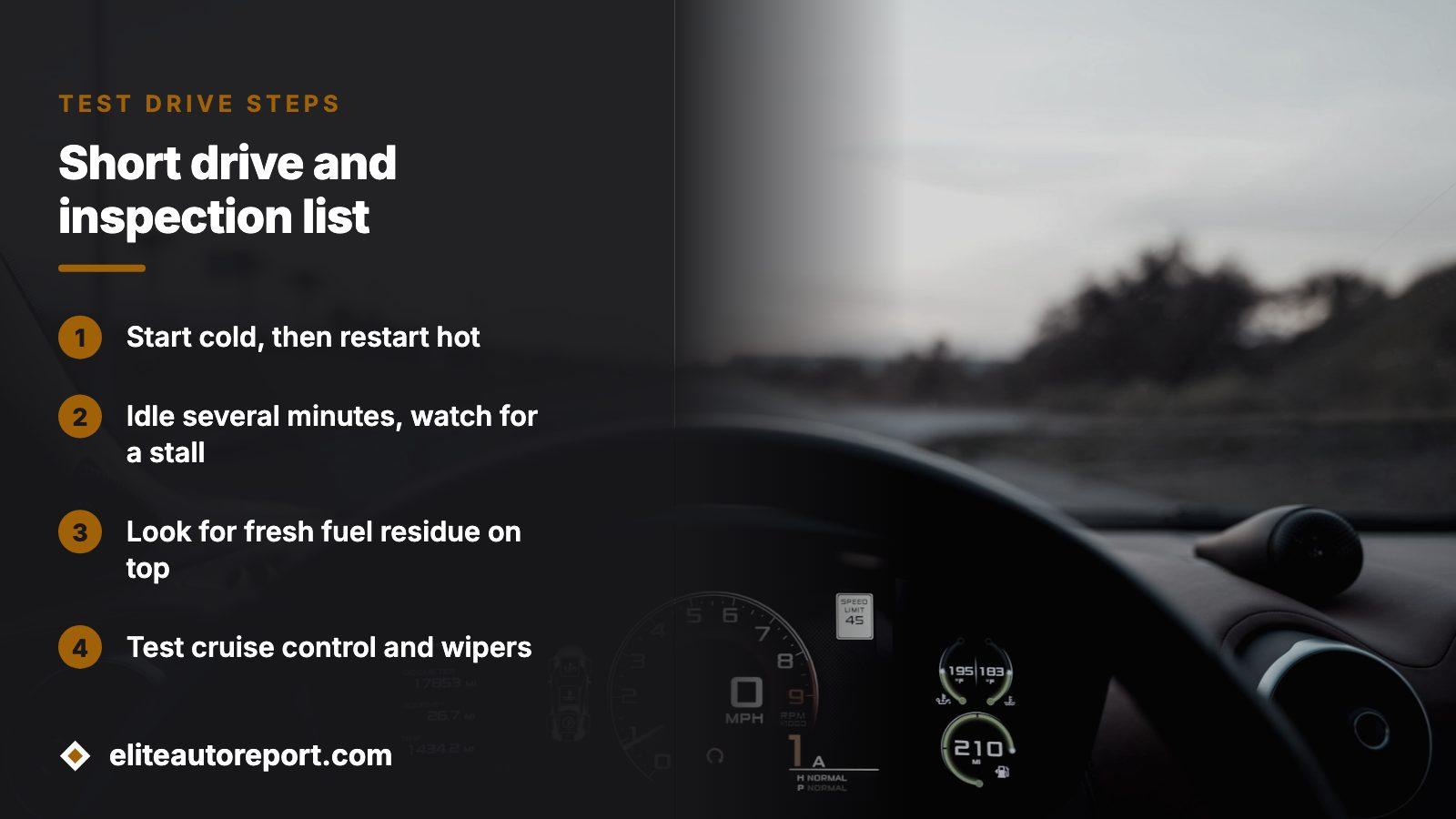
- Start it cold, then restart it hot, and note any delay or rough idle.
- Idle at a stop for several minutes and watch for a stall.
- Pop the hood and look around the top of the engine for fresh fuel residue.
- Test the cruise control and the wipers, since both sit inside recall campaigns.
- Fill a tank, drive, and check for hesitation under throttle.
- Ask to see receipts for any fuel line, sensor or tank work.
Bring a scan tool if you own one. A seller who refuses a cold start or a long idle is telling you something, and you can walk away without arguing.
Run the VIN before you hand over money
Once the decode matches and the recalls check out, search the number for title brands, flood or salvage history, and sale records. The national title information system, run by the Justice Department, exists to keep unsafe and stolen vehicles from being resold, and its flood notices cover whole storm seasons. A VIN preview from this site costs nothing and hints at what exists for the truck. Buying the whole report is a single transaction, and the pricing page shows the options.
If the history disagrees with the seller's story, ask for a plain explanation before you negotiate.
Where this information comes from
- NHTSA vPIC VIN decoder — used to decode two sample 1999 Super Duty numbers
- NHTSA recalls API, Ford F-250 1999 — campaign numbers, dates and remedies
- NHTSA complaints API, Ford F-250 2002 — complaint counts and owner wording
- NHTSA owner complaint 10166676 — owner experience, paraphrased
- NHTSA owner complaint 734652 — owner experience, paraphrased
- NMVTIS consumer information — what the national title system is for
Sources and photos: Facts checked against the sources above in November 2026. Photos by Willian Cittadin, Dennis Eusebio and Zoshua Colah on Unsplash; diagrams by EliteAutoReport.
Keep reading
- Check a Truck VIN Number for Auction History, Photos and Salvage Recordshow work trucks move through auction lanes and what the record shows
- 1993 Ford F-350: What to Check Before You Buy Onean older F-350 read through the same federal records
- Where Is the VIN on a Classic Car? Dash, Door, Firewall and Framefinding the number on an older truck before you decode it
- Auction Car Mileage Check by VIN: Is the Odometer Telling the Truth?how to compare odometer readings across sales
Frequently asked questions
How do I know a Ford truck has the 7.3 Powerstroke?
Decode the VIN with NHTSA's tool. The two sample numbers I ran returned a 7.3 L diesel, and the answer comes from the number rather than a badge or an ad. Match it to the dash plate and title, and be careful with 2003 trucks, which can carry a different diesel.
Are there recalls on these trucks I should ask about?
Yes, several apply to diesels, including fuel-system campaigns on 1999 and 2000 pickups and a speed control switch campaign with a fire warning. Get dealer proof for each one that fits the truck, or enter the number at NHTSA's recall lookup.
What do owners complain about most?
In the NHTSA files that name the 7.3, the most common thread is a position sensor failing and shutting the engine off while driving. Fuel leaks near the top of the engine and tank trouble also appear. These are owner reports, not failure rates.
Can a VIN check show if a diesel truck was sold at auction?
It can show sale records, with photographs where a seller supplied them, along with odometer readings and any title brand. Not every sale is recorded, so a clean result is useful but not a guarantee. Compare any photos with the truck itself.
Is the preview of a report free?
Yes, the preview of a report carries no charge. A full report is paid for once and never renews; the pricing page lists what is offered.
Now check the car itself
The guide explains what to look for. The report shows what this VIN has on record.