THE SHORT ANSWER
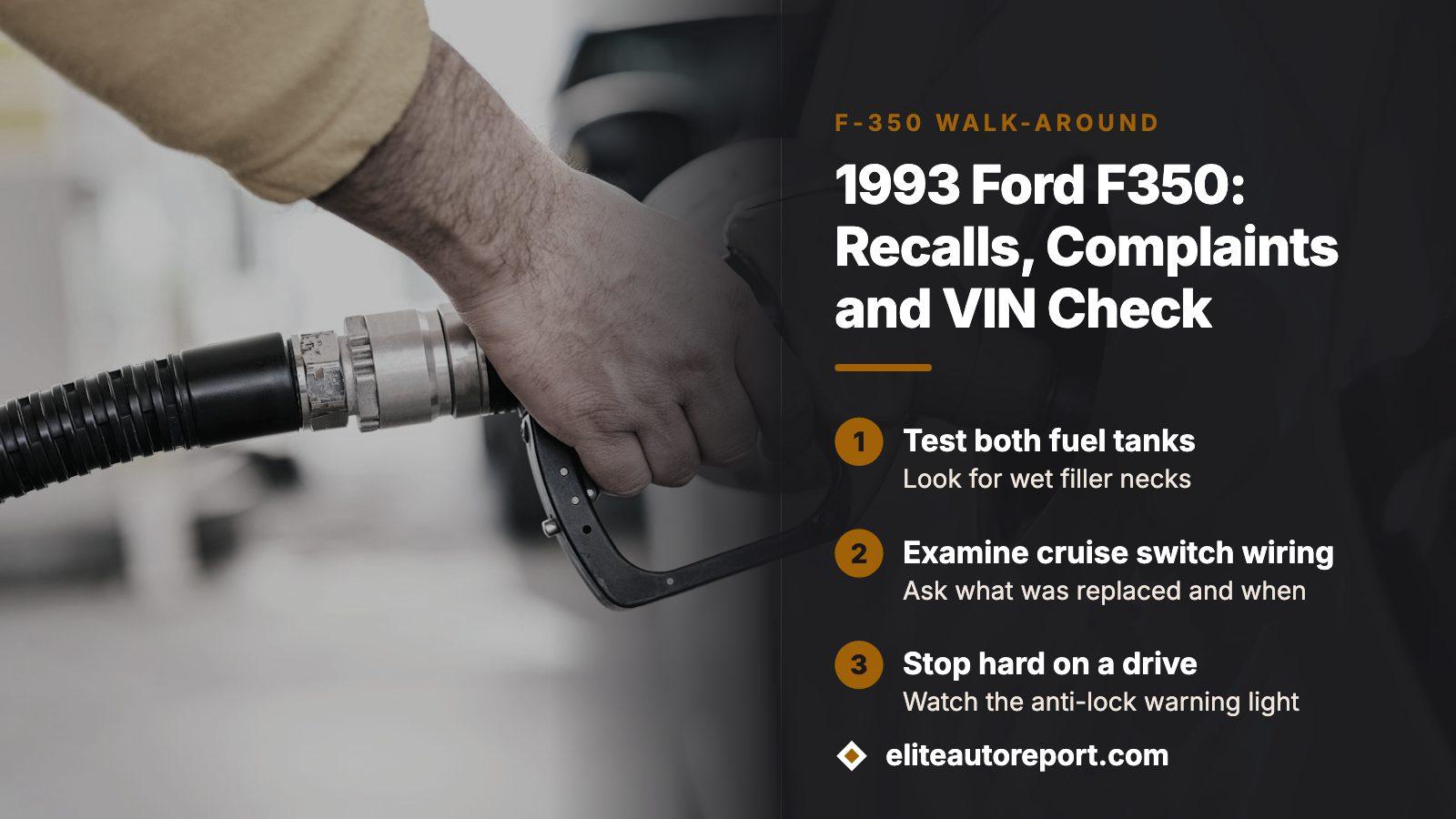
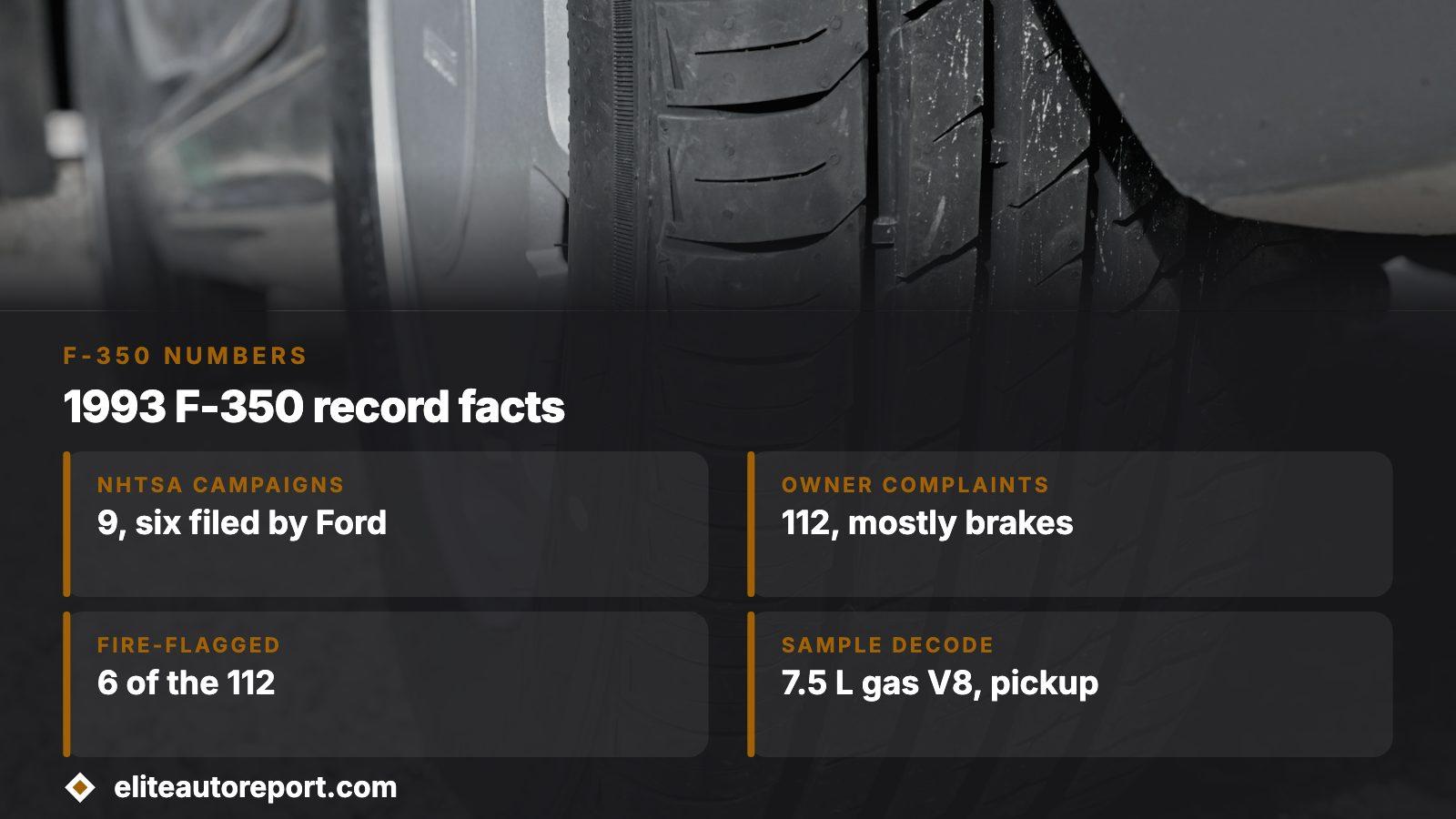
Federal records show 9 campaigns for the 1993 F-350, six filed by Ford, centered on dual fuel tanks, cruise control wiring and a parking brake. Owners filed 112 complaints, led by brakes. Check the fuel tank behavior, the cruise switch and the anti-lock brakes on a drive, then run the VIN for title brands and auction photos.
- NHTSA campaigns on file
- 9, of which six are Ford's own
- Owner complaints
- 112, mostly brakes
- Complaints flagging fire
- 6 of the 112
- Sample VIN decode
- 7.5 L gas V8, class 2H, pickup
What the VIN says this truck is
NHTSA's decoder lists the F-350 among Ford's 1993 models, next to the F-150 and F-250. A sample 17-character number for this year, pushed through that tool, came back as a gasoline pickup with a 7.5 L eight-cylinder, rear-wheel drive, in weight class 2H, which means a gross rating between 9,001 and 10,000 pounds.
That is a sample, not a promise about every truck. Still, decode the number on the one you are considering and compare it with the listing. If the ad says one engine and the decode says another, someone has swapped a part, miswritten the number or described a different truck. Fuel Economy Guide data has no F-350 entry for 1993, so there are no official mileage figures to quote for it.
Nine recall entries, sorted by who filed them
The NHTSA recalls file returns 9 records for this model year. Reading them one by one, six are campaigns Ford filed for the truck. One is an aftermarket lamp recall that matters only if someone fitted those lamps, and two are not formal recalls at all but safety improvement campaigns.
| Campaign | What it covers | Remedy |
|---|---|---|
| 93V125000 | Fuel pump check valve moves fuel between dual tanks and can spill it | New pressure regulator plus a second check valve |
| 94V018000 | Front bumper U-clip nuts can fracture | Replace four nuts and the bolts |
| 94V169001 | Parking brake pawl can skip teeth on the ratchet | A wedge locks the pawl in place |
| 00V424000 | Worn fuel pressure regulator, same cross-tank overflow | Stainless steel regulator |
| 07V336000 | Cruise deactivation switch can overheat and burn | Fused wiring harness |
| 08V051000 | Fuse in the wrong place after an earlier repair | New harness or mating part |
Ask for paperwork showing each one was done. A dealer can confirm repairs from the VIN, and a seller who shrugs at the question has told you something.
Dual tanks and the overflow problem
Three of the entries trace back to one design: a pickup with two gasoline tanks. A check valve inside the pump assembly is supposed to stop fuel from flowing back to the idle tank. When it fails, the second tank overfills and gasoline can run out past the filler cap, with the obvious fire risk.
Ford's improvement campaign reaches F-Series trucks built from 1990 through 1993 that pair twin tanks with one of four gasoline engines, 4.9 to 7.5 L. It lengthened warranty cover for the fault to 12 years or 150,000 miles, and later owners inherited that cover without a fee. That window has long since closed for a truck this old, so a failed valve today is the buyer's bill unless Ford says otherwise.
On a test, fill one tank, switch tanks, drive a while and look for a wet streak below the filler neck. It takes five minutes and costs nothing.
The cruise switch and the fires it started
Six of the 112 owner complaints for this model year report a fire, and the cruise control switch is behind several of them. Ford's 2007 campaign describes the switch leaking internally, then overheating, smoking or burning, with an underhood fire as the stated consequence. The fix is a fused harness.
From an NHTSA owner complaint
In 2007 the owners of a 1993 F350 wrote that smoke poured from under the hood while the truck sat parked and switched off beside their attached garage. The husband lifted the hood and put the fire out. Cruise control had stopped working earlier, and he had fitted a replacement switch himself. They said their VIN lookup showed no recall, and that Ford customer service offered no help.
The lesson is practical. A dead cruise control on a truck this age is a clue, not a nuisance. Ask what was replaced and with what part, and look at the wiring near the switch for melted insulation.
What 112 owners complained about
Service brakes appear in 28 of the records and hydraulic brake parts in 27, ahead of engine and cooling at 23, power train at 15 and fuel system at 14. Six records flag a crash, two report injuries, and none report a death. Filing was heaviest in 1995, with 29 complaints, and then fell to single digits in some years.
- Many brake complaints from the mid-1990s name the anti-lock system: a warning light, a pedal that sinks, or a long stop.
- Some owners describe calipers that stick, pulling the truck to one side.
- Steering failures are rarer, 8 records in all, but one of them ended in a collision.
From an NHTSA owner complaint
An owner of an F350 Super Duty reported in 2001 that the truck swerved right at about 10 mph and struck a telephone pole, with roughly $6,000.00 in damage. The dealer found that the lower steering shaft had broken.
A single account does not make a pattern, but it does tell you where to put a flashlight: the steering shaft joints, the calipers and the brake lines.
Auction photos and title history on an old truck
A truck from this era may have lived through several owners, a fleet, a farm and a dealer lot, and paper from those years is thin. That is where an auction record helps. If the truck once crossed an auction block, the listing photos show the corners, bed and cab as they stood on that day, and you can compare them with what is in front of you.
Start with any brand on the title, move to the damage entries, and save the photos for last. A swapped bed, a front end in a slightly different shade or a frame weld missing from the sale pictures each deserves a direct question to the seller. Federal title data exists mainly to stop fraud, keep unsafe trucks off the road and block resale of stolen ones.
A short walk-around before you pay
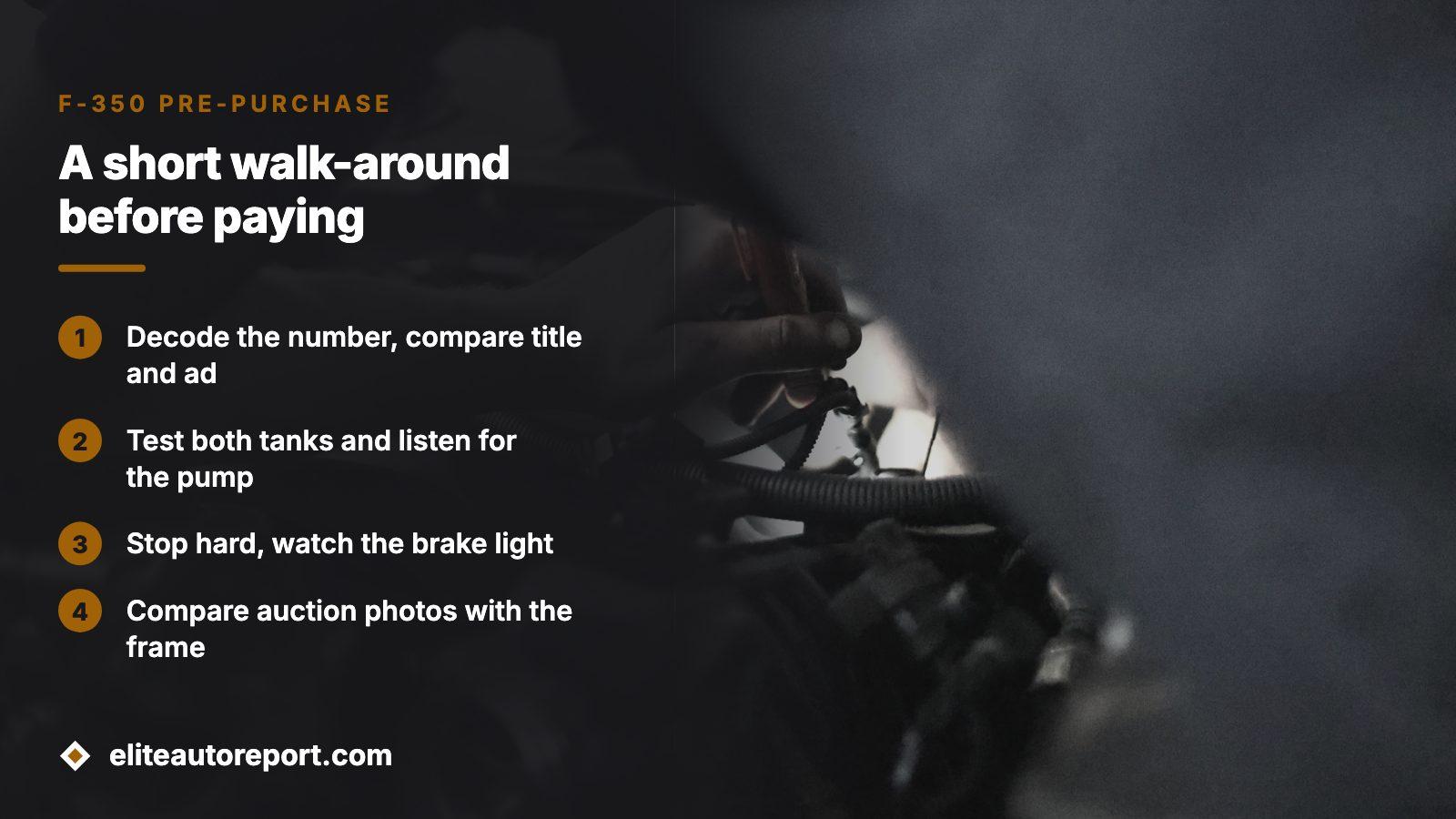
- Decode the stamped number, and see whether title and advertisement agree with it.
- Search NHTSA for open recalls using the number, and ask to see receipts for the fuel regulator and cruise switch.
- Test both tanks, check the filler necks for wet fuel and listen for the pump.
- Stop hard from a safe speed, watch the brake warning light and feel for pull or a sinking pedal.
- Look at the cruise switch wiring, then ask what was replaced and when.
- Compare any auction photos with the truck's panels, bed and frame.
If a step fails, that is a price conversation or a reason to leave, not a reason to talk yourself into it.
Where the VIN check fits
The box on this site accepts the number and returns a teaser costing nothing, enough to tell whether anything is on file before money changes hands. If you go on, you pay once for the report you want, never monthly, and the pricing page shows how single reports and packs are offered. For a truck like this one, the sections worth reading first are the title brands, the odometer readings, the auction history with its photos and the theft entries.
If a seller will not share the VIN, treat that as your answer.
Where this information comes from
- NHTSA recalls: 1993 Ford F-350 — the 9 campaigns, causes and remedies
- NHTSA complaints: 1993 Ford F-350 — counts by component, crashes and fires
- NHTSA owner complaint 10208834 — owner experience, paraphrased
- NHTSA owner complaint 894554 — owner experience, paraphrased
- NHTSA vPIC VIN decoder — what a decode reports for engine, weight class and body
- VehicleHistory.gov (NMVTIS) — purpose of the federal title database
Sources and photos: Facts checked against the sources above in November 2026. Photos by engin akyurt, Mustafa Sheikhmouss and Andres Siimon on Unsplash; diagrams by EliteAutoReport.
Keep reading
- Check a Truck VIN Number for Auction History, Photos and Salvage RecordsHow pickups appear in auction records.
- Classic Car Title Search by VIN: What Turns Up and What Doesn'tReading the title trail on an older vehicle.
- 1989 GMC Sierra: Recalls, Complaints and VIN HistoryAnother older full-size pickup with its own checklist.
- Car Auction Results Database: Where Classic Car Results LiveWhat auction records can and cannot tell you about older vehicles.
Frequently asked questions
Does a 1993 Ford F350 have open recalls?
The federal file holds 9 campaigns for this year, six of them filed by Ford, covering fuel tanks, a parking brake, bumper nuts, and cruise control wiring. Whether any is still open depends on the individual truck, so look it up by VIN and ask the seller for repair paperwork.
Why would a cruise control fault matter on this truck?
Ford's 2007 campaign says the deactivation switch can leak, overheat and burn, with an underhood fire as the result. A switch that quit working may be the first sign, so ask what was replaced and inspect the wiring around it.
Which part of the 1993 F-350 draws the most owner complaints?
Brakes. Of 112 records, 28 name service brakes and 27 name hydraulic parts, with the anti-lock system featuring in many of the mid-1990s filings. Test the pedal and the warning light on a drive.
Can a VIN check show whether this truck went through an auction?
It can show auction entries and, when they exist, photos from the sale. A lack of entries does not prove the truck never sold at auction, only that nothing appears under that number. Use it with an inspection, not instead of one.
Is the VIN preview free?
Only the preview costs nothing. It hints at what is on file for the number. Going further means paying once for the report, with no renewal later. Packs and single reports are laid out on the pricing page.
Now check the car itself
The guide explains what to look for. The report shows what this VIN has on record.