THE SHORT ANSWER
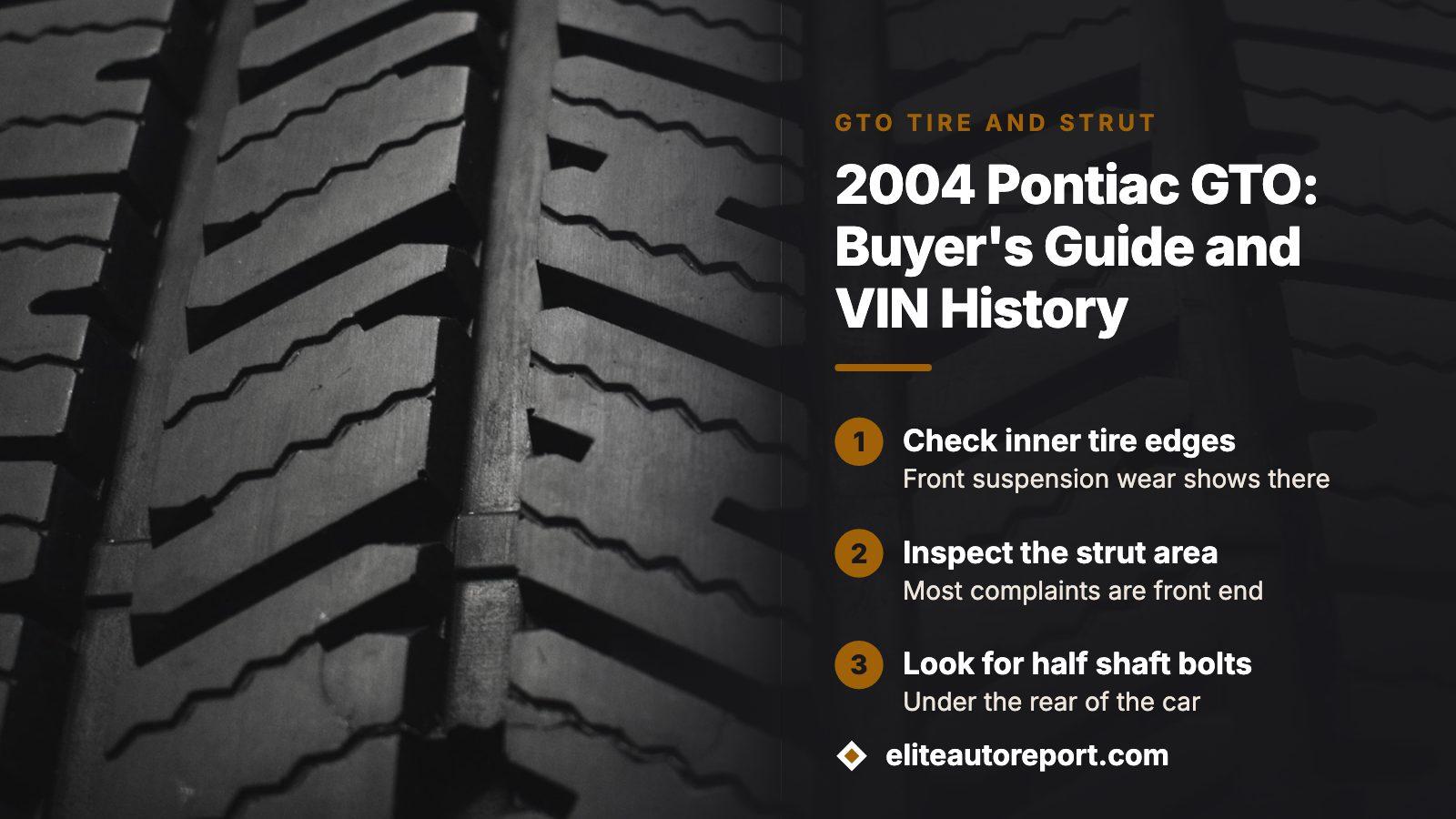
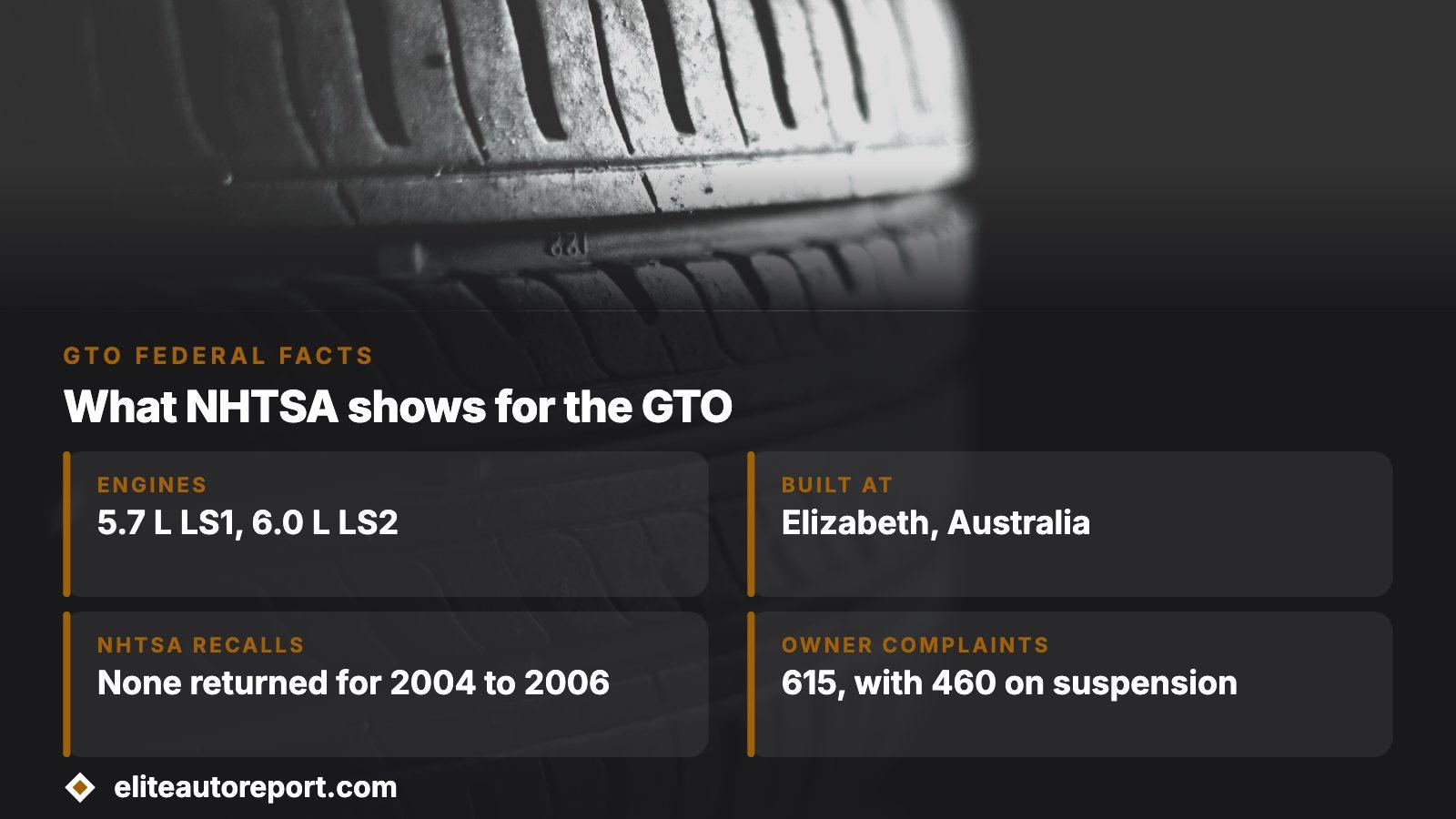
The 2004 GTO has a 5.7 L LS1 V8 and the 2005 and 2006 cars a 6.0 L LS2, all rear-wheel drive and built at Elizabeth, Australia. NHTSA's recall lookup returned no campaigns for 2004 to 2006, yet owners filed 615 complaints, mostly about front suspension and tire wear. Inspect the struts and tires, then run the VIN for salvage and auction records.
- Engines
- 5.7 L LS1 (2004), 6.0 L LS2 (2005-2006)
- Built at
- Elizabeth, Australia
- NHTSA recall campaigns
- 0 returned for 2004, 2005 and 2006
- Owner complaints
- 615 across three years, 460 tagged suspension
An Australian coupe wearing a Pontiac badge
NHTSA's decoder reads GTO VINs as General Motors cars assembled in Elizabeth, Australia, and the numbers start with 6G2. The body class is a two-door coupe. That origin explains why the car feels different from the American muscle cars it was compared with, and it matters for a buyer because the decode gives you a fast sanity check on the listing.
The decode I ran on a 2004 pattern returned the LS1 engine at 5.7 L. A 2005 and a 2006 pattern both returned the LS2 at 6.0 L. If a seller calls a 2004 car an LS2, or a 2006 an LS1, either the listing is sloppy or the engine has been swapped, and both are worth a conversation before money moves.
Engines, gearboxes and what they burn
| Year | Engine and gearbox | City / highway mpg | Combined |
|---|---|---|---|
| 2004 | 5.7 L V8, 4-speed automatic | 15 / 20 | 17 |
| 2004 | 5.7 L V8, 6-speed manual | 16 / 26 | 19 |
| 2005-2006 | 6.0 L V8, 4-speed automatic | 14 / 19 | 16 |
| 2005-2006 | 6.0 L V8, 6-speed manual | 15 / 23 | 18 |
These are EPA ratings for new cars, and the agency lists all of them as premium fuel and rear-wheel drive. A worn example will do worse. The practical point is that a manual car is the thriftier one on the highway, and that every version wants the pricier pump.
The recall lookup comes back empty
I queried NHTSA's recall service for the Pontiac GTO in each of its three model years and it returned a count of zero every time. That does not mean the cars are free of faults, as the next section shows. It means no manufacturer campaign is on file under that make, model and year, so no free dealer repair is waiting.
One owner who wrote to NHTSA in early 2011 asked why the agency had never recalled the 2004 to 2006 cars given more than 200 front suspension and tire wear reports. Whatever the answer, the lookup by VIN is still the right first step, because it also catches anything added after this was written.
615 owner complaints, and one clear theme
| Model year | Complaints | Suspension | Tires | Crash / fire flagged |
|---|---|---|---|---|
| 2004 | 245 | 169 | 79 | 7 / 1 |
| 2005 | 154 | 100 | 46 | 4 / 2 |
| 2006 | 216 | 191 | 23 | 3 / 0 |
Suspension tops every year, and the tire column shows the same story from the other end. Owners describe front tires wearing on the inner edge until the cords show, often after an alignment that was supposed to cure it. Tags overlap, since one complaint can name several components, so the columns will not add up to the totals.
What a tire failure looks like to the owner
From an NHTSA owner complaint
A 2004 GTO owner wrote to NHTSA in February 2008 after a front left tire came apart along its inner edge at highway speed, a repeat of an earlier blowout. Two sets of rubber had been lost by then. The owner blamed the tires scraping the front struts and feared for the coupe's resale value.
What to take from it: pull the front wheels or at least shine a light behind them, and look at the inner shoulder of every tire. A listing photo of glossy new tires says nothing about why the old ones came off.
Drivetrain and the odd ones out
From an NHTSA owner complaint
One early-build 2004 GTO owner wrote in April 2006 that the car, at 29,222 miles, rolled to a stop in a busy intersection because six bolts on the right rear half shaft had backed out. Warranty coverage was refused by the dealer, who blamed the aftermarket rear springs.
The takeaway is twofold. Get under the back end and see whether the shaft bolts look disturbed, and be aware that aftermarket suspension parts can turn a repair into a dispute. Other complaint areas are smaller: power train with 17 records in 2004, electrical with 14 in both 2004 and 2005, and one 2004 owner who reported a fire and suspected an engine cover rubbing a fuel line.
Where the VIN history earns its keep on a GTO
These cars are driven hard, so a fair number have had a rough day. A VIN check can show whether one was ever sold through a salvage or insurance auction, and the lot photos attached to that sale often show the damage far more clearly than a seller's description. That is the part that suits a performance car: modified, repaired and resold coupes are common, and a clean-looking paint job proves nothing.
- An auction sale followed by a new owner and fresh paint, which deserves an explanation.
- A title brand such as salvage or rebuilt that the listing leaves out.
- Odometer readings that stall or drop between records.
- Photos showing front-end or suspension damage on a car with a story of gentle use.
A short checklist for the viewing
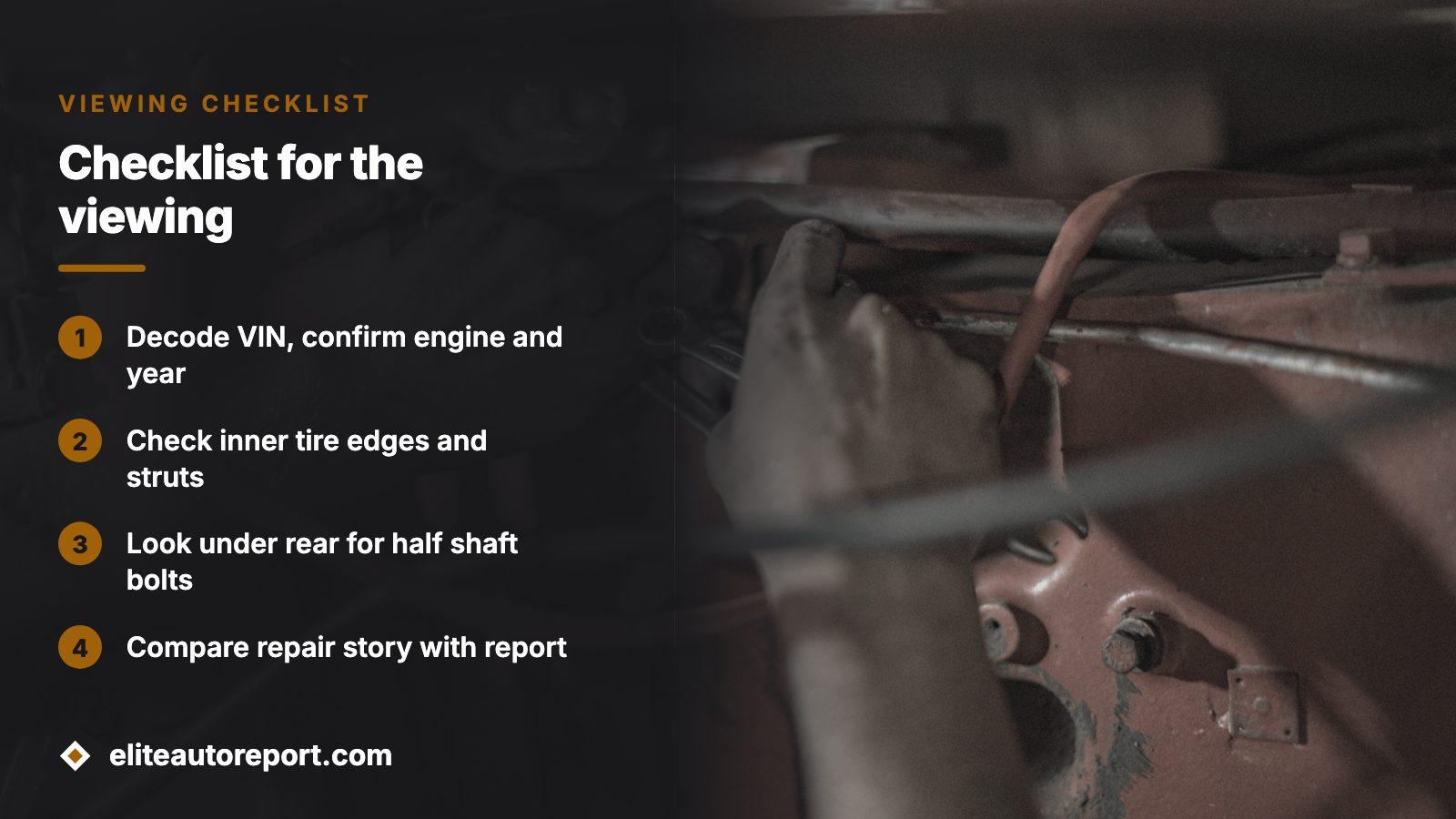
- Decode the VIN and confirm the engine and year match the advert.
- Feed that VIN to the NHTSA recall search too.
- Check inner tire edges and the strut area behind each front wheel.
- Look under the back for the half shaft bolts and any aftermarket springs.
- Test every gear and listen for noises over bumps.
- Compare any repair story with the history report's records before you negotiate.
The first two take a couple of minutes each and cost nothing. The history report is the step that covers what the owner might not mention.
Running the check on a GTO
Begin with the VIN: seventeen characters, visible from outside the car at the driver's side of the dash, and again on the door pillar sticker. Paste it in and the preview costs nothing. Should the car look promising, one payment buys the whole report, nothing renews, and the pricing page shows the amounts.
NMVTIS is a Justice Department program aimed at title fraud and at stopping stolen cars from returning to the market, and a good report draws on its records. Read the result next to your inspection notes, not instead of them.
Where this information comes from
- NHTSA recalls: Pontiac GTO — the empty campaign list for the three model years
- NHTSA complaints: 2004 Pontiac GTO — complaint counts and component tags
- NHTSA owner complaint 10219162 — owner experience, paraphrased
- NHTSA owner complaint 10155773 — owner experience, paraphrased
- NHTSA vPIC VIN decoder — plant, engine and body class from a decode
- Fuel Economy Guide: Pontiac GTO — EPA mileage and fuel grade
- VehicleHistory.gov (NMVTIS) — what the federal title system is for
Sources and photos: Facts checked against the sources above in November 2026. Photos by fr0ggy5, Nina Mercado and Benjamin Brunner on Unsplash; diagrams by EliteAutoReport.
Keep reading
- 1997 Pontiac Firebird: What to Check Before You Buy OneAnother Pontiac performance coupe, checked the same way.
- 1994-1996 Impala SS: What the Record Says Before You BuyA GM V8 sedan with its own record to read.
- Car Auction Photos by VIN: Find Salvage Sale Pictures Before You BuySee how lot photos are tied to a VIN.
- Copart Damage Types: What a Lot's Damage Label Really Tells YouDecode the damage labels on salvage lots.
Frequently asked questions
Does the 2004 Pontiac GTO have any recalls?
NHTSA's recall lookup returned no campaigns for the GTO in 2004, 2005 or 2006 when I checked. Still run the actual VIN on NHTSA's site before buying, since the lookup reflects what is on file today and a specific car may have other open items.
What engine is in a 2004 GTO?
NHTSA's decoder returns a 5.7 L LS1 V8 for the 2004 pattern I tried. The 2005 and 2006 cars decode as 6.0 L LS2 engines. Because swaps happen on older performance cars, compare the decode with the engine the advert claims.
What do GTO owners complain about most?
Front suspension and tire wear lead by a wide margin. Of 615 complaints across the three years, 460 carry a suspension tag, and many describe tires wearing on the inside edge. Inspect the front struts and every tire shoulder before you commit to a car.
Where was the Pontiac GTO built?
NHTSA decodes list the plant city as Elizabeth in Australia, and the VINs begin with 6G2. That is worth knowing when you check that a VIN looks right, since a number that does not decode that way deserves a closer look.
Can a VIN check show if a GTO was sold at auction?
It can show salvage and auction entries, often with photos, when they exist in the records the report draws on. A clean result is not a guarantee, so pair it with a hands-on inspection, particularly of the front suspension.
Now check the car itself
The guide explains what to look for. The report shows what this VIN has on record.