THE SHORT ANSWER
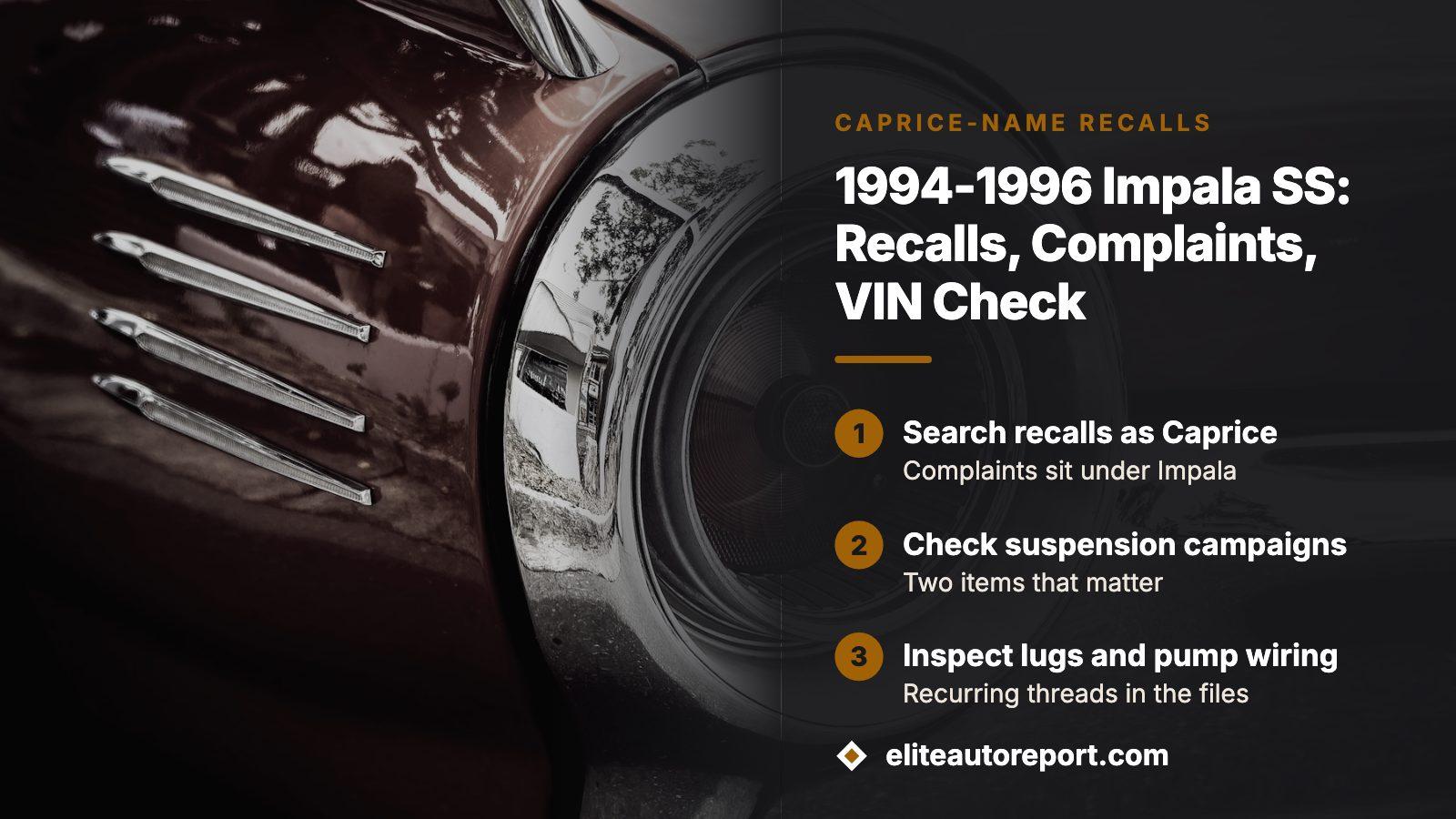
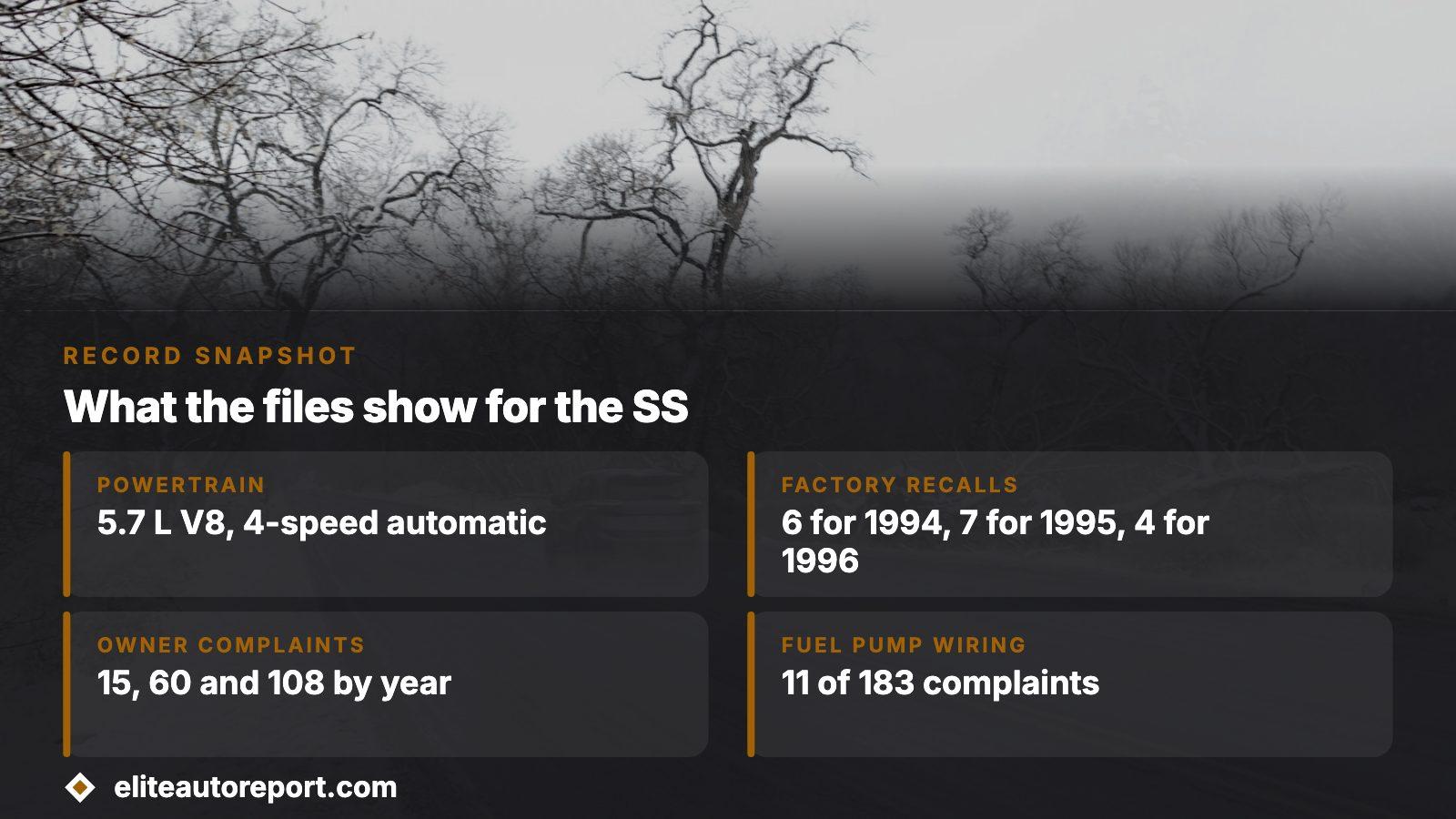
Every Impala SS built for the 1994, 1995 and 1996 model years carries a 5.7 L V8 with a 4-speed automatic. NHTSA lists the recalls under the Caprice name, with 6, 7 and 4 factory campaigns for the three years, and the complaints under Impala. Check the suspension, lug nut and fuel pump items, then run the VIN for auction history.
- Powertrain per EPA
- 5.7 L V8, 4-speed automatic, rear-wheel drive
- Factory recalls by year
- 6 for 1994, 7 for 1995, 4 for 1996
- Owner complaints filed
- 15, 60 and 108 for the three years
- Fuel pump wiring mentions
- 11 of 183 complaints
Why the federal records split the car in two
The SS shares its body and chassis with the Caprice, and the government data reflects that. The EPA lists the family as Caprice/Impala, a large rear-drive car with a 5.7 L V8 and a 4-speed automatic. NHTSA does something stranger: owner complaints sit under the Impala name, while recalls sit under Caprice. Search recalls for an Impala from these years and you get one aftermarket lamp notice and nothing else.
That gap trips people up. A buyer types 1995 Impala into a recall lookup, sees almost nothing, and relaxes. Search under Caprice for the same year and you find a real list. The sections below use both records, and only a VIN lookup tells you which campaigns reached the car in front of you.
Factory recalls, year by year
Leaving out four replacement-lamp recalls that involve aftermarket parts, NHTSA shows 6 factory campaigns for 1994, 7 for 1995 and 4 for 1996. Several overlap, so the table groups them by what went wrong.
| Problem | Campaign | Years listed |
|---|---|---|
| Paint under the wheel loosens lug nuts | 94V076000 | 1994 |
| Oil cooler hose chafes on steering gear | 94V049000 | 1994 |
| Fuel tank strap fasteners loose | 94V210000 | 1994 |
| Accelerator pedal friction in cold weather | 95V082000 | 1994, 1995 |
| Shift linkage allows leaving Park without the key | 95V221000 | 1995 |
| Front ball joint nuts under-torqued | 96V018000, 96V019000 | 1994, 1995, 1996 |
| Rear lower control arm cracks | 96V020000 | 1994, 1995, 1996 |
| Lug nuts under-torqued at assembly | 96V245000 | 1995, 1996 |
| Airbag and roof rack labels on one visor side | 95V215000 | 1995, 1996 |
The two suspension campaigns that matter most
Both January 1996 suspension campaigns describe a loss of control if a part lets go. In the front, the nuts holding the lower ball joint to the knuckle were not torqued properly. Dealers were to inspect them and replace the joint and knuckle if it had loosened. In the rear, the lower control arm can crack at the stabilizer bar attachment, and the fix was new arms plus new attachments on both sides.
NHTSA's rear-arm wording says the cracking can be made worse by a severe duty cycle. That phrase is a reason to look at where a car spent its early years, not just how many miles it shows. A garage-kept weekend car and a fleet car with the same odometer reading have not had the same life.
From an NHTSA owner complaint
An owner of a 1995 Impala reported that, while backing out, the lower ball joint failed, the passenger-side tire separated and the front end collapsed. The owner noted the car had been through the 1996 recall and doubted that the repair had worked. A recall stamp in the paperwork is a starting point, so have a shop inspect the front end yourself.
Lug nuts: a problem that outlived the sticker
Two separate campaigns deal with wheels. The 1994 one blames paint on the mounting surface for working loose. The December 1996 one says nuts were not tightened to specification at assembly, and that studs could fracture and a wheel could come off. Both fixes are cheap for a dealer or shop, so an unresolved record on a car you are shopping for is an irritation.
From an NHTSA owner complaint
The buyer of a new 1996 Impala said every lug nut was loose when the car got home and retorqued them to 100 ft lbs. Years later, in 2014, a recall check still showed the lug nut campaign as incomplete. The dealer said the car had to come in to clear it. Paperwork this old can trail the real repair history, so ask the seller exactly what was done.
What owners filed complaints about
Under the Impala name NHTSA keeps three piles of owner reports: 15 from the 1994 cars, 60 from 1995 and 108 from 1996. The 1994 pile is small, led by electrical and fuel system reports. For 1995, brakes, hydraulic parts, electrical items and tires lead with 8, 8, 7 and 7 each. For 1996, steering tops the list at 15, followed by visibility and power train at 13 each.
- Steering and visibility complaints cluster in 1996, so test the wipers, defroster and steering feel on a drive.
- Brake and hydraulic complaints cluster in 1995, so look for pedal feel and fluid condition.
- Electrical complaints show up in all three years, so work every switch and gauge before you commit.
The fuel pump harness thread
One pattern deserves its own look. Of the 183 complaints across the three years, 11 name the fuel pump or the harness feeding it. The split by year is 3, 2 and 6, oldest first. Those reports describe stalling, a blown fuse or melted insulation on the wiring that feeds the pump inside the tank.
From an NHTSA owner complaint
An owner of a 1995 Impala traced a stalling problem to the in-tank pump and saw burnt, softened insulation on the in-tank wiring. He fixed it himself for $375 and called the condition alarming after reading similar complaints. If a car stalls on the test drive, treat the harness as the first suspect.
Fuel economy and what it implies
EPA ratings for the 5.7 L car are close across the three years: 15 mpg city in each, 23 or 24 highway, and 18 combined. The 1994 car is listed for premium fuel, while 1995 and 1996 are listed for regular. A seller who quotes mileage far better than 18 combined deserves a follow-up question, and one who says 'runs great' without a service record deserves two.
Where a VIN check earns its place
Recall and complaint records say nothing about a particular car's past. A VIN check on this car is useful for two reasons. First, it shows whether the car passed through a salvage or insurance auction, with photos that reveal front-end repairs, flood lines or fire damage that a fresh paint job covers. Second, it attaches brands on the title and odometer readings to the chassis number, so the seller's account can be tested.
Start with the preview, which costs nothing. When it turns up records, one report covers this car. Options sit on the pricing page, billed once with no subscription. Reach for it on any 1994-1996 car where the seller is vague about prior owners.
A sensible order for the day you look at the car
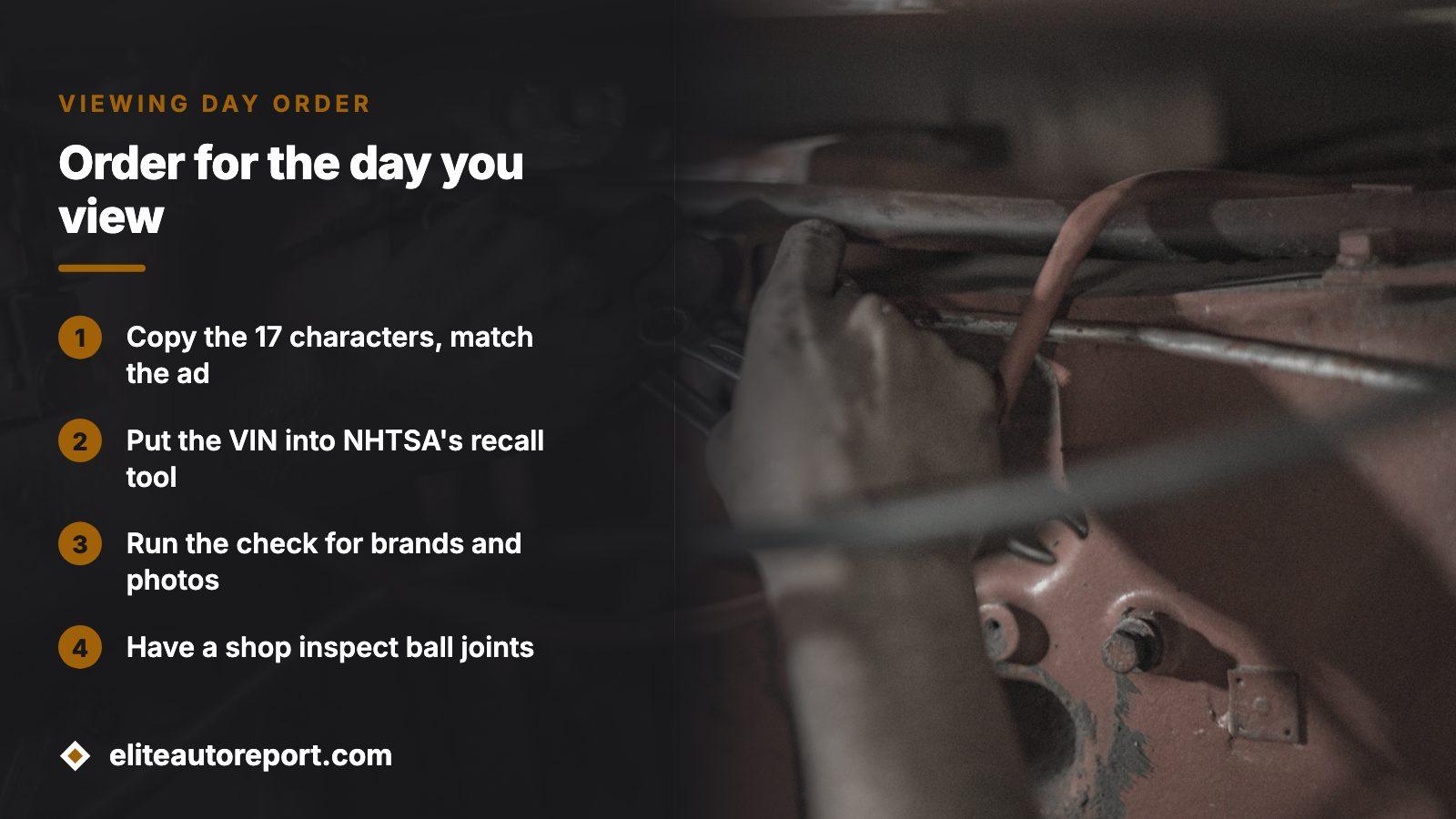
- Stand at the windshield or door jamb, copy the 17 characters, and hold them against the ad.
- Put that VIN into NHTSA's recall tool and write down anything still open.
- Run the VIN check for title brands, odometer entries and auction photos.
- Have a shop inspect the front ball joints, rear control arms and wheel studs.
- Drive it long enough to see any stalling, then recheck for a fuel pump harness repair.
Where this information comes from
- NHTSA: Recalls lookup by VIN — where to check open recalls for a specific car
- NHTSA recalls API: Chevrolet Caprice 1995 — campaign numbers, dates and remedies used in the tables
- NHTSA owner complaint 10087334 — owner experience, paraphrased
- NHTSA owner complaint 10016665 — owner experience, paraphrased
- NHTSA owner complaint 10618379 — owner experience, paraphrased
- EPA: Fuel economy data — 5.7 L ratings for the Caprice/Impala family
- VehicleHistory.gov: NMVTIS for consumers — federal title records system
Sources and photos: Facts checked against the sources above in November 2026. Photos by Warren Griffiths, Nina Mercado and Zoshua Colah on Unsplash; diagrams by EliteAutoReport.
Keep reading
- Classic Car Title Search by VIN: What Turns Up and What Doesn'tHow to read the title record on an older car.
- Car Auction Photos by VIN: Find Salvage Sale Pictures Before You BuyWhat auction photos can show about past damage.
- Police Impound Car Auctions: How They Work and What to Check by VINFleet and police cars often leave auctions with hard use behind them.
- 1997 Pontiac Firebird: What to Check Before You Buy OneAnother GM performance car from the same era, with its own federal record.
Frequently asked questions
Is the 1994-1996 Impala SS the same as a Caprice?
They share a body and chassis, and the EPA lists the family together as Caprice/Impala. NHTSA is less tidy: recalls appear under Caprice and complaints under Impala. Search both names when you research a car, and rely on the VIN for anything specific.
Which model year has the most recalls?
For these cars, 1995 shows 7 factory campaigns on NHTSA, against 6 for 1994 and 4 for 1996. Counts say little alone. A 1996 car with its rear control arm and lug nut work unfinished is worse than a 1995 car with everything done.
What engine does the Impala SS have?
EPA lists a 5.7 L V8 with a 4-speed automatic and rear-wheel drive for each of the three years. The same family also lists a 4.3 L V8 in the database, so use the VIN decode rather than the badge to confirm what a given car has.
Should I worry about the fuel pump wiring?
It is worth a look. Eleven of the 183 owner complaints mention the pump or its harness, with stalling and melted insulation described. A shop can inspect it, and a stall on your test drive is a warning to take seriously.
What does a VIN check show that NHTSA does not?
NHTSA covers recalls and complaints. A VIN check adds title brands, odometer readings, salvage records and auction photos for that specific car. You see a preview at no charge; the complete report is a one-off payment for that car.
Now check the car itself
The guide explains what to look for. The report shows what this VIN has on record.