THE SHORT ANSWER
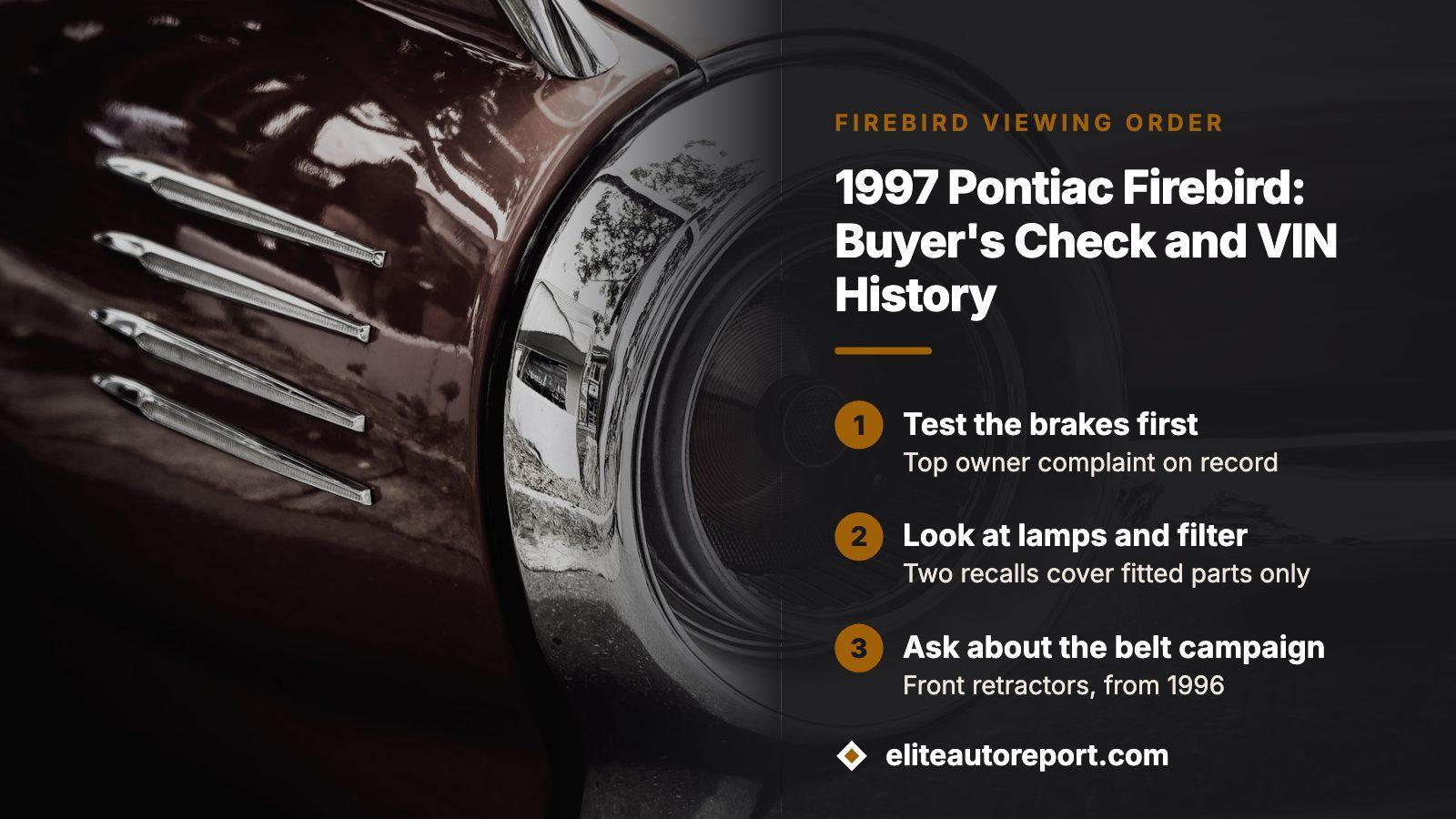
The 1997 Firebird came with a 3.8 L V6 or a 5.7 L V8, both rear-wheel drive. NHTSA lists one factory recall, a front seat belt retractor campaign from 1996, plus two aftermarket-parts recalls. Owners complain most about brakes, so inspect them closely. Then run the VIN to see whether the car ever sold at auction or carried a salvage brand.
- Engines
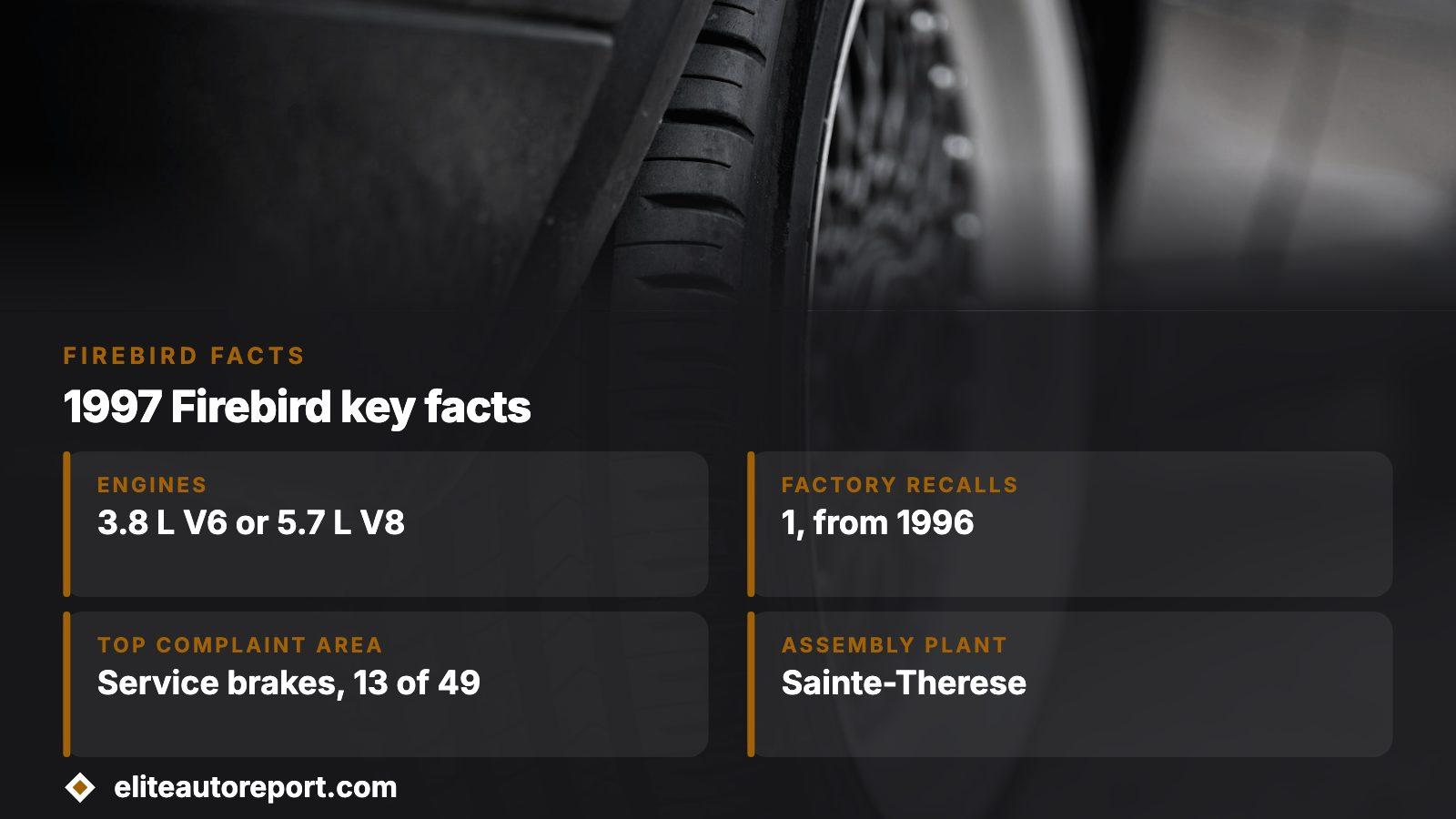
- 3.8 L V6 or 5.7 L V8
- Factory recalls on file
- 1, from 1996 (seat belt retractors)
- Top complaint area
- Service brakes, 13 of 49 records
- Assembly plant in NHTSA decodes
- Sainte-Therese
What a 1997 Firebird actually is
Pontiac sold the Firebird that year as a rear-wheel-drive hatchback, and the EPA files it as a subcompact. The federal fuel economy database lists four powertrains: a 3.8 L V6 paired with either a 4-speed automatic or a 5-speed manual, and a 5.7 L V8 with either a 4-speed automatic or a 6-speed manual. The Formula and the Trans Am sit at the top of that range, and on a car this age the badge on the trunk lid tells you little. A decode is the cleaner way to tell which engine a given car left the factory with.
That is why the engine and series should come from the VIN, not the listing. NHTSA's decoder reads a Firebird VIN into series, engine size and body style, and for a V8 Formula it names the Sainte-Therese plant. If the decode and the car in front of you disagree, stop and ask why.
Mileage numbers by engine
| Powertrain | City / highway mpg | Combined | Fuel |
|---|---|---|---|
| 3.8 L V6, automatic | 17 / 26 | 20 | Regular |
| 3.8 L V6, manual | 17 / 28 | 20 | Regular |
| 5.7 L V8, automatic | 15 / 23 | 18 | Premium |
| 5.7 L V8, manual | 15 / 24 | 18 | Premium |
These are EPA figures for the original cars, so treat them as a ceiling for a tired example. The practical gap is the fuel grade: the V8 was rated for premium, the V6 for regular.
Recalls: one factory campaign, two that are not factory parts
NHTSA returns three campaigns for this model year, and only one concerns the car as built. Campaign 96V219000 covered front seat belt retractors that were set out of position and could lock on gentler slopes than federal rules allow. Dealers were to inspect the retractor and reinstall any that sat wrong. Owner letters started going out in October 1996, so a car that never visited a dealer afterward could still be affected.
- 06E065000: aftermarket combination lamps without amber side reflectors, from 2006. The fix was reimbursement for the lamps.
- 07E088000: certain HP4 and HP8 racing-line oil filters from FRAM, built from May 25, 2006 to September 14, 2007, whose gasket could weep oil and start a fire. Owners could swap them at no charge.
- Both of those apply only if someone fitted the named parts, so look at the filter and the lamps rather than assuming.
NHTSA's lookup works by VIN, and it is worth doing even though the list is short.
What owners told NHTSA
The complaints database holds 49 records that name the 1997 Firebird. Brakes lead with 13, followed by engine and cooling, and vehicle speed control at 6 each, then electrical, fuel system, power train and seats at 5 each. Five records flag a crash, two flag a fire and four report injuries, with no deaths recorded. Owners describe long stops on wet roads, ABS failures, fuel weeping near the injectors and a pedal layout where the foot catches the steering column.
From an NHTSA owner complaint
An owner of a 1997 Firebird wrote that the turn signal sockets keep burning out because the daytime running lights use the same element as an always-on lamp. By the owner's account the sockets had been replaced twice in 134,000 miles and the third set was already scorched, so the daytime lights were disabled with a jumper wire.
The takeaway: look at the rear and front lamp sockets for browning, and look for a spliced wire that someone added to silence the daytime lights.
Trans Am cars file under a different name
NHTSA keeps Trans Am records apart from Firebird ones. A recall search under the Trans Am name for 1997 returns nothing, while its complaint file holds 12 records. If you are shopping for one, read both lists. The Trans Am set leans toward dim sealed-beam headlights, T-top glass breaking, and a car that stumbles when wet.
From an NHTSA owner complaint
The owner of a 1997 Trans Am reported that the car misfires and dies when it gets wet. By that account it had been to the shop 69 times for the same fault, and one dealer declined to touch it because nobody could explain the cause.
Run a hose-down test during a viewing if the seller allows it, and ask for repair invoices showing what was actually replaced.
Where the VIN check earns its place
Federal data tells you what the model does. It says nothing about this particular car. A Firebird of this age is exactly the kind of vehicle that gets wrecked, sold off by an insurer, rebuilt and listed again with fresh paint. EliteAutoReport reads the VIN against title brands, total-loss entries and auction sales, and where a car went through a yard, it shows the photos taken before repair.
Those pictures answer questions a seller will not: which corner took the hit, whether the airbag covers were open, and whether the nose panel was cracked. Pair them with the odometer readings over time, and a rolled-back or stalled mileage story shows itself. Typing in the VIN brings up a preview on the house. Going further means one purchase, and the pricing page spells out the options.
A sensible order for a viewing
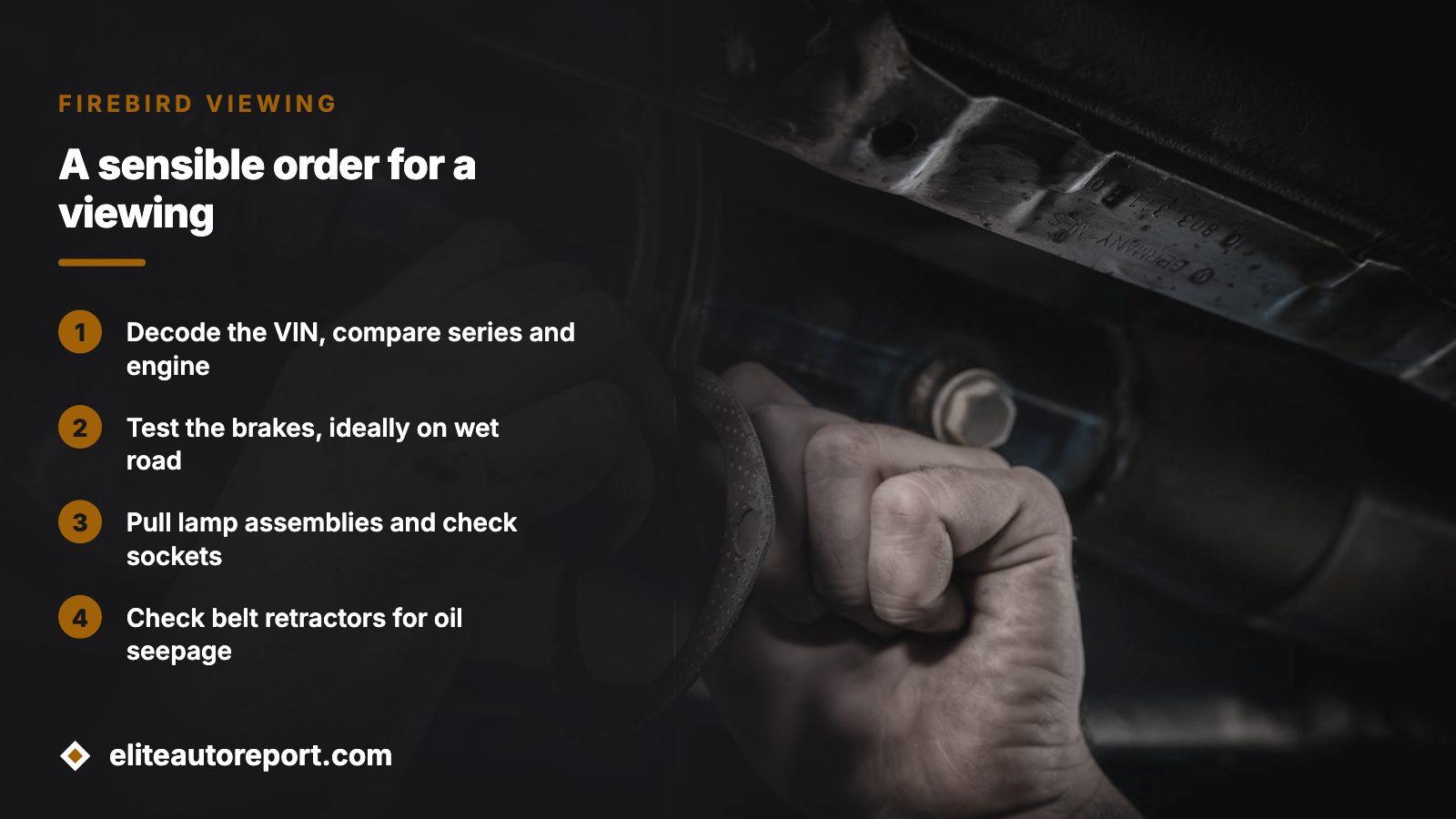
- Decode the VIN from the car and compare series and engine to the ad.
- Run the check and read any auction photos before you travel.
- Test the brakes on a wet road if you can, since that is the top owner complaint.
- Pull the lamp assemblies and look at the sockets.
- Check the front seat belt retractors and ask whether the 1996 campaign was done.
- Look for oil seepage at the intake and a fuel smell near the injectors.
Reading the result
A clean record is useful, not final. It means nobody reported a problem to the sources that feed it, and that is different from a car that has never been hit. An auction entry is not automatically bad either: lease returns and dealer trade-ins pass through auctions all the time. What matters is the pairing of a sale with a salvage or total-loss brand, or photos that show structural damage the seller never mentioned.
If the report disagrees with the story you were told, ask for the paperwork before you negotiate. If it agrees, you can spend your inspection time on the brakes and the electrics rather than on doubt.
Where this information comes from
- NHTSA recalls: 1997 Pontiac Firebird — the three campaigns, their dates and remedies
- NHTSA complaints: 1997 Pontiac Firebird — complaint counts and component breakdown
- NHTSA owner complaint 10274054 — owner experience, paraphrased
- NHTSA owner complaint 751324 — owner experience, paraphrased
- NHTSA vPIC VIN decoder — what a decode reports for series, engine and plant
- Fuel Economy Guide: 1997 Firebird/Formula — powertrains and EPA mileage
Sources and photos: Facts checked against the sources above in November 2026. Photos by Warren Griffiths, Martin Fennema and engin akyurt on Unsplash; diagrams by EliteAutoReport.
Keep reading
- Where Is the VIN on a Classic Car? Dash, Door, Firewall and FrameFind the number you need to decode before the viewing.
- Car Auction Photos by VIN: Find Salvage Sale Pictures Before You BuySee how lot photos are matched to a VIN.
- Classic Car Title Search by VIN: What Turns Up and What Doesn'tCheck title history on an older car.
- Matching Numbers Classic Car: How to Verify the Claim Before You PayConfirm that an older car's numbers agree with each other.
Frequently asked questions
Does the 1997 Pontiac Firebird have open recalls?
NHTSA lists one factory campaign for the year, a front seat belt retractor issue from 1996, and two that involve aftermarket lamps and oil filters. Whether any apply to a specific car depends on the VIN and on what parts were fitted, so look it up on NHTSA's recall page before buying.
Which engine is better in a 1997 Firebird?
That depends on what you want. The 3.8 L V6 is rated for regular fuel and 20 mpg combined, while the 5.7 L V8 is rated for premium and 18. Condition and service history matter more than the badge, so judge each car by its records and its test drive.
Is a Trans Am the same as a Firebird for recall searches?
No. NHTSA files Trans Am records under their own model name, so a Firebird search can miss them. For 1997, the Trans Am recall search returned nothing and its complaint file held 12 records. Search both names whenever you are looking at a Trans Am.
Can a VIN check show if a Firebird was sold at auction?
Yes, where the car passed through an auction that reports its sales, the record can include the listing and its photos. A lack of entries is not proof the car never sold at one, so combine the report with an in-person inspection and service paperwork.
What should I check first on a 1997 Firebird?
Start with the brakes, since they draw the most owner complaints, then the lamp sockets and any sign of fuel or oil leaks. Before that, compare the decoded VIN to the car so you know the engine and trim are what the seller claims.
Now check the car itself
The guide explains what to look for. The report shows what this VIN has on record.