THE SHORT ANSWER
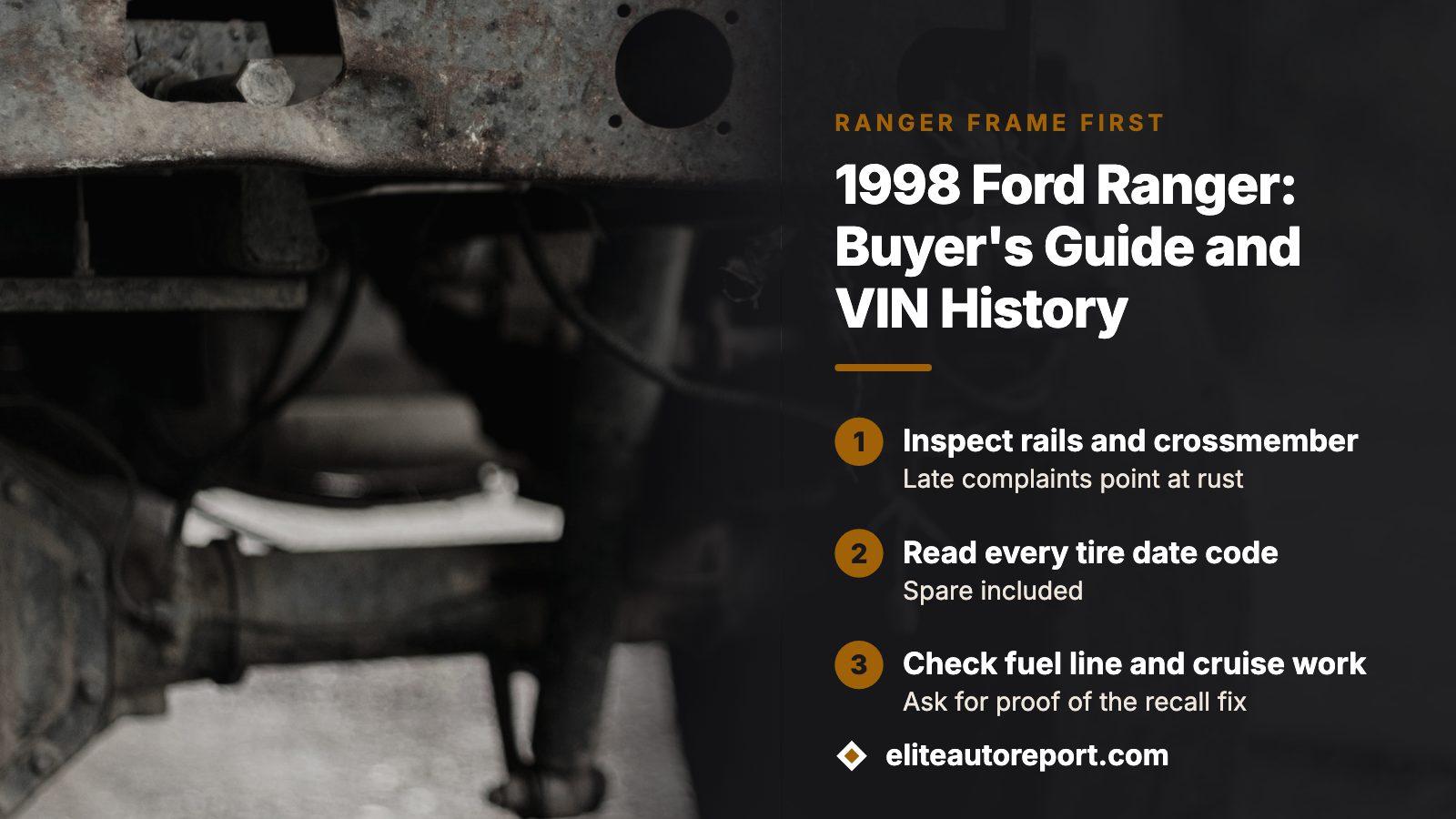
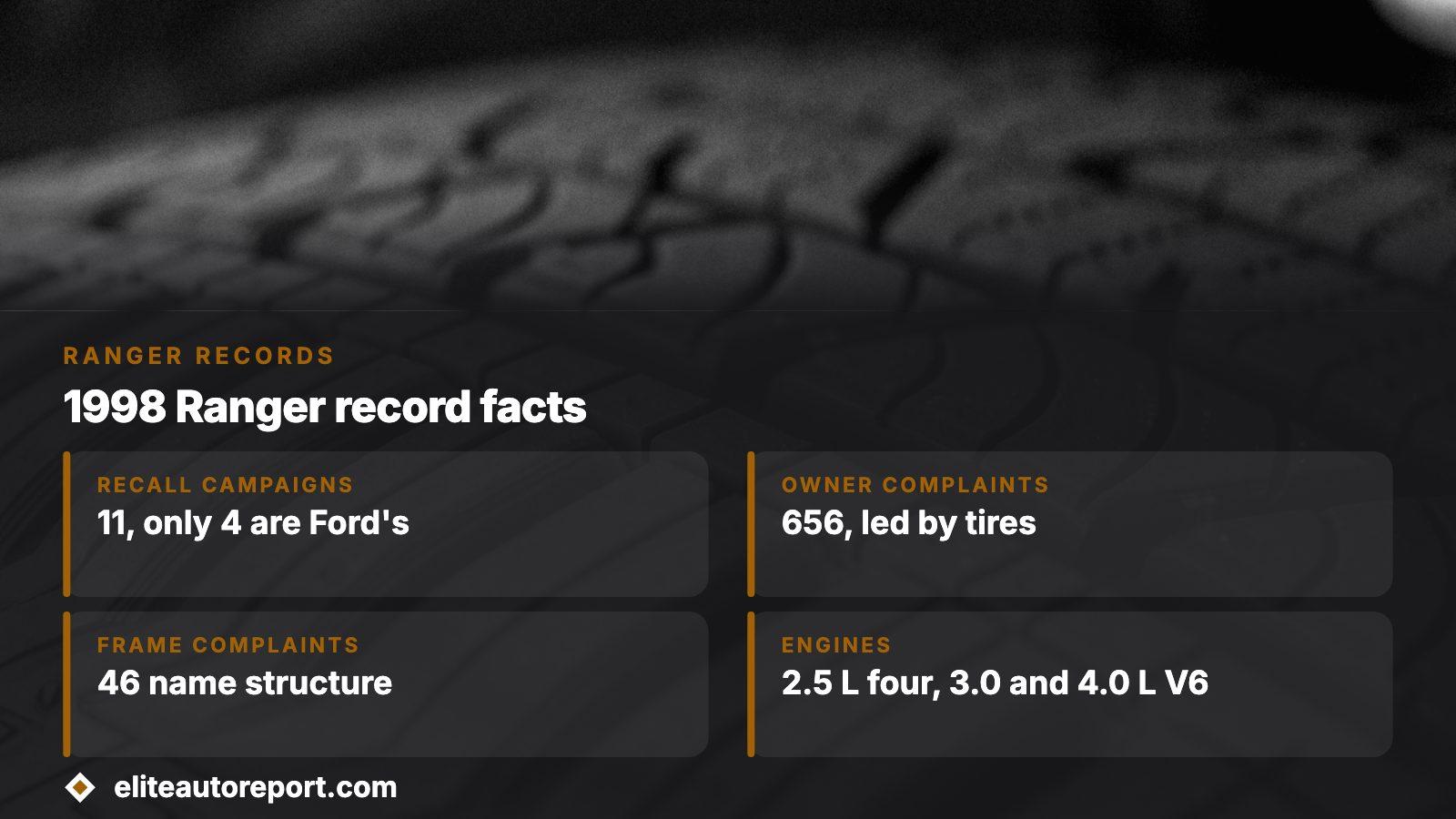
The 1998 Ranger offered a 2.5 L four, a 3.0 L V6 and a 4.0 L V6, with manual or automatic gearboxes. NHTSA lists 11 recall campaigns, though only 4 are Ford's own, and logs 656 owner complaints, led by tires. Late complaints keep pointing at rusted frames. Inspect the frame first, then run the VIN for title brands and auction photos.
- Engines
- 2.5 L four, 3.0 L V6, 4.0 L V6
- NHTSA recall campaigns
- 11, of which 4 are Ford's own
- Owner complaints on file
- 656, most about tires
- Complaints naming structure
- 46, many about frame rust
The truck, in three engines
The EPA lists six powertrains for the 1998 Ranger, all burning regular gasoline. Buyers could pick a small four-cylinder or step up to one of two V6 engines, each paired with either a manual or an automatic transmission. Ford also sold four-wheel-drive versions, and a decode of a partial VIN from one of those trucks comes back as a pickup with a 3.0 L or 4.0 L engine, with plant cities that include Edison and St. Paul.
| Engine and gearbox | City / highway mpg | Combined |
|---|---|---|
| 2.5 L four, automatic | 18 / 23 | 20 |
| 2.5 L four, five-speed manual | 19 / 24 | Combined 21 |
| 3.0 L V6, any gearbox | 15 / 21 | 17 |
| 4.0 L V6, any gearbox | 15 / 20 | 17 |
Those are rear-drive figures from the original ratings, so a worn truck will do worse. The gap between the four and the V6s is small enough that condition should decide your pick.
Eleven recall entries, four of them Ford's
NHTSA returns 11 campaigns for this model year, which sounds alarming until you sort them. Several concern aftermarket lamps and a replacement fuel filter, and they matter only if someone fitted those parts. Two more deal with Firestone tires. That leaves four campaigns Ford filed on the truck itself.
- 97V186001: on 4.0 L trucks, the flexible fuel line could sit against the exhaust manifold. Dealers added a retaining clip.
- 98V021000: four-wheel-drive trucks with the off-road package carried the wrong tire and rim label. Owners received a corrected overlay.
- 99V062001: a cruise control cable could keep the throttle from returning. The remedy was a new cable, with owners told to skip cruise control until then.
- 07V336000: the cruise deactivation switch could overheat and start an underhood fire. The fix was a fused wiring harness.
The recall lookup works from the VIN, so use it on any truck you are serious about and ask the seller for proof of completed repairs.
What 656 owner complaints say
The complaint file for this model year holds 656 records. Tires lead with 150 mentions, followed by vehicle speed control at 77, then power train, suspension, brakes and engine cooling. Of the records, 69 flag a crash and 35 flag a fire, and the file counts 49 injuries and 7 deaths. Filing peaked early, with 184 complaints in 2000, then thinned to a trickle.
Speed control appearing so high lines up with the two cruise-related campaigns above. If the truck has cruise control, check that the pedal returns freely and ask whether either recall work was done. Early complaints are mostly about how the truck behaved when new; the later ones, from the later years, are about age.
From an NHTSA owner complaint
An owner of a 1998 Ranger wrote in 2003 that the rear driver's side tire tread let go at 65 mph and wrapped around the axle, and the truck rolled over. The dealer was notified.
The takeaway for a buyer: tires on a truck this old are almost never the originals, so read the date codes yourself and do not trust a seller's word that they are new.
Rust is the late-life problem
Structure appears in 46 of the complaint records, and the more recent ones read the same way. Owners describe bumpers dropping off, spare tire carriers letting go and trucks failing inspection. One filing from 2017 puts a failed inspection at 169,000 miles, blamed on corroded subframe and crossmembers.
From an NHTSA owner complaint
In 2019 an owner wrote that the frame of a 1998 Ranger had rusted nearly through, the rear suspension was pulling away, and the spare tire and carrier had fallen off on an interstate. By that account, the bed mounts had rusted away as well.
Crawl under it with a flashlight and a small hammer. Tap the rear crossmember, the spring hangers and the bed mounts. Flaking scale is one thing; a tap that sinks in or rings dull is a reason to walk away. Road salt does its work out of sight, so a clean bed and shiny paint prove little.
Where the VIN check does the work
Federal data describes the model. It cannot tell you whether this truck was rolled, written off by an insurer and bought back cheap. Small pickups of this age pass through salvage auctions all the time, and they often come out the other side with fresh paint and a clean-looking listing.
EliteAutoReport reads the VIN against title brands, total-loss entries and auction sales. When a truck went through a yard, the lot photos show the damage as it stood before repair: which corner took the hit, whether the bed was bent, whether the airbag covers were open. Compare those pictures with what you see in the driveway. The preview costs nothing once you type in the VIN, and going further is one payment, with the choices laid out on the pricing page.
How to read what comes back
An auction entry alone is not a verdict. Fleet trucks, utility company vehicles and lease returns all pass through auctions without any damage story. What deserves a hard look is an auction sale paired with a salvage or total-loss brand, an odometer reading that falls behind an earlier one, or photos that show damage nobody mentioned.
A clean record is useful but not final. It means nothing was reported to the sources behind it, which is different from a truck that was never hit. NMVTIS is the federal title database built to stop unsafe and stolen vehicles from being sold on, and a good report draws on that sort of record.
A routine for the viewing
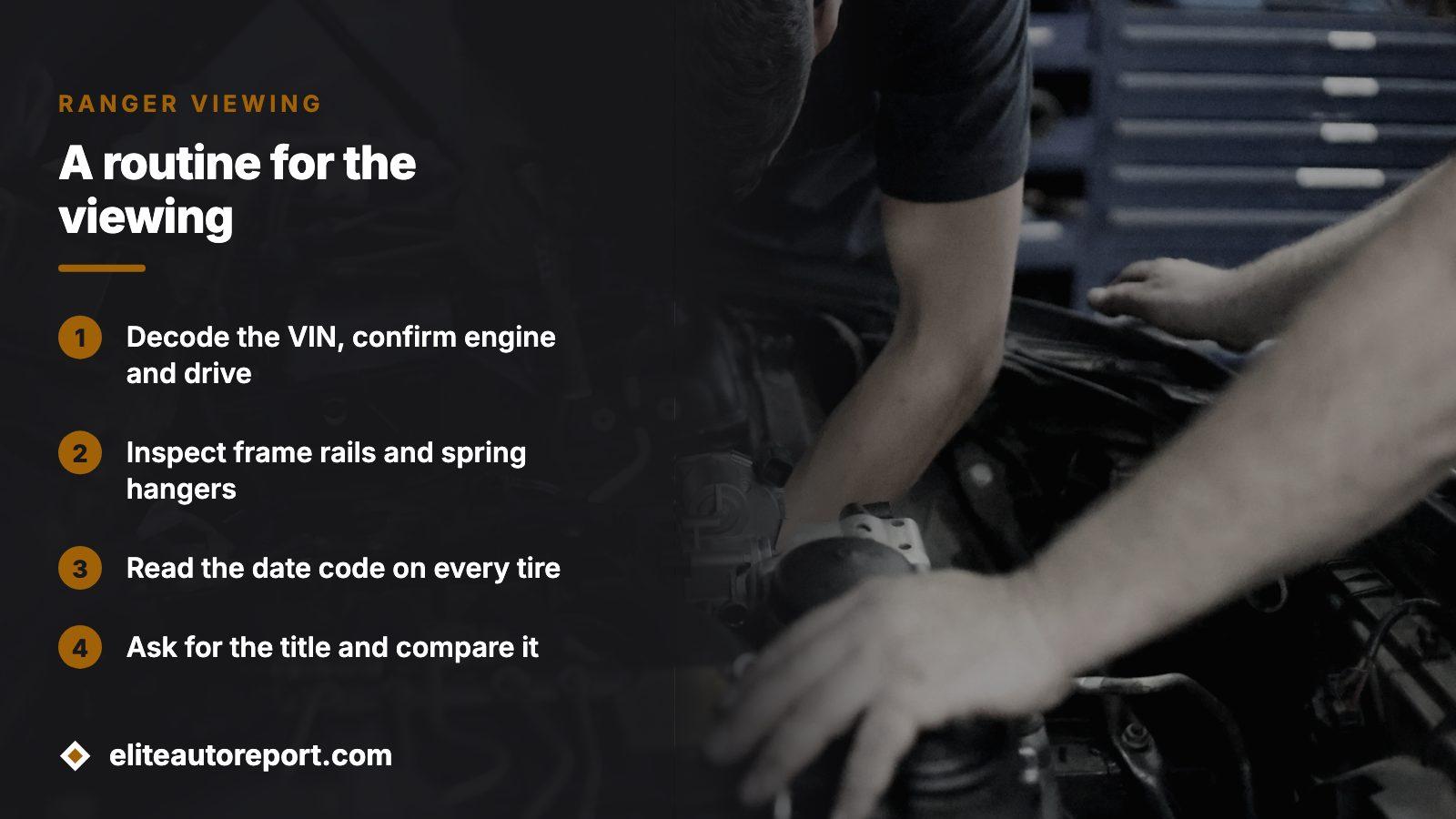
- Decode the VIN from the truck and confirm the engine and drive type match the ad.
- Run the check and study any auction photos before you drive out.
- Look under the truck: frame rails, rear crossmember, spring hangers, bed mounts and the spare tire carrier.
- Read the date code on every tire, spare included.
- Check whether the fuel line recall and the cruise control work were done, and smell for fuel near the engine.
- Ask for the title and compare the name, state and any brand with the report.
Settling the price once you know more
What you find becomes bargaining room. A frame that needs welding, tires that are past their age, or an unfinished recall repair all belong in the conversation about price. This guide does not quote values, because a truck's worth depends on region and condition, and the only sound figure is one tied to the exact truck and the day you buy.
If the report and the seller disagree about the truck's past, ask for repair invoices and the title before going further. If they agree, you can spend your inspection time on the frame and drivetrain instead of on doubt.
Where this information comes from
- NHTSA recalls: 1998 Ford Ranger — the 11 campaigns, their dates and remedies
- NHTSA complaints: 1998 Ford Ranger — complaint counts by component, crashes, fires
- NHTSA owner complaint 10033709 — owner experience, paraphrased
- NHTSA owner complaint 11234955 — owner experience, paraphrased
- NHTSA vPIC VIN decoder — what a decode reports for model, drive type and plant
- Fuel Economy Guide: 1998 Ford Ranger — powertrains and EPA mileage
- NMVTIS vehicle history — purpose of the federal title database
Sources and photos: Facts checked against the sources above in November 2026. Photos by Zoshua Colah, Mustafa Sheikhmouss and Yvette S on Unsplash; diagrams by EliteAutoReport.
Keep reading
- 1993 Ford F-350: What to Check Before You Buy OneAnother older Ford truck, with its own list of checks.
- Check a Truck VIN Number for Auction History, Photos and Salvage RecordsHow pickups show up in auction records.
- Car Auction Photos by VIN: Find Salvage Sale Pictures Before You BuySee how lot photos are matched to a VIN.
- Classic Car Title Search by VIN: What Turns Up and What Doesn'tCheck title history on an older vehicle.
Frequently asked questions
Does the 1998 Ford Ranger have open recalls?
NHTSA lists 11 campaigns for the model year, but only 4 are Ford's own, covering a fuel line, tire labels, a cruise cable and a cruise switch. Whether one is still open depends on the individual truck, so run its VIN through NHTSA's lookup before you buy.
Which problems come up most for a 1998 Ranger?
Owner complaints cluster around tires, with 150 mentions, and vehicle speed control, with 77. On trucks that survived this long, frame and crossmember rust shows up repeatedly. Check the underside carefully, since the top of the truck can hide it.
Which engine should I look for?
The EPA rated the 2.5 L four at 20 or 21 mpg combined and both V6 engines at 17. The four is lighter on fuel, while the V6 engines pull more. Neither has a clear edge, so choose the best-maintained truck and ask for service records.
Can a VIN check show if a Ranger was sold at auction?
Where the truck went through an auction that reports its sales, the record can show the sale and the lot photos. No entry does not prove it never sold at one, so pair the report with an inspection and the seller's paperwork.
Is the VIN check free?
The preview is the free part. Beyond it, you pay once per report or buy a pack, nothing recurs, and current options sit on the pricing page. NHTSA's recall lookup is a separate free federal tool you can use at any time.
Now check the car itself
The guide explains what to look for. The report shows what this VIN has on record.