THE SHORT ANSWER
NHTSA lists two recalls for the 1996 LS400: a 1998 starter switch campaign from Toyota and a 2006 aftermarket lamp recall that only matters if those lamps were fitted. Owners filed 23 complaint records, with fuel tank leaks, stalling and battery fires among them. Test for those, then run the VIN for title brands and auction photos.
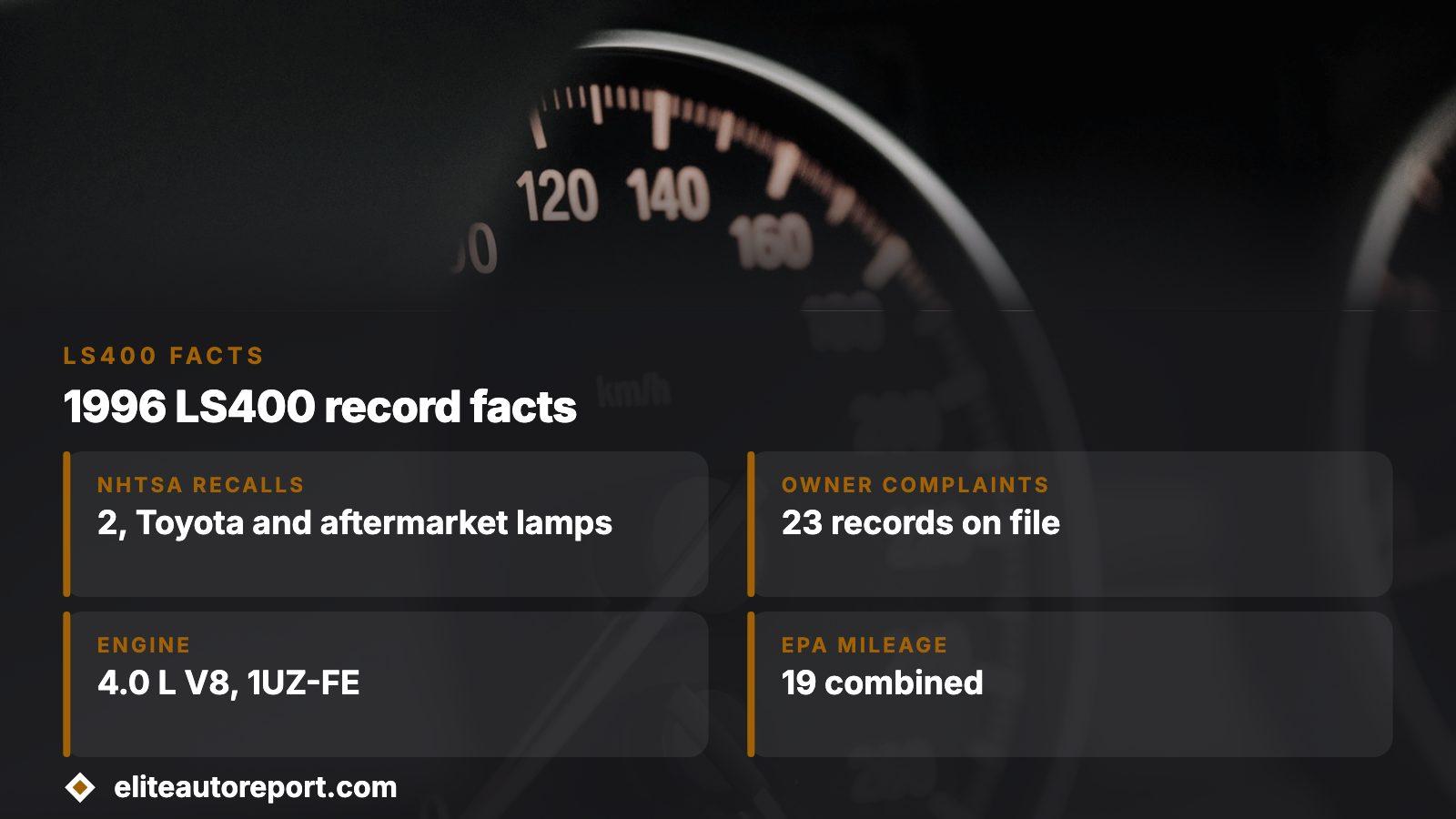
- NHTSA recalls
- 2, one by Toyota and one on aftermarket lamps
- Owner complaints
- 23 records on file
- Engine
- 4.0 L V8, 1UZ-FE
- EPA mileage
- 17 city, 24 highway, 19 combined
What a 1996 LS 400 actually is
Federal data describes one configuration for this year: a rear-drive sedan with a 4.0 L eight-cylinder, a four-speed automatic and premium fuel. The EPA rates it at 17 mpg in town, 24 on the highway and 19 combined. NHTSA's decoder reads a partial 1996 number as a Toyota-built car from the Tahara plant in Japan, with the 1UZ-FE engine.
That sameness is useful. With one engine and one drivetrain, a listing that claims anything different deserves a question. It also means condition and history, not trim choices, separate a good LS 400 from a poor one, and history is exactly what a VIN check reports.
The two recalls on file
The recalls database holds two records under the model name LS400. Searching with a space, as in LS 400, returns nothing, so use the spelling without it when you look up a car yourself.
| Campaign | Filed by | What it covers |
|---|---|---|
| 98V016000 | Toyota, January 1998 | Starter switch terminal assembled badly; road splash with deicing salt can short it, causing a no-start or an underhood fire. Dealers repair the switch. |
| 06E049000 | CK Motorsport, May 2006 | Aftermarket replacement lamps missing amber side reflectors. Not original equipment. |
Only the first one concerns how the car left the factory. Ask for paperwork showing the starter work was done, then confirm it yourself with the VIN. The second is a flag only if a previous owner swapped in cheap aftermarket headlights.
What owners told NHTSA
The complaint file for this year has 23 records. Four are marked as crashes, one as a fire, and none lists an injury. Most are ordinary old-car irritations: warped brake rotors, brake noise, bulging tires, a seat belt that would not retract, a mirror that shook at speed. The entries worth your attention are shorter in number but heavier in consequence.
- Fuel smell or a split fuel tank, reported more than once.
- Stalling, both at idle after highway driving and without warning at 116,000 miles.
- A battery fire at the positive post during starting.
- A timing belt jumped one tooth, producing hard starts and poor running.
The trunk-mounted fuel tank problem
One owner's account is the clearest warning in the file. Gasoline fumes started on a freeway, and a dealer found the tank seams split open. The tank sits in the trunk, so the leak reached the passenger area and spread across the dealer's lot.
From an NHTSA owner complaint
An owner reported in 2013 that fuel poured into the passenger area after the tank failed, and the replacement tank at a Texas Toyota dealer cost over $2,300. The owner feared it was an age problem that could affect others. A separate record from 2001 says a dealer inspected a car five times before replacing the tank. Both owners noticed a strong fuel smell first.
Take the lesson literally. Open the trunk, lift the mat and smell the cabin on a cold start and again after a drive. A fuel odor you can explain away on a test drive is a bill you will pay later.
Stalling, starters and the engine computer
The stalling complaints deserve a real test. One 2015 filing came from a person who had just bought a used 1996 car and said the engine died at idle after a long highway run, then restarted in neutral. That owner pointed to a Lexus service bulletin about engine computer software and said the maker would not cover the fix because warranty had ended.
From an NHTSA owner complaint
The owner, who had purchased the car second-hand, said the trouble was news: "no idea this problem existed." Whether a bulletin applies to the car you are considering is something to ask a Lexus dealer, using the VIN, before you buy.
A separate complaint describes a battery fire at about 170,000 miles. The mechanic tied it to the 1998 starter recall, but the maker said that work had already been done on that car. The point: a recall stamp in the history does not prove the electrical system is healthy.
What a VIN check adds that federal records cannot
NHTSA data is about the model. It cannot tell you that your car sat in a flood, was written off by an insurer or crossed an auction block with photos. For an LS 400 that is worth knowing, because old luxury sedans often end up in salvage lanes and resale lots when repairs cost more than the car is worth.
Enter the car's VIN on this site and the free preview tells you what records exist. Unlocking the full report is one payment, with no subscription. For this car, read the title brand section first, then odometer history, then any auction record and its photos. Photos of a damaged front end or a water line on the seats are the kind of detail a seller's ad leaves out.
Title and odometer: the NMVTIS caveat
The Department of Justice's national title database exists to curb fraud and keep stolen cars from being resold. Its consumer reports carry title brands such as junk, salvage and flood, the most recent odometer reading reported, and insurer total-loss records. The government's own consumer page warns that it holds less than a state title record, so a clean result is not a guarantee.
That is a good reason to add the state's title record for the car and to compare the odometer story with the maintenance paperwork. A car with 116,000 miles when it first stalled and a seller claiming far fewer needs an explanation.
A short inspection list for this model
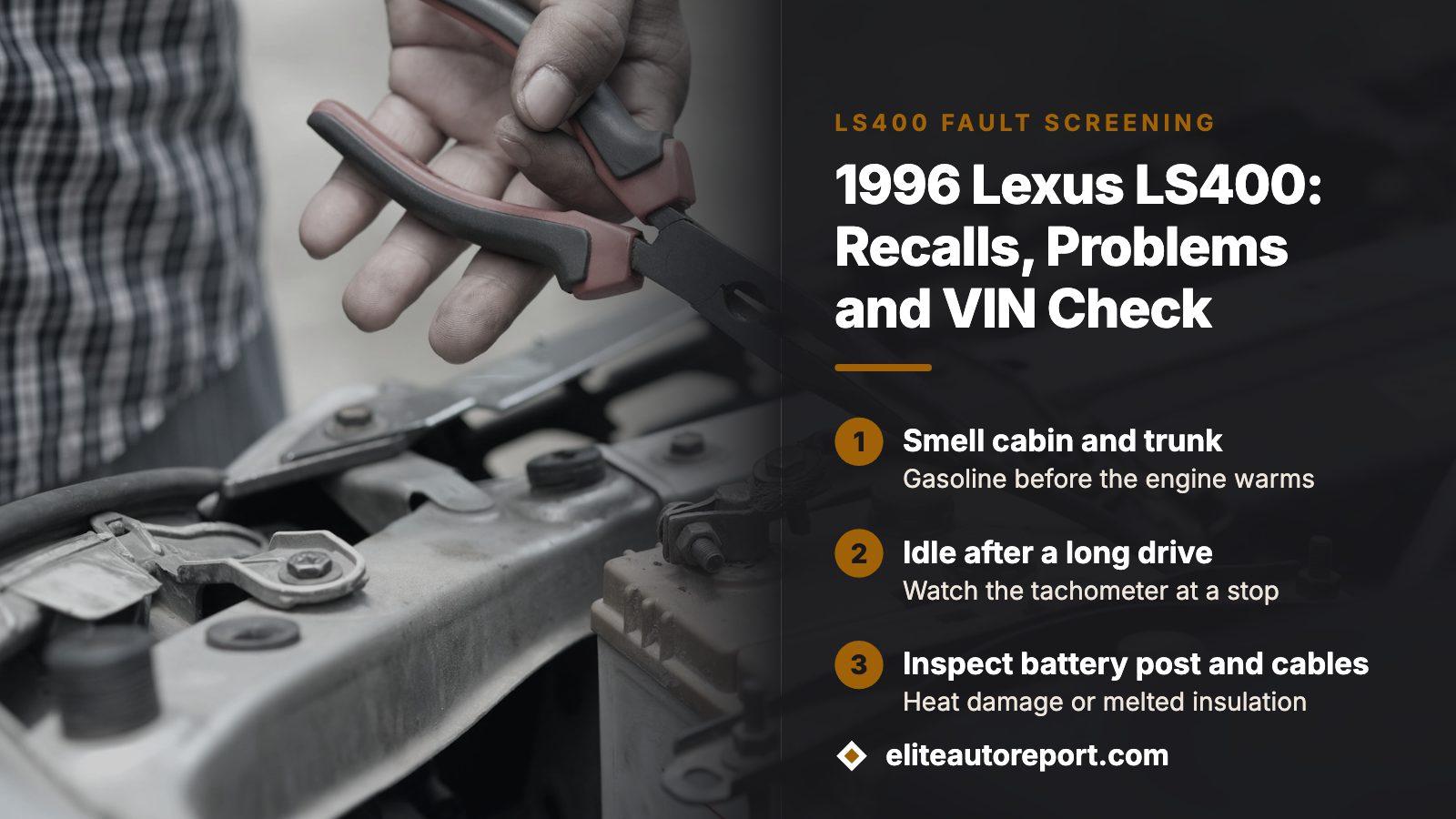
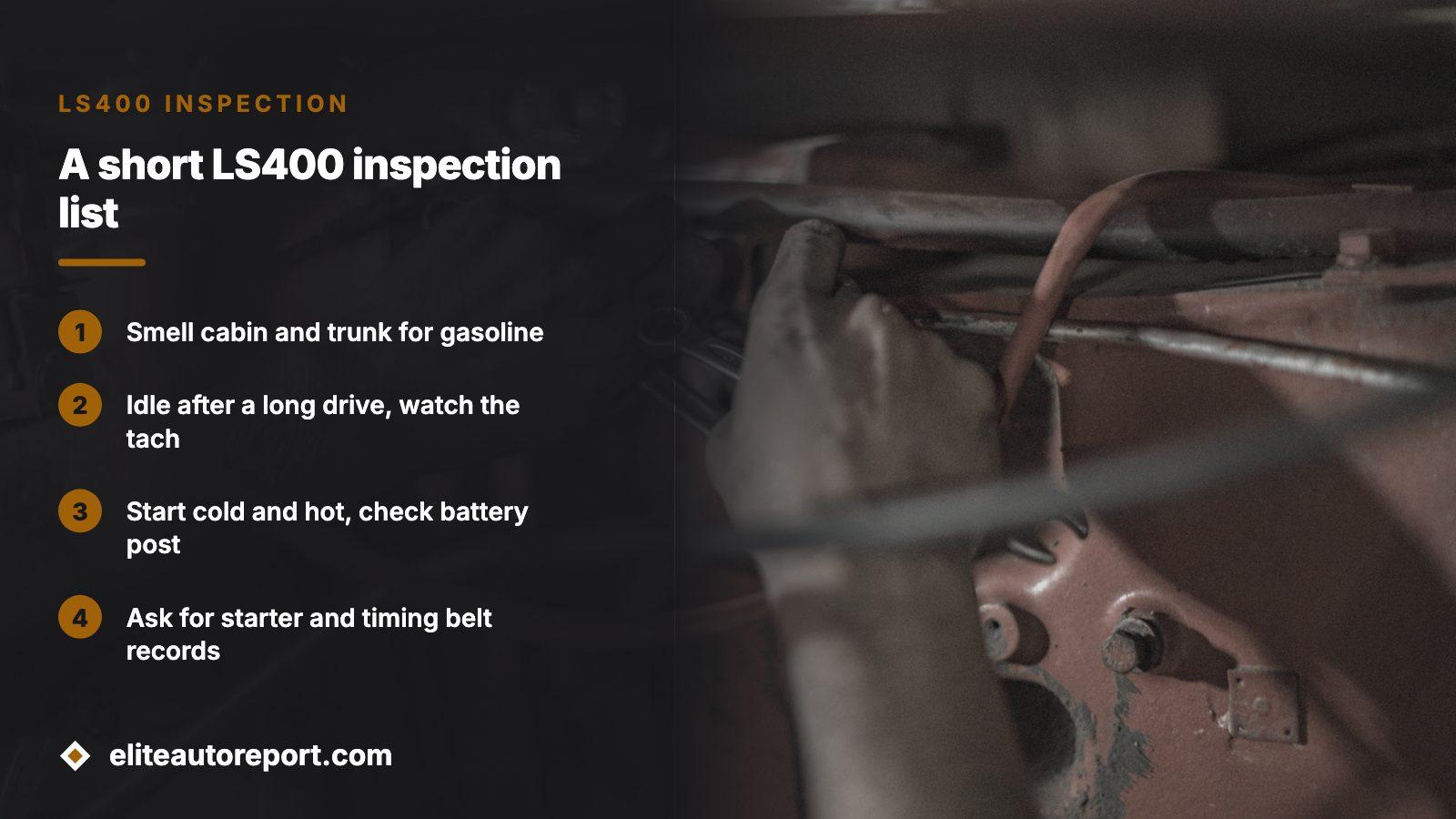
- Smell the cabin and trunk for gasoline before the engine has warmed up.
- Idle the car after at least a long drive, then watch the tachometer at a stop light.
- Start it cold and hot, and look at the battery post and cables for heat damage or melted insulation.
- Ask for the service record covering the starter work and the timing belt.
- Check tires for bulges and age, and feel the brake pedal for pulsing that points to warped rotors.
- Decode the VIN and match the engine, plant and model year to the listing.
Where this information comes from
- NHTSA recalls API, 1996 Lexus LS400 — the two campaigns, their dates and remedies
- NHTSA complaints API, 1996 Lexus LS400 — complaint count and owner accounts
- NHTSA owner complaint 10515276 — owner experience, paraphrased
- NHTSA owner complaint 10836184 — owner experience, paraphrased
- EPA fueleconomy.gov: 1996 Lexus LS 400 — engine, drivetrain and mileage ratings
- VehicleHistory.gov consumer information — what the federal title database holds and its limits
Sources and photos: Facts checked against the sources above in November 2026. Photos by Towfiqu barbhuiya, Nina Mercado and CHUTTERSNAP on Unsplash; diagrams by EliteAutoReport.
Keep reading
- Where Is the VIN on a Classic Car? Dash, Door, Firewall and Framefind the number on an older car before you run it
- Car Auction Photos by VIN: Find Salvage Sale Pictures Before You Buysee what auction photos can show about damage
- Classic Car Title Search by VIN: What Turns Up and What Doesn'tadd the state title record to your checks
- Car Auction Results Database: Where Classic Car Results Livehow older cars show up in auction records
Frequently asked questions
Is the 1996 Lexus LS 400 a reliable car to buy today?
Many are, but the records point to specific weak spots: the trunk fuel tank, stalling and the starter circuit. NHTSA shows only two recalls, so age and past repairs matter more than recall status. Judge the individual car on service paperwork, a long test drive and its VIN history.
How many recalls does the 1996 LS400 have?
NHTSA lists two. One is Toyota's 1998 starter switch campaign. The other is a 2006 recall of aftermarket lamps from CK Motorsport that is unrelated to original equipment. Search the database with the model spelled LS400, since a space returns no results.
What does a VIN check show on a 1996 LS 400?
It shows what happened to that specific car: title brands, odometer readings, insurer and auction records with photos, theft and open recalls. It cannot show mechanical condition, so pair it with an inspection by a technician who knows the 1UZ-FE V8.
Can I see auction photos of an old Lexus?
If the car was ever sold through a salvage or dealer auction that reported photos, the full report can include them. Run the VIN preview first to see whether any auction record exists, then decide on the report. Not every car has one.
Does a clean title report mean the car was never wrecked?
No. The federal title database holds less than a state title record, and a car repaired without an insurance claim may never be branded. Combine the report with the state record, an inspection and a look at the paint and panel gaps.
Now check the car itself
The guide explains what to look for. The report shows what this VIN has on record.