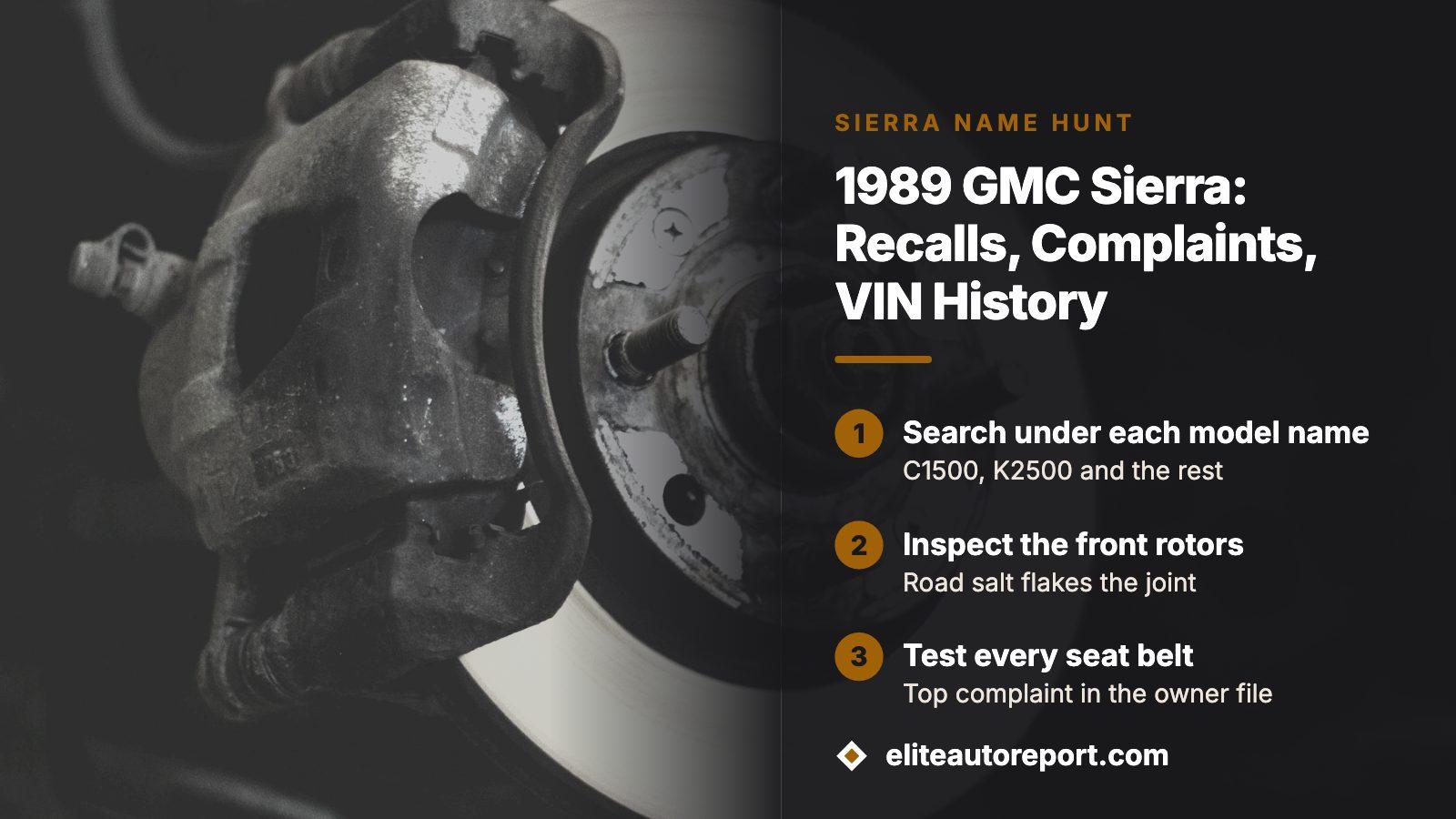
THE SHORT ANSWER
NHTSA files this truck's recalls under Sierra and also under C1500, K1500, C2500, K2500, C3500, K3500, C15 and K15, so one search is not enough. Engines ranged from a 4.3 L V6 to a 6.2 L diesel. The owner file holds only 16 complaints, led by seat belts. Check the front brake rotors and transmission vent hose, then run the VIN for title brands and auction photos.
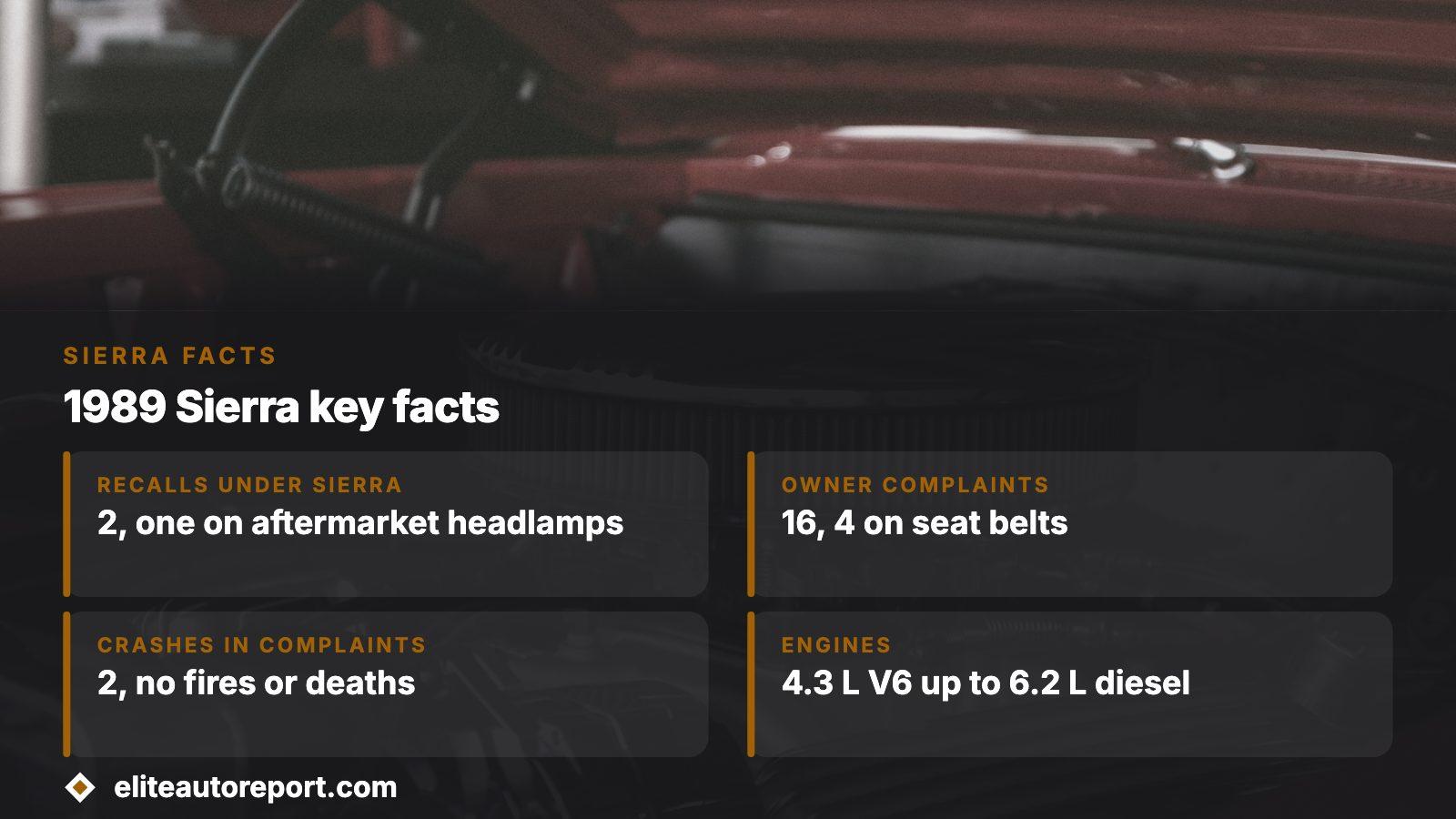
- Engines (EPA list)
- V6, two gasoline V8s, diesel V8 (4.3 to 6.2 L)
- Recalls under the Sierra name
- 2, one of them for aftermarket headlamps
- Owner complaints on file
- 16, with 4 about seat belts
- Crashes, fires, deaths in complaints
- 2 crashes, no fires, no deaths
Four engines, and mileage to match
For two-wheel-drive Sierras the EPA guide shows a small V6, two gasoline V8 sizes and a diesel V8, paired with three-speed, four-speed or five-speed gearboxes depending on the engine. Four-wheel-drive trucks sit under a separate K-series entry. Decoding a partial VIN through NHTSA's vPIC tool shows how varied the trucks were: one prefix returns a half-ton V6 built in Fort Wayne, Indiana, another returns a 5.7 L four-wheel-drive truck assembled at the Oshawa plant in Canada, with a much higher weight rating.
| Powertrain (2WD, EPA ratings) | City / highway | Combined |
|---|---|---|
| 4.3 L V6, 3-speed automatic | 15 / 16 | 15 |
| 5.7 L V8, 4-speed automatic | 13 / 18 | 15 |
| 5.7 L V8, 5-speed manual | 11 / 17 | 13 |
| 6.2 L diesel V8, 4-speed automatic | 16 / 23 | 19 |
The diesel is the thrifty one on paper, though a diesel this age needs its own inspection. Nobody should buy a square-body for its mileage figures. They matter mainly because they tell you what the engine should be doing if it was never swapped.
Recalls hide under other model names
Search NHTSA for a 1989 GMC Sierra and you get two campaigns. One is a 2008 equipment recall of aftermarket headlamps, which matters only if someone fitted those lamps. The other is a 1993 brake rotor campaign. That looks light for a full-size truck, because the maker filed several other campaigns under the pickup's series names instead.
- 89V078000, received in 1989: the optional hitch on extended cabs might have loose mounting bolts, so hitch and trailer could part under load. The fix was proper torque.
- 90V170000, received in 1990: extended-cab trucks carried wrong adjustment instructions for the rear lap-shoulder belts. The fix was a corrected manual insert.
- 93V016000, received in 1993: heat could push transmission fluid out of the vent tube, where it might ignite. The remedy was a longer vent hose.
- 93V119000, received in 1993: corroded front rotors could separate, covered in the next section.
That campaign covered bigger-engine trucks with certain automatics. Ask the seller whether the longer hose was fitted, then look for it yourself.
Road salt and the front rotors
The rotor campaign is the one with a regional edge. It targeted trucks and vans sold or registered in the snowbelt, a list of 14 states running from Connecticut to Wisconsin. Salt corroded the joint between the steel hat and the cast outer ring, and the two parts could come apart. The VIN narrows it further: the fifth character must be K or L, with a specific set of digits in the seventh position.
From an NHTSA owner complaint
An owner of a 1989 Sierra wrote in 2003 that the brakes grabbed at 25 mph. Once stopped, the driver saw that the front rotors had broken apart, with roughly half of each missing.
That report matches the failure the recall described. A truck from a salt state that never had new rotors fitted is a good reason to price a full front brake job into your offer, whatever the dealer paperwork says.
Sixteen complaints, mostly small
The complaint file for the Sierra name is short. Seat belts lead with 4 records, followed by steering, hydraulic brakes and exterior lighting with 2 each. Two records mention a crash, none a fire, and the file shows no injuries or deaths. Filing dates run from 1996 to 2010, so these are reports from trucks that had already aged.
The small ones are the useful ones for a shopper. Owners wrote about broken buckles and latches that will not catch, rear brake light sockets that corroded, a starter mount that let go of the engine, and paint that peels. One owner hit a pothole, and the wheel's drop tightened the parking brake cables enough to lock the rear wheels.
From an NHTSA owner complaint
An owner reported in 2010 that the wheel stuck, then froze mid-turn to the left, and the truck struck two other vehicles. A fresh power steering pump had gone in only days before.
Take from it that stiff or sticky steering on a test drive deserves a mechanic's attention before money changes hands, not a shrug.
What the VIN tells you before you drive
Every 1989 truck carries a 17-character number, and the tenth character is the model-year letter, a K for these trucks. Run it through a decoder and compare the answer with what the seller says. A listing that claims a diesel while the decode says V6, or a four-wheel-drive truck whose VIN reads as two-wheel-drive, usually means swapped parts or a rebuilt identity. Decoders also flag partial numbers as incomplete, so type all 17 characters.
The decode also names the assembly plant and weight class, which helps when a half-ton is advertised as a heavier truck. That mismatch comes up often with trucks that have had new springs or a different bed fitted.
Where an old pickup's history shows up
At this age a Sierra rarely has a clean, single-owner story. Farm trucks get sold at consignment events, fleet units go through dealer auctions, and wrecked ones end up as salvage lots. Lot photos from those sales can show a bent frame, flood lines on the seats or a new bed on an old cab, none of which the listing mentions.
An EliteAutoReport check pulls the sale records and lot photos tied to the number, plus any title brand, odometer reading and theft record. Start with the no-cost preview; if the truck is worth pursuing, one purchase opens the whole record (see the pricing page). A missing auction entry does not prove the truck was never sold at auction, so treat the report as one piece of evidence next to the inspection.
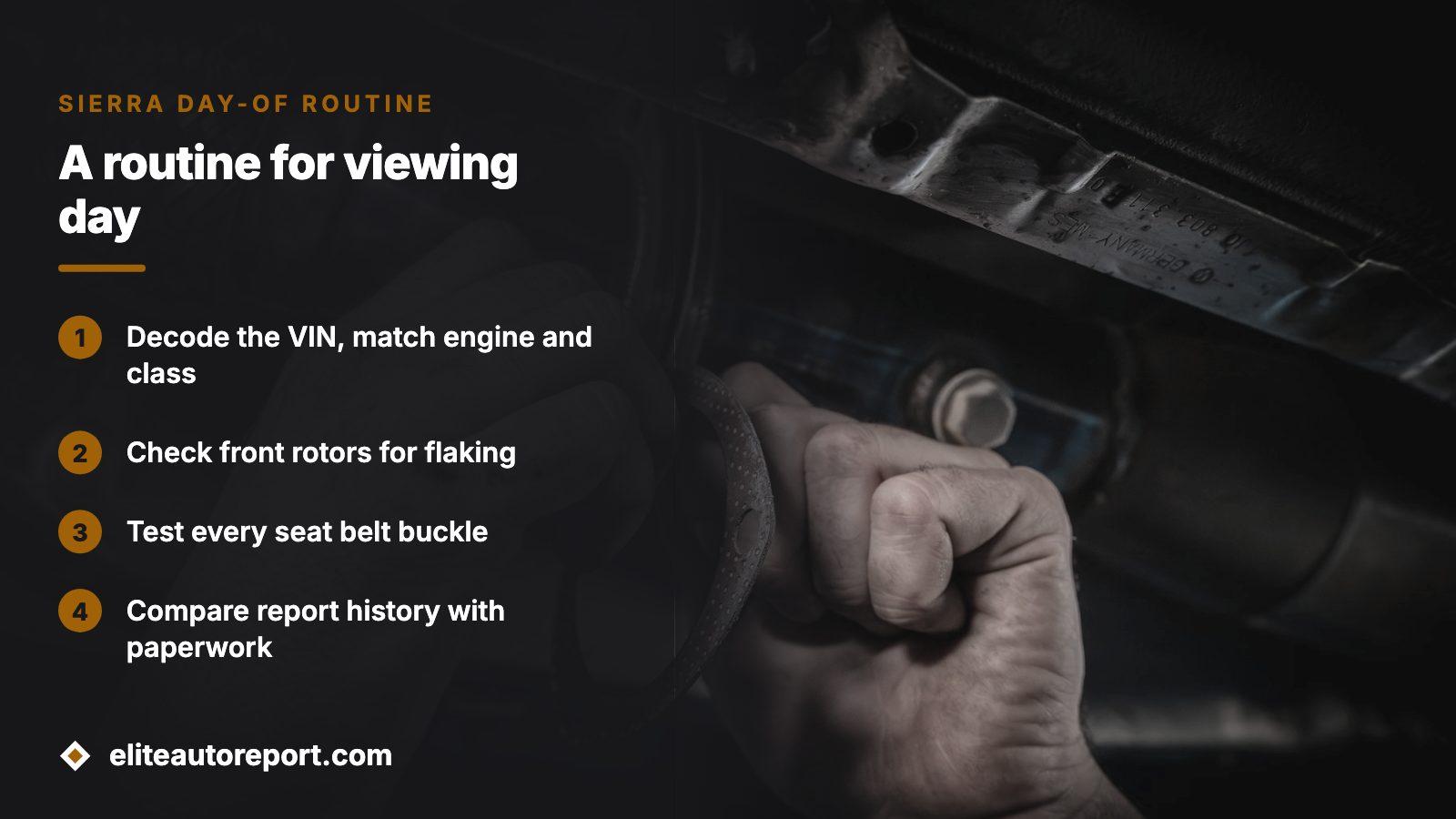
A routine for the day you go to see it
- Decode the full VIN and match engine, drive and weight class to the ad.
- Look at the front rotors for flaking at the joint, especially on a truck that spent winters in a salt state.
- Find the transmission vent hose and see where it ends.
- Test every seat belt buckle and retractor, since belts are the top complaint.
- Turn the wheel lock to lock with the engine running and feel for sticking.
- Run the VIN report and compare its mileage and title history with the paperwork in the seller's hand.
If any answer disagrees with the seller's story, walk away or lower the price. Federal records are a floor, not a guarantee, and an older truck's best evidence is the one in front of you.
Titles on a truck this old
The Justice Department operates NMVTIS so that buyers are protected from fraud and from unsafe vehicles, and so that stolen ones are harder to resell. Many states did not feed title data into it back when a truck like this was young, so a brand from the 1990s may not appear anywhere. That is a reason to ask for the title itself, read it for brands, and see whether its number agrees with the one on the Sierra's dash plate and the door jamb label.
A seller who offers nothing beyond a bill of sale should make you stop until the state confirms who owns the truck.
Where this information comes from
- NHTSA recalls: 1989 GMC Sierra — the two campaigns filed under the Sierra name, and the rotor details
- NHTSA recalls: 1989 GMC C1500 — campaigns filed under the series names
- NHTSA complaints: 1989 GMC Sierra — complaint counts by component
- NHTSA owner complaint 10042756 — owner experience, paraphrased
- NHTSA owner complaint 10315996 — owner experience, paraphrased
- NHTSA vPIC VIN decoder — what a partial-VIN decode reports
- Fuel Economy Guide: 1989 GMC pickups — engine choices and EPA mileage
Sources and photos: Facts checked against the sources above in November 2026. Photos by Benjamin Brunner, Martin Fennema and Victor Hughes on Unsplash; diagrams by EliteAutoReport.
Keep reading
- Chevy C10 Buyer's Guide: What Federal Records Flag Before You BuyA sibling square-body truck with its own checks.
- Check a Truck VIN Number for Auction History, Photos and Salvage RecordsHow pickups appear in auction records.
- Car Auction Photos by VIN: Find Salvage Sale Pictures Before You BuyHow lot photos are matched to a VIN.
- Classic Car Title Search by VIN: What Turns Up and What Doesn'tTitle checks on an older vehicle.
Frequently asked questions
Does a 1989 GMC Sierra have open recalls?
NHTSA lists campaigns for these trucks under Sierra and under C and K series names, covering trailer hitches, belt instructions, a transmission vent hose and front rotors. Which of them remain open varies from truck to truck, so run its VIN through NHTSA before you buy.
What is the most common complaint?
Seat belts, with 4 of the 16 records, mostly buckles and latches. Steering, brakes and brake light sockets follow with 2 each. With so few records, use them as an inspection checklist.
Which engine is best?
The EPA rates the 6.2 L diesel at 19 combined, against 15 for the 4.3 L V6 and 5.7 L automatic. Fuel use is only one factor. A well-kept gasoline truck with records beats a neglected diesel.
Can a VIN check show if a Sierra was sold at auction?
If an auction that shares its sales handled the truck, the report can show the sale and its lot photos. A blank result is not proof of no sale, so weigh it alongside a hands-on inspection.
Is the VIN check free?
You pay nothing for the preview. Beyond it you buy a single report or a bundle, never a subscription; the pricing page has the details. NHTSA's own recall lookup is a separate, free government tool.
Now check the car itself
The guide explains what to look for. The report shows what this VIN has on record.