THE SHORT ANSWER
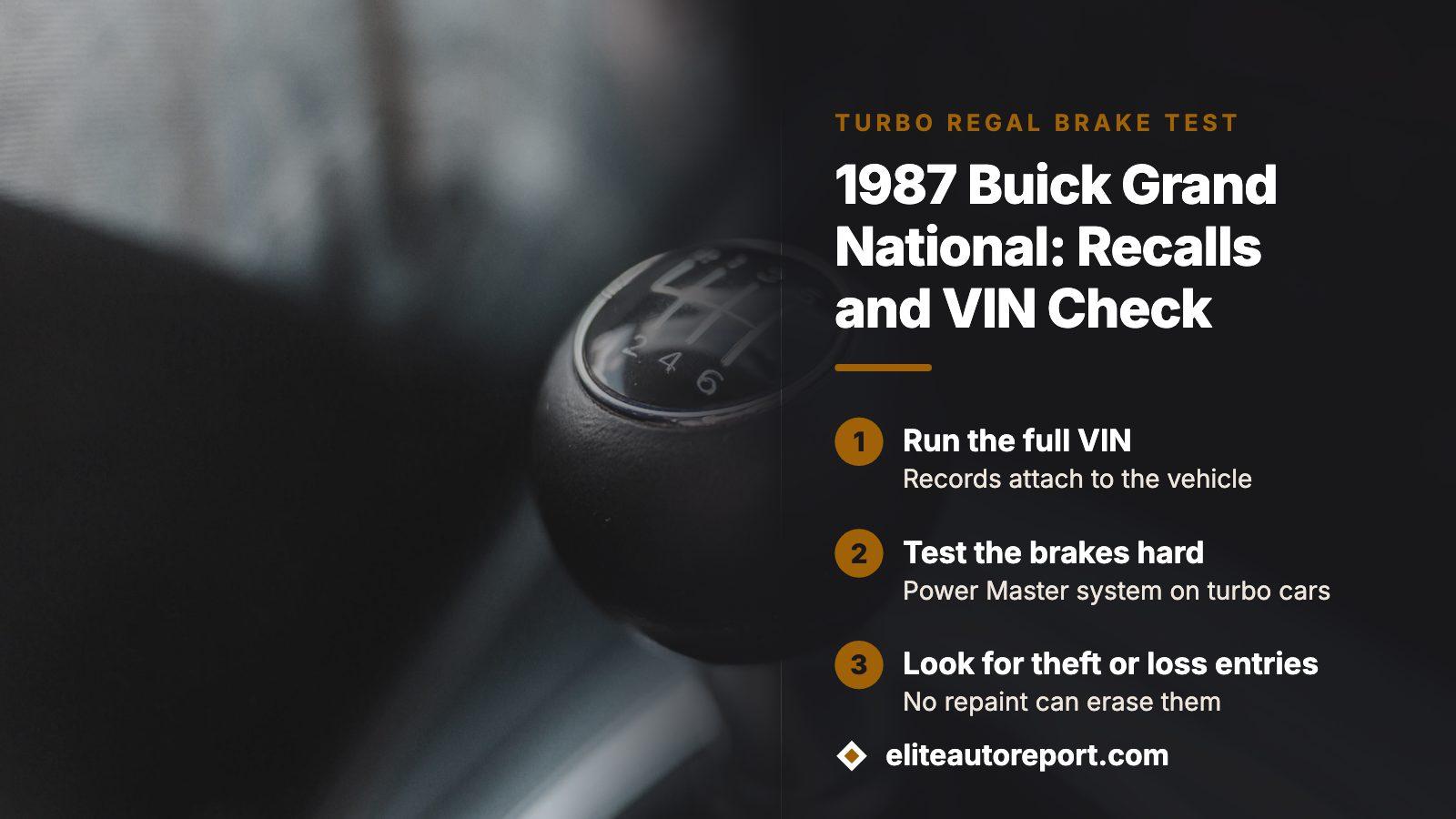
NHTSA lists three recalls under the 1987 Buick Regal: a transmission linkage campaign, a cruise control bushing campaign and a 2006 aftermarket fuel filter recall. Owners filed 27 complaints, and 16 of them concern hydraulic brakes, mostly the Power Master system on turbo cars. Test the brakes hard, then run the VIN for title brands, auction photos and prior sales.
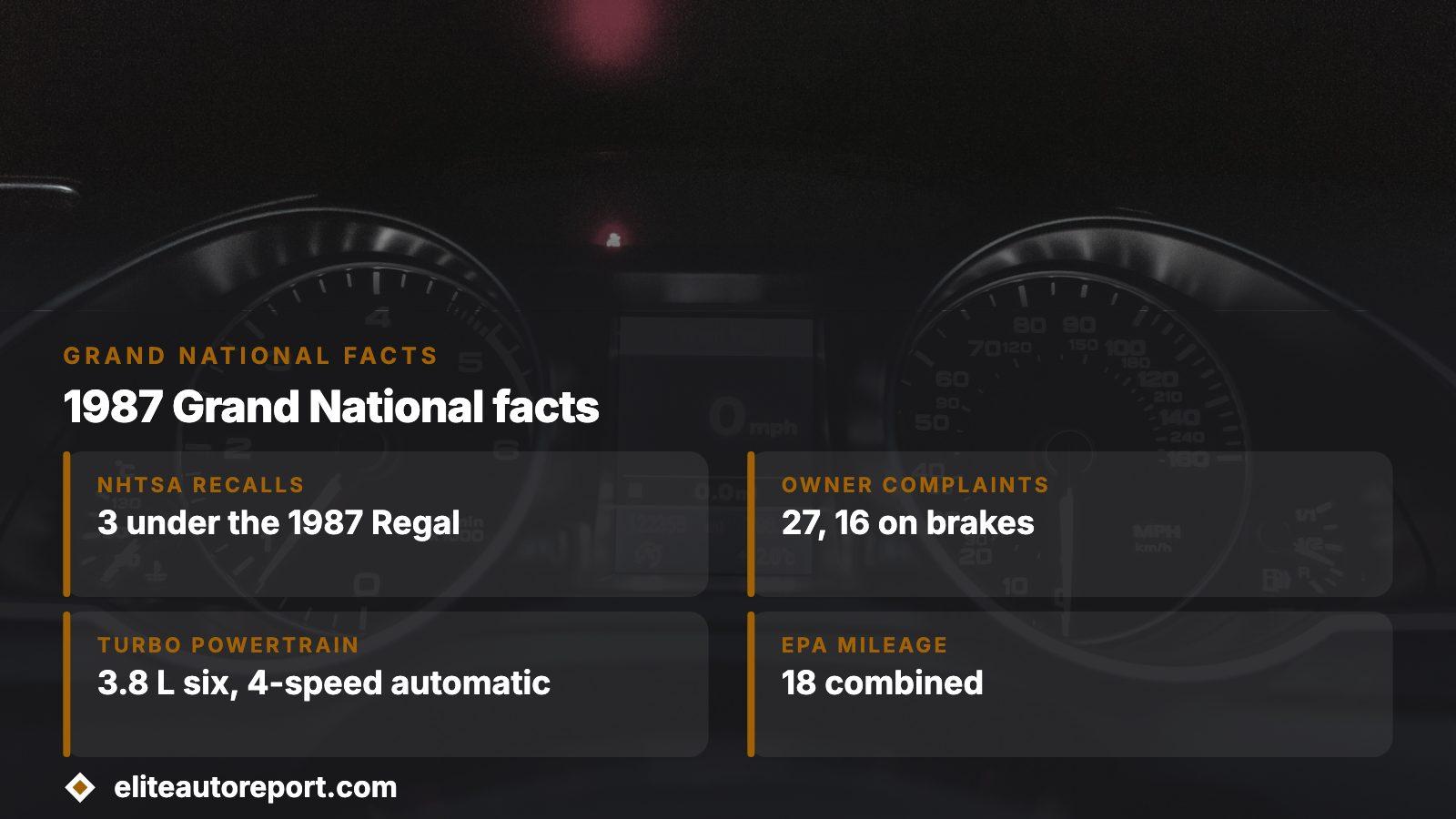
- NHTSA recalls
- 3 under the 1987 Regal
- Owner complaints
- 27, with 16 on hydraulic brakes
- Turbo powertrain
- 3.8 L six, 4-speed automatic, rear-wheel drive
- EPA mileage
- 15 city, 23 highway, 18 combined
What federal records call a Grand National
Search the government databases for a Grand National and you will get nothing back. Both the recalls and the complaints systems file these cars under the model name Regal, for make Buick and model year 1987, so that is the spelling to use when you look one up yourself. The records then mix every Regal of that year, turbo or not.
EPA data for that model year lists four powertrains: a 3.8 L six or a 5.0 L V8 with a 3-speed automatic, a 5.0 L V8 with a 4-speed, and a turbocharged 3.8 L six with a 4-speed automatic. The turbo version is rear-wheel drive, takes premium fuel and is rated at 15 mpg in town, 23 on the highway and 18 combined. A listing that describes anything else under a Grand National name needs an explanation.
The three recalls on file
NHTSA's recall database holds three campaigns for the 1987 Regal. Only two of them concern parts Buick fitted at the factory, and both are old enough that most affected cars were fixed decades ago. Still, a car that sat unregistered for years may have missed its notice.
| Campaign | Filed by | What it covers |
|---|---|---|
| 87V168000 | General Motors, October 1987 | Transmission manual valve link may be badly formed and separate, giving a different gear than selected. Remedy: replace the detent lever link. The notes name cars with 200 4R transmissions. |
| 89V102000 | General Motors, June 1989 | A small plastic bushing in the cruise servo linkage can work loose, which may cause surging or a throttle that sticks. Remedy: fit a new bushing. |
| 06E043000 | Honeywell, May 2006 | Aftermarket Fram replacement fuel filters from one production window could leak. Not original equipment; free filter replacement. |
The filter campaign matters only if someone fitted those aftermarket parts. Ask the seller what has been replaced under the hood.
Where the owner complaints cluster
NHTSA holds 27 owner complaint records for the 1987 Regal. Sixteen name hydraulic service brakes and one more names service brakes in general, so more than half the file is about stopping. Four concern seat belts, and the rest are single records on wheels, speed control, steering, suspension and engine trouble. Owners marked three of them as crashes, none involved fire, and two injuries appear across the file.
The brake entries repeat the same story in different words: a pedal that goes hard, assist that vanishes without warning, and then normal behavior again. Several owners point to the Power Master brake system that turbo Regals carried, and one says it was used only on a limited run of models, so the failure rate among those cars looks high to them. Treat that as owner opinion, not a measured rate, but the pattern is hard to ignore.
What owners went through
From an NHTSA owner complaint
A 1987 Regal owner wrote that while cruising near 40 mph a dash light for the brakes lit up and the pedal turned stiff as a board. A tow truck took the car to a mechanic, who called for a new master brake system. The trouble returned afterward, and the owner says the unit was swapped three times without a cure, around 60,000 miles in.
From an NHTSA owner complaint
Another owner said a dealer handled two recalls, but nobody ever told them about a third one on the master cylinder. They report that General Motors refused the repair, pointing to an 8 year limit on responding, and they considered the car dangerous to drive as it stood.
The lesson for a buyer is practical. One replaced brake booster does not prove the car is cured, and no paperwork on the brake system means either budgeting for that work or leaving. Another complaint cites a GM campaign number, 86-C-15, for the Power Master pressure switch. That number does not appear in the 1987 recall results, so do not assume a dealer or the NHTSA lookup will show it.
Reading the number before you pay
Feed NHTSA's decoder a partial number from a 1987 Regal and it describes a coupe made by General Motors in Pontiac with a gasoline 3.8 L engine and six cylinders. It also warns that the input is incomplete if you give it fewer than 17 characters. So type in every character, taken from the metal plate on the car, and set the result beside the title and the ad.
On a car this old, mismatches are the thing to hunt for. A decode that says V8 on a car sold as a turbo, or a number on the dash that differs from the one on the paperwork, is worth stopping the deal over. Our guide on locating the number on older cars covers where to look and how to read worn plates.
What auction history can show on a car like this
Grand Nationals change hands often, and many of them pass through auction lanes more than once. A history report can show earlier sales, the odometer reading at each sale, and photos taken at the time. Those photos are often the only record of what the car looked like before a repaint, a seat swap or a repair of crash damage.
Compare every reading on the report with the cluster in front of you. Mileage that drops between sales, or a car shown with damage that the seller never mentioned, are the two findings that change an offer. Our sale-record view exists for this cross-check. The preview costs nothing and shows whether any records exist, before you decide on the paid report.
Title brands, theft and the federal database
The federal title database, NMVTIS, sits with the Department of Justice. Its job, as the department describes it, is shielding consumers from fraud and dangerous cars while stopping thieves from reselling stolen ones. Reports built on it can expose a salvage or flood brand that a tidy-looking title from another state hides.
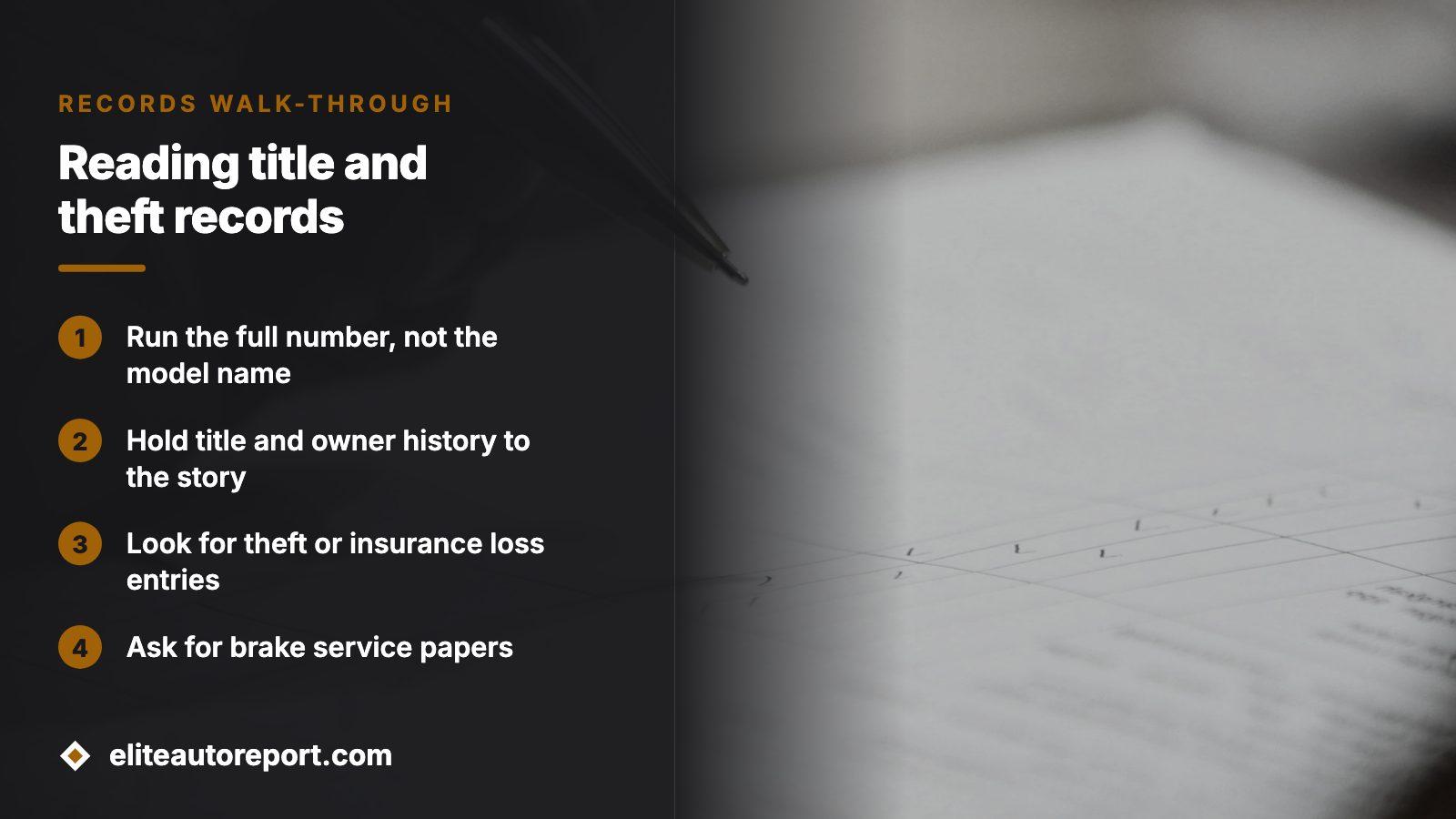
- Run the full number, not the model name, because records attach to the vehicle.
- Hold title state, owner history and odometer notes up against the seller's story.
- Look for a theft or insurance loss entry, which no repaint can erase.
- Ask for service papers on brakes, since the federal file will not hold them.
Silence in a report is encouraging but proves little, because an older car that was paid off and garaged may never have produced a record at all.
A buying order that saves money
Start with the paperwork, then the car, then the report. Read the number off the car, decode it, and confirm it matches the title. Next, drive it. Press the brake pedal hard at a low speed on an empty road, and again after the car has been run for twenty minutes, because several owners describe failures that came and went.
Finally, run the history. If the report shows an auction sale with photos, compare them with the car, and ask the seller about every difference. Ask also about open campaigns, since an unrepaired cruise control or transmission linkage item on a 1987 car is still a safety issue. When the checks agree, you are paying for the car you thought you were buying.
Where this information comes from
- NHTSA recalls API: 1987 Buick Regal — the three campaigns, their dates and remedies
- NHTSA complaints API: 1987 Buick Regal — complaint counts by component and owner accounts
- NHTSA owner complaint 10457874 — owner experience, paraphrased
- NHTSA owner complaint 10006522 — owner experience, paraphrased
- NHTSA vPIC VIN decoder — what a partial 1987 Regal number decodes to
- EPA fueleconomy.gov: 1987 Buick Regal — the four powertrains offered that year
- VehicleHistory.gov — the purpose of the federal title database
Sources and photos: Facts checked against the sources above in November 2026. Photos by Erik Mclean, Masjid MABA and Ambitious Studio* | Rick Barrett on Unsplash; diagrams by EliteAutoReport.
Keep reading
- Where Is the VIN on a Classic Car? Dash, Door, Firewall and Framefind and read the number on an older car first
- Matching Numbers Classic Car: How to Verify the Claim Before You Payconfirm the engine and car belong together
- Classic Car Title Search by VIN: What Turns Up and What Doesn'tadd the state title record to your checks
- Car Auction Results Database: Where Classic Car Results Livehow older cars appear in sale records
Frequently asked questions
Does NHTSA list the Grand National separately from the Regal?
No. Its recall and complaint databases use the model name Regal for these cars, so a search for Grand National returns nothing. Look up make Buick, model Regal, year 1987, and remember the results include non-turbo cars that share the name.
Are there open recalls on a 1987 Grand National?
The database shows three campaigns for the 1987 Regal, from 1987, 1989 and 2006. Whether one is still open on your car turns on its VIN and repair history. Check the full number with NHTSA and ask a Buick dealer if anything is unclear.
What is the most common complaint on these cars?
Brakes. Of 27 records, 16 name the hydraulic brake system, with owners describing a hard pedal and lost power assist. Several tie it to the Power Master unit on turbo cars. Seat belts come next with 4 records, so test both before buying.
Will a history report show if my Grand National went through auction?
A history report can show sale records, odometer readings at each sale and photos where they exist. Older cars may have fewer entries, so absence is not proof the car never sold. The free preview indicates whether anything is on file ahead of the paid report.
What fuel economy does the turbo model get?
EPA rates the turbocharged 3.8 L with the 4-speed automatic at 15 mpg city, 23 highway and 18 combined, on premium gasoline. The car is rear-wheel drive. Real-world figures vary with boost use, condition and tuning, so treat the rating as a baseline.
Now check the car itself
The guide explains what to look for. The report shows what this VIN has on record.