THE SHORT ANSWER
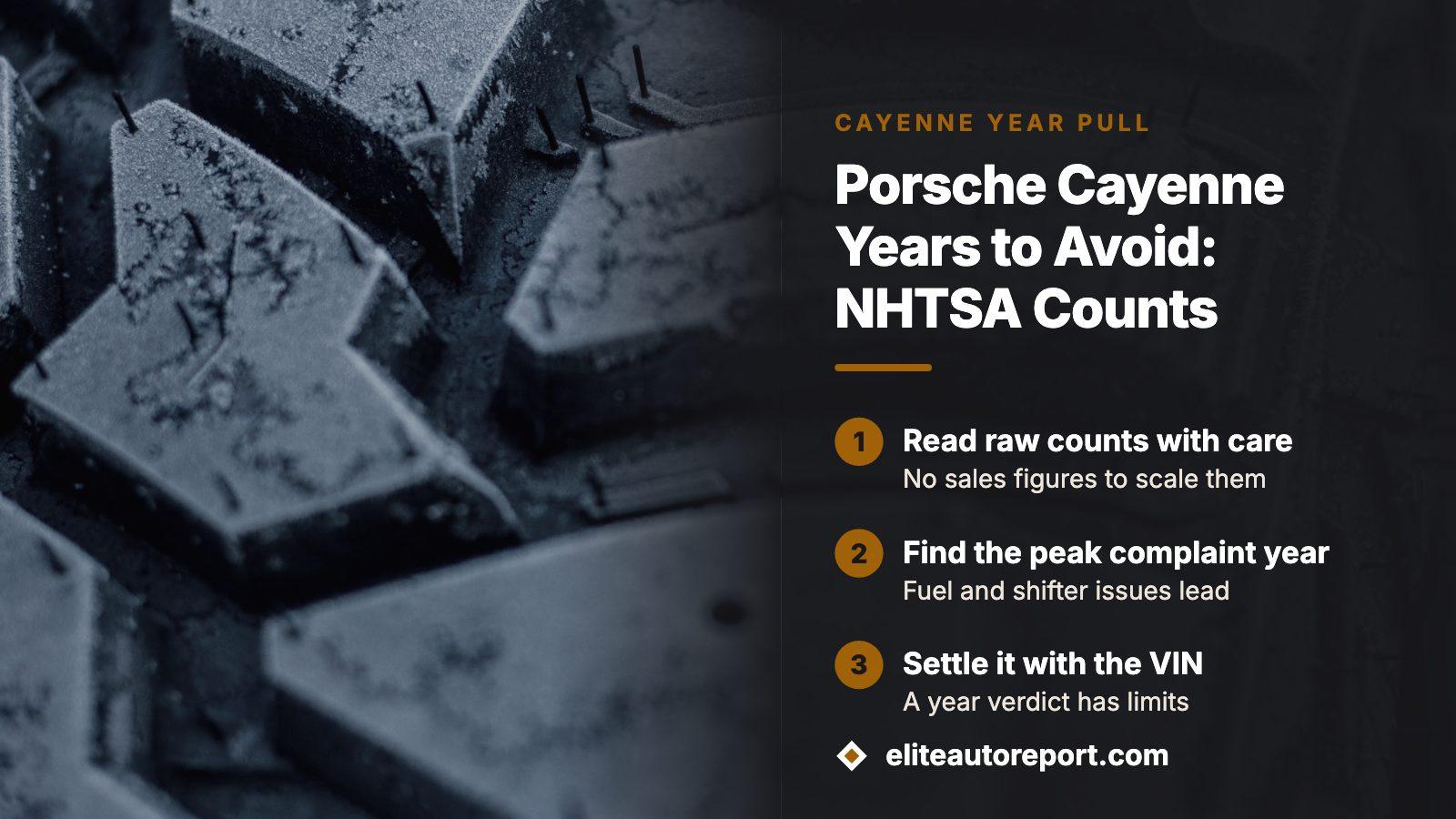
Most owner complaints land on the 2004 model year, with 101 filed with NHTSA, followed by 2011 at 62, 2006 at 55 and 2014 at 53. The earliest cars add fuel flange, shifter and engine complaints, and 2011 leans on engine trouble. Because these filings are raw counts and not rates, run the specific VIN before judging any single car by its year.
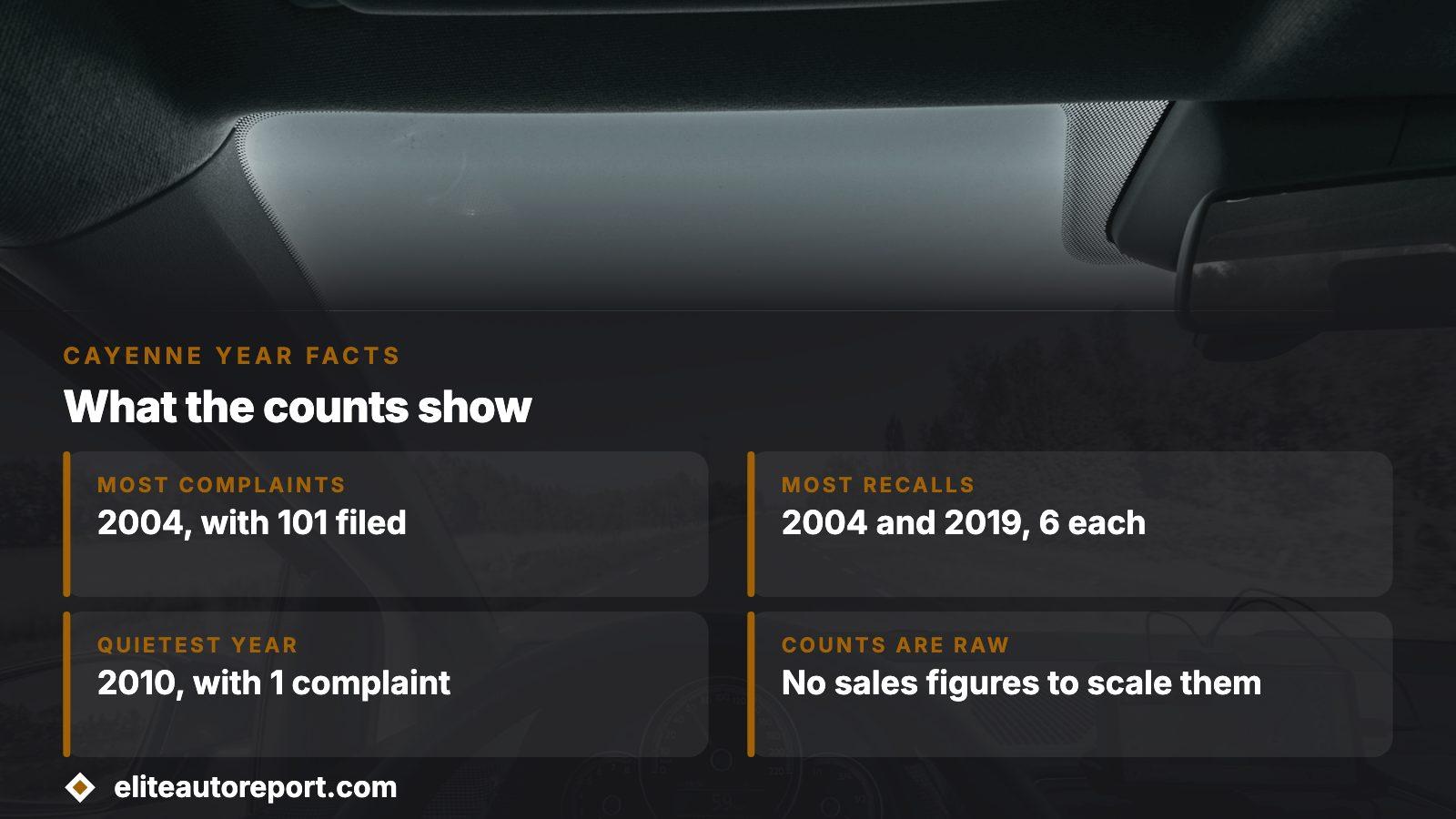
- Most complaints
- 2004, with 101 filed
- Most recalls
- 2004 and 2019, 6 campaigns each
- Quietest years
- 2010, with 1 complaint; 2022 and 2023 with a handful
- Counts are raw
- NHTSA gives no sales figures to turn them into rates
How the years were ranked
We pulled owner complaints and recall campaigns from NHTSA's public interface, one model year at a time, for the Cayenne nameplate from 2003 to 2024. A complaint is an owner's own filing, so it records what people noticed and chose to report. A recall is a maker's campaign registered with the agency.
Two cautions apply. The agency does not publish Cayenne sales per year, so a busy year may just be a big sales year. And 2007 shows zero under the plain Cayenne name and one under the S variant, a labeling quirk and not proof of a flawless year.
A ranking built this way points you to years worth a closer look. It cannot tell you that a given car is bad, which is why the last sections turn to the VIN.
Complaints and recalls by model year
Here is the full run from the first year to the most recent full one, side by side.
| Model year | Complaints | Recall campaigns |
|---|---|---|
| 2003 | 2 | 2 |
| 2004 | 101 | 6 |
| 2005 | 42 | 4 |
| 2006 | 55 | 3 |
| 2008 | 42 | 3 |
| 2009 | 15 | 2 |
| 2010 | 1 | 2 |
| 2011 | 62 | 3 |
| 2012 | 36 | 4 |
| 2013 | 40 | 3 |
| 2014 | 53 | 3 |
| 2015 | 14 | 2 |
| 2016 | 40 | 2 |
| 2017 | 19 | 2 |
| 2018 | 13 | 1 |
| 2019 | 48 | 6 |
| 2020 | 24 | 4 |
| 2021 | 21 | 5 |
| 2022 | 4 | 2 |
| 2023 | 5 | 1 |
Read down the middle column and four years stand out: 2004, 2011, 2006 and 2014. The 2019 model year is a different case, with a mid-sized complaint pile but six recall campaigns.
2004 to 2006: fuel, shifter and early build issues
The 2004 year carries 101 complaints, and 5 of them describe a crash, 3 a fire and 2 an injury. Owners tagged the power train most often (24), then the engine (17), fuel system (15) and electrical system (14). The 2005 and 2006 cars fall to 42 and 55 complaints, but fuel problems rank first in both.
Two recalls explain much of that. Campaign 17V576000 covers a fuel pump flange that can crack and leak fuel, which raises fire risk; dealers swap in a new flange at no charge. Campaign 19V446000 covers a gear selector bushing that can degrade, so the lever can read Park and release the ignition key although the gearbox has not engaged it. Owners were advised to rely on the parking brake until the fix.
From an NHTSA owner complaint
The owner of a 2006 car reported a strong fuel smell near the garage and a dealer diagnosis of a cracked filter flange. The fuel recall did not list the car's VIN, and Porsche confirmed that, so the flange stayed unrepaired at 135,000 miles.
The takeaway: for these years a flange or bushing fix is not assured by the recall notice alone. Ask for the repair invoice or a dealer printout for the exact VIN.
2011: the engine year
The 2011 model year logged 62 complaints, and 33 name the engine, nearly double the next component, the power train at 18. Three recall campaigns apply, including 12V065000 for headlights and 16V169000, which covers the hydraulic brake pedal linkage on 2011 to 2016 cars built from April 28, 2010 to January 11, 2016.
The complaint text is where the engine pattern shows. Several owners describe broken bolts on timing parts or cam adjusters, one while the car was moving in city traffic. Filings cannot prove a cause, but the cluster is why 2011 earns a hard inspection.
From an NHTSA owner complaint
One 2011 owner wrote that intake cam adjuster bolts broke while the car was in motion on a city street, and gave Porsche's own campaign number, AH08, along with a case reference.
If you are shopping a 2011, ask for proof of what engine work was done, who did it and when.
2012 to 2014: turbo recall and a power train cluster
Model years 2012 through 2014 sit at 36, 40 and 53 complaints. The 2012 Cayenne Turbo is named in recall 12V329000, where the turbocharger turbine wheel may fracture from a casting defect. A failed shaft can pull oil into the exhaust, which brings smoke and a fire risk, and dealers replace the turbine wheels without charge.
For 2014, the power train leads with 17 mentions and air bags follow with 9. Three campaigns apply. One 2014 complaint pile also records 1 fire and 3 injuries, so this is a year to read through rather than skip.
A turbo car from 2012 is the one to check against that campaign.
2019 to 2021: few complaints, many recalls
Newer cars turn the pattern around. The 2019 year has 48 complaints, with air bags (11), electrical (10) and back over prevention (6) leading, plus 6 recall campaigns. Among them are a rear belt buckle and a camera software fault.
The 2021 cars carry 5 campaigns, among them a rear axle alignment that may not have been inspected after a repair and a steering column screw connection that can fail. One December 2025 camera recall, 25V896000, spans 2019 through 2025 Cayennes.
Recalls this recent are normally free to fix and tend to be done at the dealer, so open ones on a used car are a negotiation point rather than a reason to walk away. Filings for 2022 and 2023 are tiny at 4 and 5, but those cars are young.
Which years look safest
On the counts alone, 2010 is the quietest year, with 1 complaint and 2 recall campaigns, followed by 2018 at 13 complaints and 1 campaign. The 2009, 2015 and 2017 cars sit between 14 and 19 complaints. A low count can reflect low sales as much as good build quality.
- Lowest complaint counts: 2010, 2018, 2009, 2015 and 2017.
- Heaviest recall load: 2004 and 2019, with 6 campaigns each.
- Highest complaint counts: 2004, 2011, 2006 and 2014.
- Too new to judge fairly: 2022 and 2023.
Treat the list as a sorting aid. A 2018 with a salvage title is worse than a clean 2011, and no table of counts can see that.
What a VIN check settles that the year cannot
A model year only sets expectations, while the VIN answers for one particular SUV. Our report centers on auction history and lot photos, which matters on a Cayenne because these are heavy, expensive SUVs that sometimes pass through salvage auctions after collisions, floods or insurance write-offs.
Once the VIN is in, read for four things: auction sales with photos that you can hold against the car in the driveway, any state title brand, mileage entries that climb without a dip, and recalls still open on that VIN, such as the fuel flange and shifter campaigns on older cars.
The opening summary costs nothing. A full report is bought once, with the amount listed on /pricing. NHTSA's recall lookup takes the 17-character VIN as well.
Steps before you pay for a Cayenne
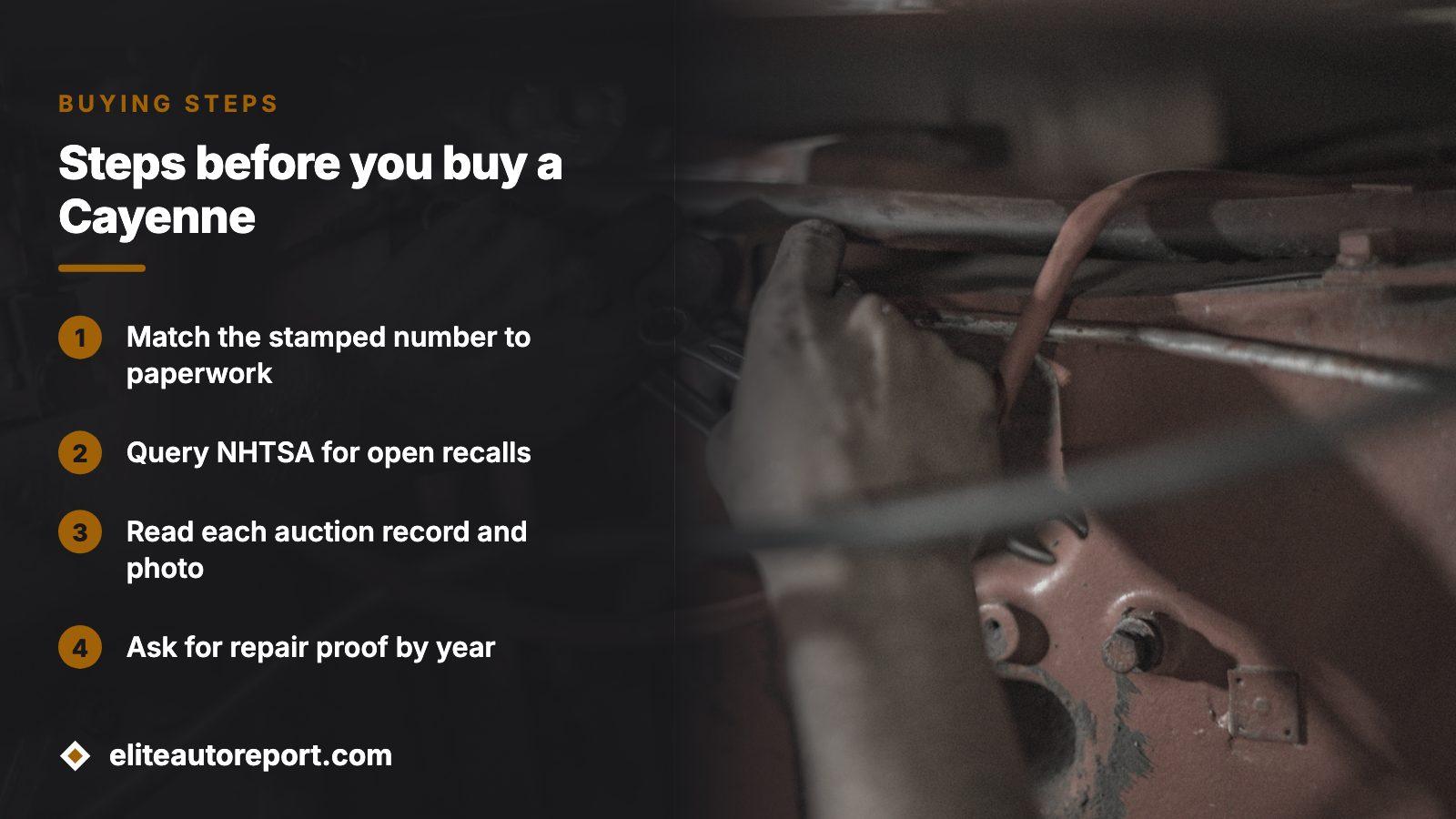
- Match the number stamped on the SUV to the paperwork.
- Query NHTSA for open recalls by VIN.
- Read each auction record and photo in the history.
- For a 2004 to 2006 car, ask for proof of the fuel flange and shifter bushing work.
- For a 2011, ask for engine repair records and the shop that did them.
- Book an independent inspection at a shop that services Porsches.
A seller who withholds the VIN or service file has answered you.
Where this information comes from
- NHTSA: Safety recalls and VIN lookup — free recall check by VIN, the step we recommend alongside any history report
- NHTSA: 2004 Porsche Cayenne — complaint and recall records for the most-reported model year
- NHTSA: 2011 Porsche Cayenne — engine-heavy complaint set and brake pedal and headlight recalls
- NHTSA: 2019 Porsche Cayenne — recall list for the year with six campaigns
- NHTSA owner complaint 11709777 — owner experience, paraphrased
- NHTSA owner complaint 11385083 — owner experience, paraphrased
Sources and photos: Facts checked against the sources above in November 2026. Photos by Joan, Nina Mercado and Sander Jeurissen on Unsplash; diagrams by EliteAutoReport.
Keep reading
- Range Rover years to avoid, by NHTSA complaint and recall countsThe same year-by-year count method applied to another luxury SUV.
- BMW X5 years to avoid, ranked by NHTSA complaints and recallsA direct rival to the Cayenne, ranked the same way.
- Porsche 911 VIN Check: Auction Photos, Titles and RecallsWhat a VIN check shows on another Porsche, including auction photos.
- Auction History by VIN: Photos for Luxury, Exotic and Classic CarsHow auction records and lot photos by VIN work.
Frequently asked questions
What is the worst Porsche Cayenne year?
On NHTSA filings, 2004 leads with 101 complaints and 6 recall campaigns, with fuel, power train and engine issues most reported. The 2011 year follows on engine complaints. Those are raw counts, so confirm a specific car through its VIN, service file and an independent inspection.
Are the early Cayennes still worth buying?
They can be, if the fuel filter flange and shifter bushing recalls were completed and documented, and the history shows no salvage sale. Cheap purchase price is outweighed quickly if a recall repair or engine job is still ahead of you.
Does a recall mean the car is unsafe to buy?
Not by itself. Recall repairs are done by the dealer at no cost to the owner. What matters is whether the work is finished for that VIN, which NHTSA's lookup shows, and whether the car was ever in a serious crash.
Why does 2007 show no complaints?
Under the plain Cayenne name NHTSA lists none, and one under the S variant. The gap likely reflects how filings were labeled. Do not read it as a flawless year, and check the VIN either way.
How does an auction history help with a Cayenne?
If the SUV sold at a salvage or insurance auction, the lot photos can show what the damage looked like then. Compare them with the car in person and with the repair invoices the seller offers.
Now check the car itself
The guide explains what to look for. The report shows what this VIN has on record.